
ACCT 210 Lecture, Fall 2001
American University of Beirut · Financial Accounting · 29 pages




Showing the first 10 of 29 pages. Download the PDF to see all of it.
More ACCT 210 files
Show the text of this lab
© The McGraw-Hill Companies, Inc., 2008
McGraw-Hill/Irwin
1-1
Financial Accounting
Financial Accounting
THIRTEENTH EDITION
Williams Haka Bettner Carcello
© The McGraw-Hill Companies, Inc., 2008
McGraw-Hill/Irwin
1-2
Accounting
Information for Decision Making
Chapter
1
© The McGraw-Hill Companies, Inc., 2008
McGraw-Hill/Irwin
1-3
Learning Objective
Learning Objective
LO1
To discuss accounting
as the language of
business and the role of
accounting information
in making economic
decisions.
© The McGraw-Hill Companies, Inc., 2008
McGraw-Hill/Irwin
1-4
Accounting
information
The
accounting
process
Decision
makers
Economic
activities
Actions
(decisions)
Accounting
“links” decision
makers with
economic
activities and
with the results of
their decisions.
© The McGraw-Hill Companies, Inc., 2008
McGraw-Hill/Irwin
1-5
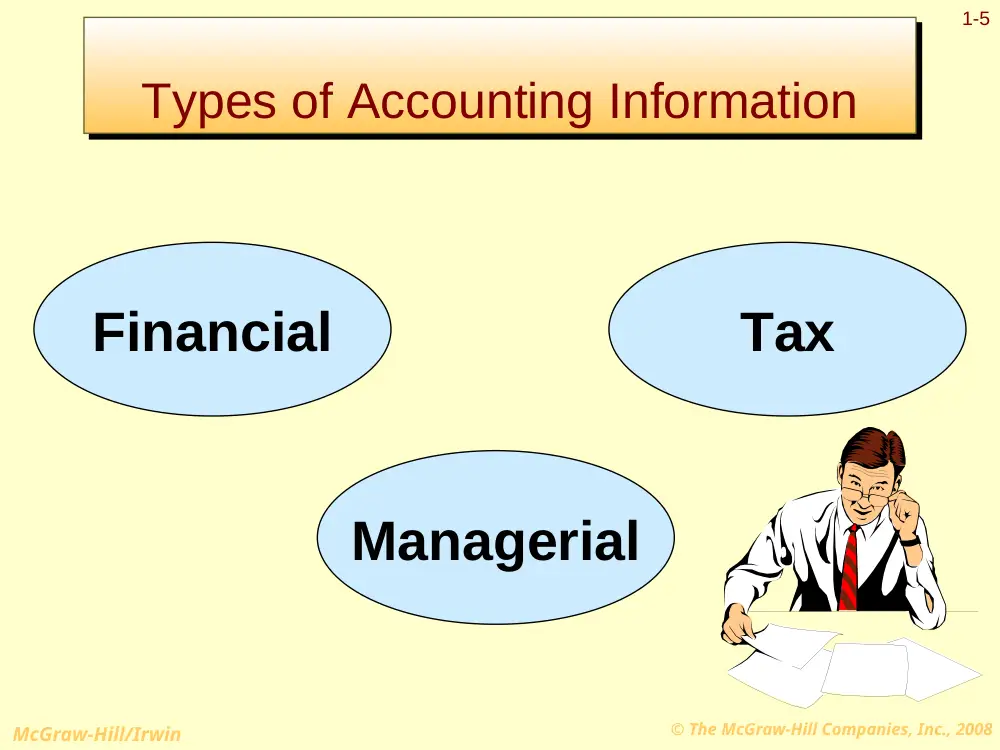
Types of Accounting Information
Types of Accounting Information
Financial
Managerial
Tax
© The McGraw-Hill Companies, Inc., 2008
McGraw-Hill/Irwin
1-6
Learning Objective
Learning Objective
LO2
To discuss the significance of
accounting systems in generating
reliable accounting information,
and understand the five
components of internal control
per COSO’s Internal Control—
Integrated Framework.
© The McGraw-Hill Companies, Inc., 2008
McGraw-Hill/Irwin
1-7
Accounting Systems
Accounting Systems
An accounting system consists of the personnel,
procedures, technology, and records used by an
organization to develop accounting information
and to communicate this information to decision
makers.
© The McGraw-Hill Companies, Inc., 2008
McGraw-Hill/Irwin
1-8
Information
Users
Investors
Creditors
Managers
Owners
Customers
Employees
Regulators
-SEC
-IRS
-FTC
Information
Users
Investors
Creditors
Managers
Owners
Customers
Employees
Regulators
-SEC
-IRS
-FTC
Decisions
Supported
Performance
evaluations
Stock
investments
Tax strategies
Labor relations
Resource
allocations
Lending
decisions
Borrowing
Decisions
Supported
Performance
evaluations
Stock
investments
Tax strategies
Labor relations
Resource
allocations
Lending
decisions
Borrowing
Information System
Information System
Financial
Information
Provided
Profitability
Financial
position
Cash flows
Financial
Information
Provided
Profitability
Financial
position
Cash flows
© The McGraw-Hill Companies, Inc., 2008
McGraw-Hill/Irwin
1-9
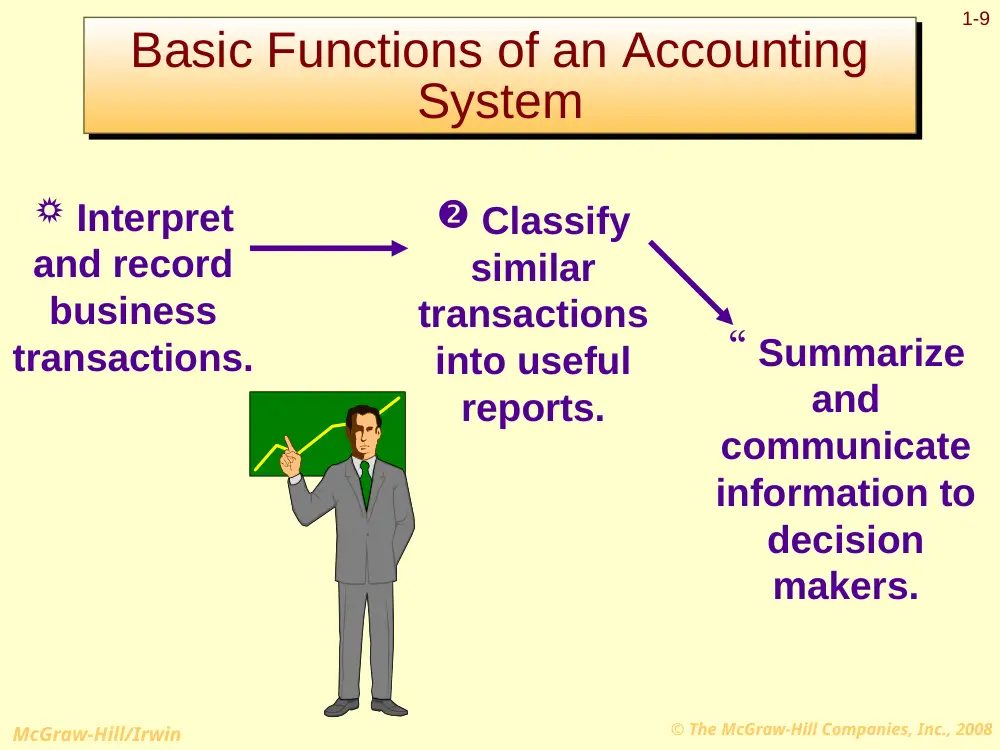
Basic Functions of an Accounting
System
Basic Functions of an Accounting
System
Summarize
and
communicate
information to
decision
makers.
Classify
similar
transactions
into useful
reports.
Interpret
and record
business
transactions.
© The McGraw-Hill Companies, Inc., 2008
McGraw-Hill/Irwin
1-10
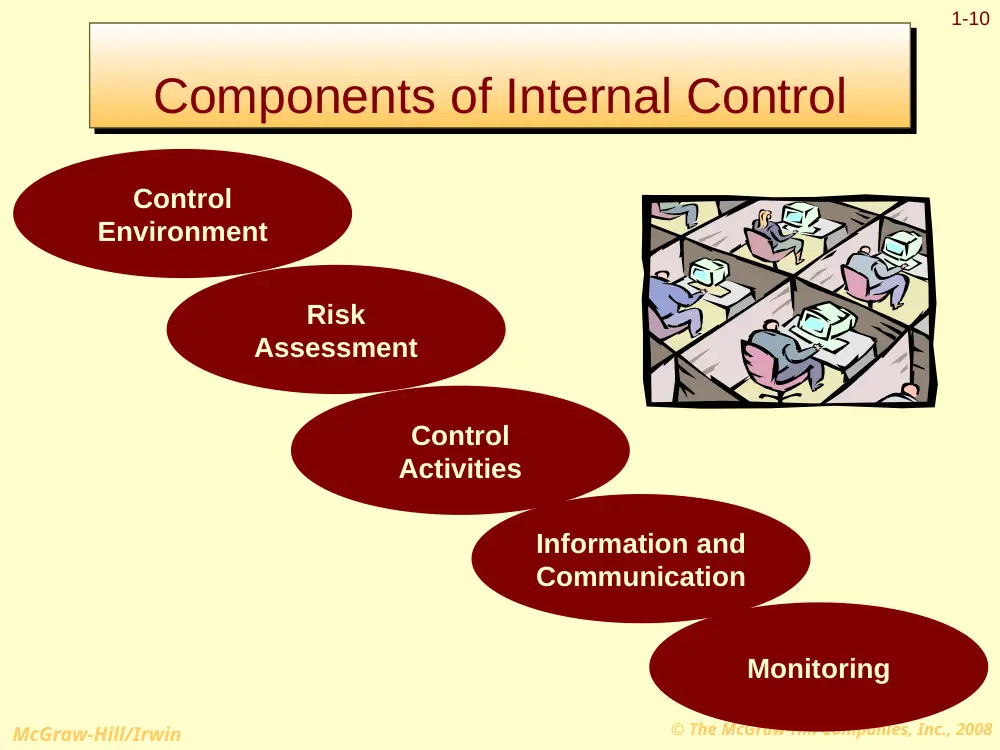
Components of Internal Control
Components of Internal Control
Control
Environment
Risk
Assessment
Control
Activities
Information and
Communication
Monitoring
© The McGraw-Hill Companies, Inc., 2008
McGraw-Hill/Irwin
1-11
Learning Objective
Learning Objective
LO3
To explain the importance
of financial accounting
information for external
parties—primarily
investors and creditors—
in terms of the objectives
and the characteristics of
that information.
© The McGraw-Hill Companies, Inc., 2008
McGraw-Hill/Irwin
1-12
External Users of Accounting
Information
External Users of Accounting
Information
•Owners
•Creditors
•Potential investors
•Labor unions
•Governmental agencies
•Suppliers
•Customers
•Trade associations
•General public
© The McGraw-Hill Companies, Inc., 2008
McGraw-Hill/Irwin
1-13
Provide information about economic
resources, claims to resources, and
changes in resources and claims.
Provide information useful in
assessing amount, timing and
uncertainty of future cash flows.
Provide information useful in making
investment and credit decisions.
(Specific)
(General)
Objectives
of
External
Financial
Reporting
© The McGraw-Hill Companies, Inc., 2008
McGraw-Hill/Irwin
1-14
Objectives of External Financial
Reporting
Objectives of External Financial
Reporting
The primary
financial
statements.
Income Statement
Balance Sheet
Statement of Cash Flows
© The McGraw-Hill Companies, Inc., 2008
McGraw-Hill/Irwin
1-15
Characteristics of Externally
Reported Information
Characteristics of Externally
Reported Information
A Means to
an End
A Means to
an End
Broader than
Financial
Statements
Broader than
Financial
Statements
Historical in
Nature
Historical in
Nature
Results from Inexact and
Approximate Measures
Results from Inexact and
Approximate Measures
Based on
General-Purpose
Assumption
Based on
General-Purpose
Assumption
Usefulness
Enhanced via
Explanation
Usefulness
Enhanced via
Explanation
© The McGraw-Hill Companies, Inc., 2008
McGraw-Hill/Irwin
1-16
Learning Objective
Learning Objective
LO4
To explain the importance
of financial accounting
information for internal
parties—primarily
management—in terms of
the objectives and the
characteristics of that
information.
© The McGraw-Hill Companies, Inc., 2008
McGraw-Hill/Irwin
1-17
Users of Internal Accounting
Information
Users of Internal Accounting
Information
Board of directors
Chief executive officer
(CEO)
Chief financial officer (CFO)
Vice presidents
Business unit managers
Plant managers
Store managers
Line supervisors
© The McGraw-Hill Companies, Inc., 2008
McGraw-Hill/Irwin
1-18
Typical
Simple
Organization
Chart
Plant
Accountants
Plant
Managers
Plant
Accountants
Plant
Managers
Business
Unit
Managers
V.P.
Human
Resources
V.P.
Information
Services
Chief
Financial
Officer (CFO)
Chief Executive
Officer
(CEO)
Board of
Directors
Owners
V.P
Ethics
Controller
Treasurer
© The McGraw-Hill Companies, Inc., 2008
McGraw-Hill/Irwin
1-19
Objectives of Management
Accounting Information
Objectives of Management
Accounting Information
To help achieve
goals and missions
To help achieve
goals and missions
To help evaluate
and reward
decision makers
To help evaluate
and reward
decision makers
© The McGraw-Hill Companies, Inc., 2008
McGraw-Hill/Irwin
1-20
Characteristics of Management
Accounting Information
Characteristics of Management
Accounting Information
Timeliness
Timeliness
Identify
Decision
Maker
Identify
Decision
Maker
Oriented
Toward
Future
Oriented
Toward
Future
Measures of
Efficiency and
Effectiveness
Measures of
Efficiency and
Effectiveness
A Means to
an End
A Means to
an End
© The McGraw-Hill Companies, Inc., 2008
McGraw-Hill/Irwin
1-21
Learning Objective
Learning Objective
LO5
To discuss elements of
the system of external
and internal financial
reporting that create
integrity in the reported
information.
© The McGraw-Hill Companies, Inc., 2008
McGraw-Hill/Irwin
1-22
Integrity of Accounting Information
Integrity of Accounting Information
Institutional Features
Generally Accepted Accounting Principles (GAAP)
Financial Accounting Standards Board
International Accounting Standards Board
Securities and Exchange Commission
Public Company Accounting Oversight Board
Audits of Financial Statements
Legislation
© The McGraw-Hill Companies, Inc., 2008
McGraw-Hill/Irwin
1-23
Learning Objective
Learning Objective
LO6
To identify and discuss
several professional
organizations that play
important roles in
preparing and
communicating
accounting information.
© The McGraw-Hill Companies, Inc., 2008
McGraw-Hill/Irwin
1-24
Integrity of Accounting Information
Integrity of Accounting Information
Professional Organizations
American Institute of Certified Public Accountants
Institute of Management Accountants
Institute of Internal Auditors
American Accounting Association
Committee of Sponsoring Organizations of the
Treadway Commission (COSO)
© The McGraw-Hill Companies, Inc., 2008
McGraw-Hill/Irwin
1-25
Learning Objective
Learning Objective
LO7
To discuss the
importance of personal
competence,
professional judgment,
and ethical behavior on
the part of accounting
professionals.
© The McGraw-Hill Companies, Inc., 2008
McGraw-Hill/Irwin
1-26
Integrity of Accounting Information
Integrity of Accounting Information
Competence, Judgment and Ethical Behavior
Certified Public Accountants (CPAs)
Certificate in Management Accounting (CMA)
Certificate in Internal Auditing (CIA)
© The McGraw-Hill Companies, Inc., 2008
McGraw-Hill/Irwin
1-27
Learning Objective
Learning Objective
LO8
To discuss various
career opportunities in
accounting.
© The McGraw-Hill Companies, Inc., 2008
McGraw-Hill/Irwin
1-28
Careers in Accounting
Careers in Accounting
Public Accounting
Management Accounting
Governmental Accounting
Accounting Education
© The McGraw-Hill Companies, Inc., 2008
McGraw-Hill/Irwin
1-29
End of Chapter 1
End of Chapter 1