
BIO 202 Exam, Spring 2011
American University of Beirut · General Biology II · 9 pages



More BIO 202 files
- Chapter 28 · Spring 2018ChapterView
- Chapter 34 · Spring 2018ChapterView
- Useful File Frog Skeleton Labeling Empty · Spring 2018FileView
- Syllabus Seedless Plants · Spring 2016LabView
- Questions Test Banks Ch 1 · Fall 2015ProblemsView
- Questions Test Banks Ch 31 · Fall 2015ProblemsView
- Questions Chapter 36 · Fall 2013ChapterView
- Syllabus · Fall 2013LabView
Show the text of this exam
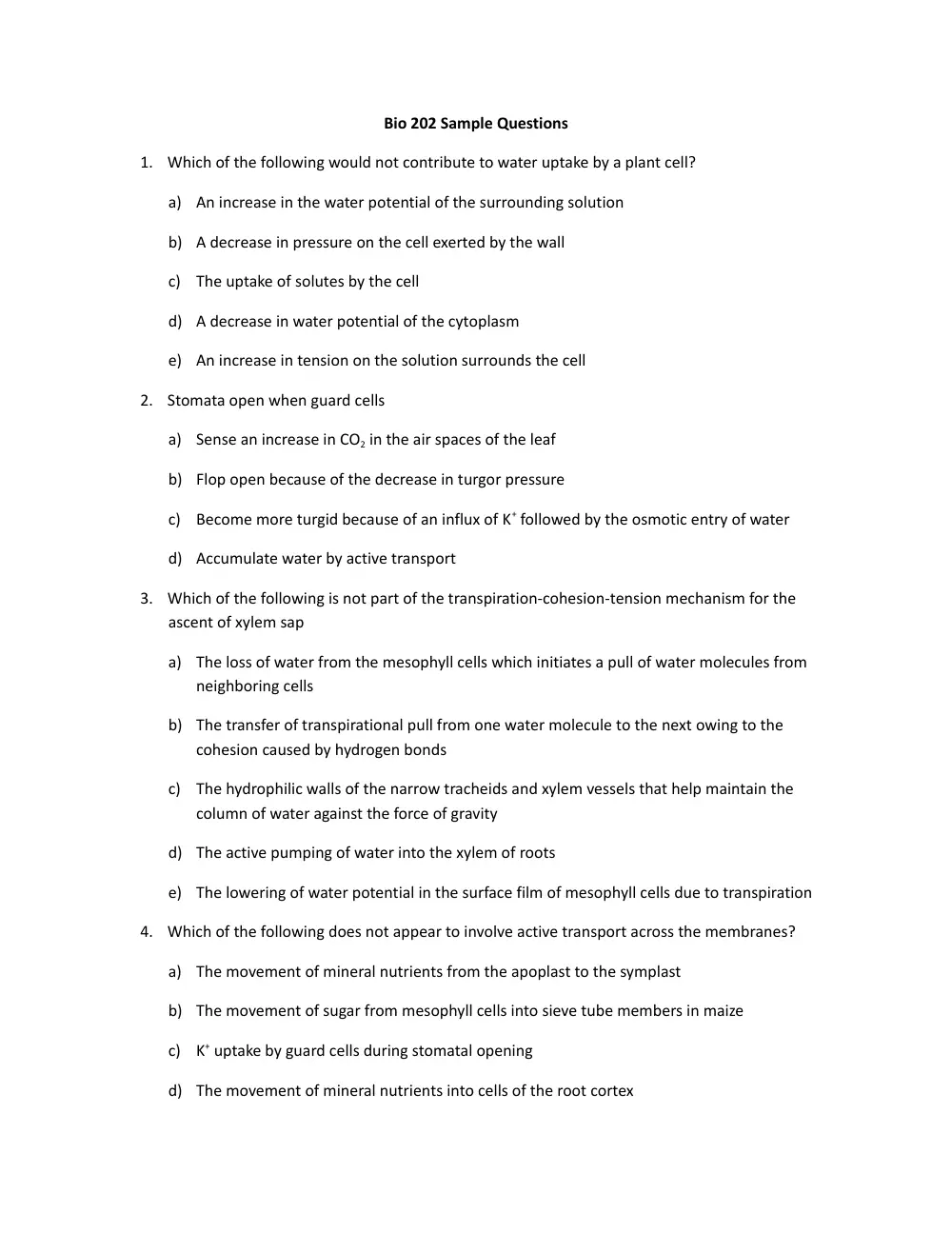
Bio 202 Sample Questions
1.
Which of the following would not contribute to water uptake by a plant cell?
a)
An increase in the water potential of the surrounding solution
b)
A decrease in pressure on the cell exerted by the wall
c)
The uptake of solutes by the cell
d)
A decrease in water potential of the cytoplasm
e)
An increase in tension on the solution surrounds the cell
2.
Stomata open when guard cells
a)
Sense an increase in CO2 in the air spaces of the leaf
b)
Flop open because of the decrease in turgor pressure
c)
Become more turgid because of an influx of K+ followed by the osmotic entry of water
d)
Accumulate water by active transport
3.
Which of the following is not part of the transpiration-cohesion-tension mechanism for the
ascent of xylem sap
a)
The loss of water from the mesophyll cells which initiates a pull of water molecules from
neighboring cells
b)
The transfer of transpirational pull from one water molecule to the next owing to the
cohesion caused by hydrogen bonds
c)
The hydrophilic walls of the narrow tracheids and xylem vessels that help maintain the
column of water against the force of gravity
d)
The active pumping of water into the xylem of roots
e)
The lowering of water potential in the surface film of mesophyll cells due to transpiration
4.
Which of the following does not appear to involve active transport across the membranes?
a)
The movement of mineral nutrients from the apoplast to the symplast
b)
The movement of sugar from mesophyll cells into sieve tube members in maize
c)
K+ uptake by guard cells during stomatal opening
d)
The movement of mineral nutrients into cells of the root cortex
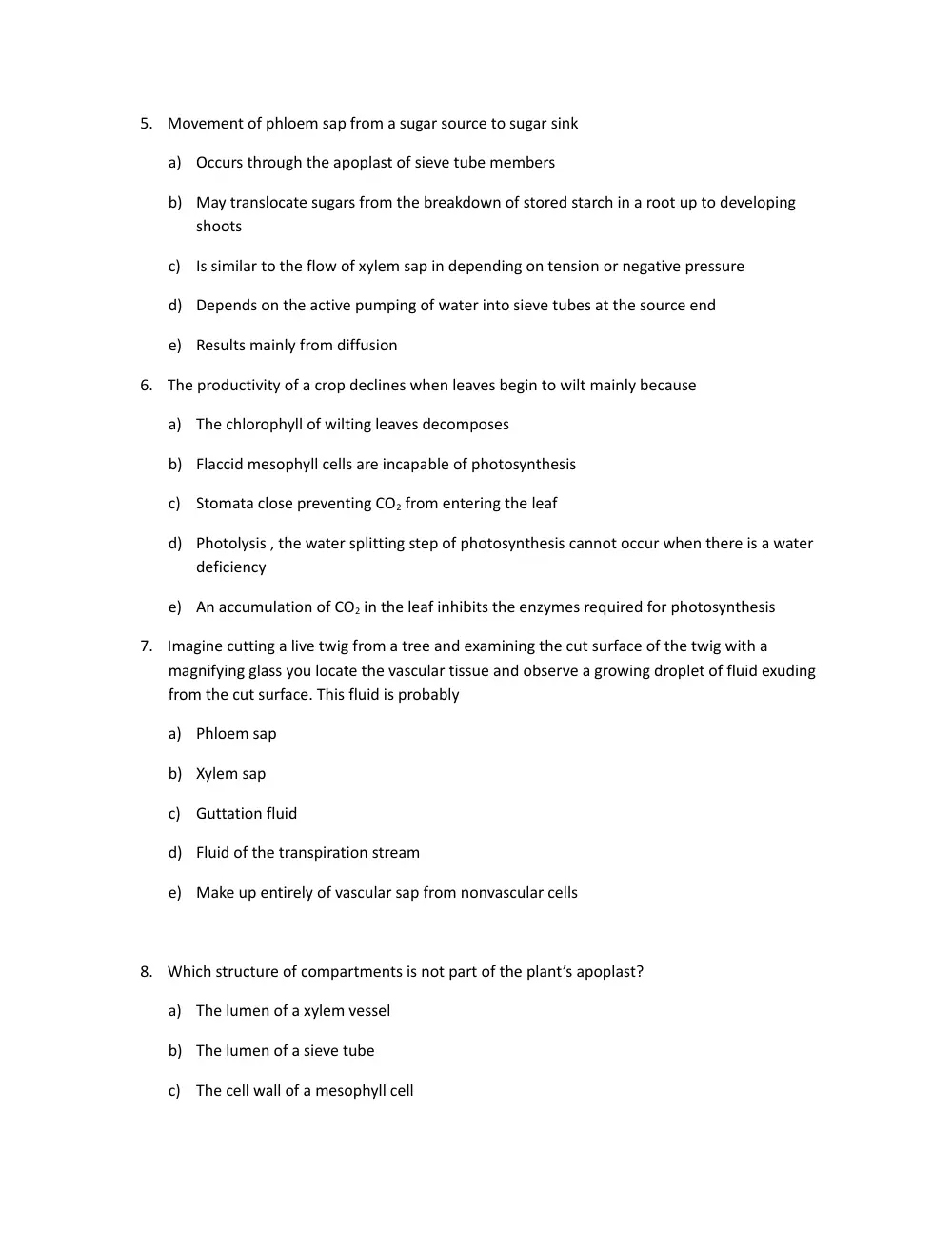
5.
Movement of phloem sap from a sugar source to sugar sink
a)
Occurs through the apoplast of sieve tube members
b)
May translocate sugars from the breakdown of stored starch in a root up to developing
shoots
c)
Is similar to the flow of xylem sap in depending on tension or negative pressure
d)
Depends on the active pumping of water into sieve tubes at the source end
e)
Results mainly from diffusion
6.
The productivity of a crop declines when leaves begin to wilt mainly because
a)
The chlorophyll of wilting leaves decomposes
b)
Flaccid mesophyll cells are incapable of photosynthesis
c)
Stomata close preventing CO2 from entering the leaf
d)
Photolysis , the water splitting step of photosynthesis cannot occur when there is a water
deficiency
e)
An accumulation of CO2 in the leaf inhibits the enzymes required for photosynthesis
7.
Imagine cutting a live twig from a tree and examining the cut surface of the twig with a
magnifying glass you locate the vascular tissue and observe a growing droplet of fluid exuding
from the cut surface. This fluid is probably
a)
Phloem sap
b)
Xylem sap
c)
Guttation fluid
d)
Fluid of the transpiration stream
e)
Make up entirely of vascular sap from nonvascular cells
8.
Which structure of compartments is not part of the plant’s apoplast?
a)
The lumen of a xylem vessel
b)
The lumen of a sieve tube
c)
The cell wall of a mesophyll cell
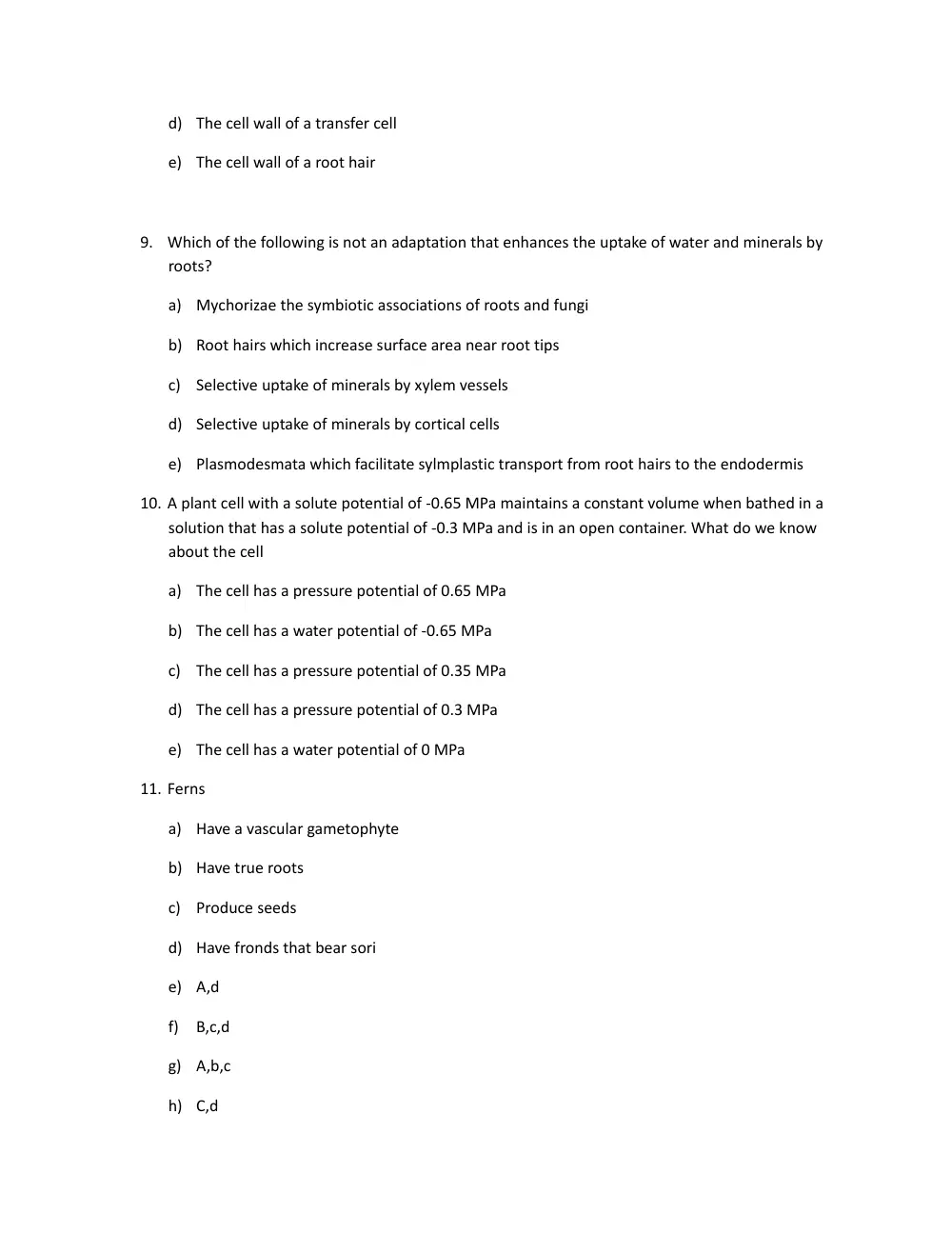
d)
The cell wall of a transfer cell
e)
The cell wall of a root hair
9.
Which of the following is not an adaptation that enhances the uptake of water and minerals by
roots?
a)
Mychorizae the symbiotic associations of roots and fungi
b)
Root hairs which increase surface area near root tips
c)
Selective uptake of minerals by xylem vessels
d)
Selective uptake of minerals by cortical cells
e)
Plasmodesmata which facilitate sylmplastic transport from root hairs to the endodermis
10. A plant cell with a solute potential of -0.65 MPa maintains a constant volume when bathed in a
solution that has a solute potential of -0.3 MPa and is in an open container. What do we know
about the cell
a)
The cell has a pressure potential of 0.65 MPa
b)
The cell has a water potential of -0.65 MPa
c)
The cell has a pressure potential of 0.35 MPa
d)
The cell has a pressure potential of 0.3 MPa
e)
The cell has a water potential of 0 MPa
11. Ferns
a)
Have a vascular gametophyte
b)
Have true roots
c)
Produce seeds
d)
Have fronds that bear sori
e)
A,d
f)
B,c,d
g)
A,b,c
h)
C,d
12. The lymphatic system empties into
a)
The arterial side of the circulatory system
b)
The venous side of the circulatory system
c)
The renal artery
d)
The renal vein
13. The function of air sacs in an avian respiratory system
a)
Gas exchange
b)
Ventilation
c)
Tidal respiration
d)
One way air flow system
14. Which of the following is not a function of the mammalian kidney
a)
Filtration of blood
b)
Secretion of nitrogenous wastes
c)
Production of urea and uric acid
d)
Maintain proper water balance
15. Which of the following excretory organs empties in to the gut
a)
Nephridia
b)
Protonephridia
c)
Contractile vacuohole
d)
Malphigian tubules
e)
A,b
f)
C,d
g)
A,c
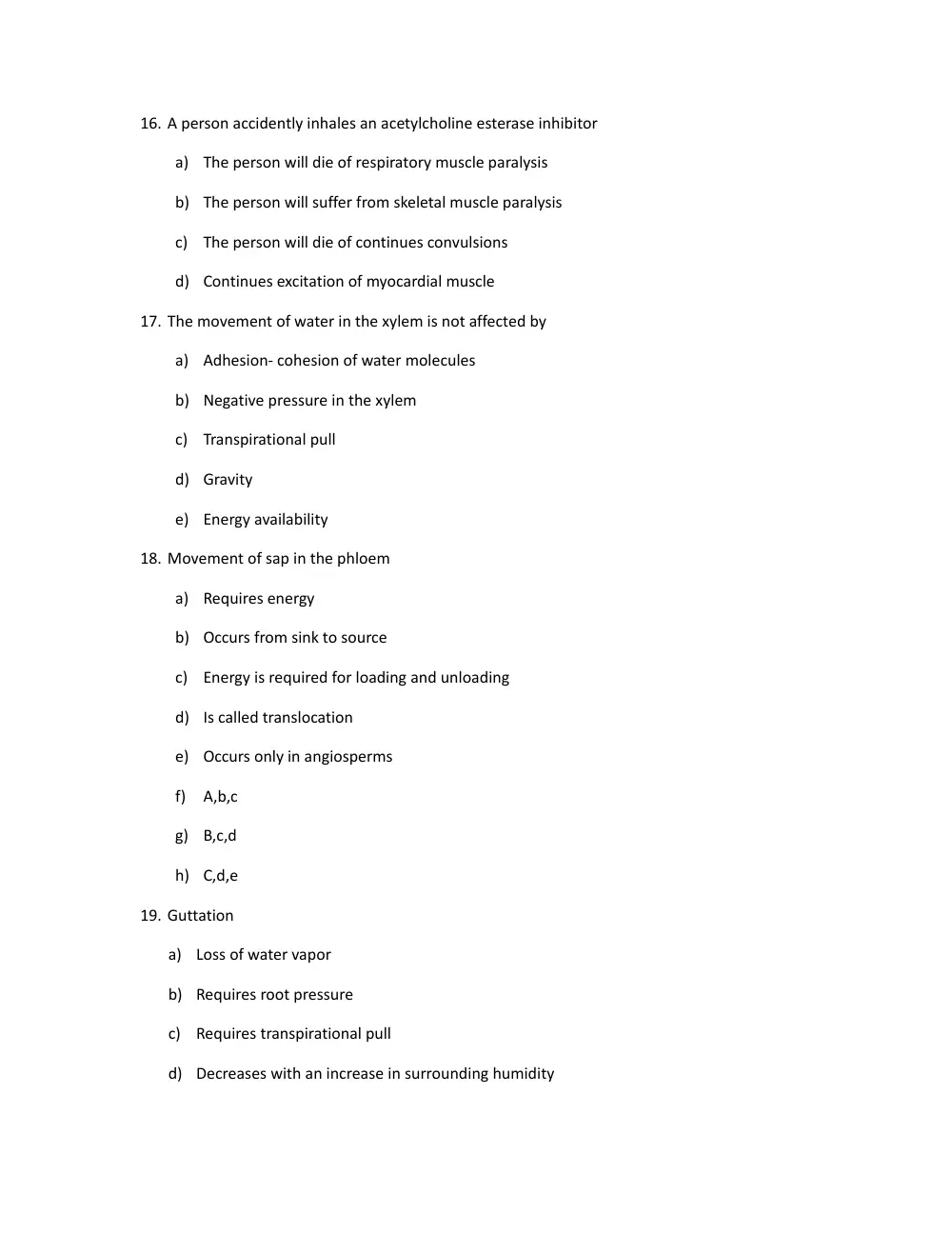
16. A person accidently inhales an acetylcholine esterase inhibitor
a)
The person will die of respiratory muscle paralysis
b)
The person will suffer from skeletal muscle paralysis
c)
The person will die of continues convulsions
d)
Continues excitation of myocardial muscle
17. The movement of water in the xylem is not affected by
a)
Adhesion- cohesion of water molecules
b)
Negative pressure in the xylem
c)
Transpirational pull
d)
Gravity
e)
Energy availability
18. Movement of sap in the phloem
a)
Requires energy
b)
Occurs from sink to source
c)
Energy is required for loading and unloading
d)
Is called translocation
e)
Occurs only in angiosperms
f)
A,b,c
g)
B,c,d
h)
C,d,e
19. Guttation
a)
Loss of water vapor
b)
Requires root pressure
c)
Requires transpirational pull
d)
Decreases with an increase in surrounding humidity
e)
Increases with increase in water content of soil
f)
Is common in the soil type : sand
g)
Is common in the soil type : clay
h)
A,b,c,d
i)
C,d,e,f
j)
B,e,f
20. Which of the following hormones have an antagonistic relationship
a)
Brassinosteroids-oligosaccarins
b)
Absissic acid-gibberellins
c)
Absissic acid-cytokinin
d)
Cytokinin-ethylene
e)
Ethylene- CO2
21. Amphibian lungs
a)
Have a high surface area
b)
Contain alveoli
c)
Guarded by a sphincter known as the glottis
d)
Guarded by the larynx
e)
A,b,d
f)
A,b,c
22. The chemical messengers the induce the feeling of satiety
a)
Gherlin
b)
Nueropeptide Y
c)
CCK
d)
Secretin
e)
Insulin
f)
Glucagon
g)
C,e
h)
C,f
i)
A,b,c
23. Which of the following is correctly matched
a)
Annelids-open circulatory system
b)
Arthropods-closed circulatory system
c)
Physalia- jet propulsion
d)
Aves- two way air flow system
e)
Grasshopper- tidal respiration
24. If a muscle cell is placed in a medium containing Ca2+ without ATP
a)
Muscle contraction continuously occurs
b)
Myosin heads can attach to actin
c)
Myosin cannot release actin
d)
Muscle stiffness
e)
A,b,c
f)
B,c,d
25. Rodents/rabbits are involved in coprophagy because
a)
They have symbiotans in their stomach
b)
They have an enlarged cecum occupied by symbiotants
c)
Digestion by symbiotants occurs after bypassing the intestine
d)
A,b,c
e)
B,c
f)
A,c
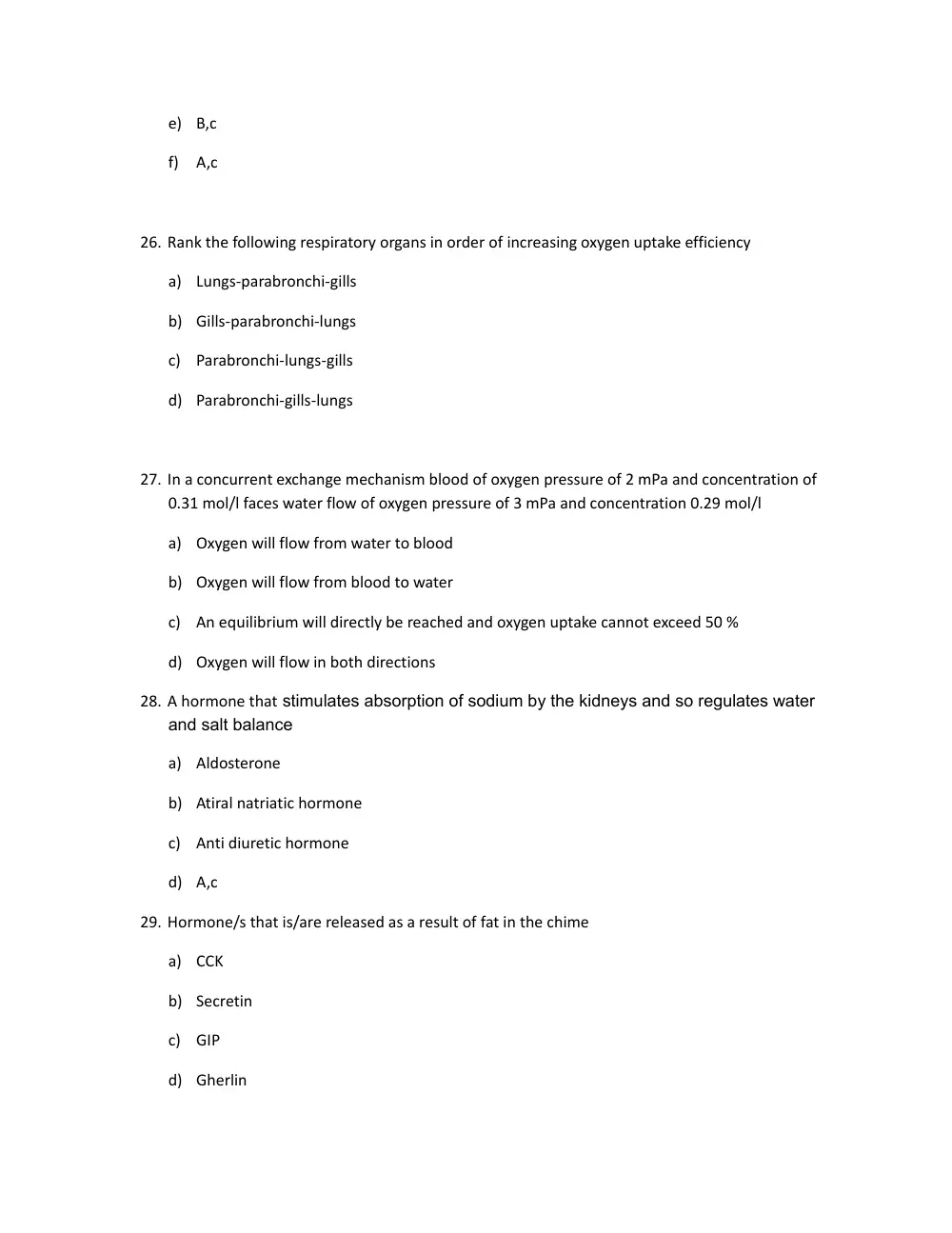
26. Rank the following respiratory organs in order of increasing oxygen uptake efficiency
a)
Lungs-parabronchi-gills
b)
Gills-parabronchi-lungs
c)
Parabronchi-lungs-gills
d)
Parabronchi-gills-lungs
27. In a concurrent exchange mechanism blood of oxygen pressure of 2 mPa and concentration of
0.31 mol/l faces water flow of oxygen pressure of 3 mPa and concentration 0.29 mol/l
a)
Oxygen will flow from water to blood
b)
Oxygen will flow from blood to water
c)
An equilibrium will directly be reached and oxygen uptake cannot exceed 50 %
d)
Oxygen will flow in both directions
28. A hormone that stimulates absorption of sodium by the kidneys and so regulates water
and salt balance
a)
Aldosterone
b)
Atiral natriatic hormone
c)
Anti diuretic hormone
d)
A,c
29. Hormone/s that is/are released as a result of fat in the chime
a)
CCK
b)
Secretin
c)
GIP
d)
Gherlin
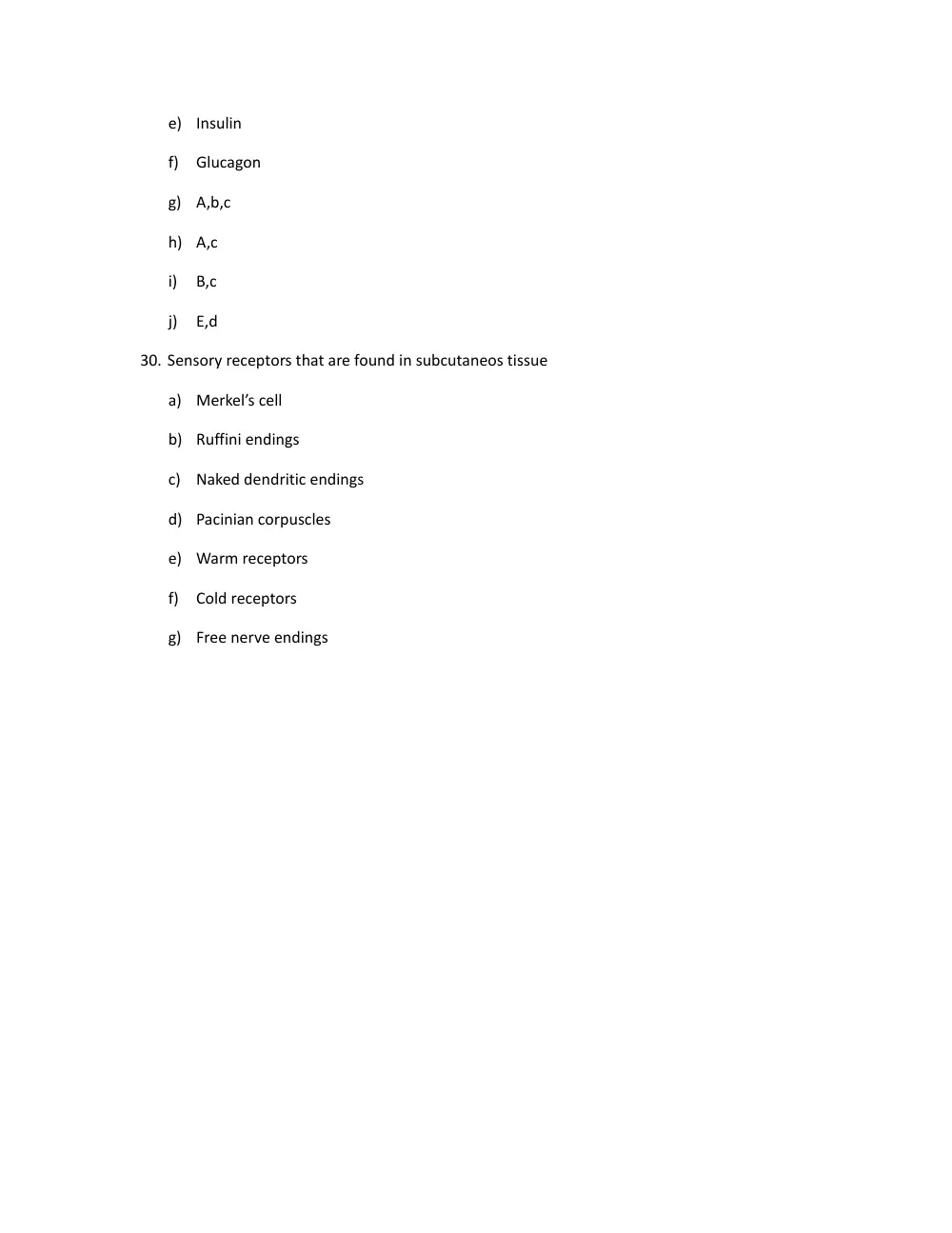
e)
Insulin
f)
Glucagon
g)
A,b,c
h)
A,c
i)
B,c
j)
E,d
30. Sensory receptors that are found in subcutaneos tissue
a)
Merkel’s cell
b)
Ruffini endings
c)
Naked dendritic endings
d)
Pacinian corpuscles
e)
Warm receptors
f)
Cold receptors
g)
Free nerve endings