
BIO 223 Final, Fall 2007
American University of Beirut · Genetics · 6 pages
More BIO 223 files
Show the text of this final exam
Biol223_Smith_2007-2008Fall_FINAL 23 January 2008 PAGE 1 of 6
Biology 223
Fall 2007-2008
FINAL, 23 November 2008
No notes, no calculators, no phones, etc.
Write your name and student ID number at the top of this page and most importantly, on the answer page.
Only the answer page will be graded, you must place your answers in the space provided.
Write legibly, if I cannot read or understand your answer, you will receive no credit. If it takes too much effort,
you may lose points.
Unanswered questions receive zero credit.
Within parts of multi-part questions, incorrect answers will subtract from correct parts.
Unjustifiable, frivolous, and grossly incorrect answers may be assigned negative points. Thus, it is possible to
receive a negative score on the exam.
If you find any mistakes of mine in the question, note it on your exam answer page and you may receive extra
credit.
100 points possible each section.
Part I: Russell, 2nd edition, chapters 1, 2, 3, 4, 11, 12, 15, 16
Part II: Russell, 2nd edition, chapters 18, 19 (Lac operon only)
Note points per question and spend your effort accordingly!
Biol223_Smith_2007-2008Fall_FINAL 23 January 2008 PAGE 2 of 6
SECTION I
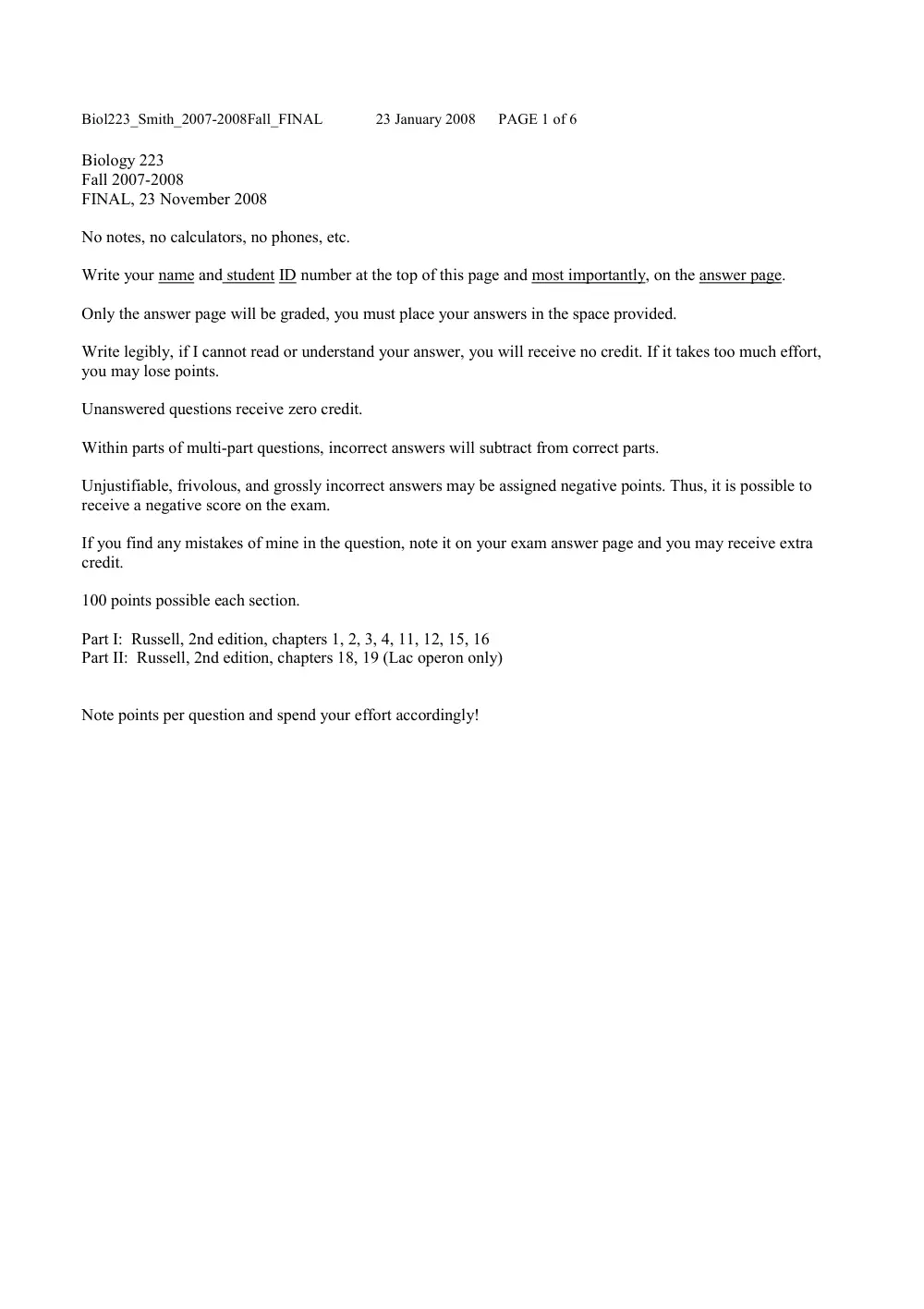
Question 1 for 10 points (2 minutes)
Polio is a positive-stranded RNA virus that replicates via a negative-stranded RNA intermediate. Assuming the
positive strand is 10,000 nt long and 20% A, 25% C, 30% G.
a) About how many uridines would be in the negative strand (answer with a whole number)?
b) About how many times would you expect the sequence 5’-AUG-3' to occur in the positive strand (answer as
the nearest whole number)?
Question 2 for 10 points (1 minute)
The single strand of DNA below was annealed to two radioactively-labeled RNA primers. The radioactively
labeled nucleotides are shown underlined. Calculate the total lengths of the radioactive, single-strand product(s)
expected from the addition of Escherichia coli DNA polymerase I and only dATP, dCTP, and dGTP in suitable
buffer (Mg++, etc). Your answer should be one or more whole numbers.
GACUUGCUGA GGUUCUAUA
3’-CTATACCTGAACGACTCGGTTCTTCCAAGATATTCGCGAGCTACGTCA-5’
Question 3 for 12 points (5 minutes)
In a cultured eukaryotic cell line, it was observed that adding tritiated thymidine to the culture for only 5 minutes
resulting in one quarter of the cell population becoming radioactively labeled. Radioactivity was first observed in
condensing chromosomes (assume beginning of prophase) 5 hours after labeling. It was also found that it required at
least 21 hours of labeling to label all cells, and mitosis lasted only 1 hour.
a) What is the duration of G1 in hours?
b) What is the duration of G2 in hours?
c) What is the duration of S in hours?
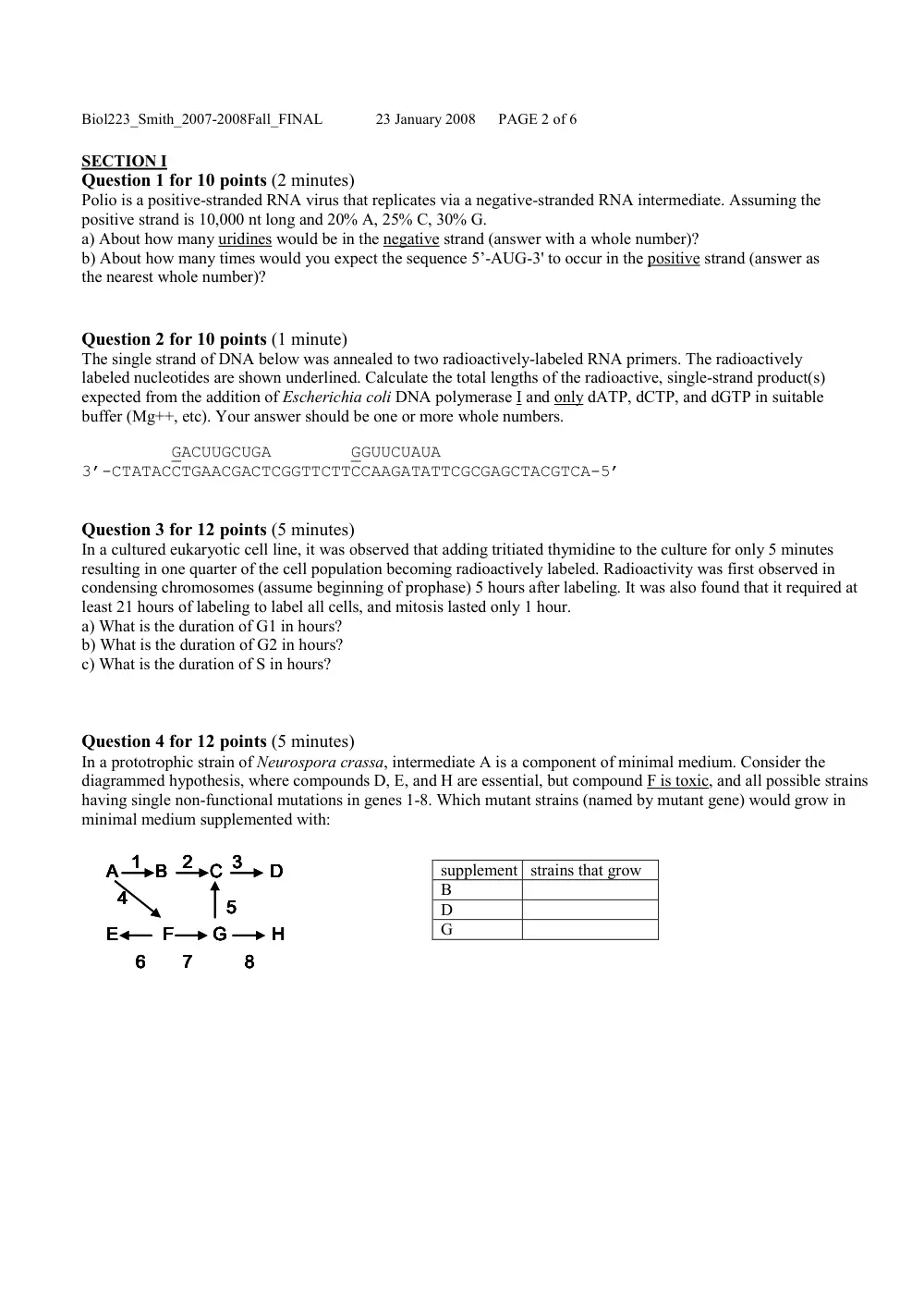
Question 4 for 12 points (5 minutes)
In a prototrophic strain of Neurospora crassa, intermediate A is a component of minimal medium. Consider the
diagrammed hypothesis, where compounds D, E, and H are essential, but compound F is toxic, and all possible strains
having single non-functional mutations in genes 1-8. Which mutant strains (named by mutant gene) would grow in
minimal medium supplemented with:
supplement strains that grow
B
D
G
AAAA
BBBB
CCCC
DDDD
FFFF
EEEE
GGGG
1111
2222
3333
7777
HHHH
4444
5555
6666
8888
AAAA
BBBB
CCCC
DDDD
FFFF
EEEE
GGGG
1111
2222
3333
7777
HHHH
4444
5555
6666
8888
Biol223_Smith_2007-2008Fall_FINAL 23 January 2008 PAGE 3 of 6
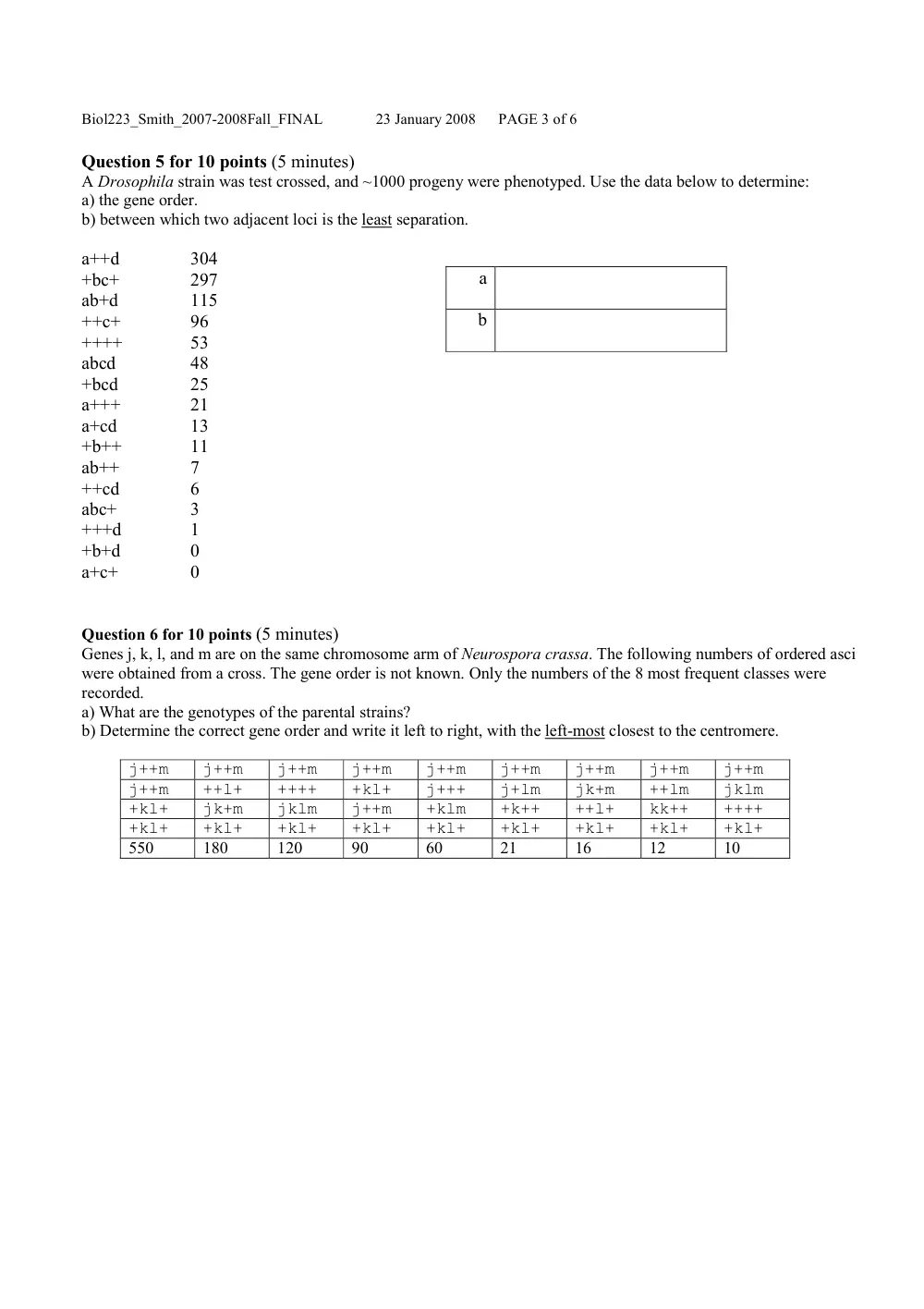
Question 5 for 10 points (5 minutes)
A Drosophila strain was test crossed, and ~1000 progeny were phenotyped. Use the data below to determine:
a) the gene order.
b) between which two adjacent loci is the least separation.
a++d
304
+bc+
297
ab+d
115
++c+
96
++++
53
abcd
48
+bcd
25
a+++
21
a+cd
13
+b++
11
ab++
7
++cd
6
abc+
3
+++d
1
+b+d
0
a+c+
0
Question 6 for 10 points (5 minutes)
Genes j, k, l, and m are on the same chromosome arm of Neurospora crassa. The following numbers of ordered asci
were obtained from a cross. The gene order is not known. Only the numbers of the 8 most frequent classes were
recorded.
a) What are the genotypes of the parental strains?
b) Determine the correct gene order and write it left to right, with the left-most closest to the centromere.
j++m
j++m
j++m
j++m
j++m
j++m
j++m
j++m
j++m
j++m
++l+
++++
+kl+
j+++
j+lm
jk+m
++lm
jklm
+kl+
jk+m
jklm
j++m
+klm
+k++
++l+
kk++
++++
+kl+
+kl+
+kl+
+kl+
+kl+
+kl+
+kl+
+kl+
+kl+
550
180
120
90
60
21
16
12
10
a
b
Biol223_Smith_2007-2008Fall_FINAL 23 January 2008 PAGE 4 of 6
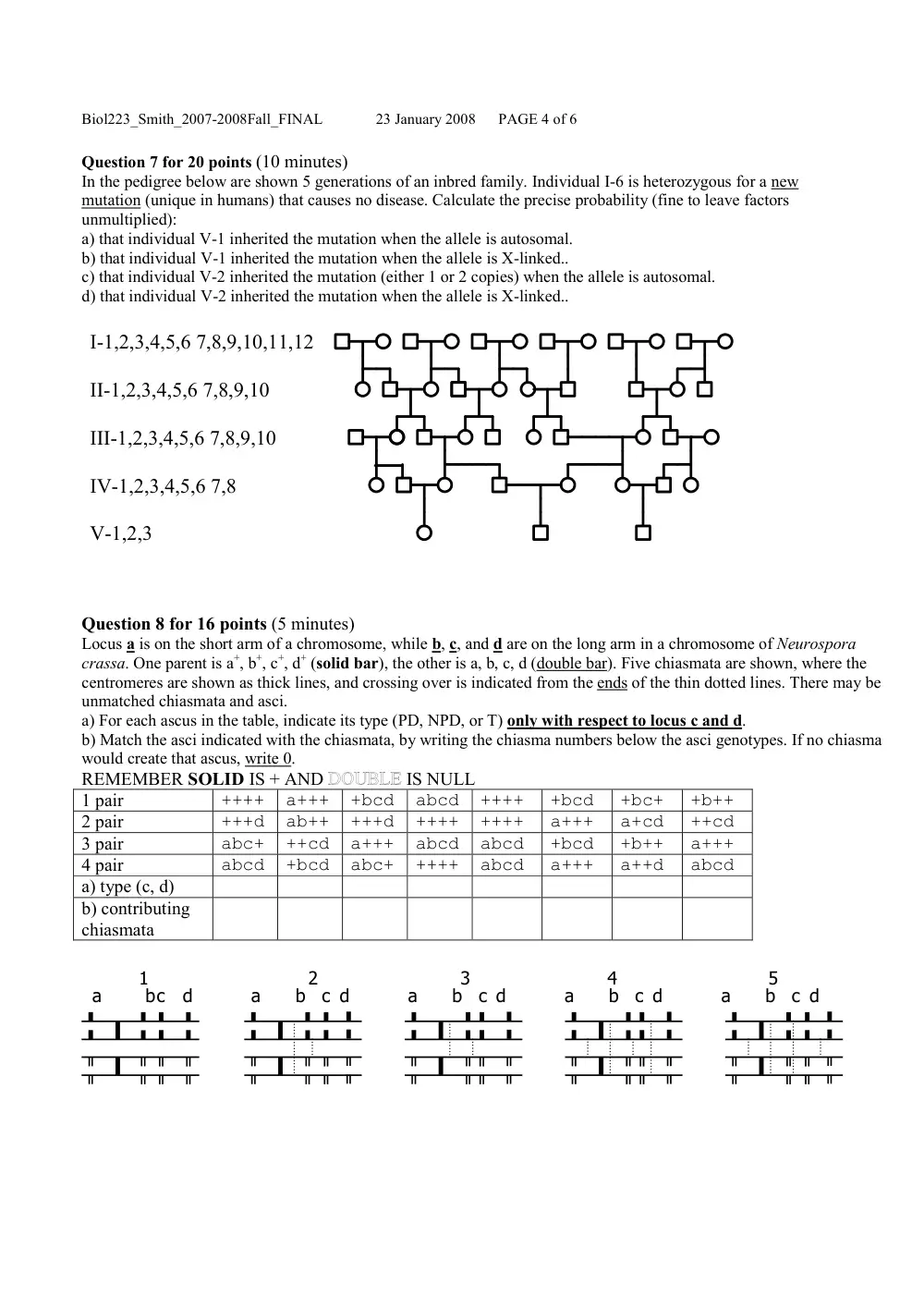
Question 7 for 20 points (10 minutes)
In the pedigree below are shown 5 generations of an inbred family. Individual I-6 is heterozygous for a new
mutation (unique in humans) that causes no disease. Calculate the precise probability (fine to leave factors
unmultiplied):
a) that individual V-1 inherited the mutation when the allele is autosomal.
b) that individual V-1 inherited the mutation when the allele is X-linked..
c) that individual V-2 inherited the mutation (either 1 or 2 copies) when the allele is autosomal.
d) that individual V-2 inherited the mutation when the allele is X-linked..
Question 8 for 16 points (5 minutes)
Locus a is on the short arm of a chromosome, while b, c, and d are on the long arm in a chromosome of Neurospora
crassa. One parent is a+, b+, c+, d+ (solid bar), the other is a, b, c, d (double bar). Five chiasmata are shown, where the
centromeres are shown as thick lines, and crossing over is indicated from the ends of the thin dotted lines. There may be
unmatched chiasmata and asci.
a) For each ascus in the table, indicate its type (PD, NPD, or T) only with respect to locus c and d.
b) Match the asci indicated with the chiasmata, by writing the chiasma numbers below the asci genotypes. If no chiasma
would create that ascus, write 0.
REMEMBER SOLID IS + AND
IS NULL
1 pair
++++ a+++ +bcd abcd ++++
+bcd
+bc+
+b++
2 pair
+++d ab++ +++d ++++ ++++
a+++
a+cd
++cd
3 pair
abc+ ++cd a+++ abcd abcd
+bcd
+b++
a+++
4 pair
abcd +bcd abc+ ++++ abcd
a+++
a++d
abcd
a) type (c, d)
b) contributing
chiasmata
a
b c d
1
a
b c d
3
a
b c d
2
a
b c d
4
a
b c d
5
I-1,2,3,4,5,6 7,8,9,10,11,12
II-1,2,3,4,5,6 7,8,9,10
III-1,2,3,4,5,6 7,8,9,10
IV-1,2,3,4,5,6 7,8
V-1,2,3
Biol223_Smith_2007-2008Fall_FINAL 23 January 2008 PAGE 5 of 6
SECTION II
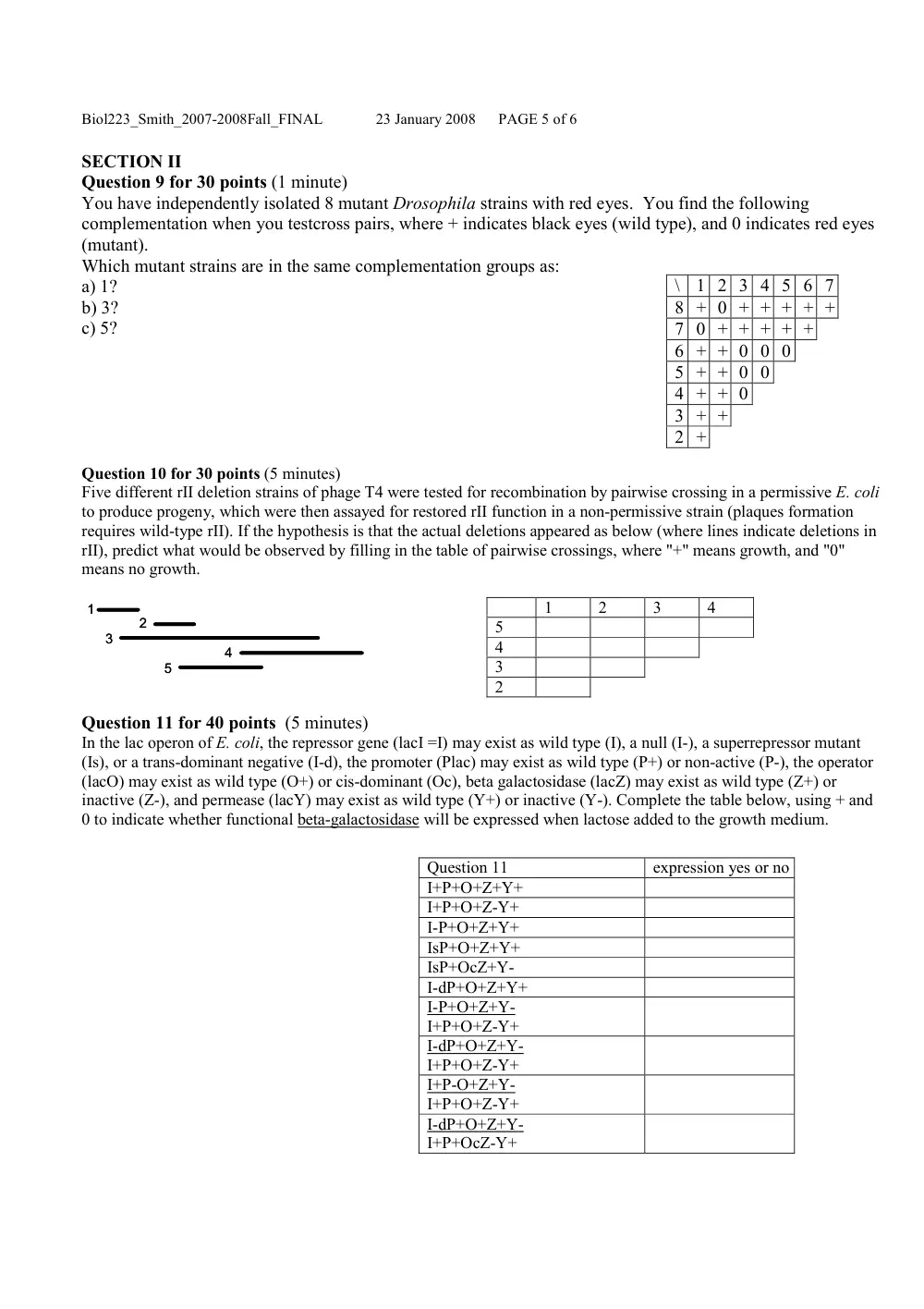
Question 9 for 30 points (1 minute)
You have independently isolated 8 mutant Drosophila strains with red eyes. You find the following
complementation when you testcross pairs, where + indicates black eyes (wild type), and 0 indicates red eyes
(mutant).
Which mutant strains are in the same complementation groups as:
a) 1?
b) 3?
c) 5?
Question 10 for 30 points (5 minutes)
Five different rII deletion strains of phage T4 were tested for recombination by pairwise crossing in a permissive E. coli
to produce progeny, which were then assayed for restored rII function in a non-permissive strain (plaques formation
requires wild-type rII). If the hypothesis is that the actual deletions appeared as below (where lines indicate deletions in
rII), predict what would be observed by filling in the table of pairwise crossings, where "+" means growth, and "0"
means no growth.
Question 11 for 40 points (5 minutes)
In the lac operon of E. coli, the repressor gene (lacI =I) may exist as wild type (I), a null (I-), a superrepressor mutant
(Is), or a trans-dominant negative (I-d), the promoter (Plac) may exist as wild type (P+) or non-active (P-), the operator
(lacO) may exist as wild type (O+) or cis-dominant (Oc), beta galactosidase (lacZ) may exist as wild type (Z+) or
inactive (Z-), and permease (lacY) may exist as wild type (Y+) or inactive (Y-). Complete the table below, using + and
0 to indicate whether functional beta-galactosidase will be expressed when lactose added to the growth medium.
\ 1 2 3 4 5 6 7
8 + 0 + + + + +
7 0 + + + + +
6 + + 0 0 0
5 + + 0 0
4 + + 0
3 + +
2 +
1
2
3
4
5
4
3
2
Question 11
expression yes or no
I+P+O+Z+Y+
I+P+O+Z-Y+
I-P+O+Z+Y+
IsP+O+Z+Y+
IsP+OcZ+Y-
I-dP+O+Z+Y+
I-P+O+Z+Y-
I+P+O+Z-Y+
I-dP+O+Z+Y-
I+P+O+Z-Y+
I+P-O+Z+Y-
I+P+O+Z-Y+
I-dP+O+Z+Y-
I+P+OcZ-Y+
1
2
3
4
5
1
2
3
4
5
Biol223_Smith_2007-2008Fall_FINAL 23 January 2008 PAGE 6 of 6
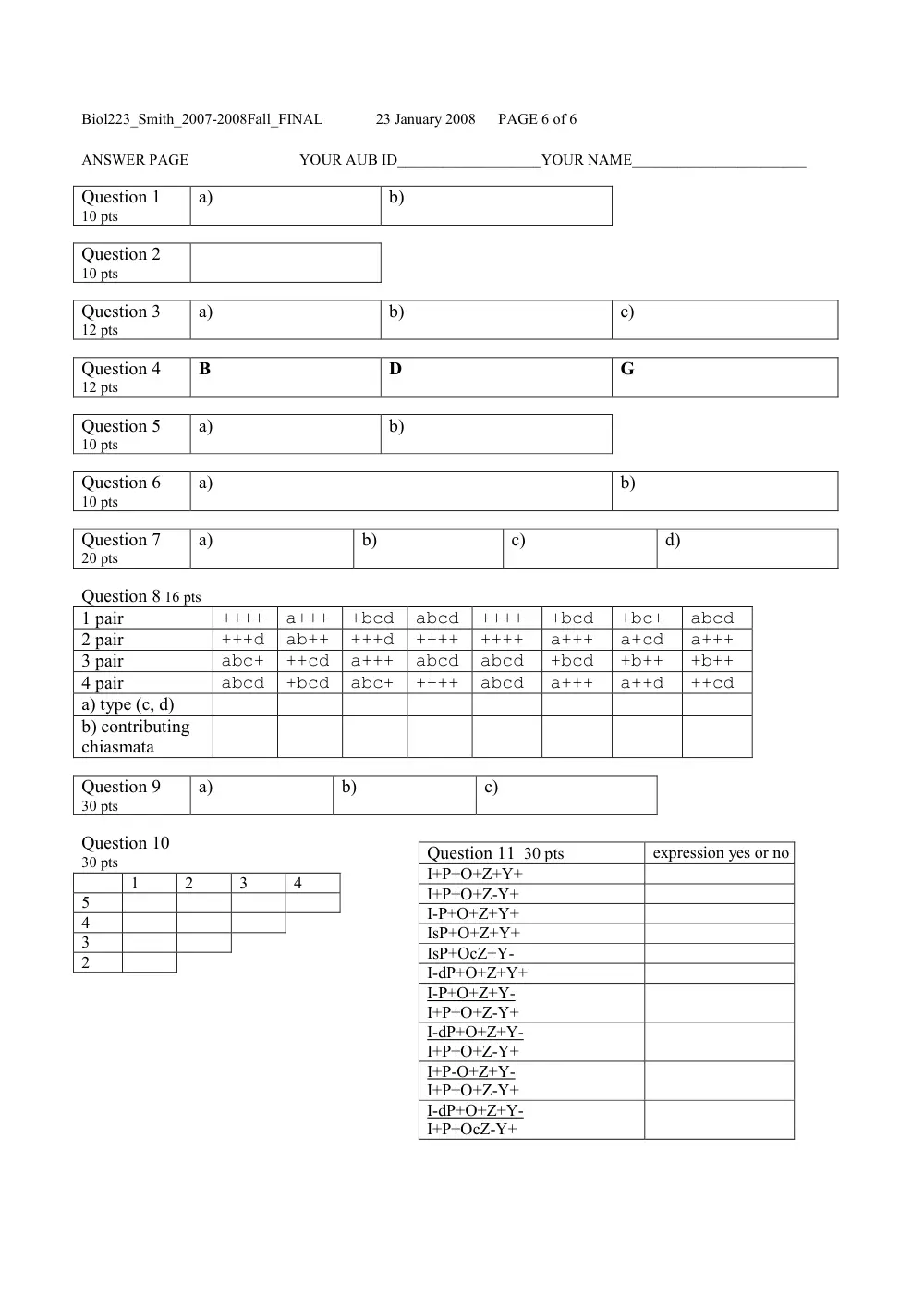
ANSWER PAGE
YOUR AUB ID___________________YOUR NAME_______________________
Question 1
10 pts
a)
b)
Question 2
10 pts
Question 3
12 pts
a)
b)
c)
Question 4
12 pts
B
D
G
Question 5
10 pts
a)
b)
Question 6
10 pts
a)
b)
Question 7
20 pts
a)
b)
c)
d)
Question 8 16 pts
1 pair
++++ a+++ +bcd abcd ++++
+bcd
+bc+
abcd
2 pair
+++d ab++ +++d ++++ ++++
a+++
a+cd
a+++
3 pair
abc+ ++cd a+++ abcd abcd
+bcd
+b++
+b++
4 pair
abcd +bcd abc+ ++++ abcd
a+++
a++d
++cd
a) type (c, d)
b) contributing
chiasmata
Question 9
30 pts
a)
b)
c)
Question 10
30 pts
Question 11 30 pts
expression yes or no
I+P+O+Z+Y+
I+P+O+Z-Y+
I-P+O+Z+Y+
IsP+O+Z+Y+
IsP+OcZ+Y-
I-dP+O+Z+Y+
I-P+O+Z+Y-
I+P+O+Z-Y+
I-dP+O+Z+Y-
I+P+O+Z-Y+
I+P-O+Z+Y-
I+P+O+Z-Y+
I-dP+O+Z+Y-
I+P+OcZ-Y+
1
2
3
4
5
4
3
2