
BIO 223 Final, Fall 2008
American University of Beirut · Genetics · 7 pages



More BIO 223 files
Show the text of this final exam
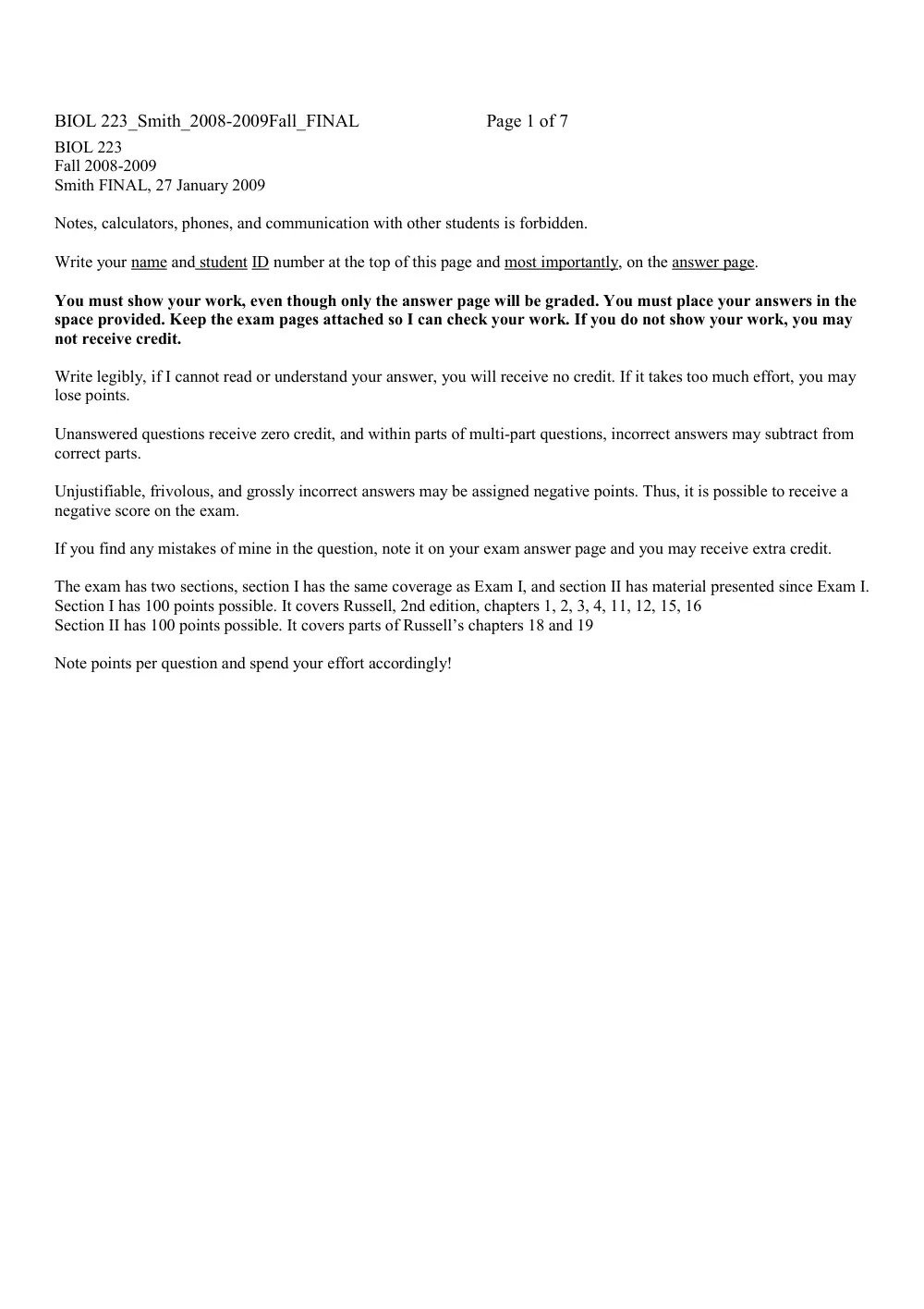
BIOL 223_Smith_2008-2009Fall_FINAL Page 1 of 7
BIOL 223
Fall 2008-2009
Smith FINAL, 27 January 2009
Notes, calculators, phones, and communication with other students is forbidden.
Write your name and student ID number at the top of this page and most importantly, on the answer page.
You must show your work, even though only the answer page will be graded. You must place your answers in the
space provided. Keep the exam pages attached so I can check your work. If you do not show your work, you may
not receive credit.
Write legibly, if I cannot read or understand your answer, you will receive no credit. If it takes too much effort, you may
lose points.
Unanswered questions receive zero credit, and within parts of multi-part questions, incorrect answers may subtract from
correct parts.
Unjustifiable, frivolous, and grossly incorrect answers may be assigned negative points. Thus, it is possible to receive a
negative score on the exam.
If you find any mistakes of mine in the question, note it on your exam answer page and you may receive extra credit.
The exam has two sections, section I has the same coverage as Exam I, and section II has material presented since Exam I.
Section I has 100 points possible. It covers Russell, 2nd edition, chapters 1, 2, 3, 4, 11, 12, 15, 16
Section II has 100 points possible. It covers parts of Russell’s chapters 18 and 19
Note points per question and spend your effort accordingly!
BIOL 223_Smith_2008-2009Fall_FINAL Page 2 of 7
SECTION I
Question 1 for 10 points (3 minutes)
Consider a random sequence of single stranded RNA 100 000 nucleotides long, with an unbiased base composition (one
quarter A, one quarter C, one quarter G, and one quarter U). N refers to any, Y refers to pyrimidine, R refers to purine.
a) How many times would you expect the sequence 5’-CAUNY-3' to occur?
b) How many times would you expect 5’-RYYNA-3' to occur in a 100 000 nt RNA made with only A, C, and G?
Q1 a
b
Question 2 for 10 points (3 minutes)
The single strand of DNA below was annealed to two RNA primers that are labeled at their 5’-ends:
5’-*AGACCGCUGA-3’ and 5’-*GGUUCUAUAUACG-3’. Calculate the total lengths of the radioactive, single-
strand product(s) expected from the addition of Escherichia coli DNA polymerase I or III in suitable buffer
(Mg++, etc), without exposure to RNase, and the dNTP(s) indicated (your answers should be one or more
whole numbers in each box):
5’-ACTGCCAATCTTCTTCAGCGGTCTCCTCTTCTTCGTATATAGAACCGAACCTATGCCCAATGC-3’
Q2
dATP+dGTP + DNA pol I
dATP+dGTP + DNA pol III
Question 3 for 10 points (3 minutes)
A dipteran similar to Drosophila melanogaster has 5 pairs of chromosomes. The male does not undergo
crossing over during meoisis.
a) What proportion of his gametes contain only chromosomes of maternal origin?
b) What proportion of his gametes contain only one chromosome of paternal origin?
Q3
a
b
Question 4 for 10 points (3 minutes)
A cell line is thought to have its cell cycle comprising G1= 12 hours, G2= 11 hours, M=1 hours, S=6 hours.
a) For how many hours would you leave tritiated thymidine in the medium in order to label one third of the cells?
b) For how many hours would you leave tritiated thymidine in the medium in order to label one half of the cells?
Q4
a
b
BIOL 223_Smith_2008-2009Fall_FINAL Page 3 of 7
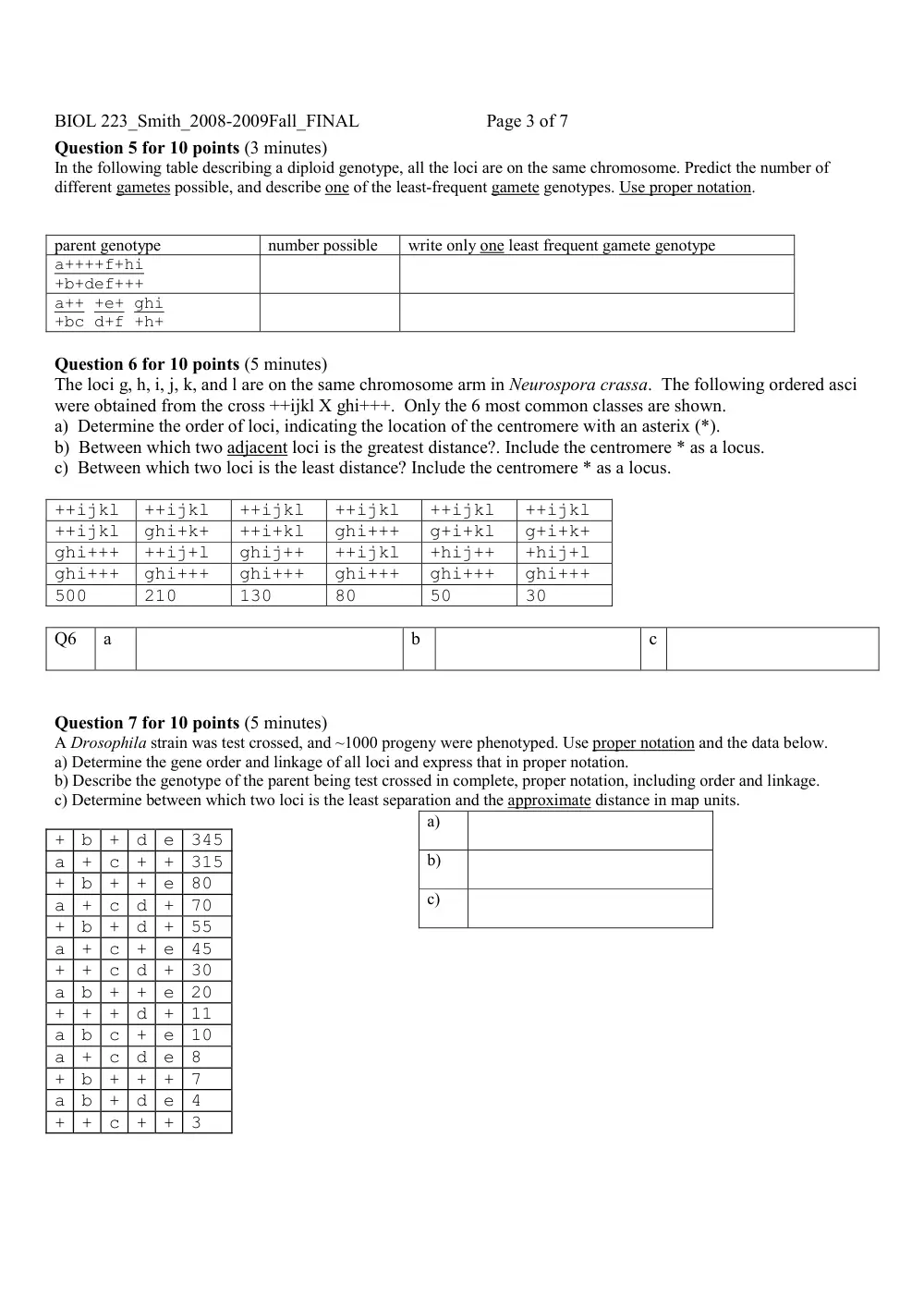
Question 5 for 10 points (3 minutes)
In the following table describing a diploid genotype, all the loci are on the same chromosome. Predict the number of
different gametes possible, and describe one of the least-frequent gamete genotypes. Use proper notation.
parent genotype
number possible
write only one least frequent gamete genotype
a++++f+hi
+b+def+++
a++ +e+ ghi
+bc d+f +h+
Question 6 for 10 points (5 minutes)
The loci g, h, i, j, k, and l are on the same chromosome arm in Neurospora crassa. The following ordered asci
were obtained from the cross ++ijkl X ghi+++. Only the 6 most common classes are shown.
a) Determine the order of loci, indicating the location of the centromere with an asterix (*).
b) Between which two adjacent loci is the greatest distance?. Include the centromere * as a locus.
c) Between which two loci is the least distance? Include the centromere * as a locus.
++ijkl ++ijkl
++ijkl
++ijkl
++ijkl
++ijkl
++ijkl ghi+k+
++i+kl
ghi+++
g+i+kl
g+i+k+
ghi+++ ++ij+l
ghij++
++ijkl
+hij++
+hij+l
ghi+++ ghi+++
ghi+++
ghi+++
ghi+++
ghi+++
500
210
130
80
50
30
Q6
a
b
c
Question 7 for 10 points (5 minutes)
A Drosophila strain was test crossed, and ~1000 progeny were phenotyped. Use proper notation and the data below.
a) Determine the gene order and linkage of all loci and express that in proper notation.
b) Describe the genotype of the parent being test crossed in complete, proper notation, including order and linkage.
c) Determine between which two loci is the least separation and the approximate distance in map units.
+ b + d e 345
a + c + + 315
+ b + + e 80
a + c d + 70
+ b + d + 55
a + c + e 45
+ + c d + 30
a b + + e 20
+ + + d + 11
a b c + e 10
a + c d e 8
+ b + + + 7
a b + d e 4
+ + c + + 3
a)
b)
c)
BIOL 223_Smith_2008-2009Fall_FINAL Page 4 of 7
Question 8 for 15 points (15 minutes)
A pedigree of 5 generations is shown. Of interest are loci a, b, and c. Loci a and b are X-linked, separated by about 20
map units. The genotype of the first generation and individuals III-1 and III-10 are known, all others are not. All
generation I females are ++/++ c/c. All generation I males are ab/y +/+. Individual III-1 is ++/y +/+. Individual III-10 is
ab/ab c/c.
Using Drosophila notation and precise probability calculations, determine:
a) the genotype of II-4
b) the genotype of II-5
c) the probability that III-3 is c/+
d) the probability that III-4 is ab/y
e) the probability that IV-1 is ab/ab
f) the probability that IV-8 is ab/++
g) the probability that V-4 is c/c
h) the probability that V-5 is c/c
a
b
c
d
e
f
g
h
I-1,2,3,4,5,6 7,8,9,10,11,12
II-1,2,3,4,5,6 7,8,9,10,11
III-1,2,3,4,5,6 7,8,9,10
IV-1,2,3,4,5,6 7,8,9,10,11
V-1,2,3,4,5,6
I-1,2,3,4,5,6 7,8,9,10,11,12
II-1,2,3,4,5,6 7,8,9,10,11
III-1,2,3,4,5,6 7,8,9,10
IV-1,2,3,4,5,6 7,8,9,10,11
V-1,2,3,4,5,6
BIOL 223_Smith_2008-2009Fall_FINAL Page 5 of 7
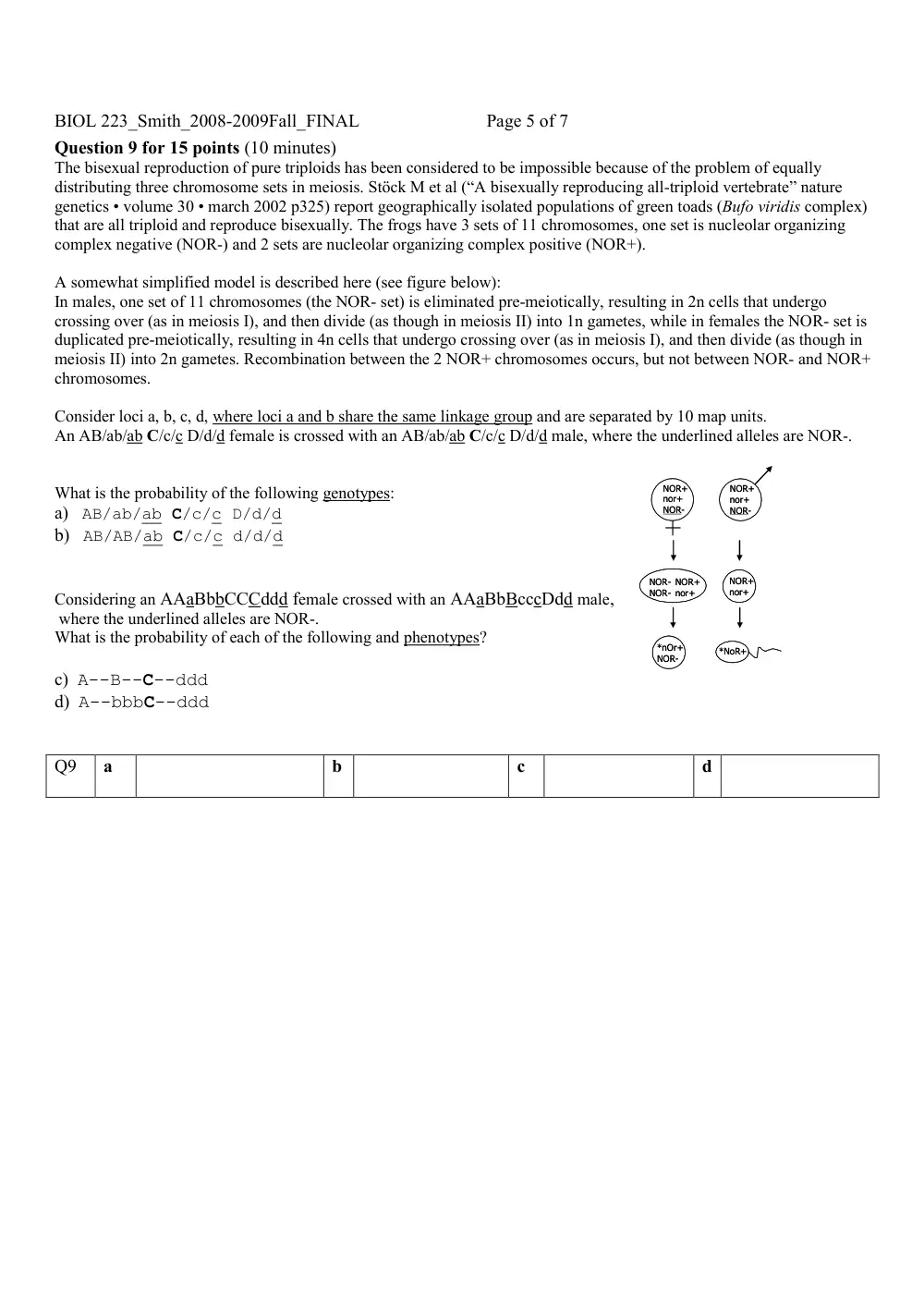
Question 9 for 15 points (10 minutes)
The bisexual reproduction of pure triploids has been considered to be impossible because of the problem of equally
distributing three chromosome sets in meiosis. Stöck M et al (“A bisexually reproducing all-triploid vertebrate” nature
genetics • volume 30 • march 2002 p325) report geographically isolated populations of green toads (Bufo viridis complex)
that are all triploid and reproduce bisexually. The frogs have 3 sets of 11 chromosomes, one set is nucleolar organizing
complex negative (NOR-) and 2 sets are nucleolar organizing complex positive (NOR+).
A somewhat simplified model is described here (see figure below):
In males, one set of 11 chromosomes (the NOR- set) is eliminated pre-meiotically, resulting in 2n cells that undergo
crossing over (as in meiosis I), and then divide (as though in meiosis II) into 1n gametes, while in females the NOR- set is
duplicated pre-meiotically, resulting in 4n cells that undergo crossing over (as in meiosis I), and then divide (as though in
meiosis II) into 2n gametes. Recombination between the 2 NOR+ chromosomes occurs, but not between NOR- and NOR+
chromosomes.
Consider loci a, b, c, d, where loci a and b share the same linkage group and are separated by 10 map units.
An AB/ab/ab C/c/c D/d/d female is crossed with an AB/ab/ab C/c/c D/d/d male, where the underlined alleles are NOR-.
What is the probability of the following genotypes:
a) AB/ab/ab C/c/c D/d/d
b) AB/AB/ab C/c/c d/d/d
Considering an AAaBbbCCCddd female crossed with an AAaBbBcccDdd male,
where the underlined alleles are NOR-.
What is the probability of each of the following and phenotypes?
c) A--B--C--ddd
d) A--bbbC--ddd
Q9
a
b
c
d
*nOr+
NOR-
*nOr+
NOR-
NOR+
nor+
NOR-
NOR+
nor+
NOR-
NOR+
nor+
NOR-
NOR+
nor+
NOR-
NOR+
nor+
NOR+
nor+
NOR+
nor+
NOR-
NOR-
NOR+
nor+
NOR-
NOR-
*NoR+
*NoR+
BIOL 223_Smith_2008-2009Fall_FINAL Page 6 of 7
SECTION II
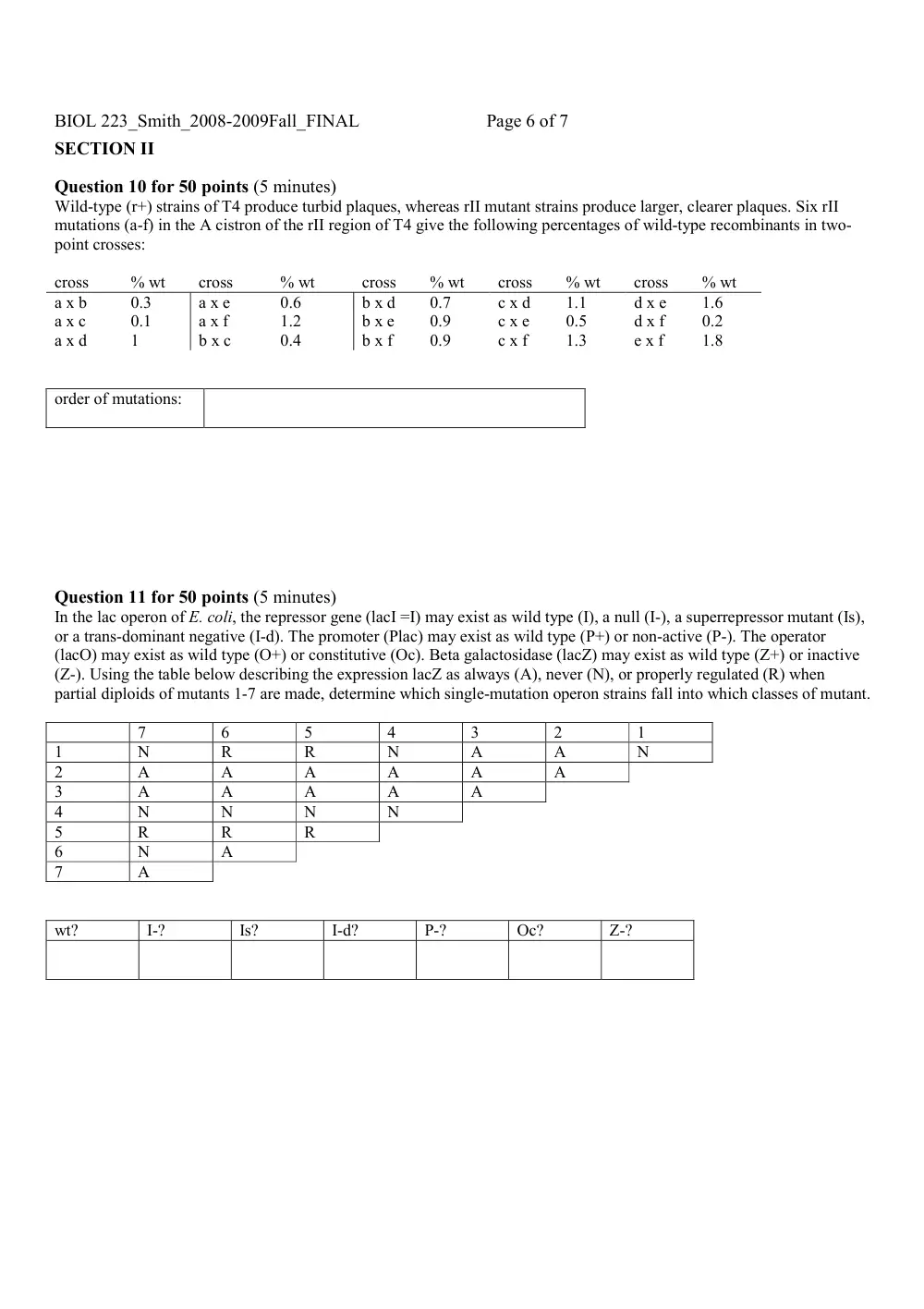
Question 10 for 50 points (5 minutes)
Wild-type (r+) strains of T4 produce turbid plaques, whereas rII mutant strains produce larger, clearer plaques. Six rII
mutations (a-f) in the A cistron of the rII region of T4 give the following percentages of wild-type recombinants in two-
point crosses:
cross
% wt
cross
% wt
cross
% wt
cross
% wt
cross
% wt
a x b
0.3
a x e
0.6
b x d
0.7
c x d
1.1
d x e
1.6
a x c
0.1
a x f
1.2
b x e
0.9
c x e
0.5
d x f
0.2
a x d
1
b x c
0.4
b x f
0.9
c x f
1.3
e x f
1.8
order of mutations:
Question 11 for 50 points (5 minutes)
In the lac operon of E. coli, the repressor gene (lacI =I) may exist as wild type (I), a null (I-), a superrepressor mutant (Is),
or a trans-dominant negative (I-d). The promoter (Plac) may exist as wild type (P+) or non-active (P-). The operator
(lacO) may exist as wild type (O+) or constitutive (Oc). Beta galactosidase (lacZ) may exist as wild type (Z+) or inactive
(Z-). Using the table below describing the expression lacZ as always (A), never (N), or properly regulated (R) when
partial diploids of mutants 1-7 are made, determine which single-mutation operon strains fall into which classes of mutant.
7
6
5
4
3
2
1
1
N
R
R
N
A
A
N
2
A
A
A
A
A
A
3
A
A
A
A
A
4
N
N
N
N
5
R
R
R
6
N
A
7
A
wt?
I-?
Is?
I-d?
P-?
Oc?
Z-?
BIOL 223_Smith_2008-2009Fall_FINAL Page 7 of 7
ANSWER PAGE
YOUR AUB ID___________________YOUR NAME_______________________
Q1 a
b
Q2
dATP+dGTP + DNA pol I
dATP+dGTP + DNA pol III
Q3
a
b
Q4
a
b
Q5
parent genotype
number possible
write only one least frequent gamete genotype
a++++f+hi
+b+def+++
a++ +e+ ghi
+bc d+f +h+
Q6
a
b
c
Q7
Q8
a
b
c
d
e
f
g
h
Q9
a
b
c
d
Q10
order of mutations:
Q11
wt?
I-?
Is?
I-d?
P-?
Oc?
Z-?
a)
b)
c)