
BUSS 230 Homework Solution, Spring 2012
American University of Beirut · Managerial Economics · 16 pages · with solution
Showing the first 10 of 16 pages. Download the PDF to see all of it.
More BUSS 230 files
- Homework Assignment 2 Solution · Spring 2012Homework · with solutionView
- Homework 1 · Fall 2011HomeworkView
- Homework 1 · Fall 2011HomeworkView
- Homework 2 · Fall 2011HomeworkView
- Homework Solutions · Fall 2009Homework · with solutionView
- Midterm Notes · Spring 2013NotesView
- Midterm · Fall 2013ExamView
- Midterm Solution · Fall 2013Exam · with solutionView
Show the text of this homework
BUSS 230: Managerial Economics
Spring 2011-2012
Assignment 3 Solution
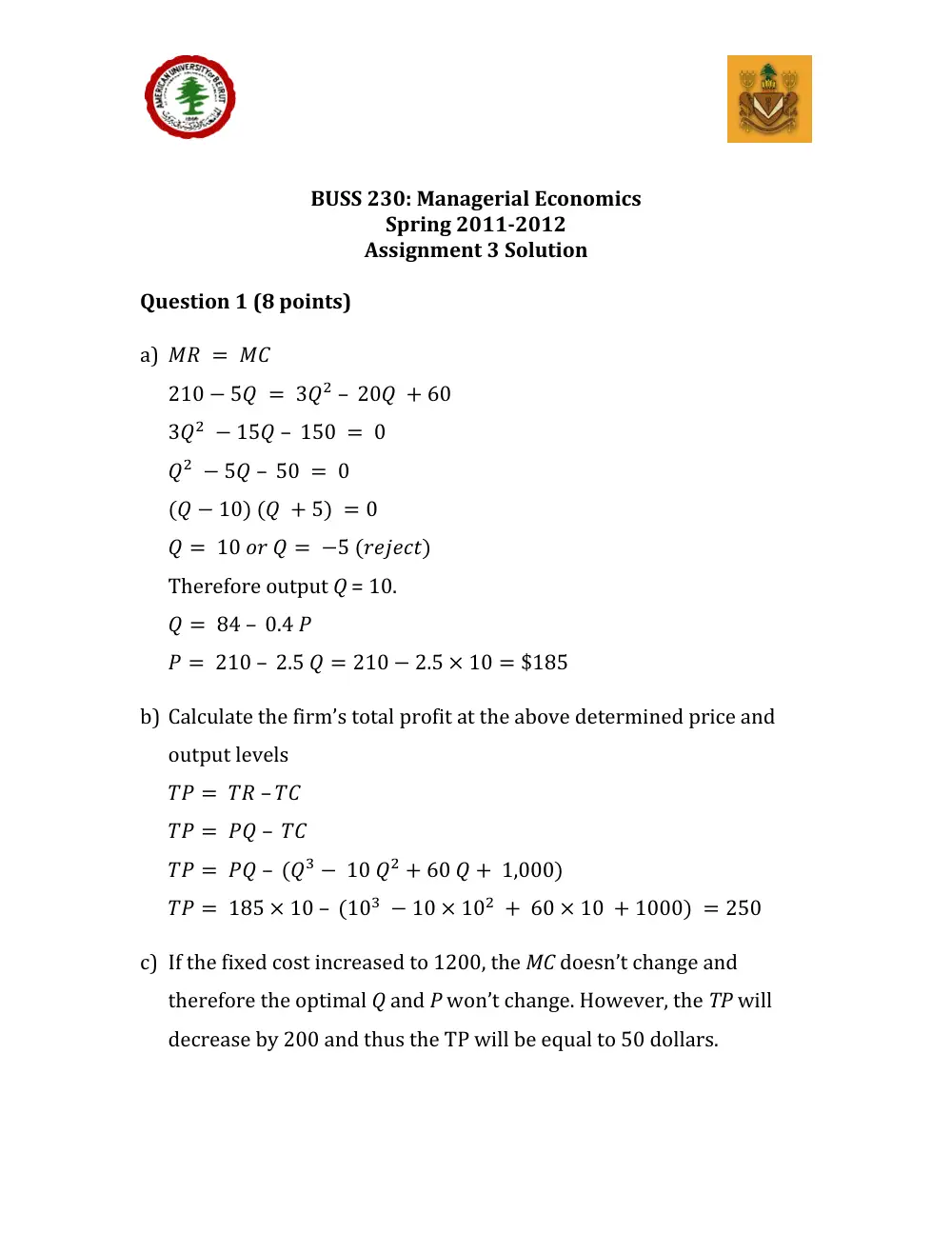
Question 1 (8 points)
a)
Therefore output Q = 10.
b) Calculate the firm’s total profit at the above determined price and
output levels
c) If the fixed cost increased to 1200, the MC doesn’t change and
therefore the optimal Q and P won’t change. However, the TP will
decrease by 200 and thus the TP will be equal to 50 dollars.
Page 2 of 16
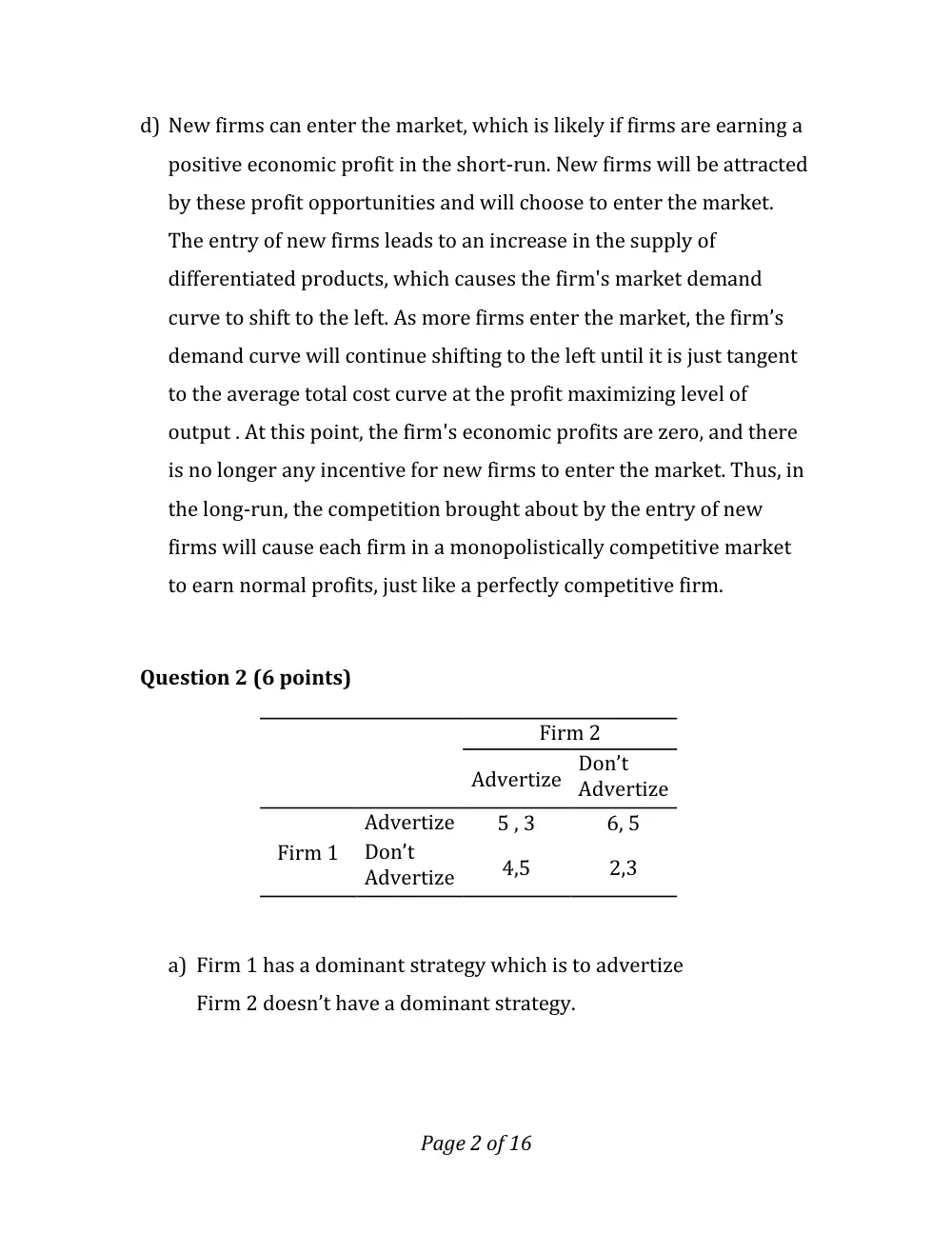
d) New firms can enter the market, which is likely if firms are earning a
positive economic profit in the short-run. New firms will be attracted
by these profit opportunities and will choose to enter the market.
The entry of new firms leads to an increase in the supply of
differentiated products, which causes the firm's market demand
curve to shift to the left. As more firms enter the market, the firm’s
demand curve will continue shifting to the left until it is just tangent
to the average total cost curve at the profit maximizing level of
output . At this point, the firm's economic profits are zero, and there
is no longer any incentive for new firms to enter the market. Thus, in
the long-run, the competition brought about by the entry of new
firms will cause each firm in a monopolistically competitive market
to earn normal profits, just like a perfectly competitive firm.
Question 2 (6 points)
Firm 2
Advertize Don’t
Advertize
Firm 1
Advertize
5 , 3
6, 5
Don’t
Advertize
4,5
2,3
a) Firm 1 has a dominant strategy which is to advertize
Firm 2 doesn’t have a dominant strategy.
Page 3 of 16
b) The Nash Equilibrium is for Firm 1 to advertize and for Firm 2 to
not advertize. Therefore, Firms 1 and 2’s profits will be 6 and 5
respectively.
c) No it is not a prisoners’ dilemma as both firms are better off using
the strategy which is for Firm 1 to advertize and Firm 2 to not
advertize.
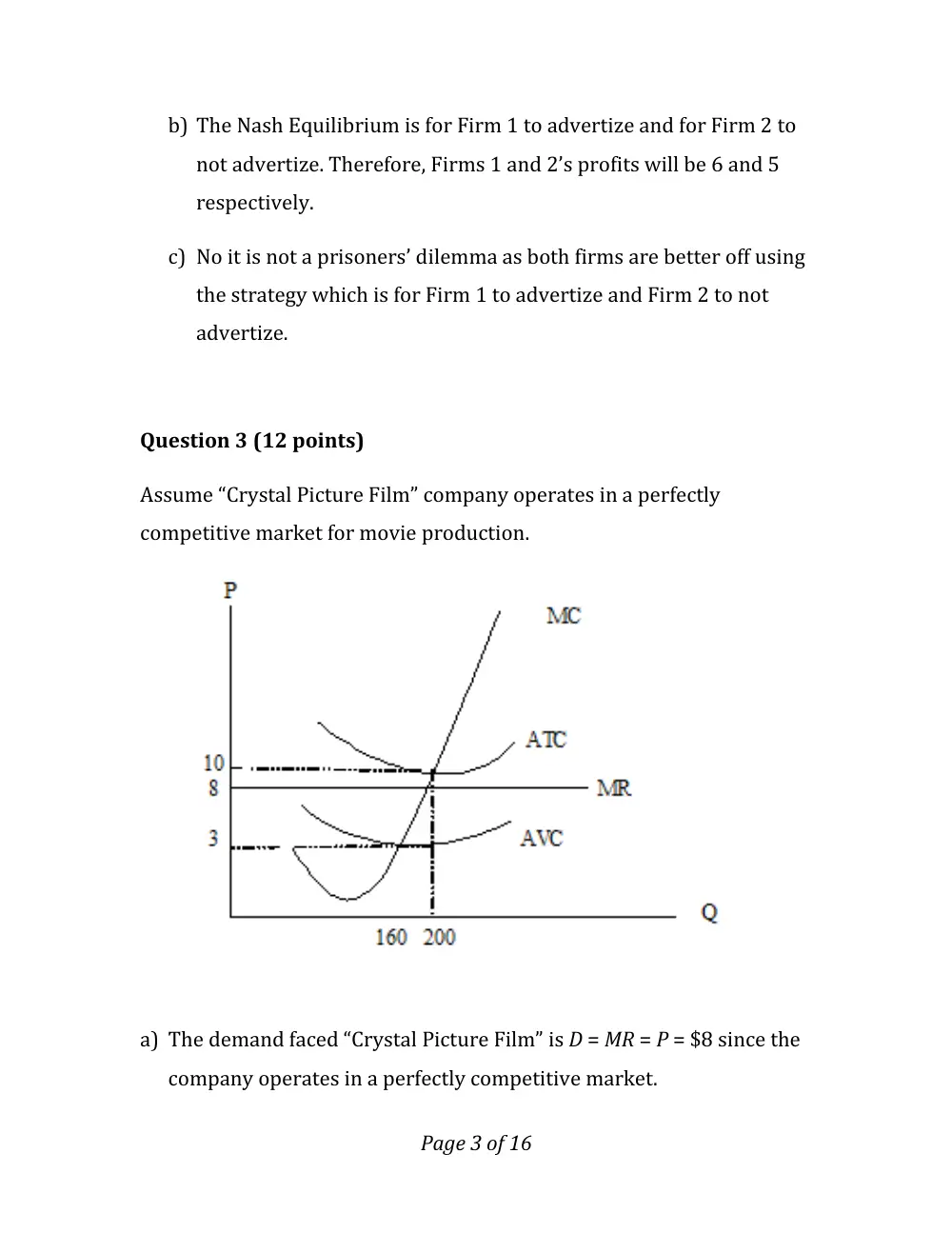
Question 3 (12 points)
Assume “Crystal Picture Film” company operates in a perfectly
competitive market for movie production.
a) The demand faced “Crystal Picture Film” is D = MR = P = $8 since the
company operates in a perfectly competitive market.
Page 4 of 16
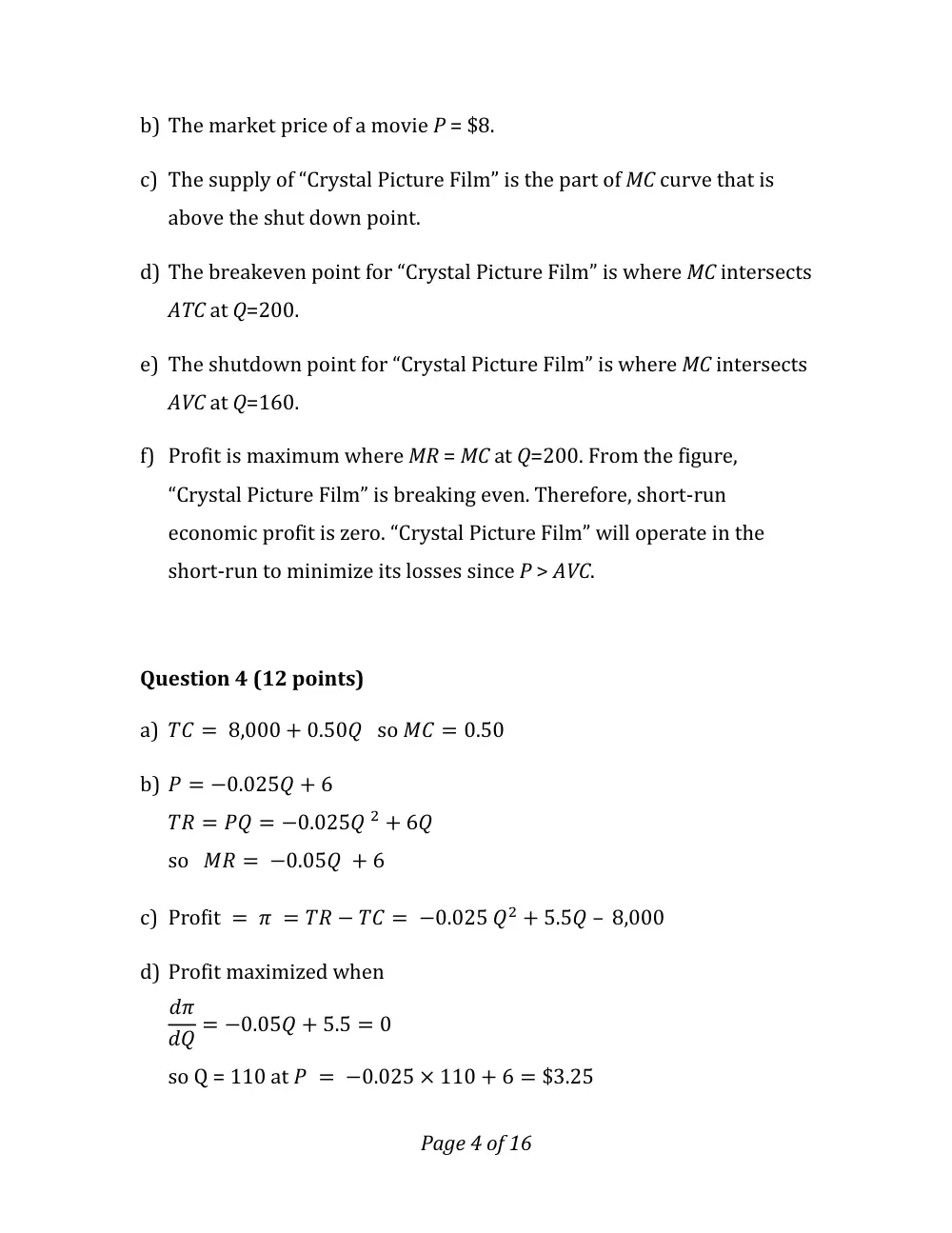
b) The market price of a movie P = $8.
c) The supply of “Crystal Picture Film” is the part of MC curve that is
above the shut down point.
d) The breakeven point for “Crystal Picture Film” is where MC intersects
ATC at Q=200.
e) The shutdown point for “Crystal Picture Film” is where MC intersects
AVC at Q=160.
f) Profit is maximum where MR = MC at Q=200. From the figure,
“Crystal Picture Film” is breaking even. Therefore, short-run
economic profit is zero. “Crystal Picture Film” will operate in the
short-run to minimize its losses since P > AVC.
Question 4 (12 points)
a) so
b)
so
c)
d) Profit maximized when
so Q = 110 at
Page 5 of 16
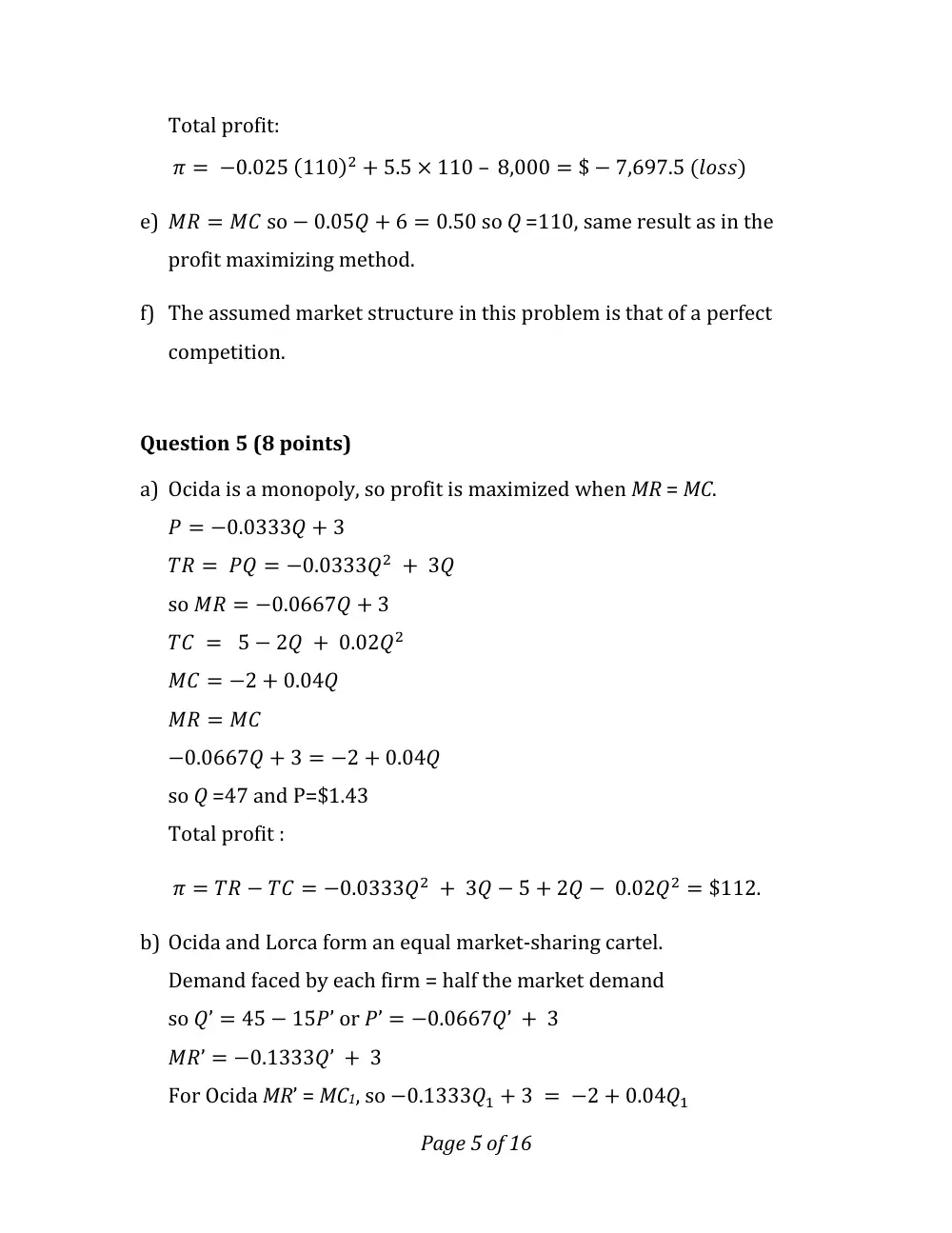
Total profit:
e) so Q =110, same result as in the
profit maximizing method.
f) The assumed market structure in this problem is that of a perfect
competition.
Question 5 (8 points)
a) Ocida is a monopoly, so profit is maximized when MR = MC.
so
so Q =47 and P=$1.43
Total profit :
.
b) Ocida and Lorca form an equal market-sharing cartel.
Demand faced by each firm = half the market demand
so or
For Ocida MR’ = MC1, so
Page 6 of 16
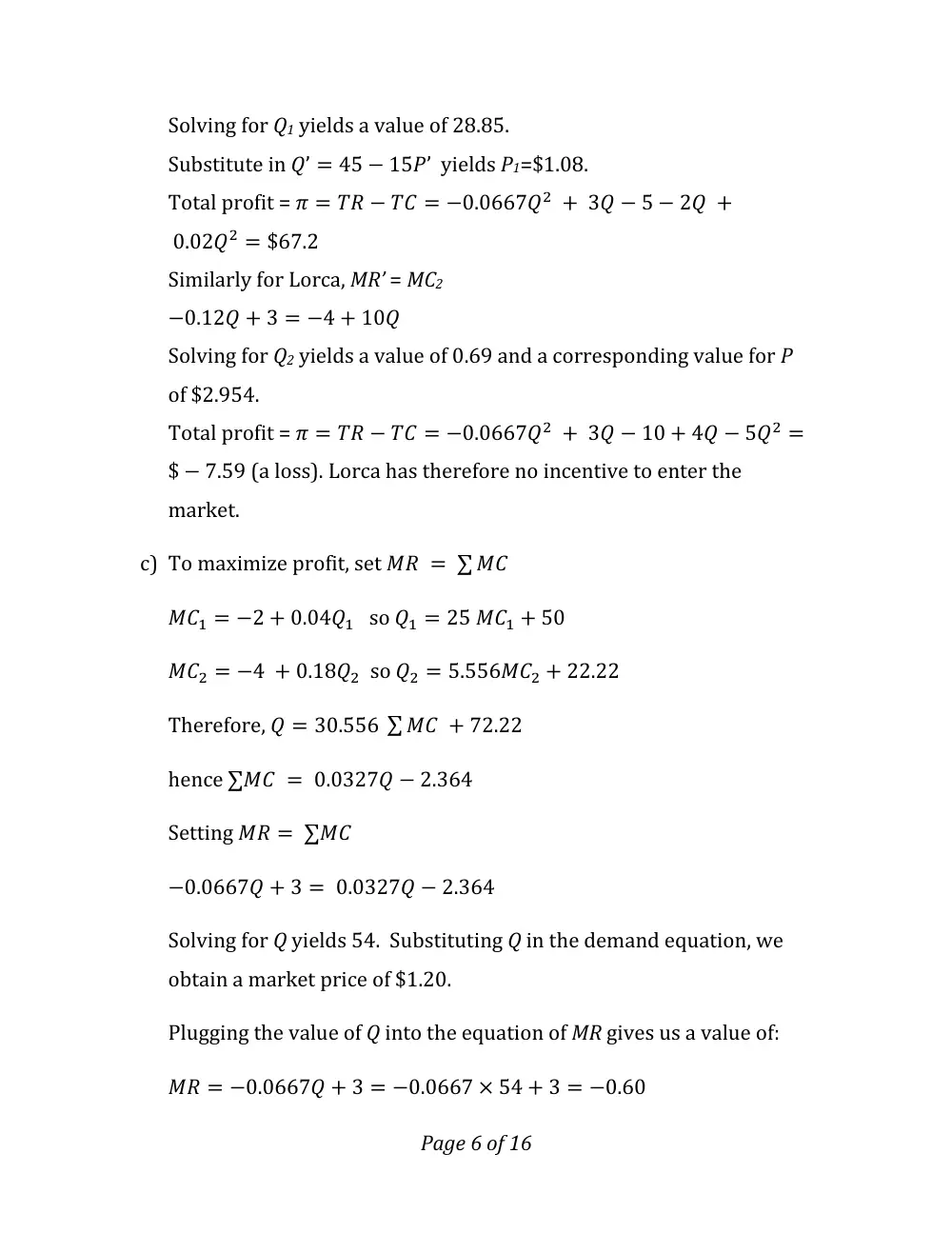
Solving for Q1 yields a value of 28.85.
Substitute in yields P1=$1.08.
Total profit =
.2
Similarly for Lorca, MR’ = MC2
Solving for Q2 yields a value of 0.69 and a corresponding value for P
of $2.954.
Total profit =
(a loss). Lorca has therefore no incentive to enter the
market.
c) To maximize profit, set
so
so
Therefore,
hence
Setting
Solving for Q yields 54. Substituting Q in the demand equation, we
obtain a market price of $1.20.
Plugging the value of Q into the equation of MR gives us a value of:
Page 7 of 16
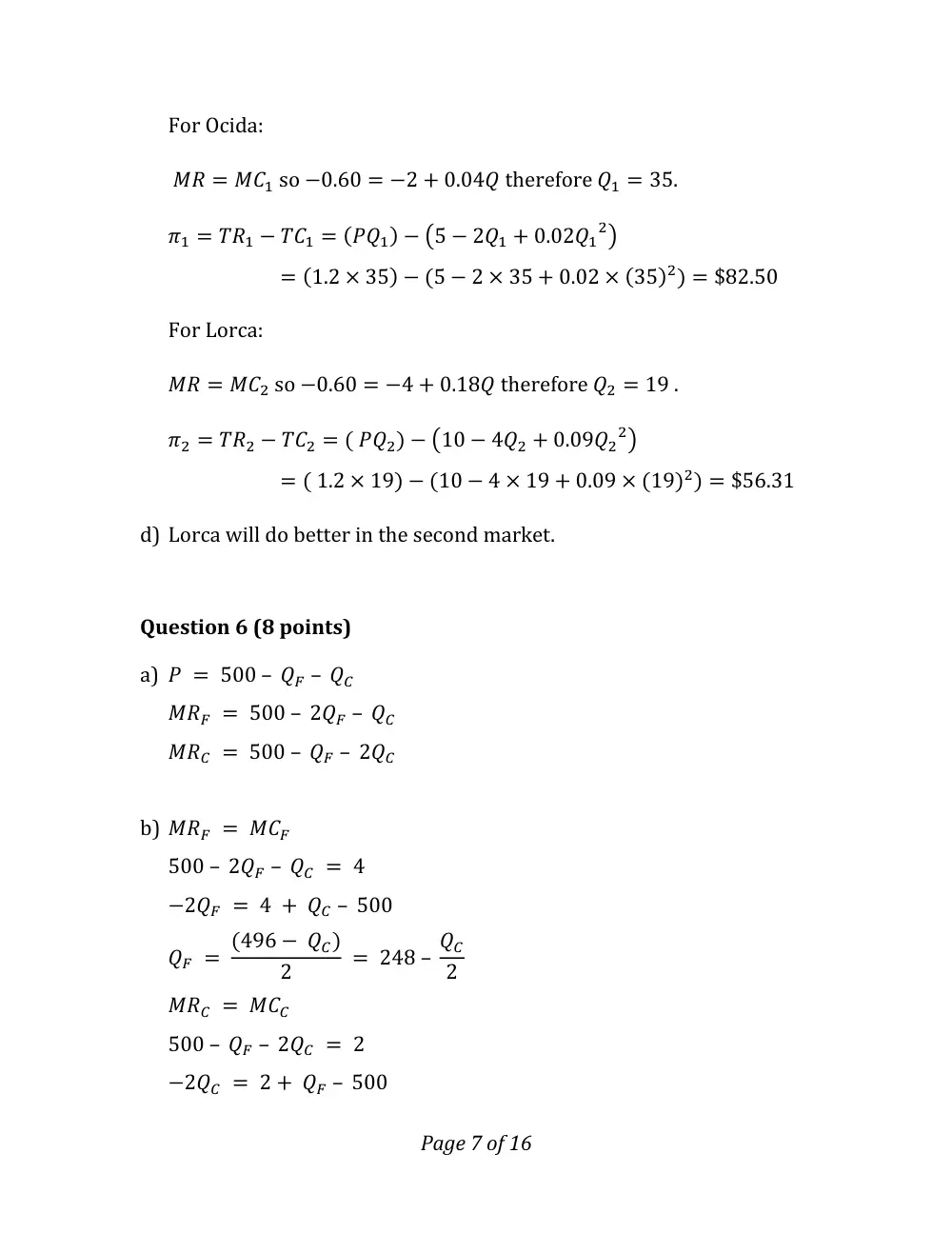
For Ocida:
so therefore .
For Lorca:
so therefore .
d) Lorca will do better in the second market.
Question 6 (8 points)
a)
b)
Page 8 of 16
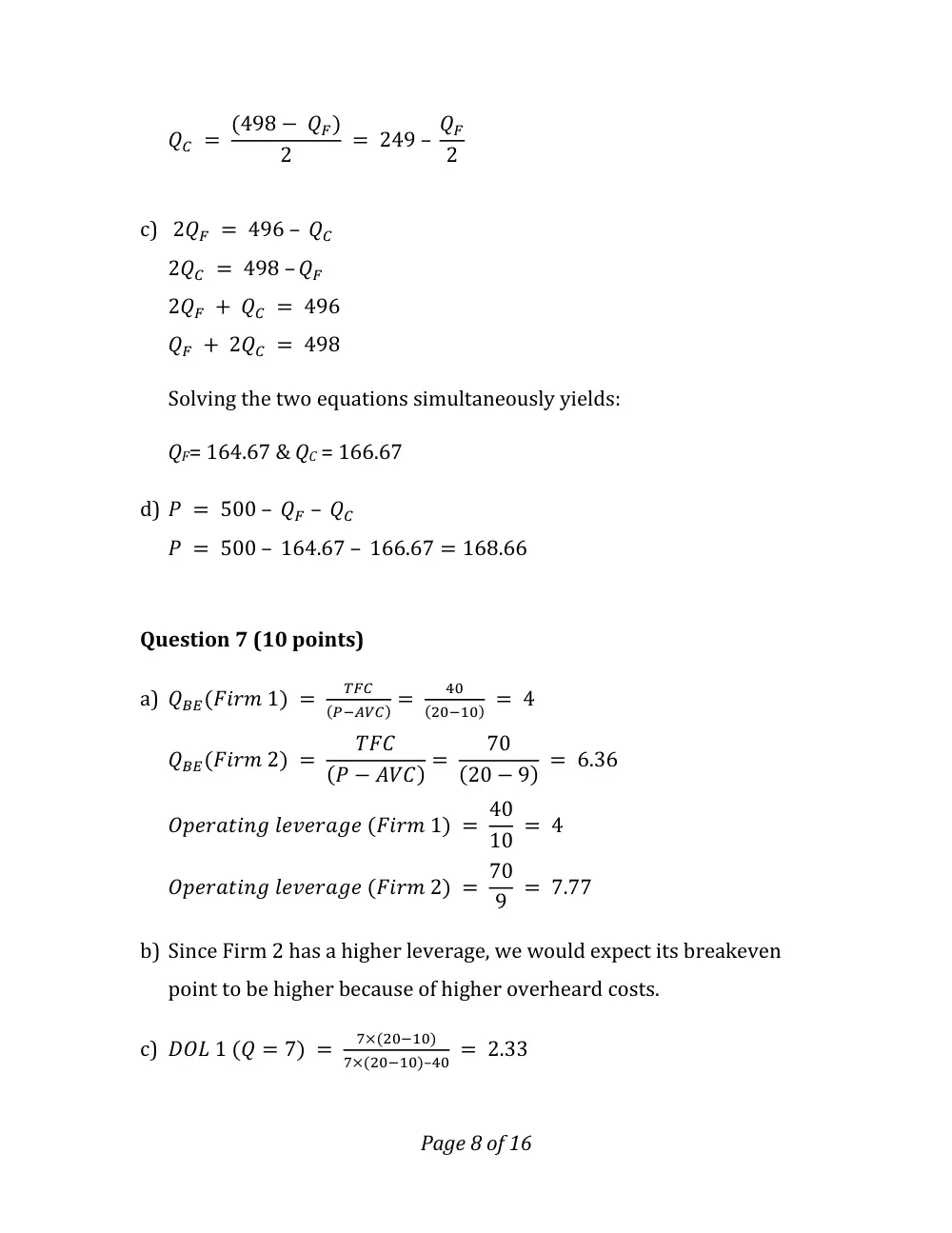
c)
Solving the two equations simultaneously yields:
QF= 164.67 & QC = 166.67
d)
Question 7 (10 points)
a)
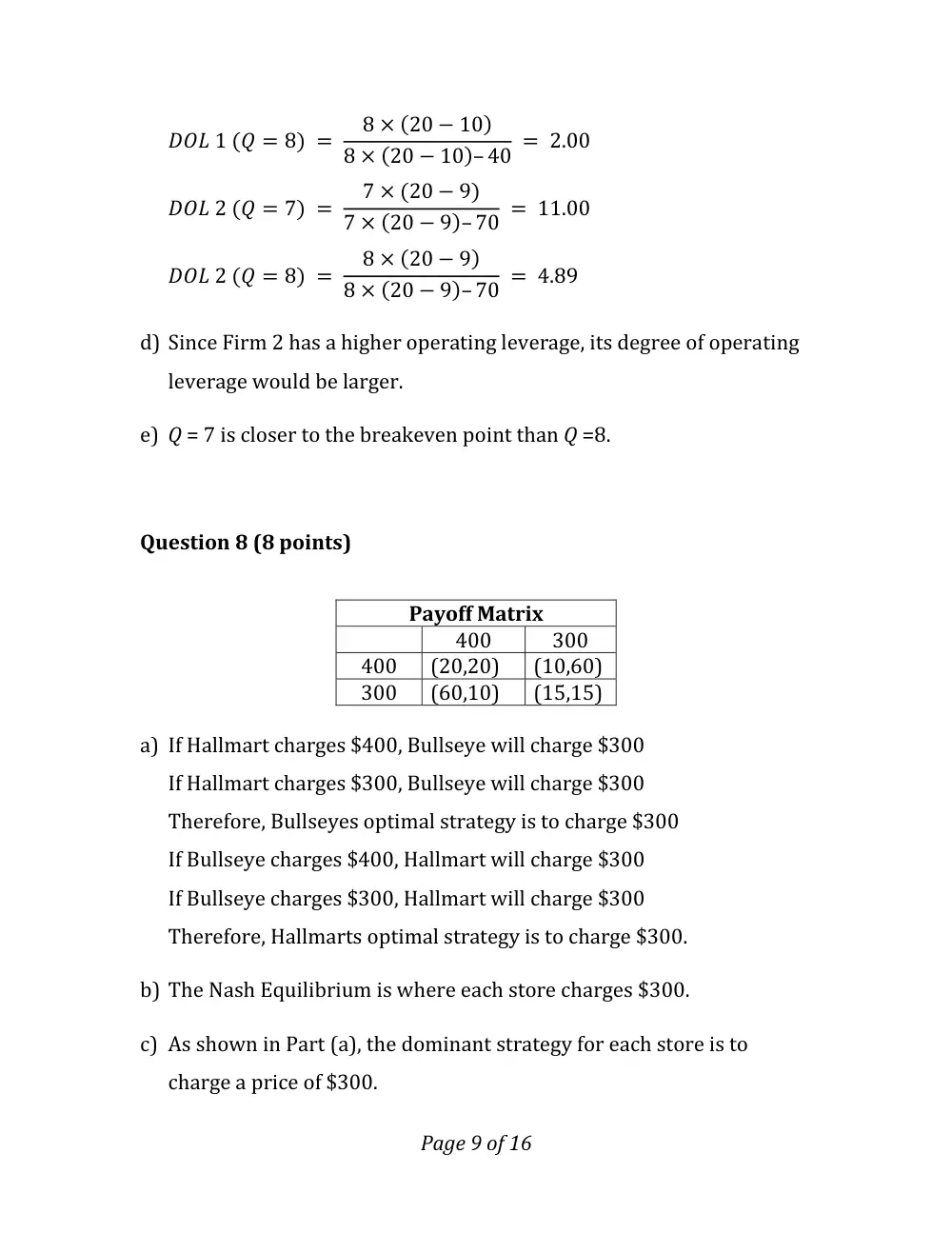
b) Since Firm 2 has a higher leverage, we would expect its breakeven
point to be higher because of higher overheard costs.
c)
Page 9 of 16
d) Since Firm 2 has a higher operating leverage, its degree of operating
leverage would be larger.
e) Q = 7 is closer to the breakeven point than Q =8.
Question 8 (8 points)
Payoff Matrix
400
300
400
(20,20)
(10,60)
300
(60,10)
(15,15)
a) If Hallmart charges $400, Bullseye will charge $300
If Hallmart charges $300, Bullseye will charge $300
Therefore, Bullseyes optimal strategy is to charge $300
If Bullseye charges $400, Hallmart will charge $300
If Bullseye charges $300, Hallmart will charge $300
Therefore, Hallmarts optimal strategy is to charge $300.
b) The Nash Equilibrium is where each store charges $300.
c) As shown in Part (a), the dominant strategy for each store is to
charge a price of $300.
Page 10 of 16
d) Although each store will follow its dominant strategy and set a price
of $300, they would each do better by cooperating and charging a
price of $400. One of the problems that might arise is that one of the
stores might cheat and lower its price to gain a higher payoff.
Question 9 (16 points)
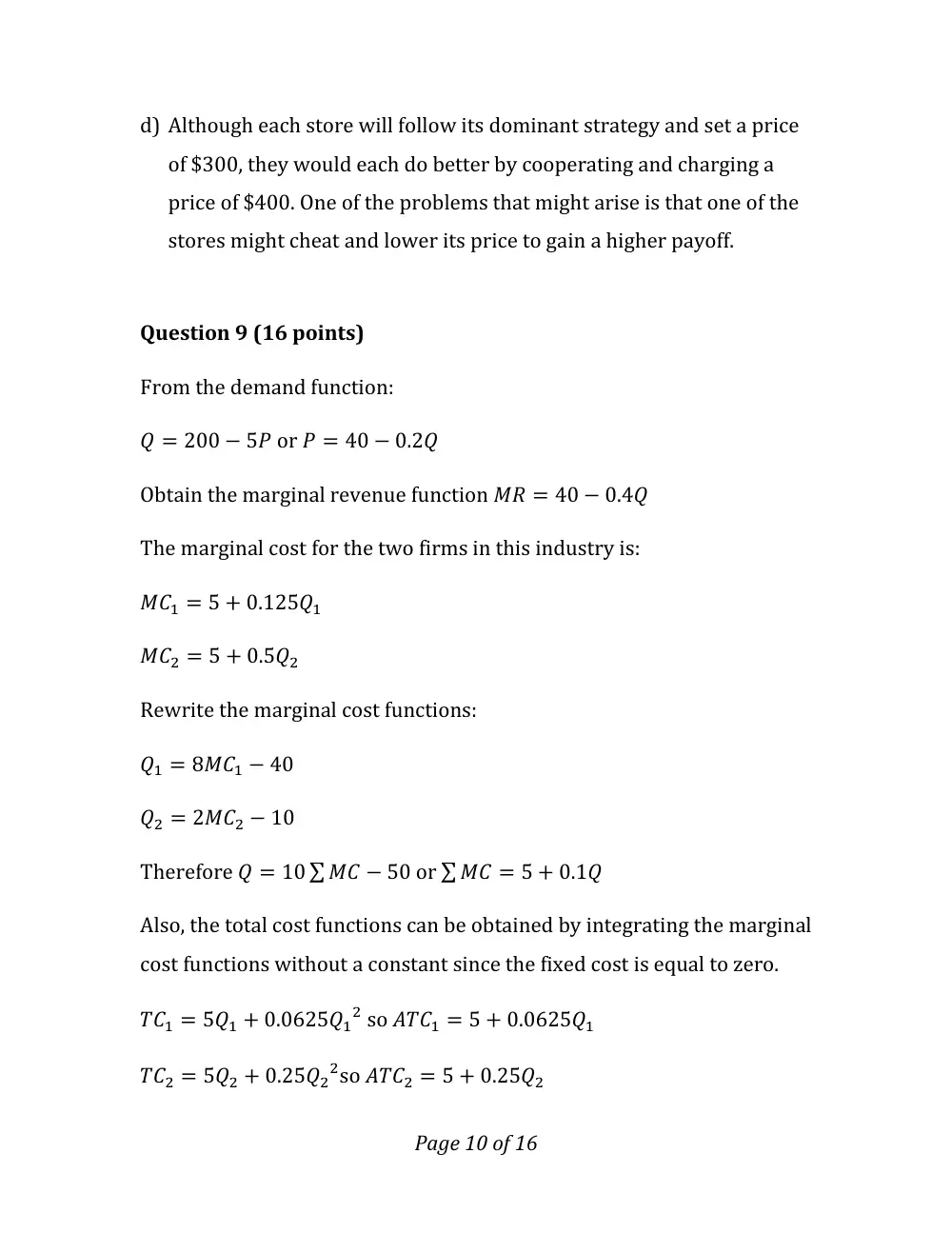
From the demand function:
or
Obtain the marginal revenue function
The marginal cost for the two firms in this industry is:
Rewrite the marginal cost functions:
Therefore or
Also, the total cost functions can be obtained by integrating the marginal
cost functions without a constant since the fixed cost is equal to zero.
so
so
Page 11 of 16
a) As can be seen from the figure below, the optimal production for the
cartel is 70 units. This is obtained at the intersection of the marginal
revenue (MR) and the marginal cost (MC) curves.
Solving the equation yields Q =70 (as can be seen in the graph).
At Q = 70,
And
Setting MC1 = MR = 12,
Solving this equation yields Q1 = 56.
Similarly, setting MC2 = MR = 12,
0
5
10
15
20
25
30
35
40
45
0
20
40
60
80
100
120
140
160
180
200
D
MR
SMC
Page 12 of 16
Solving this equation yields Q2 = 14. ( )
b)
Per unit profits for firm 1 =
Total profits for firm 1 =
0
2
4
6
8
10
12
14
16
18
20
0
10
20
30
40
50
60
70
80
90
100
MC1
ATC1
MR
0
2
4
6
8
10
12
14
16
0
1
2
3
4
5
6
7
8
9 10 11 12 13 14 15 16 17 18 19 20
MC2
ATC2
MR
Page 13 of 16
Per unit profits for firm 2 =
Total profits for firm 2 =
c) The market demand function is . The half-share market
faced by each duopolist is then or .
.
Setting
And
Setting
And
Total output of the industry = .
d) Profit for firm 1 =
Page 14 of 16
Profit for firm 2 =
Question 10 (12 points)
a)
so
so
Horizontal summation of and gives:
Page 15 of 16
b) Setting
Solving the equation yields a value of QL= 40. Plugging QL = 40 into
the leader’s demand function gives a price of
From the equation for MCF, when the price is $8.50, the followers will
produce
At price P = $8.50, the total demand is
0
2
4
6
8
10
12
14
16
18
20
22
24
0
10
20
30
40
50
60
70
80
90
100
110
120
130
140
150
160
DT
SMCF
MCL
DL
MRT
MRL
MCT
Page 16 of 16
c) Setting MRT = MCT, we get:
Solving the equation yields QT = 54. Plugging this value into the
market demand function DT gives us a market price of
And a marginal revenue of
Setting MCL = MRT, we can solve for QL:
Solving the equation yields a value of QL = 36.8, say 37.
Setting MCF = MRT, we can solve for QL:
Solving the equation yields a value of QF = 17.33, say 17. Verify that
QL + QF = QT.