
CHEM 101 Final, Fall 1997
American University of Beirut · General Chemistry I · 4 pages

More CHEM 101 files
- Final · Fall 2013Final examView
- Final · Spring 1999Final examView
- Final · Fall 1998Final examView
- Exam Quiz 3 Spring 2019 · Summer 2020ExamView
- Syllabus · Summer 2018LabView
- Syllabus · Summer 2018LabView
- Questions Chapter 7 + Answers · Summer 2014Chapter · with solutionView
- Questions Chapter 5 + Answers · Summer 2014Chapter · with solutionView
Show the text of this final exam
Time. 2 hours Chemistry 101 February 5, 1998
Final Examination(#l) U. Kortz.
H. Sleiman
INSTRUCTIONS:
|. This exam contains 9 pages
2. No scratch. loose paper, pencil, red pen
3, Calculators allowed
4. Multiple choice problems: only one answer is correct
Constants:
R=8314JK' mol | = 0.0821 L atm K" mol!
h=6.63x10 "Is
c=3x10%ms!
Ry = 109678 en’! = 2.18 x 10⁸]
m,=9.11 x l0e! kg
e =160x 10°C
First Bohr radius for H: r= Wh?/Z4rne mee” =ayg = 0.529 A
Energy of a Bohr orbit: E = - 2n°me'Z7/W'n?
| atm = 1.01325 x 10° Pa = 760 mmHg
Which answer does not belong? The atomic number of an element
a. corresponds to the number of protons in the element
b. corresponds to the number of electrons in the element
c. identifies the order in which the element was discovered
d. is always an integer
For the Na ion,
the nuniber of protons equals the number of electrons
the atomic number is the number of electrons
the number of protons is greater than the number of electrons
the number of electrons is greater than the number of protons
The compound most likely to be ionic is
a. SO,
b. PC
c. Nal
d. N204
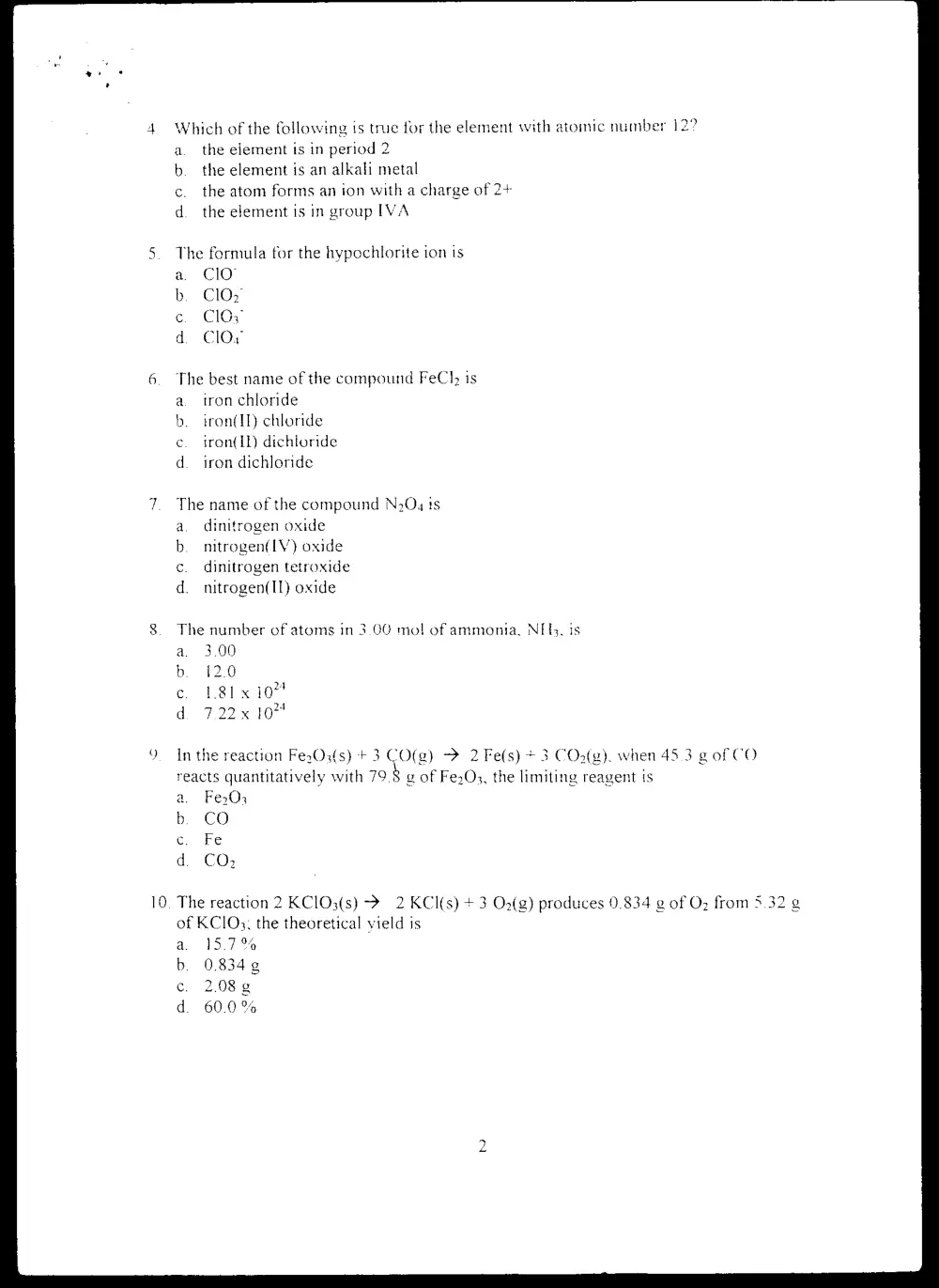
Which of the following is true for the element with atomic number 12?
a. the element is in period 2
b. the element is an alkali metal
c. the atom forms an ion with a charge of 2+
d. the element is in group [VA
The formula for the hypochlorite ion is
a. ClO”
b. ClOy
c. ClO;
d. ClOy
The best name of the compound FeCl, is
a. iron chloride
b. iron(II) chloride
ec. iron{LL) dichloride
d. iron dichloride
The name of the compound N04 1s
a. dinitrogen oxide
b. nitrogen(1V) oxide
c. dinitrogen tetroxide
d. nitrogen(IL) oxide
The number of atoms in 3.00 mol of ammonia. NIf, is
a. 3.00
b. 12.0
1.81 x 107"
722x107"
In the reaction Fe.O3(s) + 3 CO(g) > 2 Fe(s) + 3 COo(g). when 45.3 g of CO
reacts quantitatively with 79 8 g of Fe.O3, the limiting reagent is
a. Fe,0;
b. CO
c. Fe
d. CO,
The reaction 2 KCIO3(s) > 2 KCl(s) + 3 Oo(g) produces 0.834 g@ of O2 from 5.32 g
of KCIOs; the theoretical vield is
a. 15.7%
0.834 g
2.08 g
60.0 %
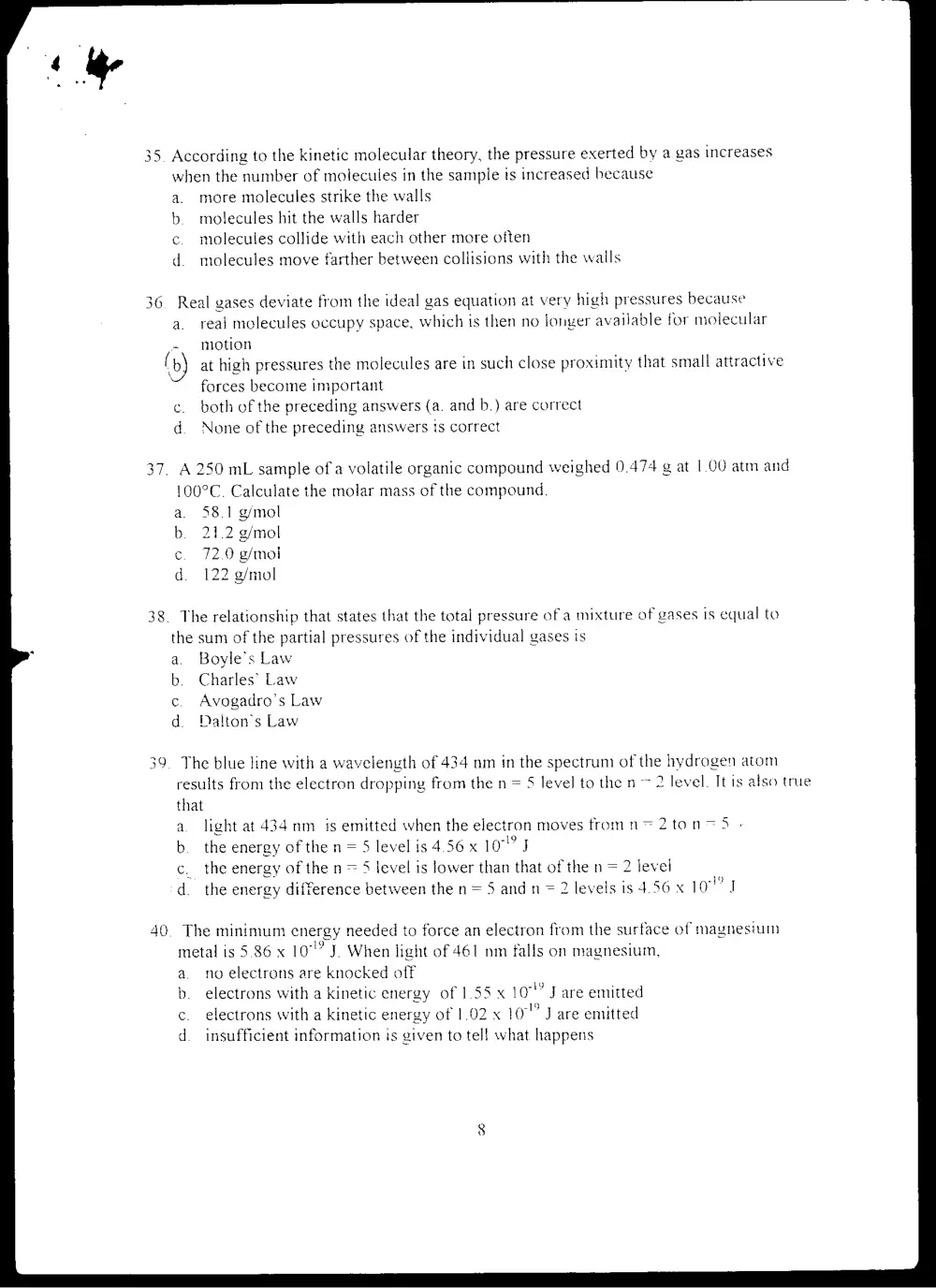
35. According to the kinetic molecular theory, the pressure exerted by a gas increases
when the number of molecules in the sample is increased because
a. more molecules strike the walls
b. molecules hit the walls harder
c. molecules collide with each other more often
d. molecules move farther between collisions with the walls
36. Real gases deviate from the ideal gas equation at very high pressures because
real molecules occupy space, which is then no longer available for molecular
motion
at high pressures the molecules are in such close proximity that small attractive
forces become important
both of the preceding answers (a. and b,) are correct
None of the preceding answers is correct
250 mL sample of a volatile organic compound weighed 0.474 g at 1.00 atm and
100°C. Calculate the molar mass of the compound.
a. 58.1 g/mol
b. 21.2 g/mol
c. 72.0 g/mol
d. 122 g/mol
_ The relationship that states that the total pressure of a mixture of gases is equal to
the sum of the partial pressures of the individual gases is
a. Boyle's Law
b. Charles’ Law
c. Avogadro's Law
d. Dalton’s Law
The blue line with a wavelength of 434 nm in the spectrum of the hydrogen atom
results from the electron dropping from the n = $ level to the n ~ 2 level. It is also true
that
a. light at 434 nm is emitted when the electron moves from n= 2ton=5 -
b. the energy of the n = 5 level 1s 4.56 x 19? J
c. the energy of the n = 5 level is lower than that of the n = 2 level
d. the energy difference between the n= 5 and n = 2 levels is 4.56 x lol J
The minimum energy needed to force an electron from the surface of magnesium
metal is 5.86 x 10°" J. When light of 461 nm falls on magnesium,
a. no electrons are knocked off
b. electrons with a kinetic energy of 1.55 x 10°” J are emitted
c. electrons with a kinetic energy of 1.02 x 10? J are emitted
d. insufficient information is given to tell what happens
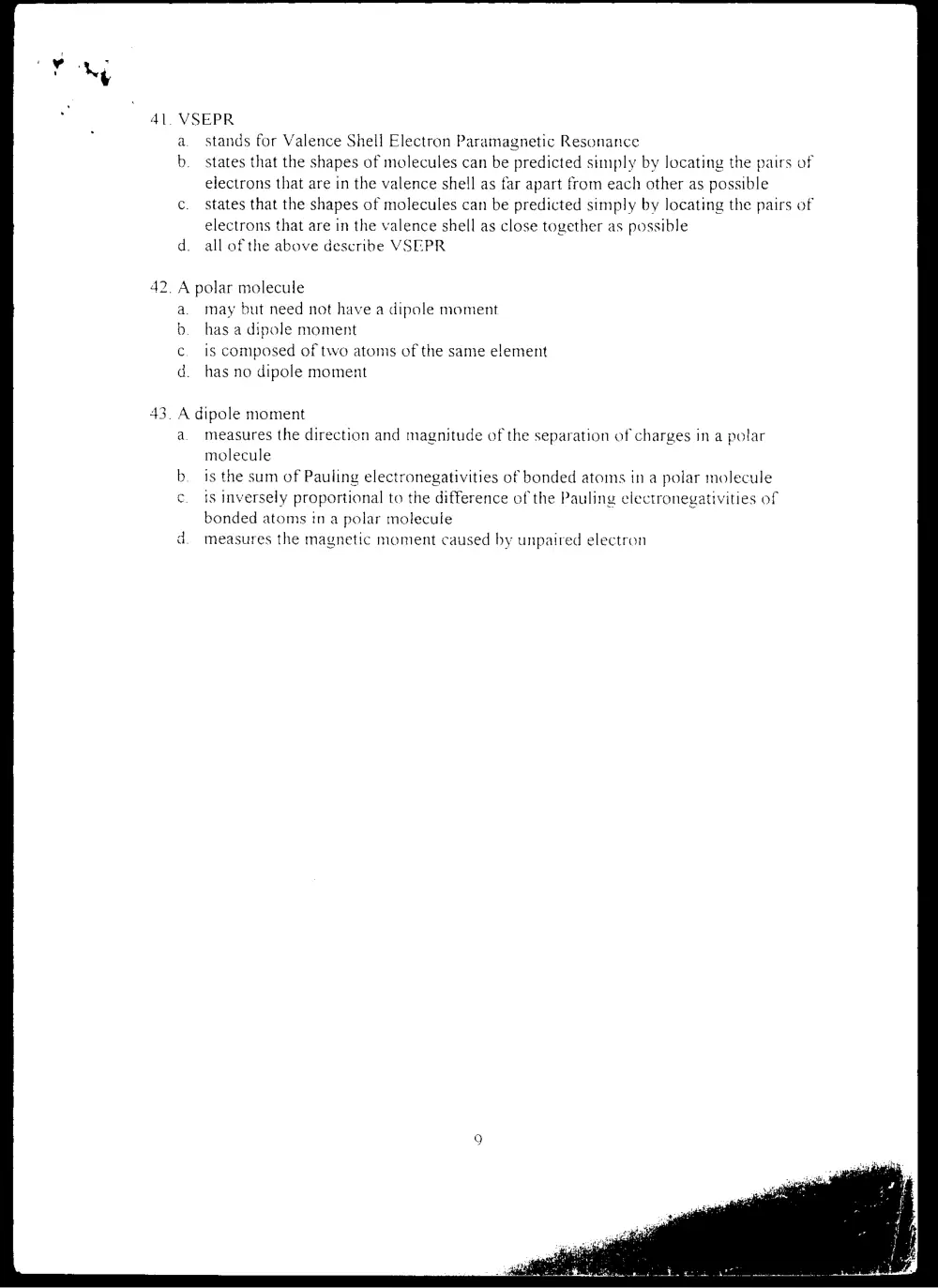
VSEPR
stands for Valence Shell Electron Paramagnetic Resonance
states that the shapes of molecules can be predicted simply by locating the pairs of
electrons that are in the valence shell as far apart from each other as possible
states that the shapes of molecules can be predicted simply by locating the pairs of
electrons that are in the valence shell as close together as possible
all of the above describe VSEPR
.A polar molecule
a. may but need not have a dipole moment
has a dipole moment
is composed of two atoms of the same element
has no dipole moment
. Adipole moment
a. measures the direction and magnitude of the separation of charges in a polar
molecule
is the sum of Pauling electronegativities of bonded atoms in a polar molecule
is inversely proportional to the difference of the Pauling clectronegativities of
bonded atoms in a polar molecule
measures the magnetic moment caused by unpaired electron