
CHEM 101 Final, Fall 2013
American University of Beirut · General Chemistry I · 3 pages

More CHEM 101 files
- Final · Spring 1999Final examView
- Final · Fall 1998Final examView
- Final · Fall 1997Final examView
- Exam Quiz 3 Spring 2019 · Summer 2020ExamView
- Syllabus · Summer 2018LabView
- Syllabus · Summer 2018LabView
- Questions Chapter 7 + Answers · Summer 2014Chapter · with solutionView
- Questions Chapter 5 + Answers · Summer 2014Chapter · with solutionView
Show the text of this final exam
Chem 101
Recitation 9 Chapter 7
Chang 9
th
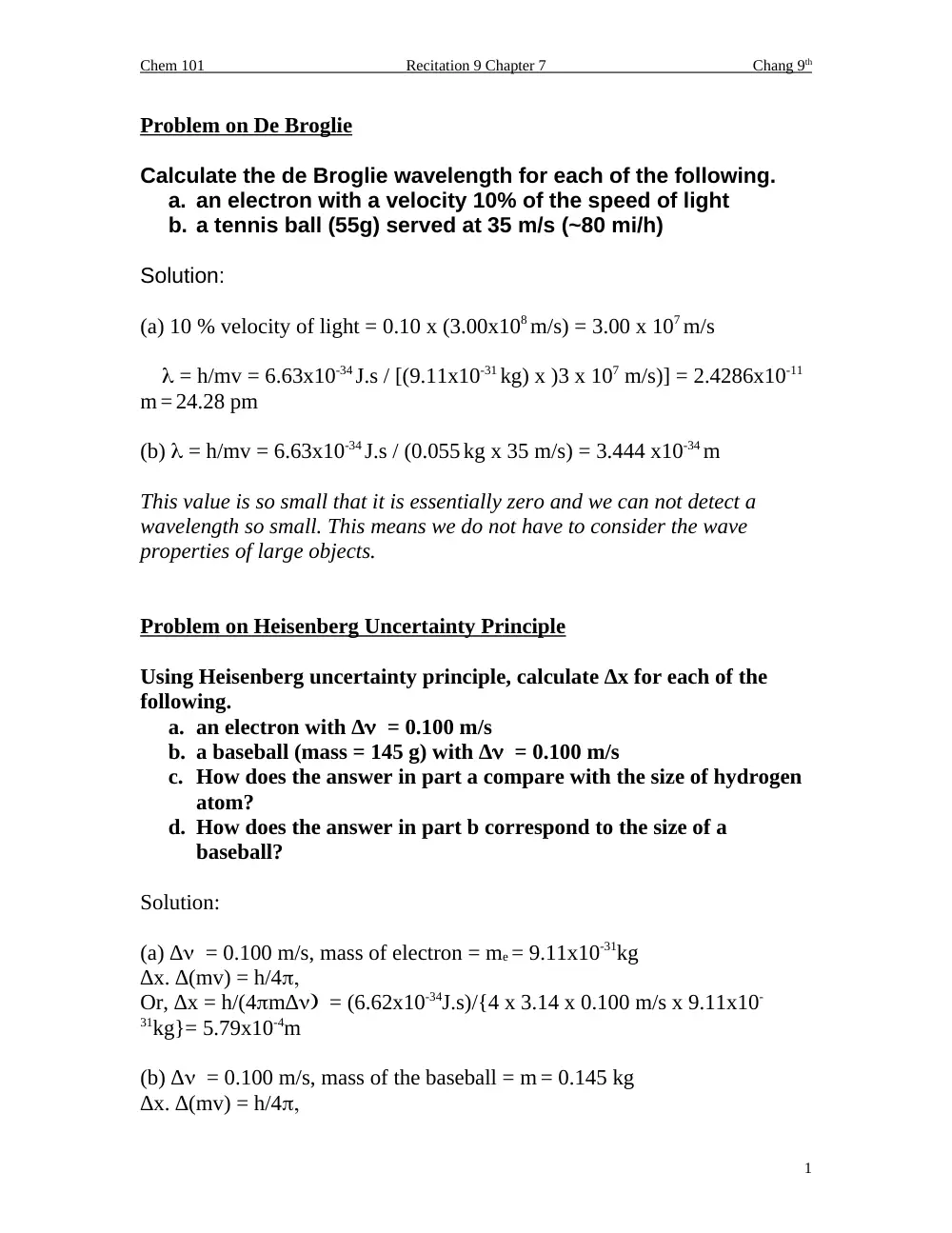
Problem on De Broglie
Calculate the de Broglie wavelength for each of the following.
a. an electron with a velocity 10% of the speed of light
b. a tennis ball (55g) served at 35 m/s (~80 mi/h)
Solution:
(a) 10 % velocity of light = 0.10 x (3.00x108 m/s) = 3.00 x 10⁷ m/s
= h/mv = 6.63x10⁻³⁴ J.s / [(9.11x10⁻³¹ kg) x )3 x 10⁷ m/s)] = 2.4286x10⁻¹¹
m = 24.28 pm
(b) = h/mv = 6.63x10⁻³⁴ J.s / (0.055 kg x 35 m/s) = 3.444 x10⁻³⁴ m
This value is so small that it is essentially zero and we can not detect a
wavelength so small. This means we do not have to consider the wave
properties of large objects.
Problem on Heisenberg Uncertainty Principle
Using Heisenberg uncertainty principle, calculate ∆x for each of the
following.
a. an electron with ∆= 0.100 m/s
b. a baseball (mass = 145 g) with ∆= 0.100 m/s
c. How does the answer in part a compare with the size of hydrogen
atom?
d. How does the answer in part b correspond to the size of a
baseball?
Solution:
(a) ∆= 0.100 m/s, mass of electron = me = 9.11x10⁻³¹kg
∆x. ∆(mv) = h/4
Or, ∆x = h/(4m∆= (6.62x10⁻³⁴J.s)/{4 x 3.14 x 0.100 m/s x 9.11x10-
31kg}= 5.79x10⁻⁴m
(b) ∆= 0.100 m/s, mass of the baseball = m = 0.145 kg
∆x. ∆(mv) = h/4
1
Chem 101
Recitation 9 Chapter 7
Chang 9
th
Or, ∆x = h/(4m∆= (6.62x10⁻³⁴J.s)/{4 x 3.14 x 0.100 m/s x 0.145 kg}=
3.64x10⁻³³m
(c) The diameter of H-atom is roughly 1.0x10⁻⁸
cm. The uncertainty in
position is much longer than the size of the atom.
(d) The uncertainty is insignificant to the size pf the baseball.
7.52
2
Chem 101
Recitation 9 Chapter 7
Chang 9
th
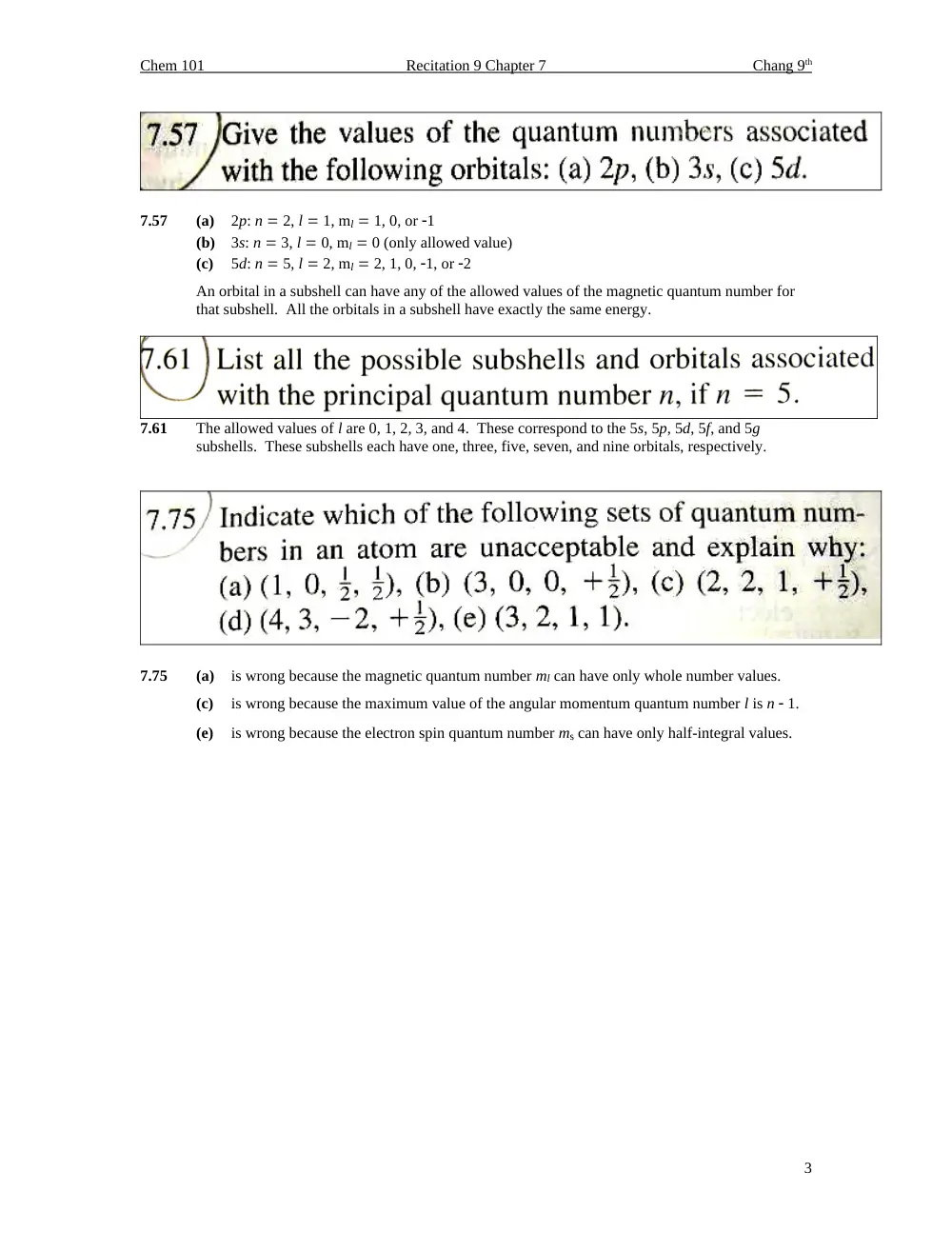
7.57
(a)
2p: n 2, l 1, ml 1, 0, or 1
(b)
3s: n 3, l 0, ml 0 (only allowed value)
(c)
5d: n 5, l 2, ml 2, 1, 0, 1, or 2
An orbital in a subshell can have any of the allowed values of the magnetic quantum number for
that subshell. All the orbitals in a subshell have exactly the same energy.
7.61
The allowed values of l are 0, 1, 2, 3, and 4. These correspond to the 5s, 5p, 5d, 5f, and 5g
subshells. These subshells each have one, three, five, seven, and nine orbitals, respectively.
7.75
(a)
is wrong because the magnetic quantum number ml can have only whole number values.
(c)
is wrong because the maximum value of the angular momentum quantum number l is n 1.
(e)
is wrong because the electron spin quantum number ms can have only half-integral values.
3