
CHEM 101 Final, Fall 1998
American University of Beirut · General Chemistry I · 11 pages




Showing the first 10 of 11 pages. Download the PDF to see all of it.
More CHEM 101 files
- Final · Fall 2013Final examView
- Final · Spring 1999Final examView
- Final · Fall 1997Final examView
- Exam Quiz 3 Spring 2019 · Summer 2020ExamView
- Syllabus · Summer 2018LabView
- Syllabus · Summer 2018LabView
- Questions Chapter 7 + Answers · Summer 2014Chapter · with solutionView
- Questions Chapter 5 + Answers · Summer 2014Chapter · with solutionView
Show the text of this final exam
Time: 1060 min. Chemistry 161 February 2, 1999
Final Examination
Name: Student Number:
Signature:
Circle one: Sects. 1, 2,3, 7 Prof. Kortz
Sects. 4, 5, 6,8 Prof. Sultan
instructions:
- There are 50 multiple-choice type questions and only ONE of the proposed
answers is correct. Circle the letter corresponding to the right answer. No penalty
for wrong answers.
Tables of atomic numbers and molar masses of the elements provided
Pencil and red pen will not be graded
Do not detach any pages
Constants:
Gas constant. R = 8.314 J K™ mol“! = 0.0821 L atm K"! mol’
Planck’s constant, h = 6.626 x 10°" Js
Speed of light, c = 2.998 x 10° ms"
Rydberg constant, Ry = 109678 em! = 2.18 x 10⁷° J
Electron mass, Me = 9.11 x 10⁷! kg
Electron charge,e = 1.60 x 10% C
| atm = 760 mmHg
Avogadro's number, Na = 6.022 x 1073 molec mol!
Activity series:
Li
The Lewis structure for the chlorate ion (C1O;) should show __ single
bond(s). double bond(s) and lone pairs.
or Wweiv
>
Avogadro's Law relates the number of molecules of a gas to its
a. pressure
b. temperature
c. molar mass
d. volume
The electron dot formula for O2 shows:
a single covaleut buud
a double covalent bond
an ionic bond
a total of 16 electron dots
a total of 32 electron dots
Which of the following covalent bonds is the least polar?
a. C-Cl
C-C
C-H
O-C
N-C
The interaction between Ba and Cl in BaCl; is through a(n) bond.
a. single, nonpolar covalent
ionic
double, polar covalent
single, polar covalent
double, nonpolar covalent
Which answer does not belong? The atomic number of an element
a. corresponds to the number of protons in the element
identifies the order in which the element was discovered
is always an integer
corresponds to the number of electrons in the element
plus the number of neutrons gives the mass number of the element
The peroxide ion (O27) has
a. adouble bond
a triple bond
six lone pairs
two resonance structures
a polar covalent bond
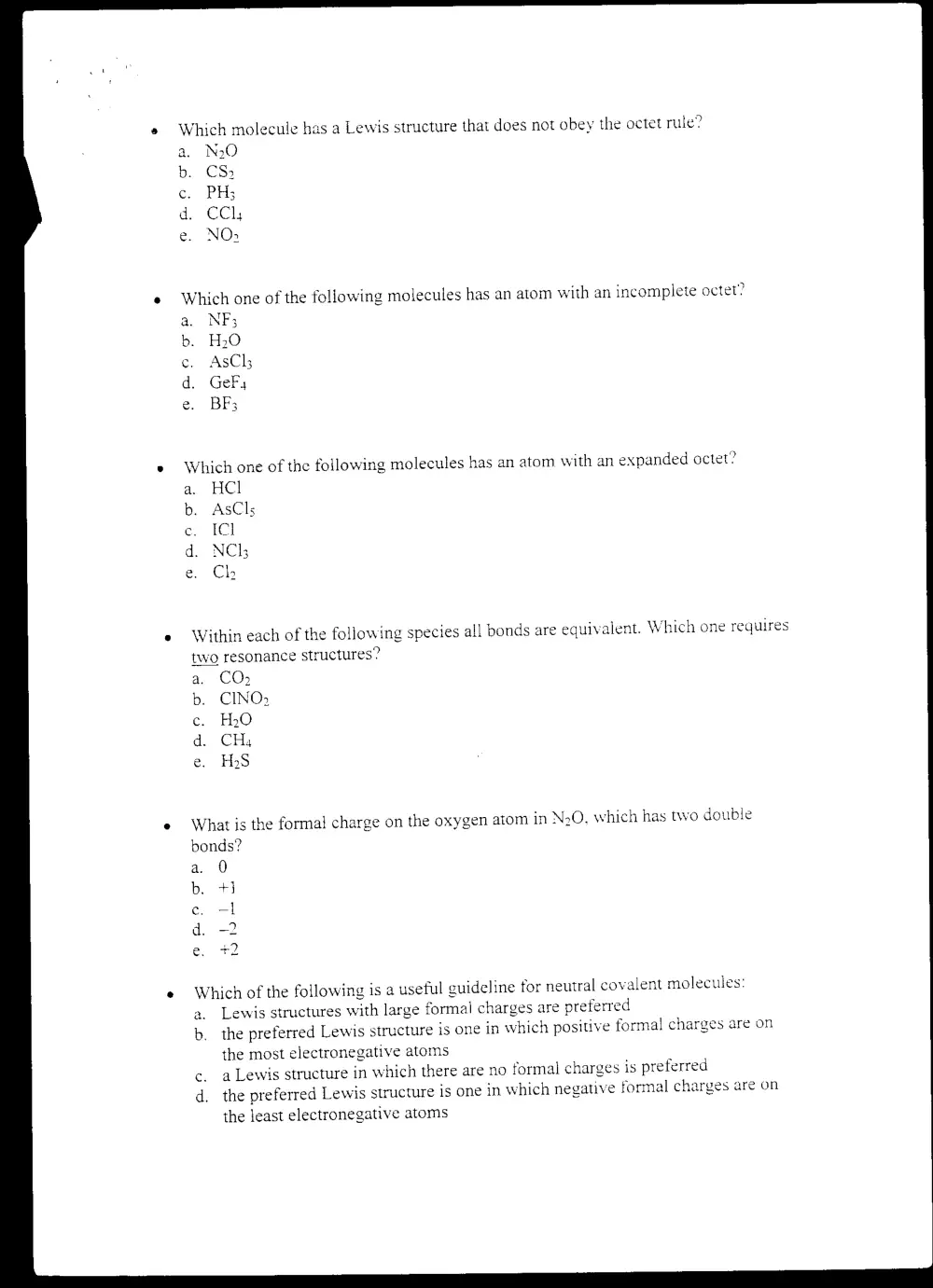
Which molecule has a Lewis structure that does not obey the octet rule?
N20
C82
PH;
CCl
NO:
Which one of the following molecules has an atom with an incomplete octet?
a. NF3
H20
AsCly
GeF4
BF;
Which one of the following molecules has an atom with an expanded octet?
HCl
AsCls
IC]
NC]
Ch
Within each of the following species all bonds are equivalent. Which one requires
two resonance structures?
CO
CINO2
H20
CHa
HS
What is the formal charge on the oxygen atom in N20. which has two double
bonds?
0
+}
-1
Which of the following is a useful guideline for neutral covalent molecules:
a. Lewis structures with large formal charges are preferred
b. the preferred Lewis structure is one in which positive formal charges are on
the most electronegative atoms
4 Lewis structure in which there are no formal charges is preferred
the preferred Lewis structure is one in which negative formal charges are on
the least electronegative atoms
¢ The bond angle in the molecule Cl20 is expected to be closest to
a. 90°
b. 109 °
c, 120°
d. 145°
e. 180°
e Which of the following molecules is nonpolar?
b. OF2
c. CH3Cl
d. H2,0
e. BeCl,
e “No two electrons in an atom can have the same four quantum numbers” is a
statement called
a. the Pauli exclusion principle
b. Bohr’s equation
c. Hund’s rule
d. DeBroglie’s relation
e. Dalton’s atomic theory
¢ Calculate the frequency of the light absorbed by a hydrogen atom during a transition
of its electron from the n=3 to the n=6 principal energy level.
a. 1.64 10's"
b. 9.13 x 10% s!
¢. 3.65 x 10's!
d. 1.82 x 10°77 s"
e. 2.70 x 10's"
e A5.0 liter tank was filled with 46 liters of O2 (g) and 12 liters of He (g), both
measured at 25 °C and 1.0 atrn pressure. Calculate the total pressure in the tank at
25 °C,
2.39 atm
9.39 am
11.6 atm
22.4 atm
23.4 atm
When methane (CH,) 1s burned in oxygen, water vapor and carbon dioxide ure
formed. If the final pressure of the gaseous products is 6 mm Hg, what is the
partial pressure of water vapor?
a. 1mm Hg
2mm Hg
3 mm Hg
4mm Hg
6mm Hg
The correct formula for stannous iodide is
a. SblI,
Srl,
Snh
Sbl,
Snly
The correct name for MgCl is
a. manganese(II) chloride
b. magnesium dichloride
c. magnesium(IJ) chloride
d. magnesium chloride
e. manganous chloride
Real gases do not always obey the ideal gas law because real gas molecules
‘a are attracted to one another
are in constant motion
are widely separated
have elastic collisions
have negligible intermolecular interactions
Beta (B) rays
are positively charged particles
are electrons
are high-energy rays with no charge
are equivalent to microwaves
are deflected by a positively charged plate
For the reaction COjg) ~ 3Hag) > CHa) + H2O,e) carried out at constant pressure
and temperature in a container sealed with a piston. which of the following would
remain constant?
a. mass of the sample
b. volume of the sample
€) total number of molecules in the sample
density of the sample
none of the above
Ions and atoms that are isoelectronic have the same
a. chemical properties
electron affinity
first ionization energy
electron configuration
atomic number
The ionization energy with the lowest value is
a. the first ionization energy of Rb
the second ionization energy of Rb
the first ionization energy of Ca
the second ionization energy of Ca
the third ionization energy of Ca
The effective nuclear charge is the
arrangement of electrons around the nucleus of an atom or ion
measure of an atom’s tendency to gain an electron
charge actually felt by the electrons
amount of energy needed to remove the most loosely bound electron from a
mole of gaseous atoms
With respect to the size of the species, which of the following relationships is
correct?
a. K<K™
c)< cr
se <cr
Cr* <cr*
O>N
Which of the following molecules do not follow the octet rule?
Q)HS (2) BC) (3) PH; (4) SE,
aL,
¢ What is the coefficient of H1O when the following equation is properly balanced
with smallest set of whole numbers?
ALC; + HO +> __ AKOH); + CH;
eBeO sp
¢ Which of the following is a nonelectrolyte
a. NaOH
b. HNO;
*. CH3COOH (acetic acid)
d. KF
é. C2H¢0 (ethanol)
* According to the solubility rules, which one of the following is soluble in water?
a. HgCl,
.Na2S
¢ . AgCO;
Ag S
. BaSQ,
own
¢ The oxidation number of Clin ClOs is
a.-] ~
b. +1 2
c. +3
d. +S
er?
¢ Which of the following equations does not represent an oxidation-reduction
reaction?
a3 Al + 6HC] > 3H) - AICh
b.2 H20 > 2 Hp _ O2
c.2NaCi + Pb(NO3)2 > PbCl. + 2 NaNO;
d.2Nal+Bro > 2NaBr + L
e. None of these
¢ How many grams of Cl; can be prepared from the reaction of 15.0 g of MnO: and
30.0 g of HCl according to the following equation?
MnO, + 4HCl - MnCl, + Cl; + 2H20
¢ What is the theoretical yield of vanadium that can be produced by the reaction of
40.0 g of V20s with 40.0 g of calcium according to the following equation?
V20s (s) + 5Ca(l) > 2Vd) + 5 CaO ({s)
i)
OQ
~)
to
to
wg SPW
7a G2 gq a
gp
ui
lon
e One mole of iron
a. is heavier than one mole of lead (Pb)
b. is 77.0 g of iron
c. is 26.0 g of iron
d. weighs the same as one mole of lead
e, none of these
¢ Which of the following contains the greatest number of atoms?
a. 100 g of Pb
b. 2.0 moie of Ar
c. 0.1 mole of Fe
d. S g of He
e, 20 million O2 molecules
e How many atoms are in 6.0 g of NasN?
a. 3.6 x 10⁷ atoms
b. 4.6 x 10°? atoms
¢. 1.3 x 10⁷ atoms
d. 0.217 atoms
e. 0.072 atoms
e Which element has the following electron configuration?
[Kr]5s4d!°5p°
a.Sn
b
c. Pb
d. Bi
e. Te
An atom ofiron has __ unpaired electrons and is
a. 0, diamagnetic
. 6, diamagnetic
. 3, paramagnetic
_ 5, paramagnetic
. 4, paramagnetic
¢ A molecule of the type ABsE2 has the geometry:
a. tetrahedral
b. distorted tetrahedron
c. octahedral
d. square planar
e@. square pyramidal
e The geometry of the CIF3 molecule is best described as:
a. distorted tetrahedron
b. trigonal planar
c. tetrahedral
d. T-shaped
e. trigonal pyramidal
According to the VSEPR theory, the geometry of the atoms in the carbonate ion.
CO37 is
a. square planar
b. tetrahedral
c. trigonal planar
d. pyramidal
e. octahedral
According to the VSEPR theory, which of the following species is linear?
. 2S
. HCN
. BF
. H2CO
. SO2
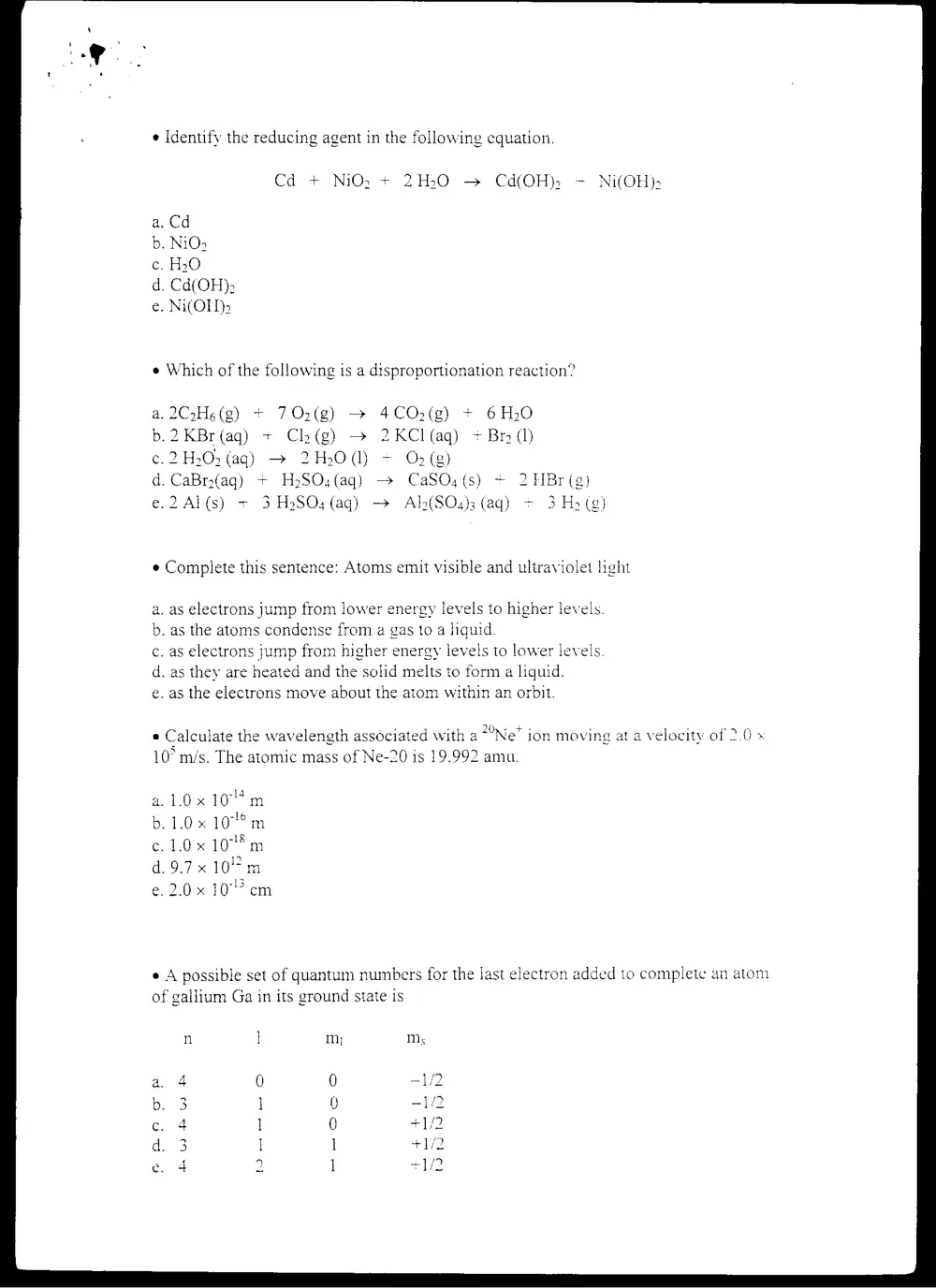
e Identify the reducing agent in the following equation.
Cd + NiO2 + 2H20 — Cd(OH) - Ni(OH)2
a, Cd
b. NiO»
Cc. H20
d. Cd(OH);
e. Ni(OID.
e Which of the following is a disproportionation reaction?
a. 2C2H6(g) + 702(g) > 4CO2(g) + 6H20
b.2KBr(aq) + Ch(g) > 2KCl(aq) + Br (1)
c.2 H:0; (ag) > 2H2O() = O2(g)
¢ Complete this sentence: Atoms emit visible and ultraviolet light
as electrons jump from lower energy levels to higher levels.
as the atoms condense from a gas to a liguid.
as they are heated and the solid melts to form a liquid.
a.
b.
c. as electrons jump from higher energy levels to lower levels.
d.
e. as the electrons move about the atom within an orbit.
* Calculate the wavelength associated with a 2°Nie* jon moving at a velocity of 2.0 x
10° m/s. The atomic mass of Ne-20 is 19.992 amu.
a.1.0x 10" m
b.1.0x 107° m
c. 1.0 x 10⁷% m
d. 9.7 x 10⁷° m
e. 2.0x 10% em
e A possible set of quantum numbers for the last electron added to complete an atom
of gallium Ga in its ground state is
n ] m, Ms
0 -1/2
0 -1/2
0 +1/2
] +1/2
1
+1/2
Bw Bu