
CHEM 217 Problems Chapter 5, Fall 2011
American University of Beirut · Thermodynamics and Chemical Dynamics · 30 pages

Showing the first 10 of 30 pages. Download the PDF to see all of it.
More CHEM 217 files
- Problems Chapter 4 · Fall 2011ChapterView
- Problems Chapter 6 · Fall 2011ChapterView
- Problems Set 6 Solutions (First 5 Chapters) · Fall 2011Chapter · with solutionView
- Problems Problem Quiz 2 · Fall 2017ProblemsView
- Exam 1 with Solution · Fall 2011Exam · with solutionView
- Exam 2 with Solution · Fall 2011Exam · with solutionView
- Exam 3 with Solution · Fall 2011Exam · with solutionView
- Problems Set 1 · Fall 2011ProblemsView
Show the text of this chapter
~t
~
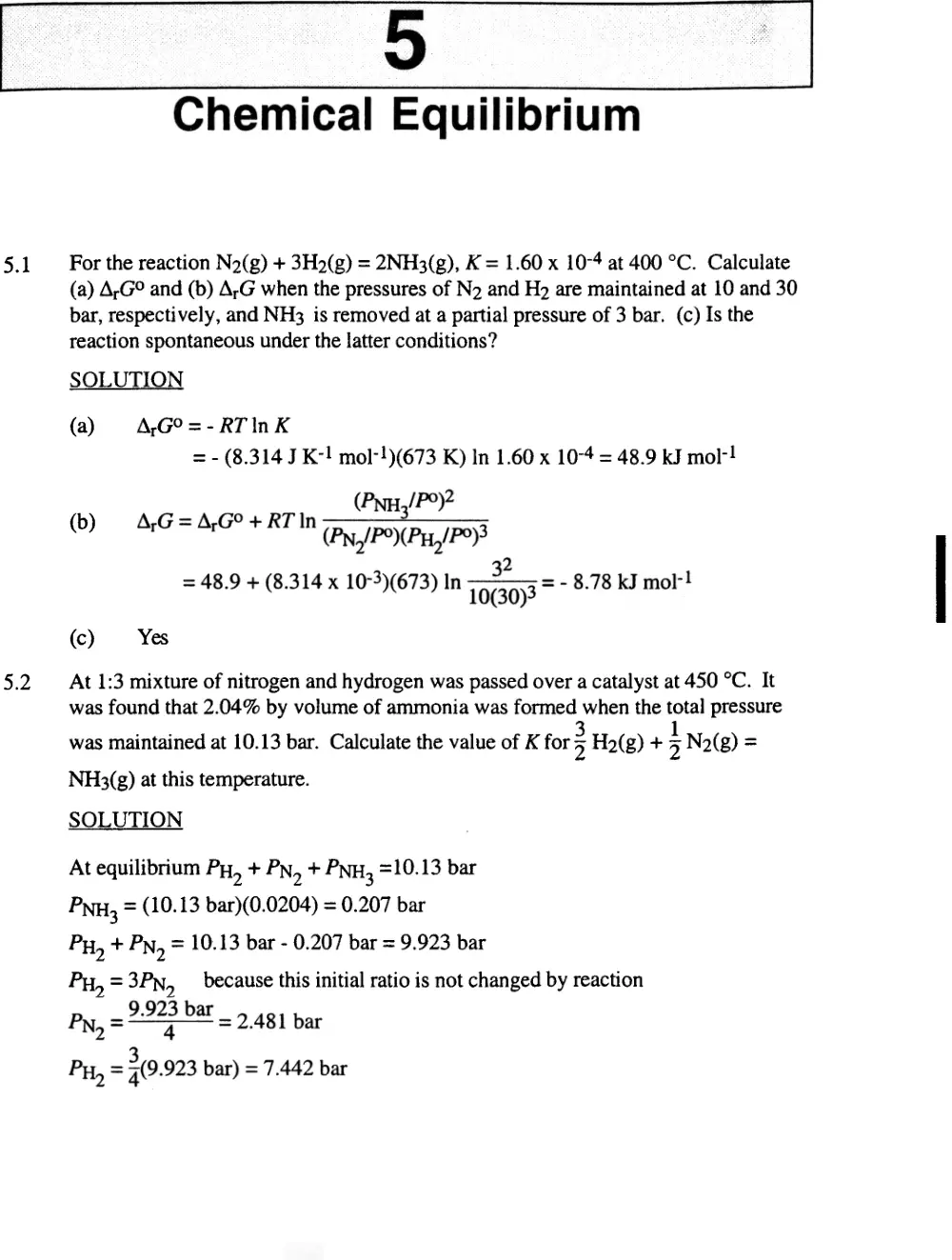
For the reaction N2(g) + 3H2(g) = 2NH3(g), K = 1.60 x 10⁻⁴ at 400 °C. Calculate
(a) ~rGo and (b) ~rG when the pressures of N2 and H2 are maintained at 10 and 30
bar, respectively, and NH3 is removed at a partial pressure of 3 bar. (c) Is the
reaction spontaneous under the latter conditions?
SOLUTION
5.1
(a)
~rGO = -RTln
K
= -(8.314
J K-l mol-l)(673
K) In 1.60 x 10-4 = 48.9 kJ mol-l
(b)
I
Yes
(c)
5.2
At 1 :3 mixture of nitrogen and hydrogen was passed over a catalyst at 450 °C. It
was found that 2.04% by volllme of ammonia was fonned when the total pressure
was maintained at 10.13 bar. Calculate the value ofKfor~
H2(g) + ~N2(g) =
NH3(g) at this temperature.
SOLUTION
At equilibrium
PH2 + PN2 + PNH3 =10.13 bar
PNH3 = (10.13 bar)(0.0204)
= 0.207 bar
PH2 + PN2 = 10.13 bar -0.207
bar = 9.923 bar
PH2 = 3PN2
because this initial ratio is not changed by reaction
Chapter 5/Chemical Equilibrium
66
5.3
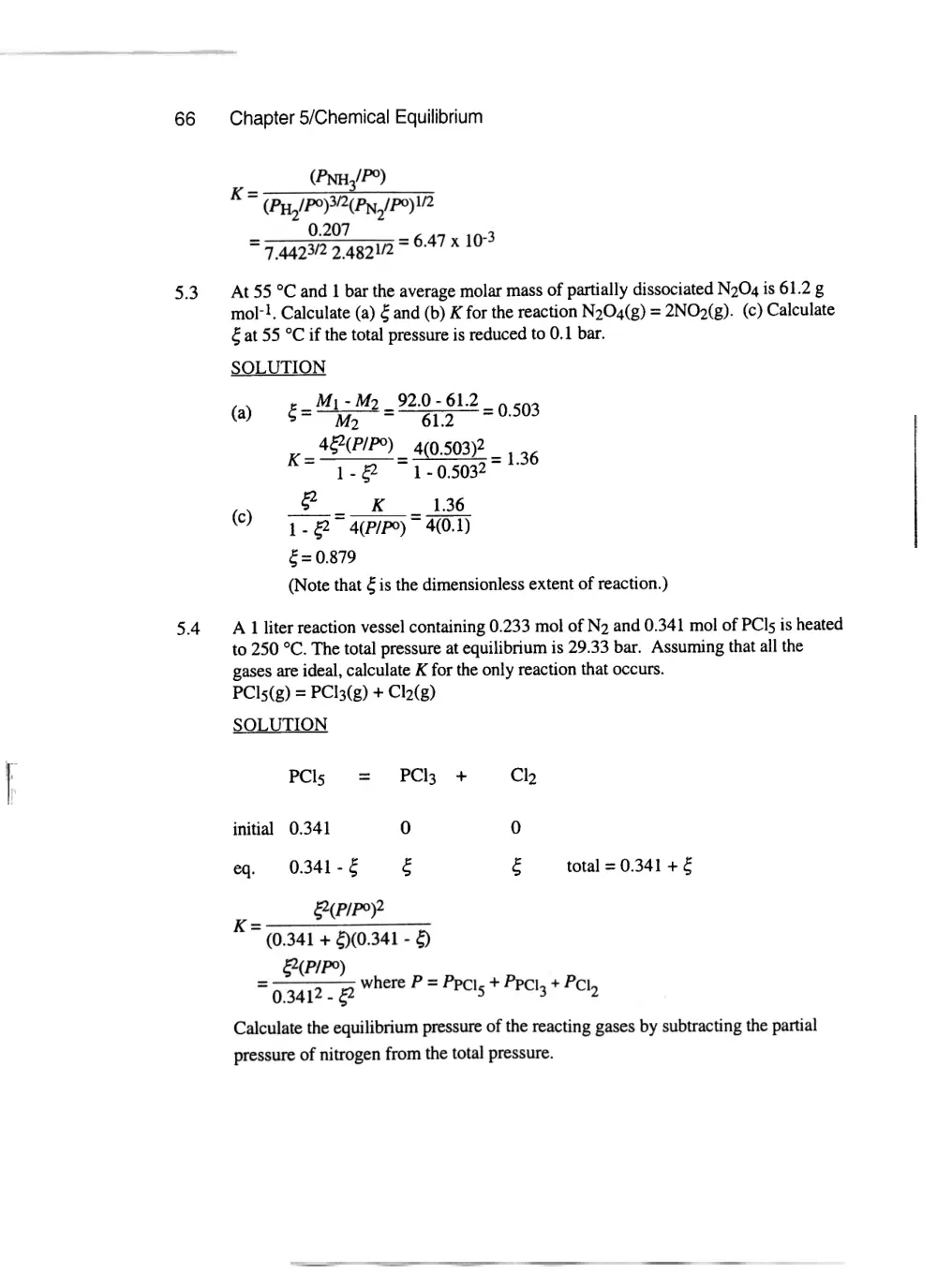
At 55 °C and 1 bar the average molar mass of partially dissociated N2O4 is 61.2 9
mol-l. Calculate (a) ~ and (b) Kfor the reaction N2O4(g) = 2NO2(g). (c) Calculate
~ at 55 °C if the total pressure is reduced to 0.1 bar.
SOLUTION
92.0- 61.2 = 0.503
61.2
4(0.503)2
= 1.36
= 1 -0.5032
1= -MI
-M2
-
~ -M2
-
4C}(P/PO)
K=
(a)
l-C}
~
(c)
K
1.36
=~
-- f;2
1 -f;2 -4(PlPO)
C; = 0.879
(Note that C; is the dimensionless
extent of reaction.)
A 11iter reaction vessel containing 0.233 mol of N2 and 0.341 mol of PCl5 is heated
to 250 °C. The total pressure at equilibrium is 29.33 bar. Assuming that all the
gases are ideal, calculate K for the only reaction that occurs.
PCI5(g) = PCI3(g) + Cl2(g)
SOLUTION
5.4
PCl3
Cl2
PC1S
+
=
0
0
initial 0.341
9
9
total
= 0.341
+ 9
0.341 -~
eq.
67
Chapter 5/Chemical Equilibrium
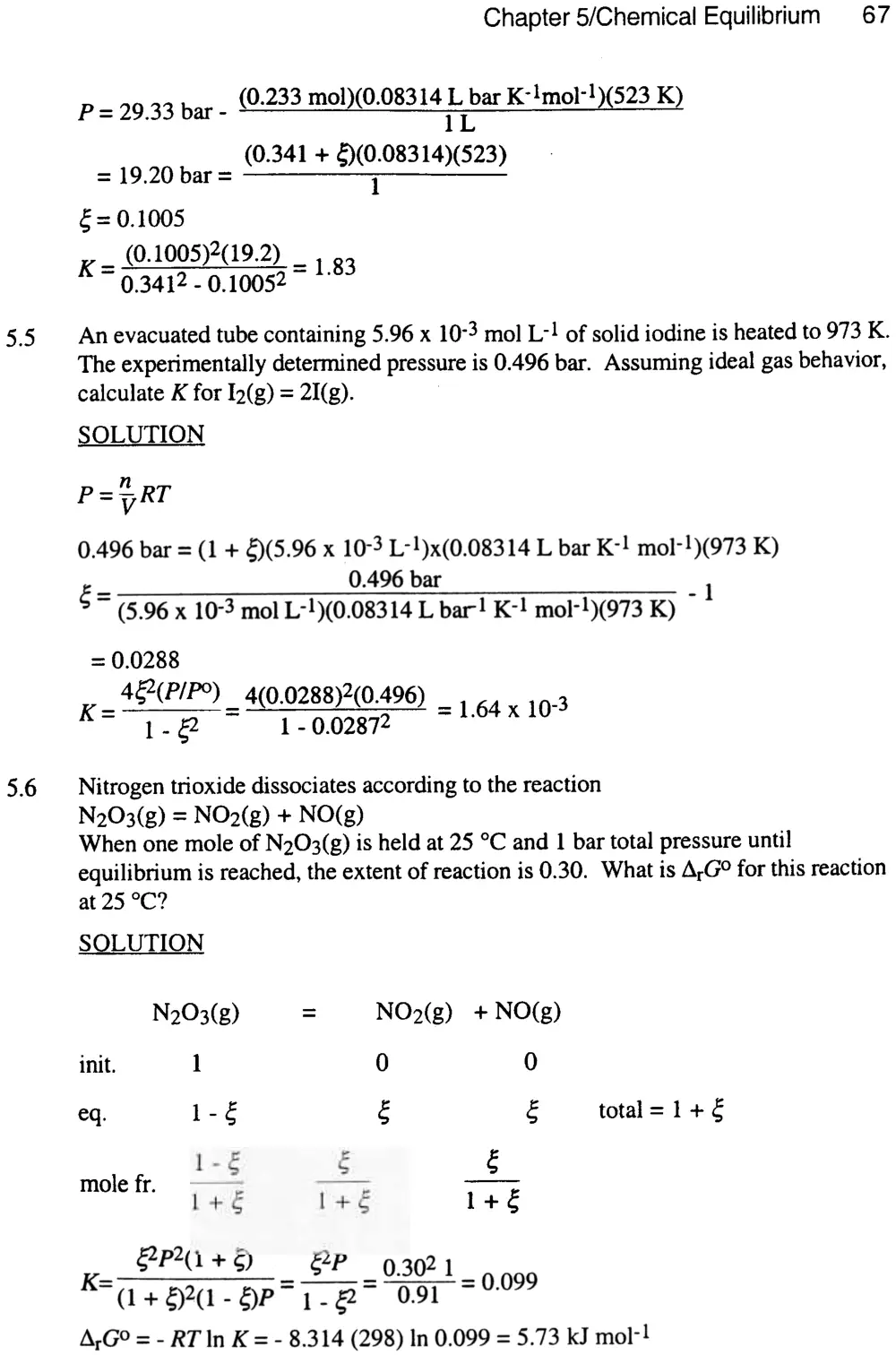
An evacuated tube containing 5.96 x 10⁻³ mol L -I of solid iodine is heated to 973 K.
The experimentally determined pressure is 0.496 bar. Assuming ideal gas behavior,
calculate K for 12(g) = 21(g).
5.5
SOLUTION
n
P=VRT
=
0.0288
4gz(PlPO)
K=
4(0.0288)2(0.496)
= 1.64 x 10-3
=
1 -0.02872
1-1:;2
5.6
Nitrogen trioxide dissociates according to the reaction
N203(g) = NO2(g) + NO(g)
When one mole of N203(g) is held at 25 °C and 1 bar total pressure until
equilibrium is reached, the extent of reaction is 0.30. What is LlrGo for this reaction
at 25 °C?
SOLUTION
NO2(g)
+ NO(g)
N203(g)
=
0
0
init.
1
total
= 1 + ~
9
~
1-~
eq.
mole fr .
c;
1+C;
p = 29.33 bar -(0.233
mol)(0.08314
~ ~ar
K-lmol-l
)(52
(0.341 + ~(0.08314)(523)
= 19.20 bar =
1
~ = 0.1005
K = (0.1005)2(19.2)
= 1 83
0.3412-
0.10052
.
68
Chapter 5/Chemical
Equilibrium
*5.7
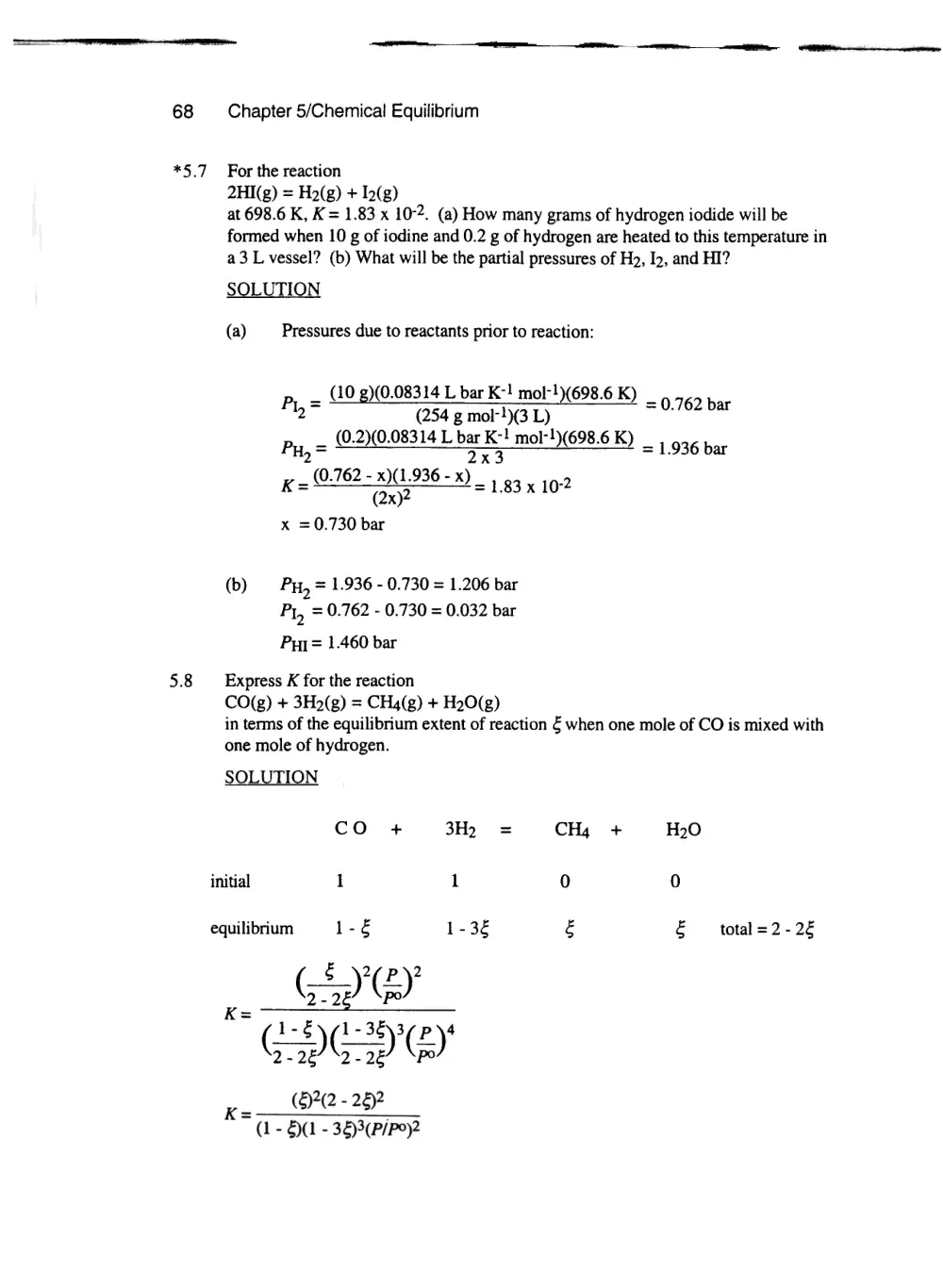
For the reaction
2lfl(g)
= lI2(g) + 12(g)
at 698.6 K, K = 1.83 x 10⁻². (a) lIow many grams of hydrogen iodide will be
formed when 10 9 of iodine and 0.2 9 of hydrogen are heated to this temperature in
a 3 L vessel ? (b) What will be the partial pressures of lI2, Iz, and lII?
SOLUTION
(a)
Pressures due to reactants prior to reaction:
(10 g)(0.08314
Lbar
K-l mol-l)(698.6
K)
= 0.762 bar
PI2 =
(254 9 mol-l)(3
L)
(0.2)(0.08314
L bar K-l mol-l)(698.6
K) = 1.936 bar
PH2=
2x3
-(0.762
-x)(1.936
-x) = 1.83 x 10⁻²
K-
(2x)2
x = 0.730 bar
(b)
PH2 = 1.936-
0.730 = 1.206 bar
Pl2 = 0.762 -0.730
= 0.032 bar
PHI = 1.460 bar
5.8
Express K for the reaction
CO(g) + 3H2(g) = ClI4(g) + H2O(g)
in tenns of the equilibrium extent of reaction ~ when one mole of CO is mixed with
one mole of hydrogen.
SOLUTION
co
3H2
CH4
H2O
+
+
=
initial
1
1
0
0
l-C;
1-3~
~
total
= 2 -2~
equilibrium
;
(-L)2(~)2
'2 -2C;"
, PO"
K=
( ~
)(~)3(
~ )4
2-2C;
2-2C;
po
69
Chapter 5/Chemical Equilibrium
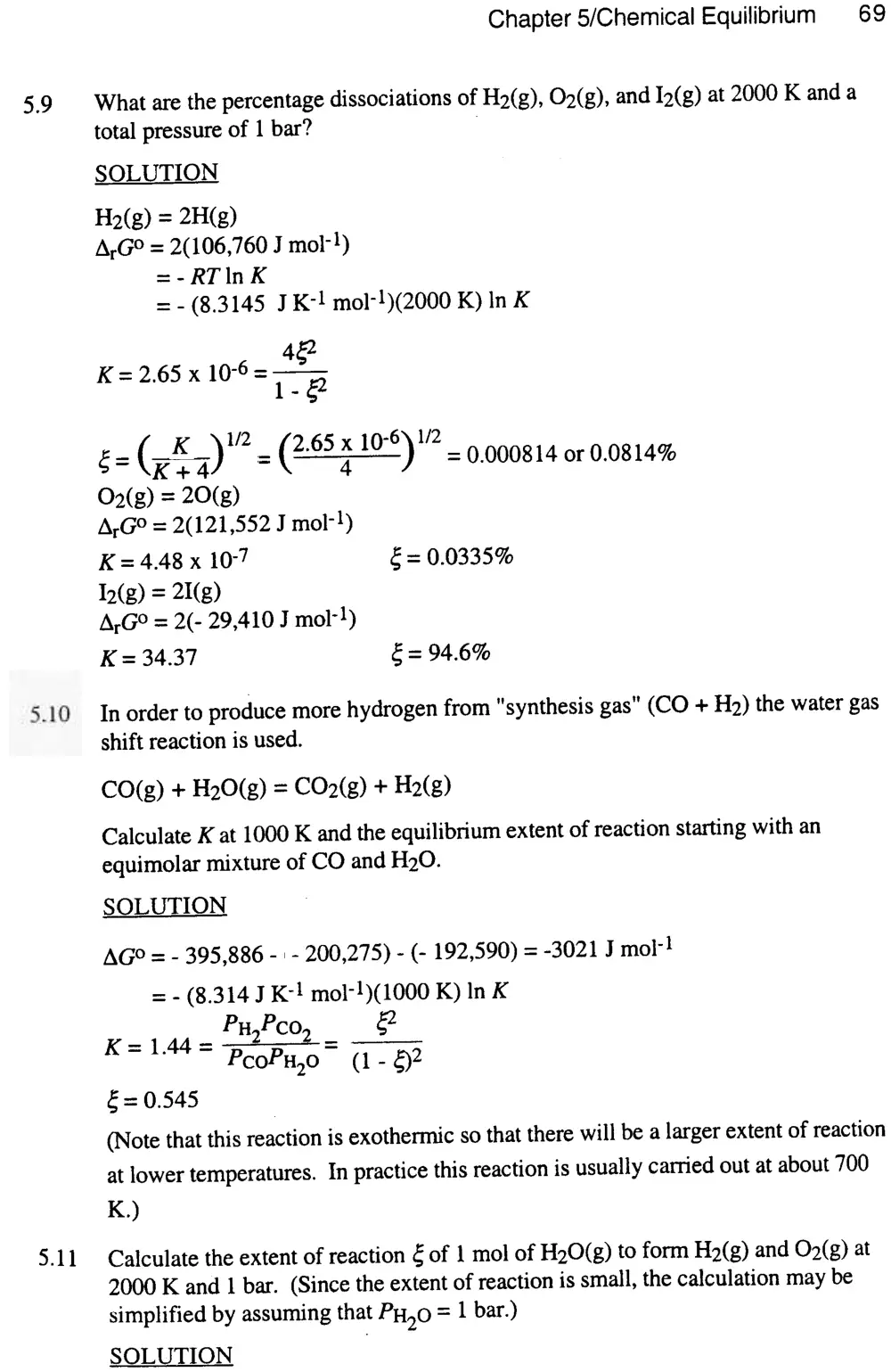
What are the percentage dissociations of H2(g), O2(g), and h(g) at 2000 K and a
total pressure of 1 bar?
SOLUTION
5.9
H2(g) = 2H(g)
/lrGo = 2(106,760 J mol-l)
= -RT In K
= -(8.3145
J K-l mol-l)(2000
K) In K
4l!/-
~
K = 2.65
x 10-6 =
~
= (~)
1/2
K
= 0.000814
or 0.0814%
9 = 0.0335%
(
) 1/2
g=
K+4
4
02(g) = 20(g)
~rGo = 2(121,552 J mol-l)
K = 4.48 x 10⁻⁷
h(g) = 2I(g)
~rGo = 2(- 29,410 J mol-l)
K = 34.37
~
=
94.6%
In order to produce more hydrogen from "synthesis gas" (CO + H2) the water gas
shift reaction is used.
CO(g) + H20(g) = CO2(g) + H2(g)
Calculate
K at 1000 K and the equilibrium
extent of reaction starting with an
equimolar
mixture
of CO and H2O.
SOLUTION
~GO = -395,886-
1- 200,275)
-(-
192,590) = -3021 J mol-l
= -(8.314
J K-l mol-l)(1000
K) In K
PH2PCO2
f}
K=1.44=
p
p
=
CO
H20
( 1 -~2
~ = 0.545
(Note that this reaction is exothermic so that there will be a larger extent of reaction
at lower temperatures. In practice this reaction is usually carried out at about 700
K.)
Calculate the extent of reaction 9 of 1 mol of H2O(g) to form H2(g) and O2(g) at
2000 K and 1 bar. (Since the extent of reaction is small, the calculation may be
simplified by assuming that PH20 = 1 bar.)
SOLUTION
5.11
(
2
!c;
1- 9
~
eq.
L\rGO
= 135,528
J mol-l
= -(8.1315
J K-1 moI-1)(2000
K) In K
K = 2.887 x 10⁻⁴
( ~
) ( ~
) 112
Po
Po
PO2
PH2
K -(~)
, Po
-2PO
( ~
) ( ~
) 112 = 1- ( ~
) 312
Po
2PO
.v2
Po
~ = (~
) = (.v2 K)213 = 0.0055
5.12
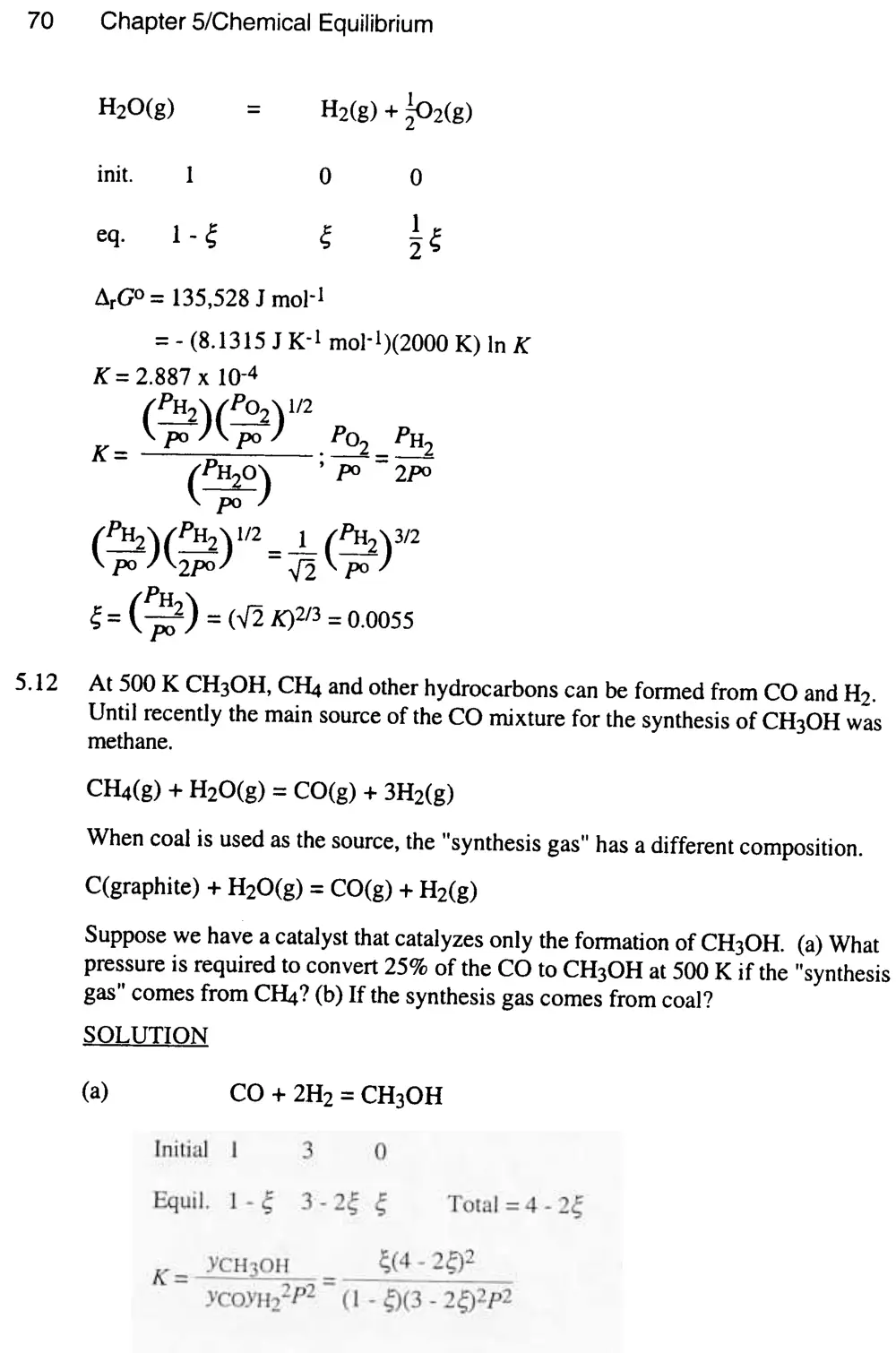
At 500 K CH30H, ClI4 and other hydrocarbons can be formed from CO and H2.
Until recently the main source of the CO mixture for the synthesis of CH30H was
methane.
CH4(g) + H20(g) = CO(g) + 3H2(g)
When coal is used as the source, the "synthesis gas" has a different composition.
C(graphite) + H20(g) = CO(g) + H2(g)
Suppose we have a catalyst that catalyzes only the foImation of CH3OH. (a) What
pressure is required to convert 25% of the CO to CH3OH at 500 K if the "synthesis
gas" comes from ClI4? (b) If the synthesis gas comes from coal?
SOLUTION
(a)
CO + 2H2 = CH30H
70
Chapter 5/Chemical
Equilibrium
1
fl2()(g)
=
fl2(g)
+ ~2(g)
init.
1
0
0
71
Chapter 5/Chemical
Equilibrium
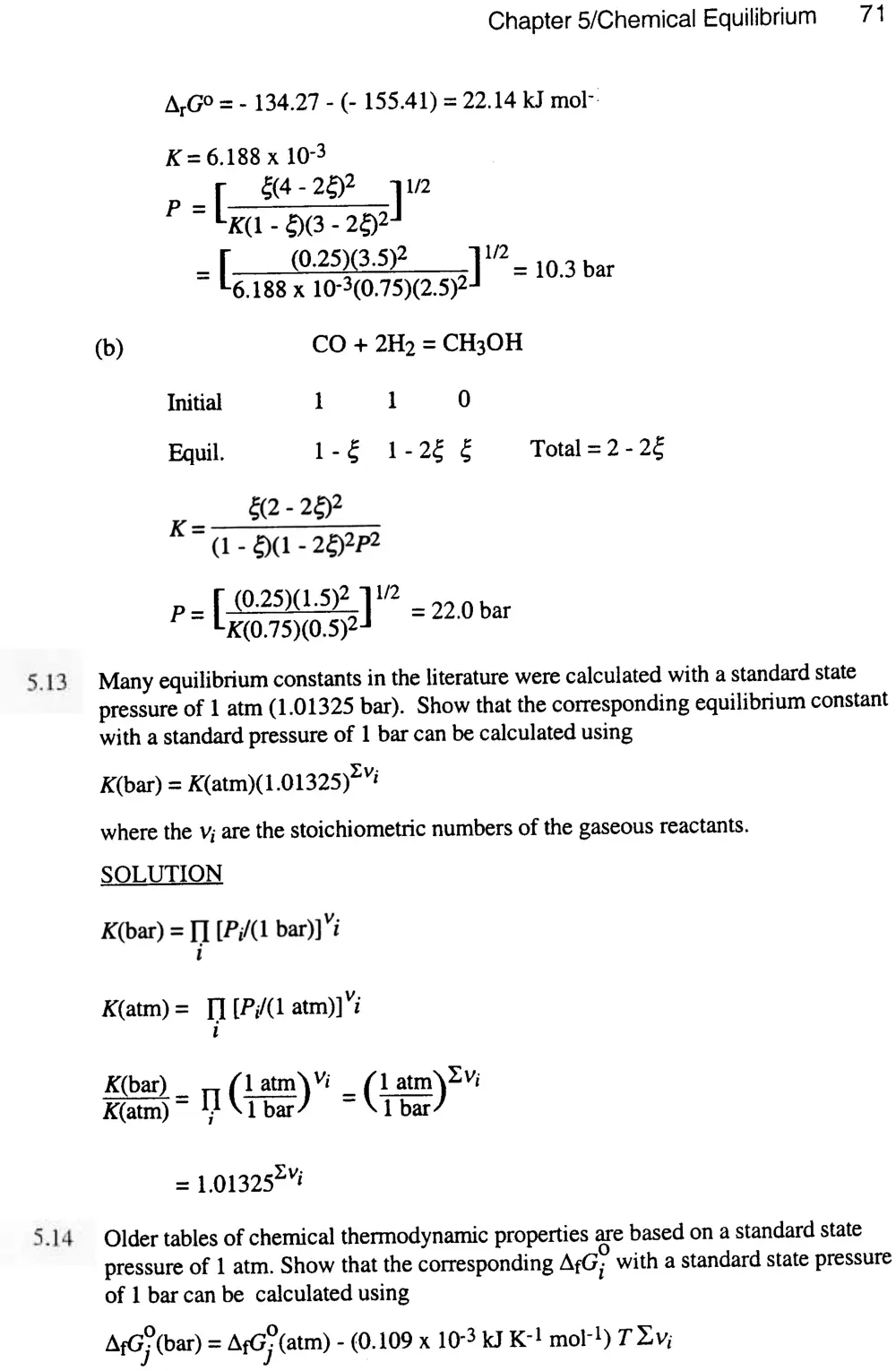
L\rGO = -134.27-
(- 155.41) = 22.14 kJ mol-
K=
6.188
x 10-3
p
= [ -~(4
-2/:;)2--
] 112
K(l
-/:;)(3 -2/:;)2
[
(0.25)(3.5)2
] 112
=
6.188
~
10-3(0.75)(2.5)2
=
10.3
bar
CO + 2H2 = CH30H
(b)
0
1
1
Initial
Total = 2 -2~
1-2~
~
1- 9
Equil.
p = [ (0.25)(1.5)2 ] 1/2
K(O.75)(0.5)2
= 22.0
bar
Many equilibrium constants in the literature were calculated with a standard state
pressure of 1 atm (1.01325 bar). Show that the corresponding equilibrium constant
with a standard pressure of 1 bar can be calculated using
K(bar) = K(atm)(1.01325)~Vi
where the Vi are the stoichiometric numbers of the gaseous reactants.
SOLUTION
K(atm) = O [Pi/(1 atm)) vi
I
- ( ~
)
LVi
-Ibar
~-
n ( ~
)
Vi
K(atm)
-;
1 bar
= 1.01325Lvi
Older tables of chemical thennodynamic properties are based on a standard state
pressure of 1 atm. Show that the corresponding L\fG~ with a standard state pressure
of 1 bar can be calculated using
o
o
L\tGj (bar) = L\tGj (atm) -(0.109 x 10⁻³ kJ K-l mol-l) TLvi
Chapter 5/Chemical Equilibrium
72
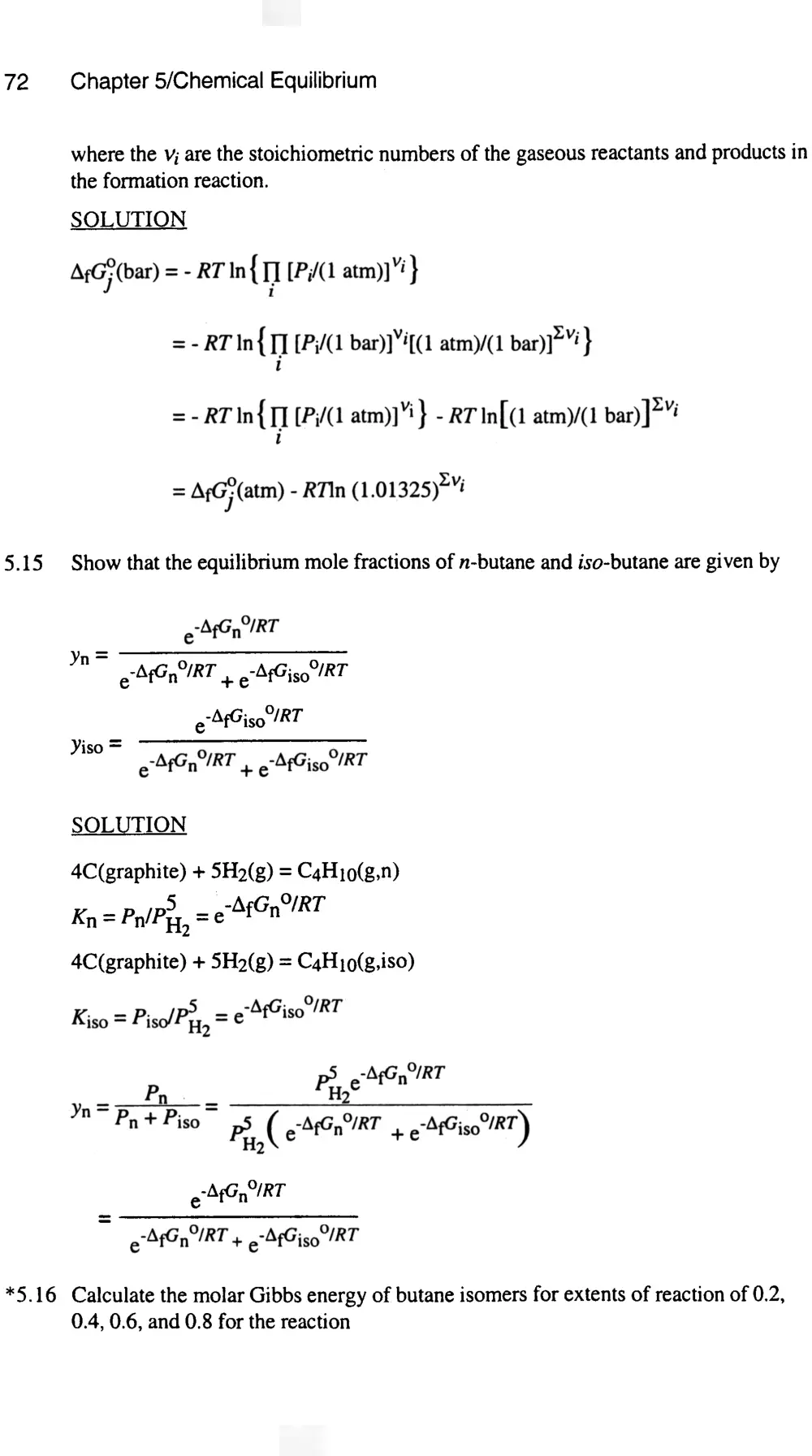
where the Vi are the stoichiometric numbers of the gaseous reactants and products in
the formation reaction.
SOLUTION
Show that the equilibrium mole fractions of n-butane and iso-butane are given by
5.15
Yn=
e-6.tGnoIRT
+ e-6.tGisooIRT
e-6.tGisooIRT
Yiso
=
SOLUTION
4C(graphite) + SH2(g) = C4HlO(g,n)
K
- p /p S
--J1.fGnoIRT
n -n
H2 -e
4C(graphite)
+ SH2(g) = C4HlO(g,iso)
e-~tGnO/RT
~
*5.16
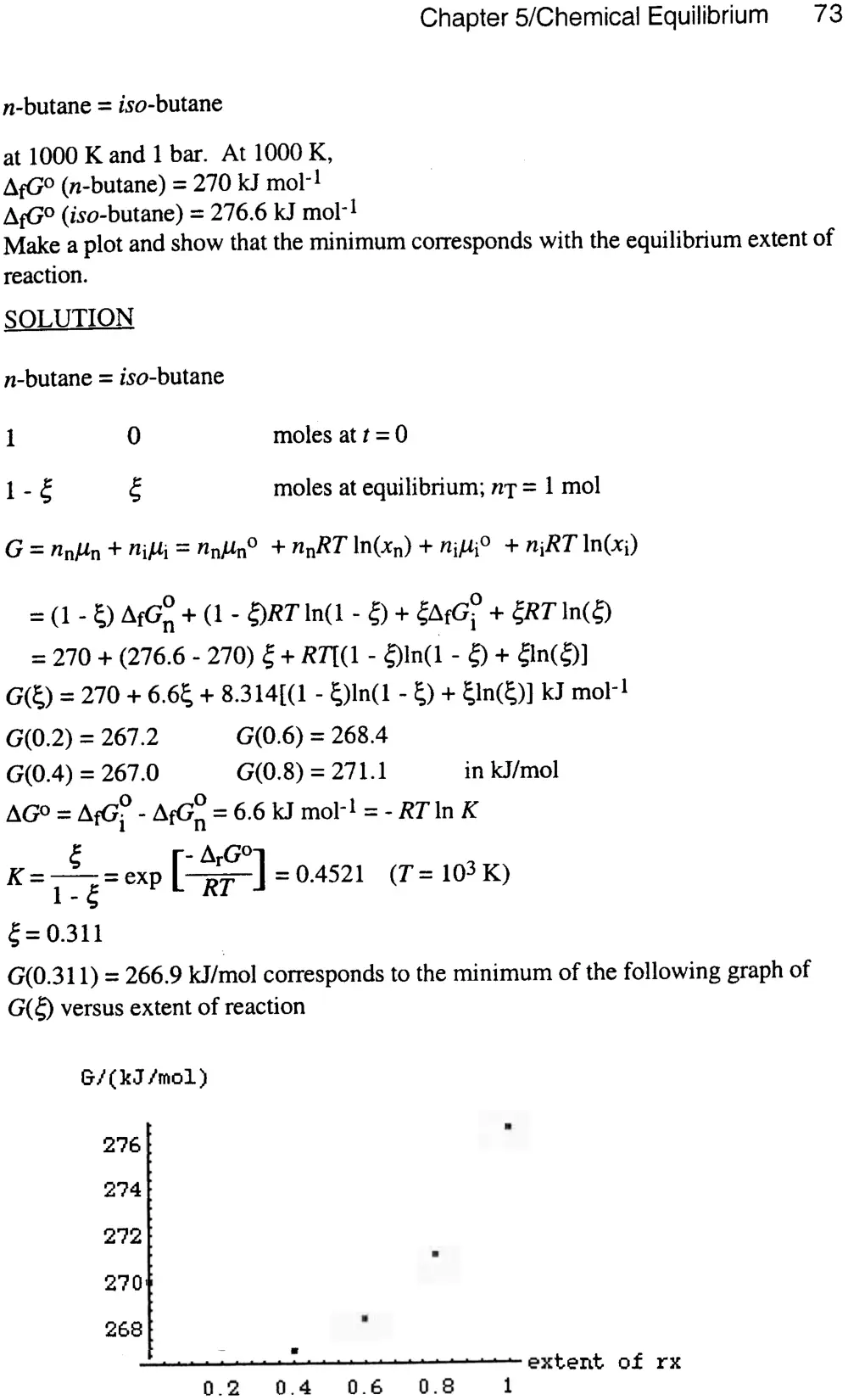
Calculate the molar Gibbs energy of butane isomers for extents of reaction ofO.2,
0.4, 0.6, and 0.8 for the reaction
73
Chapter 5/Chemical
Equilibrium
n-butane = iso-butane
at 1000 K and I bar. At 1000 K,
L\tG° (n-butane) = 270 kJ mol-l
L\tG° (iso-butane) = 276.6 kJ mol-l
Make a plot and show that the minimum co1Tesponds with the equilibrium extent of
reaction.
SOLUTION
n-butane = iso-butane
moles
at t = 0
0
1
9
moles at equilibrium;
nT = 1 mol
1-~
G = nn'Un + nj'Uj = nn'UnO + nnRT In(xn) + nj'UjO + njRT In(xj)
o
o
= (1 -~) ~fGn + (1 -f;)RT
In(l
-g) + g~tGi
+ gRT In(f;)
= 270 + (276.6-
270) 9 + RT[(l
-f;)ln(l
-f;)
+ gln(f;)]
G(~) = 270 + 6.6~ + 8.314[(1
-~)ln(l
-~) + ~ln(~)]
kJ mol-l
G(0.2) = 267.2
G(0.6) = 268.4
G(0.4) = 267.0
G(0.8)
= 271.1
in kJ/mol
o
o
1
~Go = ~tG.
-~tG
= 6.6 kJ mol-
= -RT In K
1
n
9
[ -~rGO ]
K=-=exp
RT
=0.4521
(T=
103K)
l-g
9 = 0.311
G(0.311)
= 266.9 kJ/mol
corresponds
to the minimum
of the following
graph of
G(f;) versus extent of reaction
GJ(kJJmol)
2761
2741
2'72
270'
268
.
extent
of
rx
0.6
0.8
1
0.2
0.4
~
Chapter 5/Chemical Equilibrium
74
In the synthesis of methanol by CO(g) + 2H2(g) = CH3OH(g) at 500 K, calculate
the total pressure required for a 90% conversion to methanol if CO and H2 are
initially in a 1:2 ratio. Given: K= 6.09 x 10⁻³.
SOLUTION
5.17
CO(g) + 2H2(g) = CH30H(g)
initial moles
1
2
0
equil. moles
0.1
0.2
0.9
total 1.2
K
=
(PCH30H/
PO)
(PCdPO)(PH2/PO)2=
6.09
x
10-3
0.9
p
--
1.2 po
-QlE-
(~
E- )2
1.2po
1.2 po
p
-I
(0.9)(1.2)2
:iJ() = -\'
(0.1)(0:04)(6.09 x 10⁻³) = 231
p = 231 bar = total pressure for 90% conversion to CH30H
).l~
At 1273 K and at a total pressure of 30.4 bar the equilibrium in the reaction CO2(g)
+ C(s) = 2CO(g) is such that 17 mole % of the gas is CO2. (a) What percentage
would be CO2 if the total pressure were 20.3 bar? (b) What would be the effect on
the equilibrium of adding N2 to the reaction mixture in a close" vessel until the
partial pressure of N2 is 10 bar? (c) At what pressure of the reactants wi1125% of
the gas be CO2 ?
SOLUTION
(a)
PCO2 = (30.4 bar)(0.17)
= 5.2 bar
PCO = (30.4 bar)(0.83)
= 25.2 bar
K=~=
122
Let x = mole fraction
CO2
K -[20.3(1
-x)]2
-
122
-20.3x
-
x = 0.127
Percentage
CO2 at equilibrium=
12.7%
(b)
No effect for ideal gases because the partial pressures of the
reactants are not affected.
.
75
Chapter
5/Chemical
Equilibrium
K = [0.75(P/PO)]2
0.25(P/PO)
P = 54 bar
(c)
When alkanes are heated up, they lose hydrogen and alkenes are produced. For
example,
K = 0.36
at 1000
K
C:2lI6(g) = C:2lI4(g) + lI2(g)
If this is the only reaction that occurs when ethane is heated to 1000 K, at what total
pressure will ethane be (a) 10% dissociated and (b) 90% dissociated to ethylene and
hydrogen?
SOLUTION
C2H6 = C2H4 + H2
0
1
0
Init.
~
total
= 1 + ~
1-~
~
Equil,
l;2(PlPO)
(I
+
~)(I
-~
[}-(P/po)
1-[}-
K=
=
(a)
(b)
At 2000 °C water is 2% dissociated into oxygen and hydrogen at a total pressure of
1 bar.
1
(a) Calculate K for H2O(g) = H2(g) + 2 O2(g)
(b) Will the extent of reaction increase or decrease if the pressure is reduced? (c)
Will the extent of reaction increase or decrease if argon gas is added, holding the
total pressure equal to 1 bar? (d) Will the extent of reaction change if the pressure
is raised by addition of argon at constant volume to the closed system containing
partially dissociated water vapor? (e) Will the extent of reaction increase or
decrease if oxygen is added while holding the total pressure constant at 1 bar?
Chapter 5/Chemical
Equilibrium
76
SOLUTION
1
+
2 02(g)
O
H2(g)
H20(g)
(a)
==
0
1
initial
~
1:)2
9
1+2
p
PO2=
~/2(PlPO)1/2
-{2(1
+
f)2)1/2(1
-~
1 + Cj2 po
0.023/211/2
= 2.03 x 10⁻³
(b)
(c)
{2 (1.01)1/2 (0.98)
If the total pressure is reduced, the extent of reaction will increase because
the reaction will produce more molecules to fill the volume.
If argon is added at constant pressure, the extent of reaction will increase
because the partial pressure due to the reactants will decrease.
If argon is added at constant volume, the extent of reaction will not be
changed because the partial pressure due to the reactants will not change.
If oxygen is added at constant total pressure, the extent of reaction of H20
will decrease because the reaction will be pushed to the left.
(d)
(e)
5.21
At 250 °C PCIS is 80% dissociated at a pressure of 1.013 bar, and so K= 1.80.
What is the extent of reaction at equilibrium after sufficient nitrogen has been added
at constant pressure to produce a nitrogen partial pressure of 0.9 bar? The total
pressure is maintained at 1 bar.
SOLUTION
OA -1
-!:;2
9 = 0.973
or 97.3%
dissociated.
5.22
The following exothermic reaction is at equilibrium at 500 K and 10 bar.
CO(g) + 2H2(g) = CH30H(g)
Assuming the gases are ideal, what will happen to the amount of methanol at
equilibrium when (a) the temperature is raised, (b) the pressure is increased, (c) an
0.02j/:l
11/:l
:=2.0
~
(1.01 )1/2 (0.98)
77
Chapter 5/Chemical Equilibrium
inert gas is pumped in at constant volume, (d) an inert gas is pumped in at constant
pressure, and (e) hydrogen gas is added at constant pressure?
SOLUTION
(a)
(b)
(c)
(d)
(e)
n(CH30H) decreases because heat is involved.
n(CH30H) increases because there are fewer molecules of gas in the
product.
No effect.
n(CH30H) decreases because the volume increases.
n(CH30H) increases because there is more of a reactant. Note: the effect of
the addition of CO is more complicated.
The following reaction is nonspontaneous at room temperature and endothermic.
3C(graphite) + 2H2O(g) = CH4(g) + 2CO(g)
As the temperature is raised, the equilibrium constant will become equal to unity at
some point. Estimate this temperature using data from Appendix C.3.
SOLUTION
At 1000 K
/).rGo = 19.492 + 2(- 200.275) -2(- 192.590) = 4.122 kJ mol-l
= -(8.3145
x 10-3 kJ K-l
moI-l)(1000
K) In K
The measured density of an equilibrium mixture of N2O4 and NO2 at 15 °C and
1.013 bar is 3.62 9 L -I, and the density at 75 °C and 1.013 bar is 1.84 9 L -I. What
is the enthalpy change of the reaction N2O4(g) = 2NO2(g)?
SOLUTION
~
Chapter 5/Chemical
Equilibrium
78
4!:}P
1-!:}
4(0.0753)2(1.013)
= 0.0231
1 -0.07532
K=
=
At 75 °C
M -(0.08314)(348)(1.84)
- 52 55
1-1
-1.013
-.9
mo
~=~=0.751
K=5.24
A H -RTIT2
1
~-(8.314)(288)(348)
1
~r
-(T2
-Tl)
n Kl -60
n 0.0231
5.24
= 75 kJ mol-l
Ca]cu]ate Kc for the reaction in prob]em 5.19 at 1000 K and describe what it is equa]
to.
5.25
SOLUTION
Kc = Kp( ~
) ~Vi
coRT
1
bar
= 0.36
1
1
1
(1 L mol- )(0.08314
L bar K-
mol- )(238 K)
= 0.0145
(~)(~)
-
[C2H6J
cO
where [ ] indicates concentrations
in moles per liter and CO = 1 mol L -I
~
*5.26
The equilibrium constant for the reaction
~2(g) + 3II2(g) = 2~II3(g)
is 35.0 at 400 K when partial pressures are expressed in bars. Assume the gases are
ideal. (a) What is the equilibrium volume when 0.25 mol ~2 is mixed with 0.75 mol
II2 at a temperature of 400 K and a pressure of 1 bar? (b) What is the equilibrium
composition and equilibrium pressure if this mixture is held at a constant volume of
33.26 L at 400 K?
SOLUTION
2NH3
3H2
(a)
N2
+
=
0.75
0
initial
0.25
total
= 1 -2~
0.75- 3g
~
0.25 -9
equil.
6
1 bar
(1 L mol-l)(O.O8314
L bar K-l
mol
79
Chapter 5/Chemical Equilibrium
The method of successive approximations or the use of an equation solver
yields 9 = 0.1652.
P(Nv/PO = (0.25- g)/(1 -2g) = 0.1266
P(Hv/PO = 3(0.1266) = 0.3798
P(NH3)/PO = 2l:j(1 -2g) = 0.493
Since the total pressure is 1 bar, these numbers also give the equilibrium
mole fractions.
V = (1 -2g)RT/P
= (0.6696 mol)(0.8314 L bar K-l mol-l)(400
K)/(l
bar)
= 22.27 L
When MathematicaTM is used to calculate the extent of reaction, four
solutions are obtained; two of them are not satisfactory because they are
imaginary and one is 0.334 mol, which is impossible because the extent of
reaction has to be less than 0.25 mol. The fourth solution is correct.
In order to calculate the equilibrium composition at constant volume, it is
convenient to use Kc.
Kc = (PO/cDR1)~Vi Kp
= [
1 bar
.
] -2350
(1 mol L -1)(0.08314 L bar K-l mol-l)(400
K)
.
= 3.871 x 10⁴
Kc = [C(NH3)/cD]2/[c(Nv/cD][c(H2)/cDr
= (2~2 33.262/(0.25 -~(0.75
-3~3
= 3.871 x 10⁴
The method of successive approximation or the use of an equation solver
yields ~ = 0.151.
n(N2)
= 0.25 -~ = 0.0990
n(H2)
= 0.75- 3~ = 0.2970
n(NH3) = 2~ = 0.302
n(total) = 0.698
p -(0.698
mol)RT
- 0 698 b
-33.26
L
-.ar
(b)
5.27
Show that to a first approximation the equation of state of a gas that dimerizes to a
small extent is given by
PV
-
RT = 1 -KdV
SOLUTION
2A(g) = A2(g)
Kc = [A2]/[A]2
= nA2 V/nA 2
80
Chapter
5/Chemical
Equilibrium
(a)
assuming an ideal gas mixture.
2
nO = Total number of moles of A = nA + 2nA2 = nA + 2KcnA/V
This can be solved for nA using the quadratic formula for ax2 + bx + c = 0:
-b .t (b2 -4ac)1/2
x=
2a
This yields
nA = no(1 -2Kcn0/V)
(b)
when the approximation (I + x)1/2 = I + x/2 -x2/8 + ...is used.
The gas law indicates that
PV
2
Rt = nA + nA2 = nA + Kcn A/V = nA(1 + KcnNV)
(c)
Substituting equation b in equation c yields
PV
Rt=
nO(1 -2Kcn0/V)(1 + KcnA/V)
(d)
Since nA is just a little smaller than no, it can be replaced by no in a term that is small
compared to unity. Thus equation d can be written as
PV
--
Rt=
no(1 -2Kc/V)(1
+ Kc/V)
(e)
When this is multiplied out ignoring higher order terms and the no is moved to the
left-hand side of the equation, we obtain
PV
,- "'
~
= 1 -KdV
5.28
Water vapor is passed over coal (assumed to be pure graphite in this problem) at
1000 K. Assuming that the only reaction occurring is the water gas reaction
C(graphite) + H2O(g) = CO(g) + H2(g)
K = 2.52
calculate the equilibrium pressures of H2O, CO, and H2 at a total pressure of 1 bar.
[Actually the water gas shift reaction
CO(g) + H2O(g) = CO2(g) + H2(g)
occurs in addition, but it is considerably more complicated to take this additional
reaction into account.]
SOLUTION
(PColPO)(PH2/PO)
-~
-~
= 2.52
K=
(PH2o1PO)
-y
-1-
2x
2x+y=
1
X2 = 2.52- 5.04x
X2 + 5.04x -2.52
= 0
x = -5.04
.:t "V' 5.~42 + 4(2.52)
= 0.458
-~-~
-pa-pa
"",,""'
81
Chapter
5/Chemical
Equilibrium
-2t=O.O84=~
po
1
PH20
= 0.084
bar
Pco
= 0.458
bar
PH2
= 0.458
bar
What is the standard change in entropy for the dissociation of molecular oxygen at
298.15 K and 1000 K? Use Appendix C.3.
SOLUTION
= 2 O(g)
LlrS(298.15
K) = 2(161.058)
-205.147
= 116.969 J K-l mol-l
LlrS(1000 K)
= 2(186.790)
-243.578
= 130.002 J K-l mol-l
Using molar entropies from Appendix C.2, calculate I1.rS° for the following
reactions
at 25 °C.
1
(a)
H2(g) + -02(g)
= H20(!)
(b)
H2(g) + tl2(g)
= 2HCl(g)
1
(c)
Methane (g) + 2 02(g) = methanol(!)
SOLUTION
(a)
(b)
~rSO = 69.91- 130.68- ~ (205.13) = -163.34 J K-l mol-l
~rSo = 2(186.908) -130.681-
223.066 = 20.066 J K-l mol-l
~rSo = 126.8- 186.264- ~(205.138) = -162.0 J K-l mol-l
(c)
What is L\rSO (298 K) for
H20(1) = H+(ao) + OH-(ao)
Why is this change negative and not positive?
SOLUTION
IlrSO
= -10.75-
69.92 = -80.67 J K-l mol-l
The ions polarize neighboring water molecules and attract them. For this reason the
product state is more ordered than the reactant state.
Mercuric oxide dissociates according to the reaction 2HgO(s) = 2Hg(g) + O2(g).
At 420 °C the dissociation pressure is 5.16 x 10⁴ Pa, and at 450 °C it is 10.8 x 10⁴
Pa. Calculate (a) the equilibrium constants, and (b) the enthalpy of dissociation per
mole of HgO.
SOLUTION
5.29
WI
02(g)
5.30
Chapter 5/Chemical
Equilibrium
82
(a)
(b)
L\Ho
=!I&ln~
r
T2-
Tl
Kl
(8.314 J K-l mol-l)(693
K)(723
K) 1 0.1794
= -30K
n 0.0196
= 308 kJ mol-l
for the reaction as written
= 154 kJ mol-l
of HgO(s)
The decomposition of silver oxide is represented by
2Ag20(s) = 4Ag(s) + 02(g)
Using data from Appendix C.2 and assuming ~rCp = 0 calculate the temperature at
which the equilibrium pressure of 02 is 0.2 bar. This temperature is of interest
because Ag20 will decompose to yield Ag at temperatures above this value if it is in
contact with air.
SOLUTION
The dissociation of ammonium carbamate takes place according to the reaction
(NH2)CO(ONH4)(S)
= 2NH3(g) + CO2(g)
When an excess of ammonium carbamate is placed in a previously evacuated vessel,
the partial pressure generated by NH3 is twice the partial pressure of the CO2, and
the partial pressure of (NH2)CO(ONH4)
is negligible in comparison. Show that
K=(~)2(~)=~(~)3
where p is the total pressure.
Chapter 5/Chemical Equilibrium
83
SOLUTION
P = PNH3 + PCO2 = 3PCO2
since
PNH3 =2PCO2
P
2
PCO2
= 3
PNH3
= 3P
K=
(~)2(~)
= (~~)2(~~)
=~(~)3
At 1000 K methane at 1 bar is in the presence of hydrogen. In the presence of a
sufficiently high partial pressure of hydrogen, methane does not decompose to form
graphite and hydrogen. What is this partial pressure?
SOLUTION
ClI4(g) = C(graphite) + 2H2(g)
L\Go = -RT In K = -19.46 kJ mol-l
K= 10.39 = (~)2
~
Po
PH = PO[(10.39)(1)]1/2 = 3.2 bar
2
For the reaction
Fe203(s) + 3CO(g) = 2Fe(s) + 3CO2(g)
the following
values of K are known.
1000
t/OC
250
K
100
0.0721
At 1120 °C for the reaction 2C02(g) = 2CO(g) + 02(g), K = 1.4 x 10⁻¹². What
equilibrium partial pressure of 02 would have to be supplied to a vessel at 1120 °C
containing solid Fe203 just to prevent the formation of Fe?
SOLUTION
( K2 )
L\rHO(T2-
TI)
In
Kl
=
RTIT2
L\ H o -(8.314)(523)(1273)
In (0.0721/100)
r
-(750)
= -53.4 k J mol-l
1 (K1393)
(53400)(120)
n Kim
= 8.314 (1393)(1273)
5.36
5.35
Chapter 5/Chemical Equilibrium
83
SOLUTION
P = PNH3 + PCO2 = 3PCO2
since
PNH3 =2PCO2
P
2
PCO2
= 3
PNH3
= 3P
K=
(~)2(~)
= (~~)2(~~)
=~(~)3
At 1000 K methane at 1 bar is in the presence of hydrogen. In the presence of a
sufficiently high partial pressure of hydrogen, methane does not decompose to form
graphite and hydrogen. What is this partial pressure?
SOLUTION
ClI4(g) = C(graphite) + 2H2(g)
L\Go = -RT In K = -19.46 kJ mol-l
K= 10.39 = (~)2
~
Po
PH = PO[(10.39)(1)]1/2 = 3.2 bar
2
For the reaction
Fe203(s) + 3CO(g) = 2Fe(s) + 3CO2(g)
the following
values of K are known.
1000
t/OC
250
K
100
0.0721
At 1120 °C for the reaction 2C02(g) = 2CO(g) + 02(g), K = 1.4 x 10⁻¹². What
equilibrium partial pressure of 02 would have to be supplied to a vessel at 1120 °C
containing solid Fe203 just to prevent the formation of Fe?
SOLUTION
( K2 )
L\rHO(T2-
TI)
In
Kl
=
RTIT2
L\ H o -(8.314)(523)(1273)
In (0.0721/100)
r
-(750)
= -53.4 k J mol-l
1 (K1393 )
(53400)(120)
n Kim
= 8.314 (1393)(1273)
Chapter 5/Chemical
Equilibrium
85
Calculate the partial pressure of CO2(g) over CaCO3(calcite) -CaO(s) at 500 °C
using the equation in Example 5.11 and data in Appendix C.3.
SOLUTION
CaCO3(calcite)
= CaO(s) + CO2(g)
L\rHo = -635.09 + (- 393.51) -(- 1206.92) = 178.32 kJ mol-l
L\r~ = 42.80 + 37.11- 81.88 = -1.97 J K-l mol-l
L\rSo= 39.75 + 213.74- 92.9 = 160.6 J K-l mol-l
Substituting in the equation in Example 5.11,
178320
160.6
1.97
In K773 = -(8.314)(773.15)
+ 8:314 + 8:314 (1 - 298.15--1 ~
)
773.15
n 298.15
Pco
K773
= --1
= 20
x 10-5
po
The NBS Tables contain the following data at 298 K:
~fHo/kJ
mol-l
-771.36
-1085.83
-1684.31
-241.818
/1tG°1kJ mol-l
-661.8
-918.11
-1399.96
-228.572
CUSO4(S)
CuSO4oH20(S)
CuSO4o3H20(S)
H20(g)
(a) What is the equilibrium partial pressure of H20 over a mixture of CUSO4(S) and
CuSO4'H20(S) at 25 °C?
(b) What is the equilibrium partial pressure of H20 over a mixture of
CuSO4'H20(S)
and CuSO4'3H20(S) at 25 °C?
(c) What are the answers to (a) and (b) if the temperature is 100 °C and LlC~ is
assumed to be zero?
SOLUTION
(a)
CuSO4.H20(S)
= CUSO4(S) + H20(g)
L\Go = -228.572-
661.8 + 918.11
= 27.7 kJ mol-l
( -L\GO )
PH
o
K=
exp
RT
= 1.4 x 10-5 = -j!;-
PH2o=
1.4 x 10⁻⁵ bar
Chapter 5/Chemical
Equilibrium
86
(b)
CuSO4.3H20(S)
= CuSO4.H20(S)
+ 2H20(g)
LlGo = 2(- 228.572)
-918.11
+ 1399.46
= -24.71
kJ mol-l
[
-24 710
]
PH20
= exp
(2)(8.314)(298)
= 6.83
x 10-3
bar
(c)
For the first reaction
K1OO
72650(75)
ln 1.4 x 10-5 = 8.314(298)(373)
Mlo = -241.818-
771.36 + 1085.83 = 72.65 kJ mol-l
K1OO
ln 1.4 x 10-5 = 5.896
K1OO = 363.6(1.4 x 10⁻⁵) = 0.0051 bar
For the second reaction
MJO
= 2(- 241.818) -1085.83 + 1684.31
= 114.84 kJ mol-l
K1OO
114840(75)
ln 4.7 x 10-5 = 8.314(298)(373) = 9.32
2
K 100 = 0.52 bar2 = PH20
PH20 = 0.72 bar
5.41
One micromole of CuO(s) and 0.1 ~mole of Cu(s) are placed in a 1 L container at
1000 K. Determine the identity and quantity of each phase present at equilibrium if
tltG° of CuO is -66.66 kJ mol-l and that of CU2O is -77 .94 kJ mol-l at 1000 K.
(From H. F. Franzen, I. Chem. Ed. 65, 146 (1988).)
SOLUTION
Cu(s) + CuO(s) = CU20(S)
~rGo = -77.94-
(- 66.66) = -11.28 kJ mol-l
Therefore, this reaction goes to completion to the right. The two solids are in
equilibrium with 02(g).
1
2CuO(s) = CU20(S) + 2 02(g)
~rGo = -77.94- 2(-66.66) = 55.38 kJ mol-l = -RTln
p~~
[
2(55 380) ]
-6
PO2 = exp
-(8.314)(1000)
= 1.64 x 10
The amount of 02(g) at equilibrium is
PV
(1.64 x 10⁻⁶)(1)
8
no2 = RT = (O.08314)(1000)
= 1.97 x 10- mol
Thus the amounts at equilibrium are essentially
Chapter 5/Chemical
Equilibrium
87
ncuo = 0.9 -4(0.02)
= 0.82 J.!mol
ncu2o = 0.1 + 2(0.02) = 0.14 J.!mol
no2 = 0.02 J.!mol
For the heterogeneous reaction
CH4(g) = C(s) + 2H2(g)
derive the expression for the extent of reaction in tenns of the equilibrium constant
and the applied pressure, where the extent of reaction when graphite is in
equilibrium with the gas mixture. Is this the same expression (equation 5.33) that
was obtained for the reaction N204(g) = 2NO2(g)?
SOLUTION
CH4(g)
= C(s) + 2H2(g)
1-~
~
~
~p
1+~
This is the same as equation 5.33, but it only applies when graphite is in equilibrium
with the gas.
Calculate the equilibrium extent of the reaction N204(g) = 2NO2(g) at 298.15 K
and a total pressure of 1 bar if the N204(g) is mixed with an equal volume of N2(g)
before the reaction occurs. As shown by Example 5.3, K = 0.143. Do you expect
the same equilibrium extent of reaction as in example? If not do you expect a larger
or smaller equilibrium extent of reaction?
SOLUTION
If there is initially 1 mol of N2O4, the total amount of gas at equilibrium is 2 + ~.
Thus the expression for the equilibrium constant is
4~2(p/po)
K=
(2+~)(1-~)
where p is the total pressure. When the total pressure is 1 bar, the equilibrium
extent of reaction obtained by solving this quadratic equation with the fonnula
~
=
::E;t(b2
-4ac)1/2
2a
Chapter 5/Chemical
Equilibrium
88
is 0.249.
This equilibrium extent of reaction is smaller than that in Example 5.3
because the partial pressure of N204(g) plus NO2(g) is larger than 0.5 bar. The
partial pressure of N2(g) was initially 0.5 bar, but it is less than this in the
equilibrium mixture because of the expansion of the reaction mixture during the
reaction at a constant pressure of 1 bar .
(a) A system contains CO(g), CO2(g), H2(g), and H20(g).
How many chemical
reactions are required to describe chemical changes in this system? Give an
example. (b) If solid carbon is present in the system in addition, how many
independent chemical reactions are there? Give a suitable set.
5.44
SOLUTION
(a)
(b)
CO
CO2
H2
H20
C
1
1
0
0
O
1
2
0
2
H
0
0
2
2
To perform
a Gaussian elimination,
subtract the first row from the second,
and divide the third row by 2.
1
1
0
0
0
1
0
1
0
0
1
1
Subtract the second row from the first.
1
0
0
-1
0
1
O
1
0
O
1
1
The rank of the A matrix is 3, and so the number of independent
reactions is
R = N -rank
A = 4 -3 = 1
where N is the number of species.
The stoichiometric
numbers for a suitable reaction is obtained by changing
the sign of the numbers in the last column, and extending
the vector with a
1; that is, 1, -1, -1,1.
These are the stoichiometric
numbers for the species
across the top of A .
CO -CO2
-H2 + H20 = 0
CO2 + H2 = CO + H20
CO
CO2
H2
H20
C
C
1
1
0
0
1
O
1
2
O
1
O
H
O
O
2
2
O
Subtract the first row from the second and divide the third row
by 2.
1
1
O
0
1
0
1
0
1
-1
0
0
1
1
0
Subtract the second row from the first
1
0
0
-1
2
0
1
0
1
-1
0
0
1
1
0
Rank
A = 3 and R = N- rank A = 5 -3 = 2. To obtain a suitable set of
reactions, change the signs in the last two columns and put an identity
Chapter 5/Chemical Equilibrium
89
matrix at the bottom.
1
-2
-1
1
-1
O
1
O
O
1
These two independent reactions are
CO -CO2 -H2 + H20 = O
-2CO + CO2 + C = O
or
CO2 + H2 = CO + H20
2CO = CO2 + C
*5.45
For a closed system containing C2H2, H2, C6ll6, and CIOH8, use a Gaussian
elimination to obtain a set of independent chemical reactions. Perform the matrix
multiplication
to verify A V = 0.
SOLUTION
C2H2
H2
C6H6
CIOH8
C
2
0
6
10
H
2
2
6
8
3
3
5
4
1
1
O
1
1
O
O
1
3
O
5
-1
-5
1
O
1
v=
C2H2
-3
H2
O
C6ll6
1
CIOH8
O
3C2H2 = C6ll6
5C2H2 = CIOH8 + H2
2
O
6
2
2
6
g]
10)[ -3
8
0
01
~]
[ 9
=
5.46
The reaction A + B = C is at equilibrium
at a specified
Tand P. Derive the
fundamental
equation for G in terms of components
by eliminating
.uc.
~
SOLUTION
(I)
(2)
The fundamental equation for G is
dG = -SdT + VdP + .uAdnA + .uBdnB + .ucdnc
When the reaction is at equilibrium,
.uA + .uB = .uc
Eliminating .uc from equation 1 yields
Chapter 5/Chemical Equilibrium
90
dG = -SdT+
VdP + JlA(dnA
+ dnC) + JlB(dnB + dnc)
(3)
This equation is written
in terms of 2 components
rather than 3 species because C =
N- R = 3 -1 = 2. The two components
can be referred to as the A,C pseudoisomer
group with amount
m' = n A + nc
(4)
and the B component
with amount
nB'=nB+nc
(5)
Thus at chemical equilibrium
the fundamental
equation can be written as
dG = -SdT
+ VdP + JlAdnl' + JlBdnB'
(6)
Note that the chemical
potentials of the components
are the same as the chemical
potentials
of two of the species.
*5.47
The article C. A. L. Figueiras, J. of Chem. Educ., 69,276 (1992) illustrates an
interesting problem you can get into in trying to balance a chemical equation.
Consider the following reaction without stoichiometric numbers:
C1O3- + Cl- + H+ = C1O2 + C12 + H20
There is actually an infinite number of ways to balance this equation. The following
steps in unraveling this puzzle can be carried out using a personal computer with a
program like Mathematica TM, which can do matrix operations. Write the
conservation matrix A and determine the number of components. How many
independent reactions are there for this system of six species? What are the
stoichiometric numbers for a set of independent reactions? These steps show that
chemical change in this system is represented by two chemical reactions, not one.
~
SOLUTION
The conservation matrix A for this system is
CIO3- Cl-
H
0
0
O
3
0
Cl
1
1
charge -3
-I
H+
1
0
O
+1
H2Q
2
1
0
O
CIO2
Cl2
0
0
2
0
1
2
0
0
Row reduction of this matrix yields
CIO3-
Cl-
CIO3-
1
O
Cl-
O
1
H+
O
O
H20
O
O
H+
0
0
1
0
H2O
0
0
0
1
CIO2
5/6
1/6
1
-1/2
Cl2
1/3
5/3
2
-1
This indicates that there are 4 components. Thus R = Ns -C = 6- 4 = 2. The last
two columns with changed signs and augmented by a 2x2 unit matrix at the bottom
give the stoichiometric numbers of two independent reactions. Another way to
obtain a set of independent reactions is to calculate the null space of the A matlix.
The null space V is
Chapter 5/Chemical
Equilibrium
91
CIO3- Cl-
H+
H2O
CIO2
C12
rx
1
rx
2
-1
-5
-5
-1
-6
-5
3
3
O
6
3
O
A chemical reaction system contains three species: C2H4 (ethylene), C3B6
(propene), a