
CHEM 217 Problems Chapter 6, Fall 2011
American University of Beirut · Thermodynamics and Chemical Dynamics · 28 pages
Showing the first 10 of 28 pages. Download the PDF to see all of it.
More CHEM 217 files
- Problems Chapter 4 · Fall 2011ChapterView
- Problems Chapter 5 · Fall 2011ChapterView
- Problems Set 6 Solutions (First 5 Chapters) · Fall 2011Chapter · with solutionView
- Problems Problem Quiz 2 · Fall 2017ProblemsView
- Exam 1 with Solution · Fall 2011Exam · with solutionView
- Exam 2 with Solution · Fall 2011Exam · with solutionView
- Exam 3 with Solution · Fall 2011Exam · with solutionView
- Problems Set 1 · Fall 2011ProblemsView
Show the text of this chapter
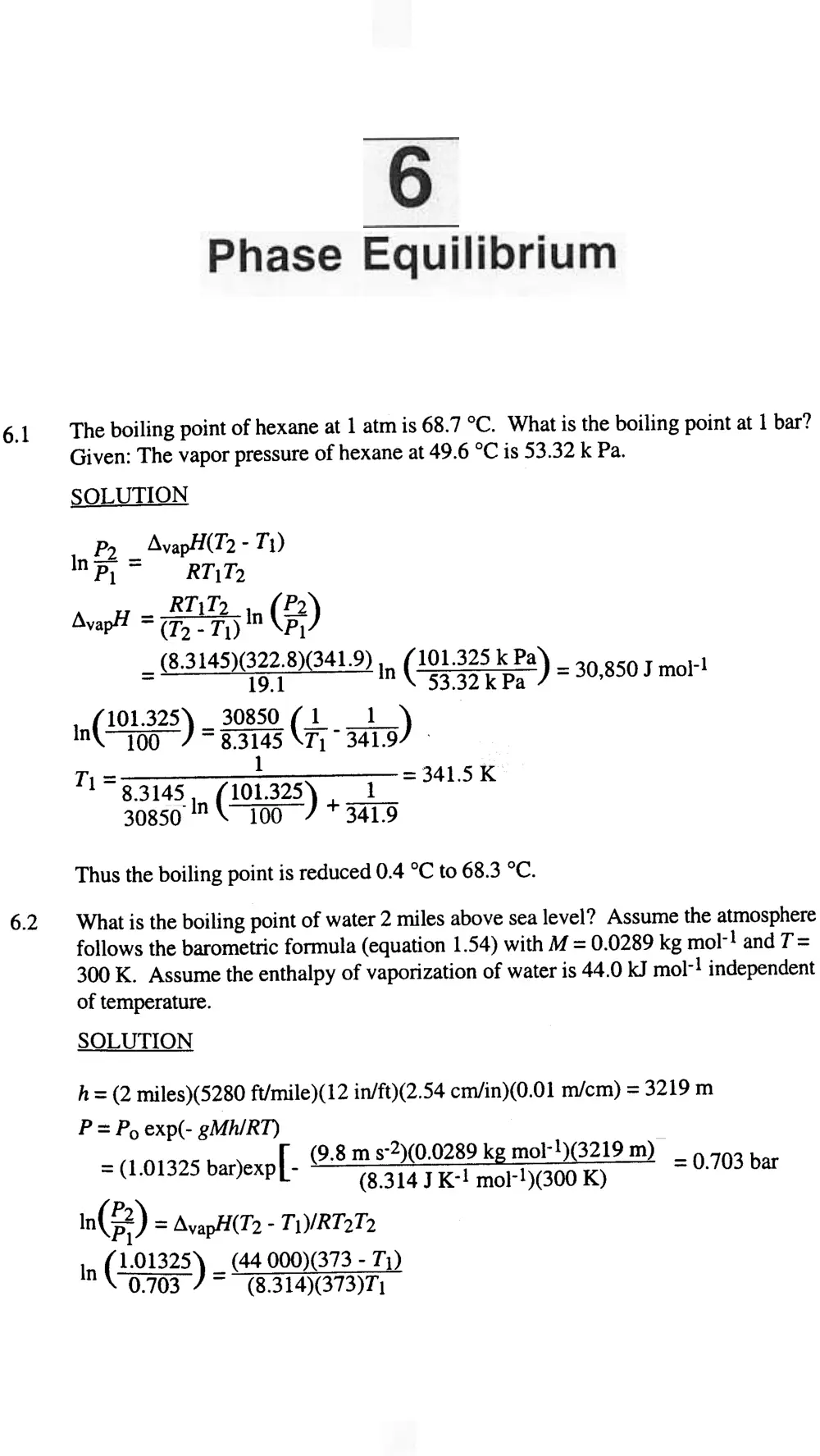
The boiling point of hexane at 1 atm is 68.7 °C. What is the boiling point at 1 bar?
Given: The vapor pressure of hexane at 49.6 °C is 53.32 k Pa.
6.1
SOLUTION
~vapH(T2 -TI)
P2
In PI =
RT1T2
RT1T2 (P2 )
t.vapH = (T2-:-rI)
In
PI
(8.3145)(322.8)(3419)
I (101.325 k Pa
)
=
30850
J
mnl-l
=
19.1n
53.32kPa
,
( 101.325) -~
(J:-.- -~
)
In-
-8.3145
Tl
341.9
1
100
= 341.5 K
TI
=
8.314~
1 ( 101.325 )
~
30850
n
+ 341.9
100
Thus the boiling point is reduced 0.4 °C to 68.3 °C.
What is the boiling point of water 2 miles above sea level? Assume the atmosphere
follows the barometric formula (equation 1.54) with M = 0.0289 kg mol-l and T =
300 K. Assume the enthalpy of vaporization of water is 44.0 kJ mol-l independent
of temperature.
SOLUTION
6.2
h = (2 miles)(5280
ft/mile)(12
in/ft)(2.54
cm/in)(0.01
m/cm) = 3219 m
p = Po exp(- gMh/R7)
= (1.01325
b r)
[ -(9.8
m s-2)(0.0289
kg mol-l)(3219
ml-
a exp
(8.314 J K-l mol-l)(300
K)
(P2)
In Pl
= Llvap1l(T2 -Tl)/RT2T2
In ( 1.01325 )
-(44
000)(373
-Tl)
0.703
-(8.314)(373)Tl
= 0.703
bar
Chapter 6/Phase Equilibrium
96
TI = 364 K = 90.6
°C
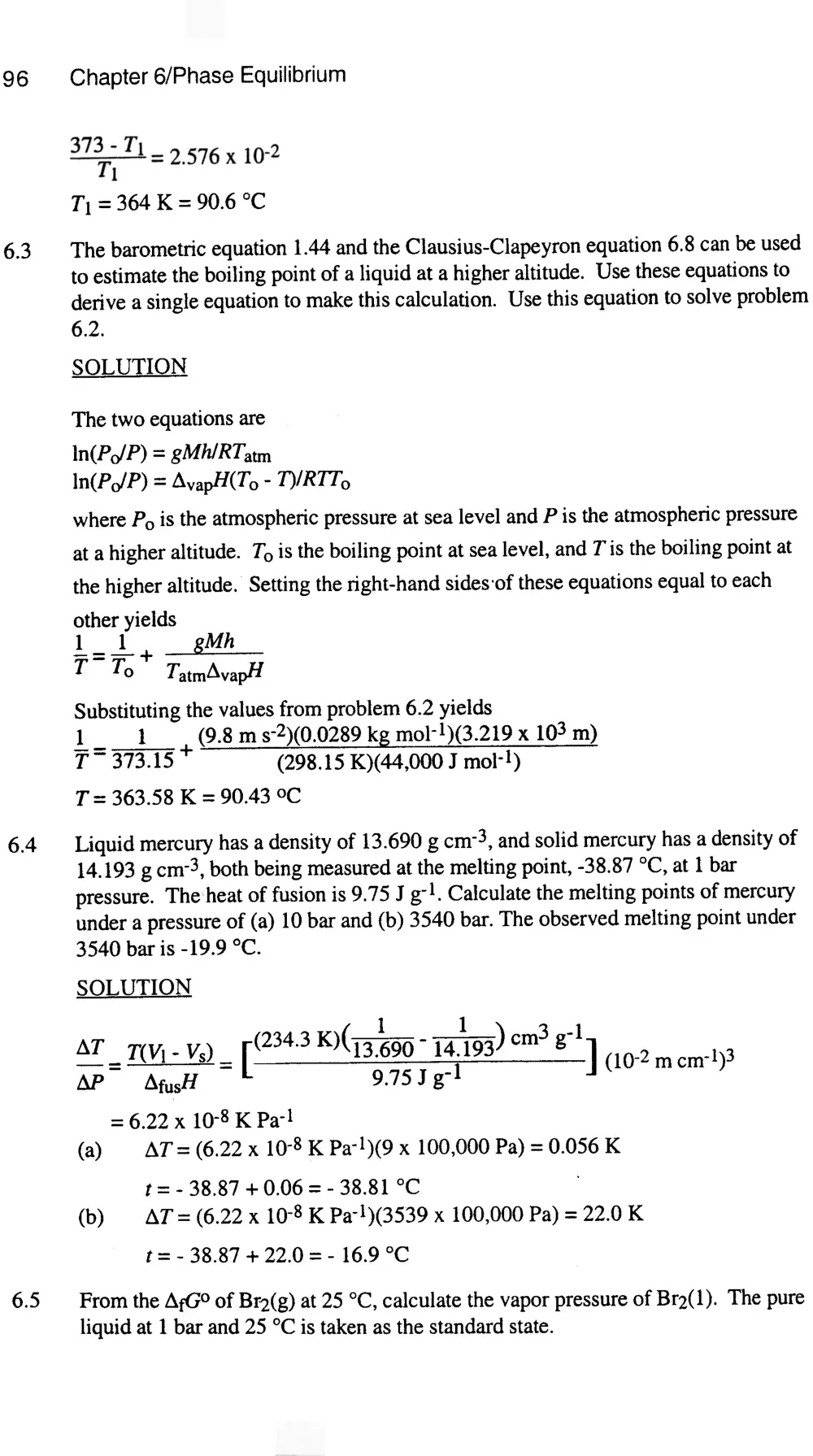
The barometric equation 1.44 and the Clausius-Clapeyron equation 6.8 can be used
to estimate the boiling point of a liquid at a higher altitude. Use these equations to
derive a single equation to make this calculation. Use this equation to solve problem
6.2.
6.3
SOLUTION
The
two
equations
are
In(PJP)
= gMhlRTatm
In(PJP)
= L\vapH(To
-T)/RTTo
where p ° is the atmospheric pressure at sea level and p is the atmospheric pressure
at a higher altitude. T ° is the boiling point at sea level, and T is the boiling point at
the higher altitude. Setting the right-hand sides 'of these equations equal to each
other yields
!-1-+
gMh
T -T °
T atm~vapll
Substituting the values from problem 6.2 yields
! --1-
(9.8 m s-2)(0.0289 kg mol-l)(3.219
x 103 m)
T- 373.15 +
(298.15 K)(44,000 J mol-l)
T = 363.58 K = 90.43 °C
Liquid mercury has a density of 13.690 9 cm-3, and solid mercury has a density of
14.193 9 cm-3, both being measured at the melting point, -38.87 °C, at 1 bar
pressure. The heat of fusion is 9.75 J g-l. Calculate the mel ting points of mercury
under a pressure of (a) 10 bar and (b) 3540 bar. The observed melting point under
3540 bar is -19.9 °C.
6.4
SOLUTION
(
1
1
)
3
-1
~T
T(\I]
-~
)
(234.3
K)
13.690
-14.193
cm
9
]
-=
1
s=
1
(10-2mcm-l)3
L\P
~fusH
9.75
J g-
= 6.22 x 10⁻⁸ K Pa-l
(a)
~T= (6.22 x 10⁻⁸ K Pa-l)(9 x 100,000 Pa) = 0.056 K
t = -38.87 + 0.06 = -38.81 °C
(b)
~T= (6.22 x 10⁻⁸ K Pa-l)(3539 x 100,000 Pa) = 22.0 K
t = -38.87 + 22.0 = -16.9 °C
From the L\tG° of Bf2(g) at 25 °C, calculate the vapor pressure of Br2(1). The pure
liquid at 1 bar and 25 °C is taken as the standard state.
6.5
= [~
97
Chapter 6/Phase Equilibrium
illL
UTlOO
PBr2
K=-p;-
Br2(1) = Br2(g)
L\GO = -RT In ( ~
)
3110 J mol-l
PBr2
[
-
]
-p;-=
exp -(8.314 J K-l mol-l)(298.15
K)
PEr = 0.285 bar
2
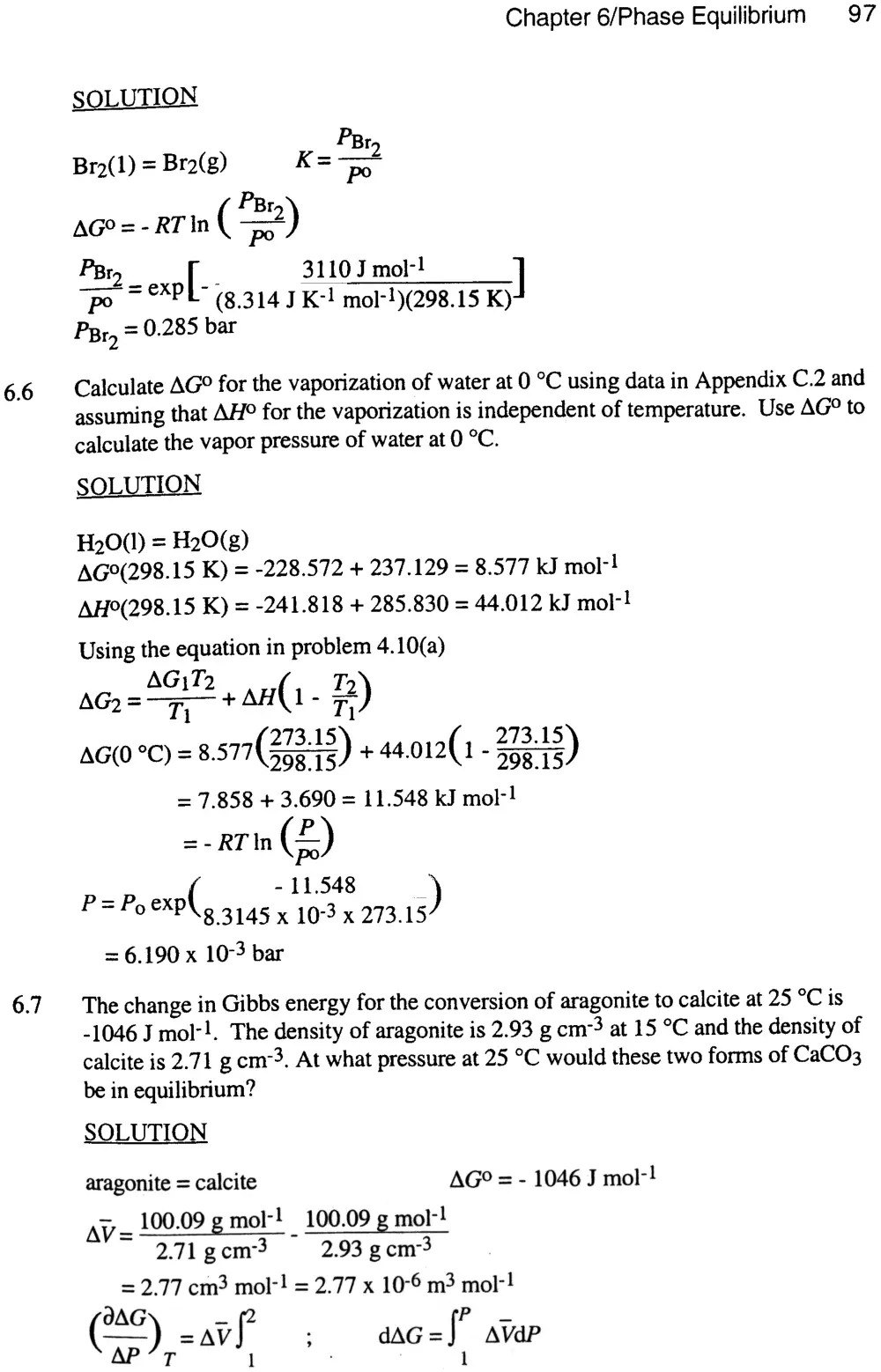
Calculate l1Go for the vaporization of water at O °C using data in Appendix C.2 and
assuming that MlO for the vaporization is independent of temperature. Use l1Go to
calculate the vapor pressure of water at O °C.
6.6
SQLUTION
H20(1) = H20(g)
~GO(298.15 K) = -228.572 + 237.129 = 8.577 kJ mol-l
MlO(298.15 K) = -241.818 + 285.830 = 44.012 kJ mol-l
Using the equation in problem 4.10(a)
l1G1T2
(
T )
l1G2=T!+AH
1- i
l1G(O °C) = 8.577(~)
+ 44.012( 1 -~)
= 7.858 + 3.690 = 11.548 kJ mol-l
= -RTln
(~)
-11.548
p = Po exp(S.3145
x 10-3 x 273.15)
= 6.190
x 10-3 bar
The change in Gibbs energy for the conversion of aragonite to calcite at 25 °C is
-1046 J mol-l. The density of aragonite is 2.93 9 cm-3 at 15 °C and the density of
calcite is 2.71 9 cm-3. At what pressure at 25 °C would these two forms of CaCO3
be in equilibrium?
6.7
SOLUTION
I J mol-l
]
nol-l)(298.15 K)
Chapter 6/Phase
Equilibrium
98
1102 -1101 = 11 V(P -1)
0 + 1046 J mol-l
= (2.77 x 10⁻⁶ m3 mol-l)(p
-1)
p = 3780 bar
*6.8
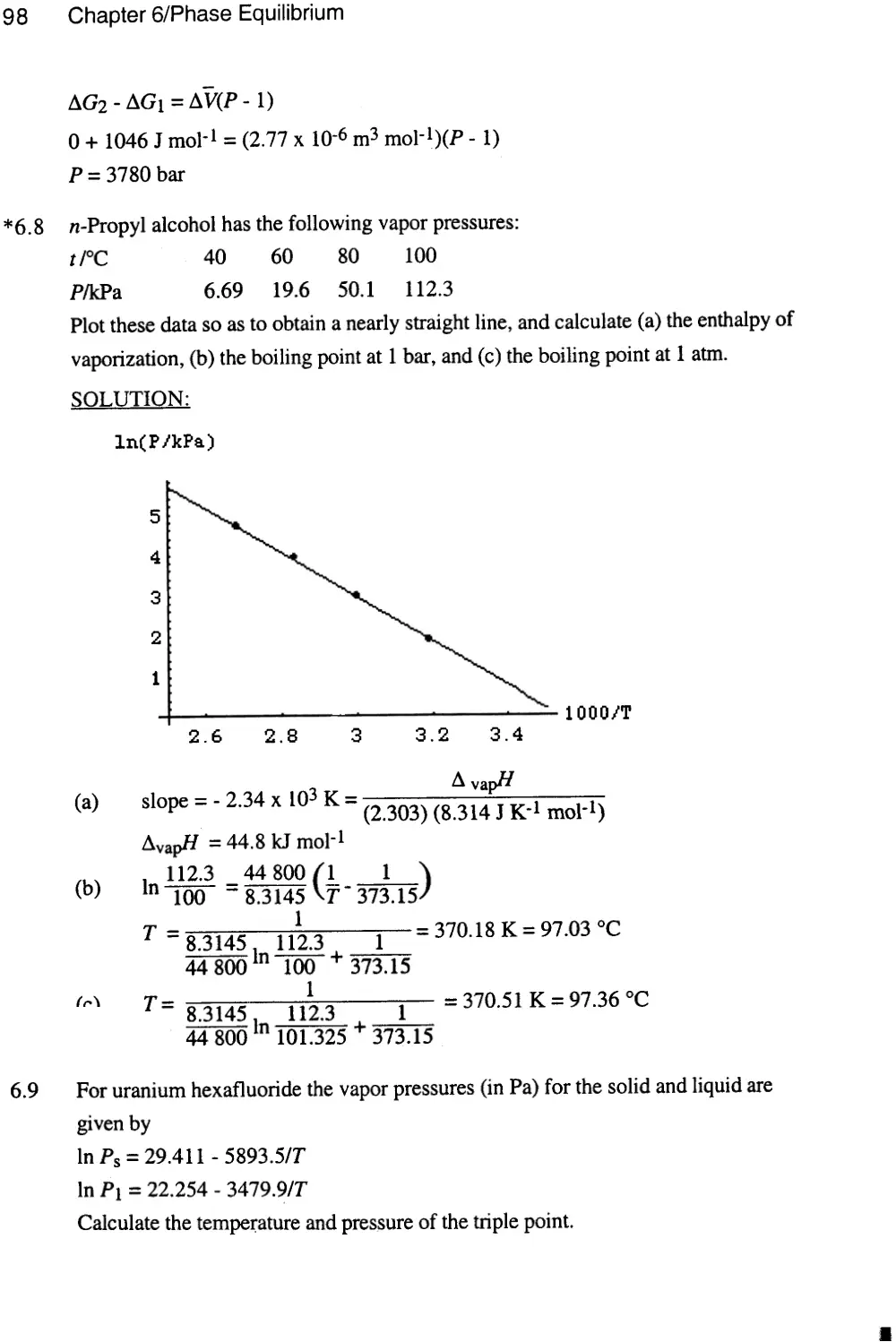
n-Propyl alcohol has the following vapor pressures:
t/OC
40
60
80
100
P/kPa
6.69
19.6
50.1
112.3
Plot these data so as to obtain a nearly straight line, and calculate (a) the enthalpy of
vaporization, (b) the boiling point at 1 bar, and ( c ) the boiling point at 1 atm.
SOLUTION:
In(PJkPs.)
5
4
3
2
1
1000JT
3.2
3.4
2.6
2.8
3
Ll vapll
slope = -2.34
x 103 K =
(a)
(2.303) (8.314 J K-l mol-l)
(b)
~vapll = 44.8 kJ mol-l
In ~
= ~
(!
-1--
)
100
8.3145
T- 373.15
T-
1
-8.3145
112.3
1
= 370.18 K = 97.03 °C
44 800 In 100
+ 373.15
T-
1
-~
112.3
1
= 370.51 K = 97.36 °C
44 800 In 101.325 + 3nI5
(,..\
6.9
For uranium hex afluoride the vapor pressures (in Pa) for the solid and liquid are
given by
In Ps = 29.411 -5893.5/T
In PI = 22.254 -3479.9/T
Calculate the temper:ature and pressure of the triple point.
.
£..1 vapll:
103 K=
I"
'1{\'1\
'Q '11A
T V-l
n1-1\
Chapter 6/Phase Equilibrium
99
SOLUTION
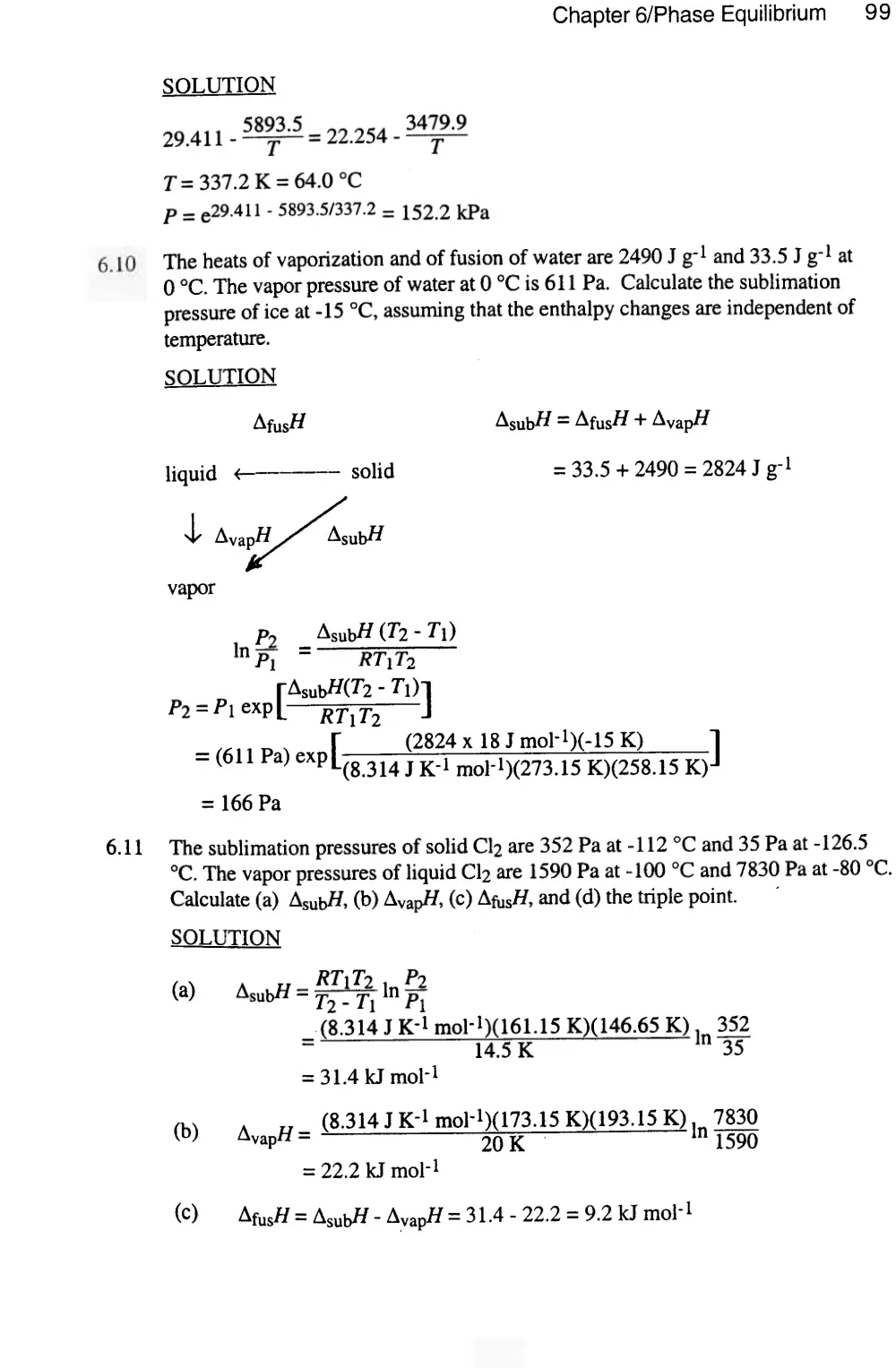
The heats of vaporization and of fusion of water are 2490 J g-l and 33.5 J g-l at
0 °C. The vapor pressure of water at 0 °C is 611 Pa. Calculate the sublimation
pressure of ice at -15 °C, assuming that the enthalpy changes are independent of
temperature.
SOLUTION
/1subH = /1fusH
+ /1vapH
L\fusH
= 33.5 + 2490 = 2824 J g-l
liquid
f
solid
.J, 6V.~U~
~
vapor
8subH
(T2
-TI)
In~
PI
RTIT2
P2 = PI
exp[~S~~
-TI)
-
RTIT2
[
(2824 x 18 J mol-l)(-15
K)
]
= (611 Pa) exp
(8.314 J K-l mol-l)(273.15
K)(258.15
K)
=
166
Pa
The sublimation pressures of solid CI2 are 352 Pa at -112 °C and 35 Pa at -126.5
°C. The vapor pressures of liquid Cl2 are 1590 Pa at -100 °C and 7830 Pa at -80 °C.
Calculate (a) ~subll, (b) ~vapll, (c) ~fusH, and (d) the triple point.
,
SOLUTION
6.11
(a)
!1
.u
-!!J:lI1..
In f1
su~~ -T2-
TI
PI
(8.314
J K-I
moI-I)(161.15
K)(146.65
K)
I
352
=
.14:5
K
n35
= 31.4 kJ mol-l
~
H -(8.314
J K-l
mol-l)(173.15
K)(193.15
K) l
~
yap
-20
K
n 1590
(b)
= 22.2 kJ mol-l
~fusH
= ~subH
-~vapH
= 31.4-
22.2 = 9.2 kJ mol-l
(c)
£
-
-1.
[ J1.subll(T2
-TI) ]
PI exp
RTIT2
[
(2824
x 1
, (611 Pa) exp
(Sl ~1LI. T 1(-1 mn1
Chapter 6/Phase Equilibrium
100
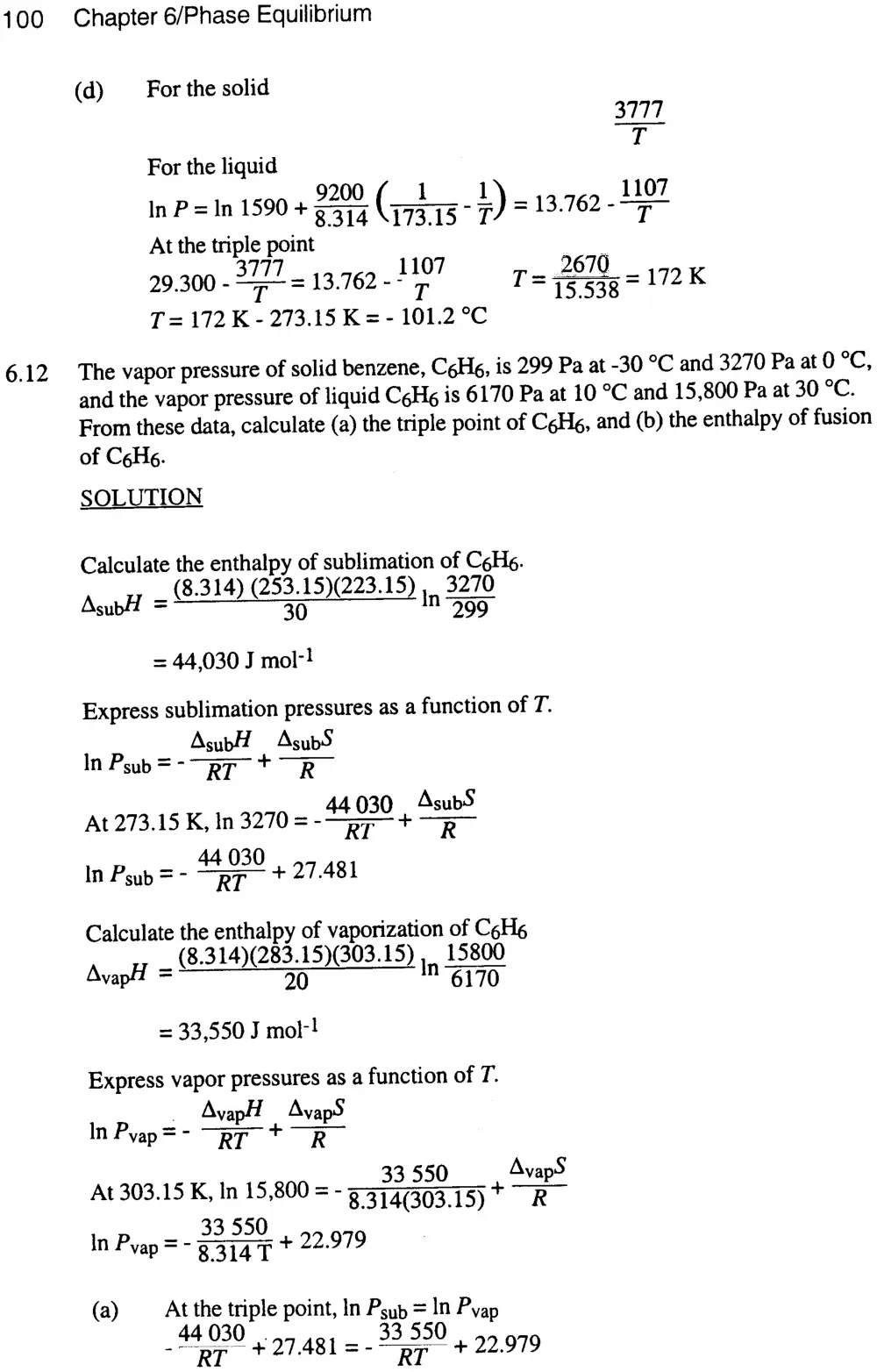
For the solid
(d)
3777
r-
1107
r-
2670
T- -15.538
=
172
K
6.12
The vapor pressure of solid benzene, C6fl6, is 299 Pa at -30 °C and 3270 Pa at 0 °C,
and the vapor pressure of liquid C6H6 is 6170 Pa at 10 °C and 15,800 Pa at 30 °C.
From these data, calculate (a) the triple point of C6fl6, and (b) the enthalpy of fusion
of C6H6.
SOLUTION
Calculate the enthalpy of sublimation of C6ll6.
A .u
-(8.314)
(253.15)(223.15)
1
~
tisu~..
-30
n
299
= 44,030 J mol-l
Express sublimation pressures as a function of T.
~subll
~subS
lnPsub=-~+
-y
~subS
~
44 030
At 273.15 K, In 3270 = -RT
44 030 + 27.481
+
In Psub = -
RT
Calculate the enthalpy of vaporization of C6lI6
A -J/ -~8.314)(283.15)(303.15)
1
~
Uvap'A-
20
n
6170
= 33,550 J mol-l
Express vapor pressures as a function of T.
ilvapH
ilvapS
InPvap=-
RT+
-y
~vapS
R
33 550
At 303.15 K, In 15,800 = -8.314(303.15)
+
33 550
In Pvap = -8.314 T + 22.979
At the triple point, In Psub = In Pvap
-~+.27.481
= -33 5~
+ 22.979
(a)
RT
RT
For the liquid
9200 (
1
1)
In p = In 1590 + K3I4
r7m
-f
= 13.762 -
At the triple point
29.300- ~=
13.762- J~7
~
T= 172 K- 273.15 K = -101.2 °C
Chapter 6/Phase Equilibrium
101
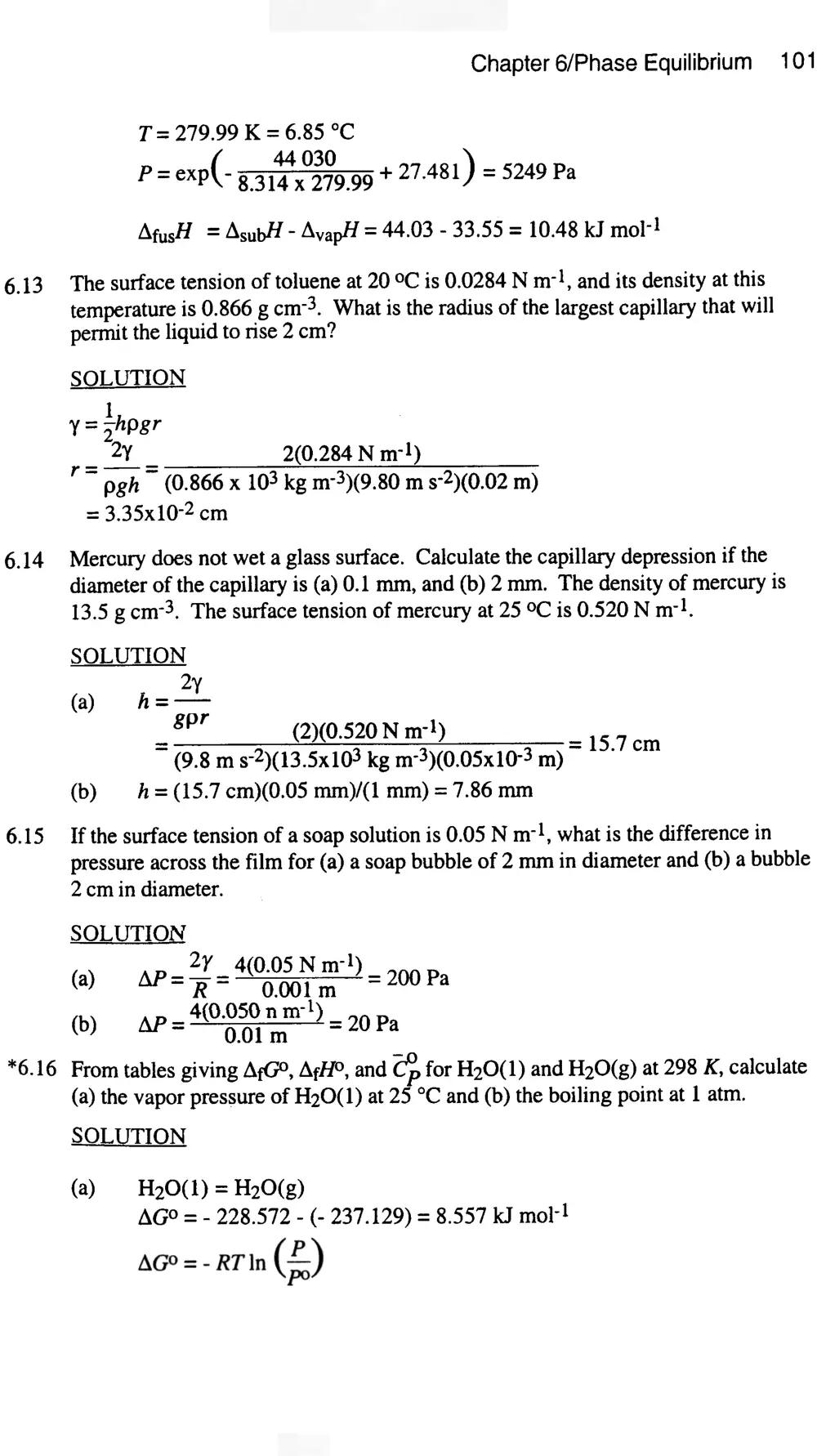
T=
279.99
K = 6.85
°C
(
44 030
)
p = exp
-8.314
x 279.99
+ 27.481
= 5249
Pa
~fusH
= ~sub1l-
~vapH
= 44.03
-33.55
= 10.48
kJ mol-l
The surface tension of toluene at 20 °C is 0.0284 N m-l, and its density at this
temperature is 0.866 9 cm-3. What is the radius of the largest capillary that will
permit the liquid to rise 2 cm?
6.13
SOLUTION
1
y = 2hpgr
2y
2(0.284 N m-i)
r----pgh
-(0.866
x 103 kg m-3)(9.80
m s-2)(0.02 m)
= 3.35xI0-2
cm
Mercury does not wet a glass surface. Calculate the capillary depression if the
diameter of the capillary is (a) 0.1 mm, and (b) 2 mm. The density of mercury is
13.5 9 cm-3. The surface tension of mercury at 25 °C is 0.520 N m-l.
6.14
SOLUTION
(a)
2y
h=-:-
gpr
(2)(0.520
N m-l)
==
15.7 cm
(9.8 m s-2)(13.5x10³
kg m-3)(O.O5x10-3
m)
h = (15.7 cm)(O.O5 mm)/(l
mm) = 7.86 mm
(b)
If the surface tension of a soap solution is 0.05 N m-l, what is the difference in
pressure across the film for (a) a soap bubble of 2 mrn in diameter and (b) a bubble
2 cm in diameter.
6.15
SOLUTION
4(0.05 N m-l ,
2r
(a)
M=R=
0.001 m
=200
Pa
(b)
M
= 4(0.§.~~ ~ m-i) = 20 Pa
*6.16
From tables giving L\tGD, L\fJlO, and cPp for H2O(1)
and H2O(g)
at 298 K, calculate
(a) the vapor pressure of H2O(1)
at 25 °C and (b) the boiling
point at 1 atm.
SOLUTION
(a)
H20(1) = H20(g)
LlGo = -228.572 -( -237.129) = 8.557 kJ mol-l
l~
-2y
4(0.05
N m-i)
= 200
Pa
=R=
0.001
m
.4/1\ I\~I\
---1
\
Chapter 6/Phase Equilibrium
102
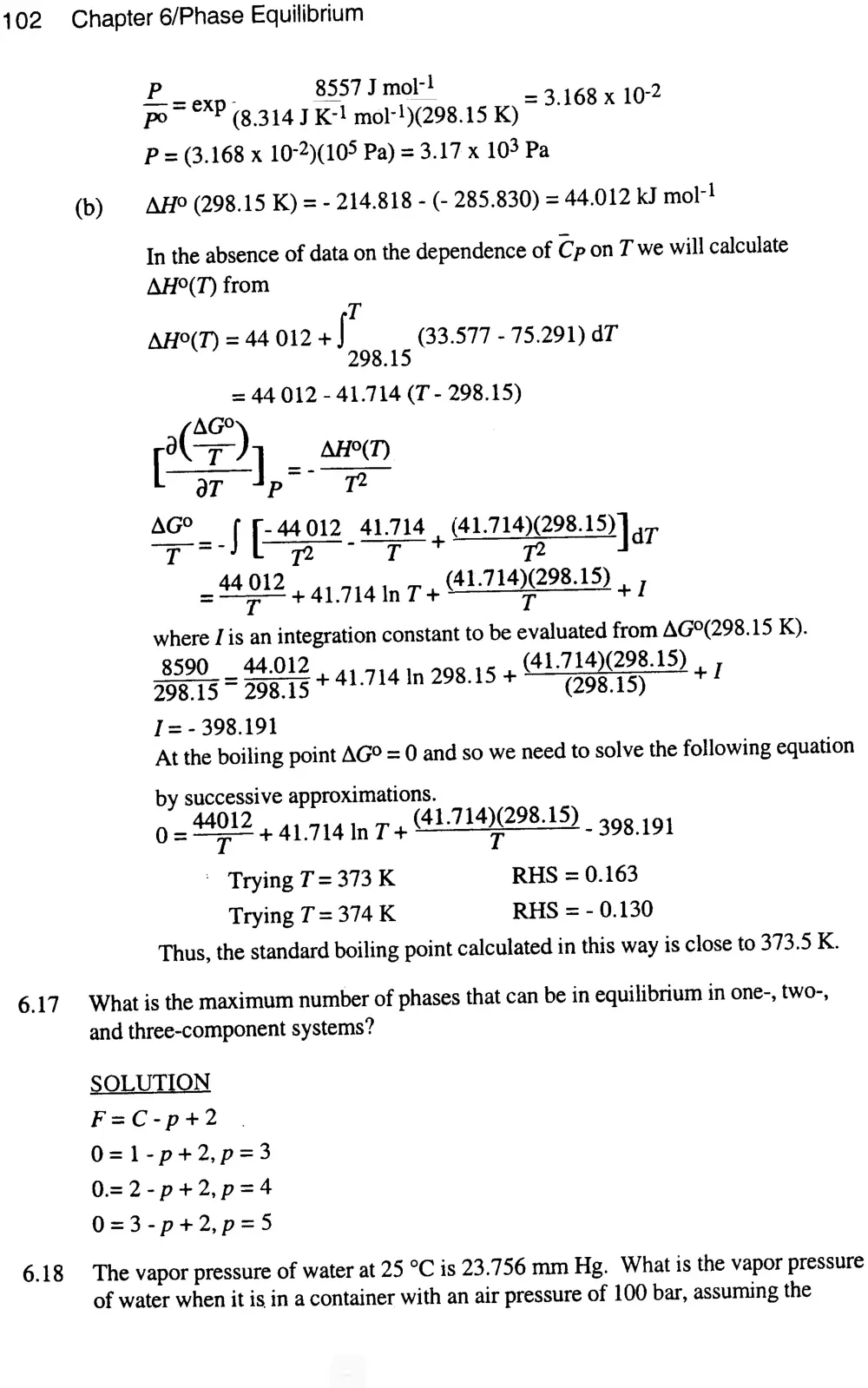
8557 J mol-l
p
--exp-
-3168x10-2
po -(8.314
J K-l
mol-l)(298.15
K)
-.
p = (3.168 x 10⁻²)(105 Pa) = 3.17 x 10³ Pa
MlO (298.15 K) = -214.818-
(- 285.830)
= 44.012 kJ mol-l
(b)
In the absence of data on the dependence of C p on T we will calculate
MIO(7) from
T
MlO(7)
= 44012
+ f
298.15
= 44012
-41.714
(T-
298.15)
(~
)
[~
(33.577- 75.291) dT
~0(1)
12
--
p
~GO
-44012
41.714
T =-J I
44012
-
(41.714)(298.15}
]dT
12
T
+
12
T
+41.7141nT+~!4¥29~+I
where I is an integration
constant to be evaluated from l1GO(298.15 K).
~-~
417141
29815
{11.714)(298.15)
I
298.15-
298.15 +
.n
.+
(298.15)
+
I=
-398.191
At the boiling
point l1Go = O and so we need to solve the following
equation
by successive approximations.
O = .'!.'!:Q!1 + 41.714 In T + ~7J4¥298~ill-
398.191
T
Trying T= 373 K
RHS = 0.163
Trying T= 374 K
RHS = -0.130
Thus, the standard boiling point calculated in this way is close to 373.5 K.
What is the maximum number of phases that can be in equilibrium in one-, two-,
and three-component systems?
6.17
SOLUTION
F=C-p+2
0 = 1 -p + 2, p = 3
0.= 2 -p + 2, p = 4
0 = 3 -p + 2, p = 5
The vapor pressure of water at 25 °C is 23.756 mm Hg. What is the vapor pressure
of water when it is. in a container with an air pressure of 100 bar, assuming the
6.18
-=-
,
-~~
v..~
~~. .~ .,.
-
(~GO)
[~]
=-~
dT
p
l~
~--
f
[ --44012-~+!
T
-7'2
T
=~+41.7141n
T+
(
Chapter 6/Phase
Equilibrium
103
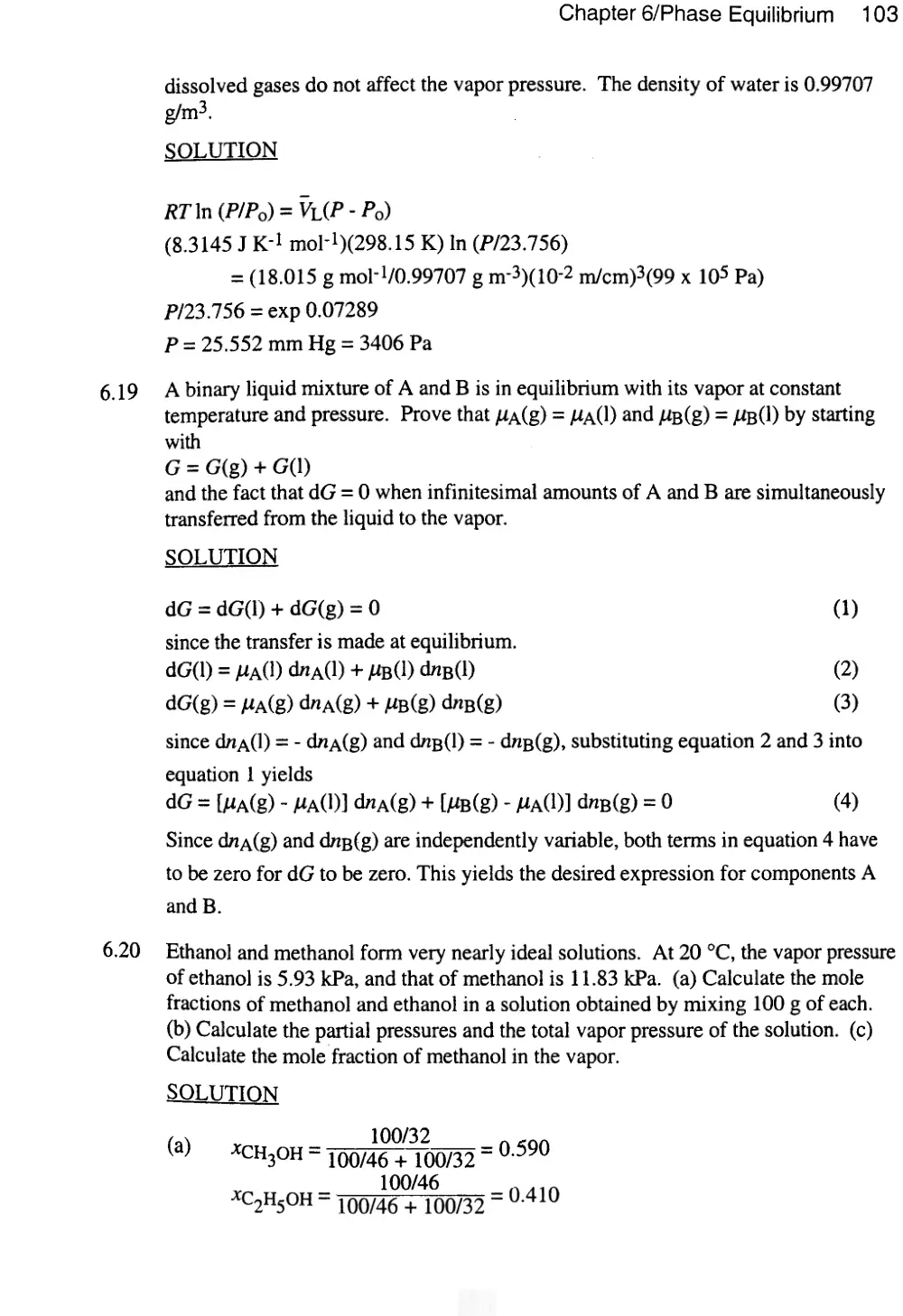
dissolved gases do not affect the vapor pressure. The density of water is 0.99707
g/m3.
SOLUTION
-
RTln
(P/Po) = VL(P-
Po)
(8.3145 J K-l mol-l)(298.15
K) In (P/23.756)
= (18.015 9 mol-l/0.99707
9 m-3)(10-2 m/cm)3(99
x 105 Pa)
P/23.756
= exp 0.07289
P = 25.552 mm Hg = 3406 Pa
6.19
A binary liquid mixture
of A and B is in equilibrium
with its vapor at constant
temperature
and pressure.
Prove that 'UA(g) = 'UA(l) and 'UB(g) = 'UBO) by starting
with
G = G(g) + GO)
and the fact that dG = O when infinitesimal
amounts of A and B are simultaneously
transferred
from the liquid to the vapor.
SOLUTION
~
dO = dO(I) + dO(g)
= O
(I)
since the transfer is made at equilibrium.
dO(I) = ,LtA(I) dnA(1) + ,LtB(1) dnB(1)
(2)
dO(g) = ,LtA(g) dnA(g) + ,LtB(g) dnB(g)
(3)
since dnA(1) = -dnA(g)
and dnB(1) = -dnB(g),
substituting
equation
2 and 3 into
equation 1 yields
dO = [,LtA(g) -,LtA(1)] dnA(g) + [,LtB(g) -,LtA(1)] dnB(g) = 0
(4)
Since dnA(g) and dnB(g) are independently
variable, both terms in equation 4 have
to be zero for dO to be zero. This yields the desired expression
for components
A
andB.
6.20
Ethanol and methanol form very nearly ideal solutions. At 20 °C, the vapor pressure
of ethanol is 5.93 kPa, and that of methanol is 11.83 kPa. (a) Calculate the mole
fractions of methanol and ethanol in a solution obtained by mixing 100 9 of each.
(b) Calculate the partial pressures and the total vapor pressure of the solution. (c)
Calculate the mole fraction of methanol in the vapor.
~OLUTION
100/32
(a)
XCH3OH
= lOO/46
+ lOO/32
= 0.590
100/46
lOO/32
,
13OH = lOO/46 + 100732 = 0.-
100/46
~H5OH = 100/46 + 100/32 = 0
Chapter 6/Phase Equilibrium
104
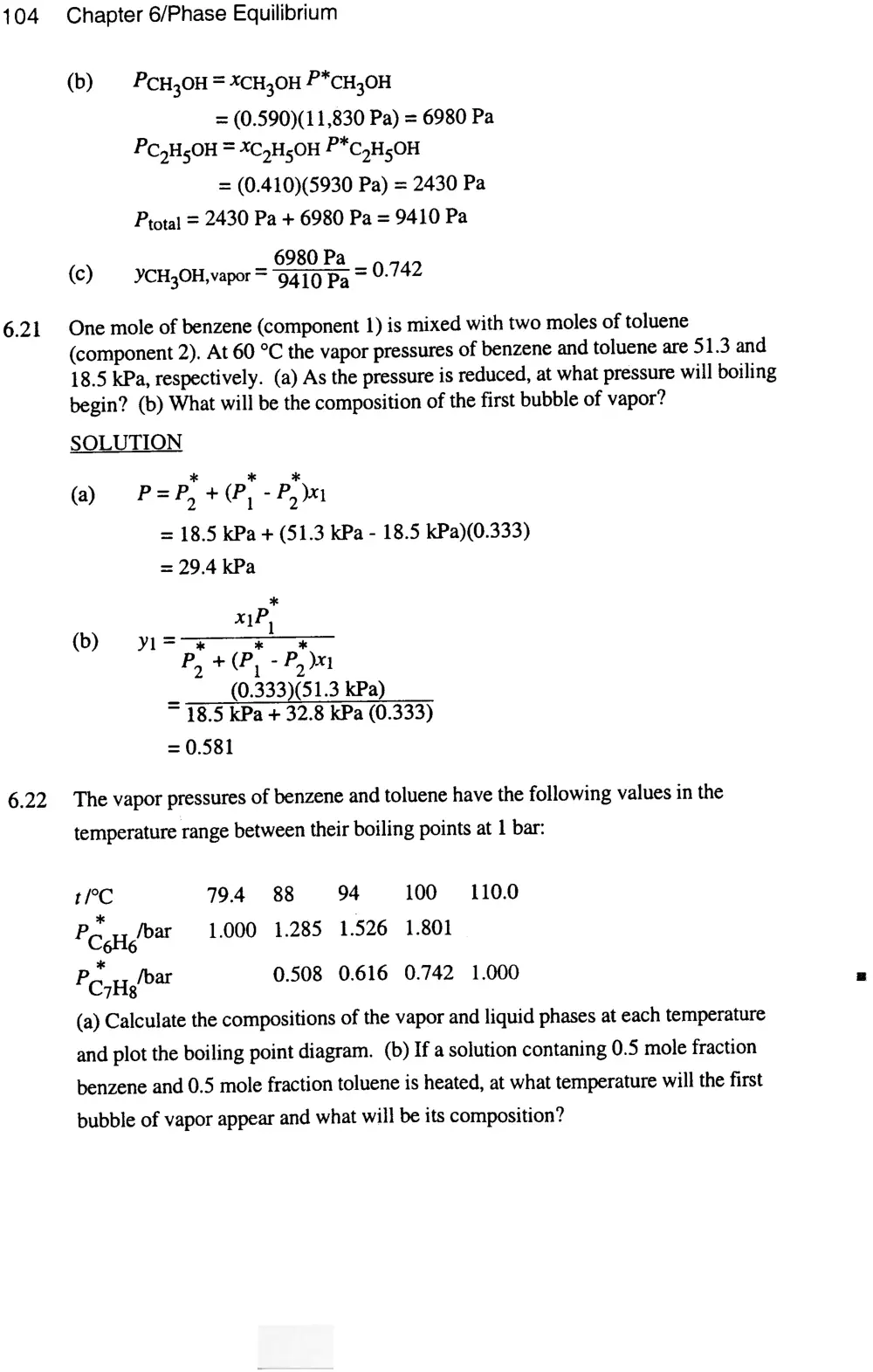
(b)
PCH30H = XCH30H P*CH30H
= (0.590)(11,830 Pa) = 6980 Pa
PC2HSOH = XC2HSOH P*C2HSOH
= (0.410)(5930 Pa) = 2430 Pa
Ptotal = 2430 Pa + 6980 Pa = 9410 Pa
6980 Pa
YCH30H,vapor=
9410 Pa= 0.742
(c)
6.21
One mole of benzene (component 1) is mixed with two moles of toluene
(component 2). At 60 °C the vapor pressures of benzene and toluene are 51.3 and
18.5 kPa, respectively. (a) As the pressure is reduced, at what pressure will boiling
begin ? (b) What will be the composition of the first bubble of vapor?
SOLUTION
(a)
*
*
*
p = p 2 + (P I -p 2 )XI
= 18.5 kPa + (51.3 kPa -18.5 kPa)(0.333)
= 29.4 kPa
*
XlPl
(b)
yI =
*
*
*
p 2 + (P I -p 2 )XI
(0.333)(51.3
kPa)
= 18.5 kPa + 32.8 kPa (0.333)
= 0.581
The vapor pressures of benzene and toluene have the following values in the
temperature range between their boiling points at 1 bar:
6.22
tlOC
110.0
*
p C6B6/bar
*
PC7HS/bar
0.508
0.616
0.742
1.000
(a) Calculate the compositions of the vapor and liquid phases at each temperature
and plot the boiling point diagram. (b) If a solution contaning 0.5 mole fraction
benzene and 0.5 mole fraction toluene is heated, at what temperature will the first
bubble of vapor appear and what will be its composition?
79.4
88
94
100
1.000 1.285 1.526 1.801
.
.l\,1~ 1
Yl
=
*
*
*
p
...( p
-p
)}"1
105
Chapter
6/Phase
Equilibrium
.SOL UTION
At 88 °C
(a)
At 94 °c
At 100 °C
oXB(1.285) + (1 -oXB) 0.508 = 1
oXB = 0.633
YB = (0.633)(1.285)/1 = 0.814
oXB(1.526) + (1- XB) 0.616 = 1
oXB = 0.422
yB = (0.4222)(1.526)/1 = 0.644
oXB(1.801)+(1-oXB)0.742=
1
oXB = 0.244
YB= (0.244)(1.801)/1 = 0.439
tJoC
1
0.4
0.6
0.8
0.2
The liquid curve is below the vapor curve. These curves were plotted by
using Mathematica TM to fit them with quadratic equations.
(b)
The fit of the liquid data with t = a + bXB + CXB2 yields t = 109.9 -42.72\B
+ 12.29XB2. At xB = 0.5, t = 91.6 °C. Fit of the vapor data yields t =
109.9- 15.13YB -15.13YB2. Setting the temperature in this equation equal
to the bubble point temperature 91.6 °C yields yB = 0.72, by use of
the
quadratic formula. This is the composition at which the first bubble of
vapor
will appear .
6.23
At 1.013 bar pressure propane boils at -42.1 oC and n-butane boils at -0.5 oC; the
following vapor-press'ure data are available.
t 1°C
-31.2
-16.3
P/kPa(propane)
160.0 298.6
P/kPa(n-butane)
26.7
53.3
Chapter 6/Phase Equilibrium
106
Assuming that these substances fonn ideal binary solutions with each other, (a)
calculate the mole fractions of propane at which the solution will boil at 1.013 bar
pressure at -31.2 and -16.3 °C. (b) Calculate the mole fractions of propane in the
equilibrium vapor at these temperatures. (c) Plot the temperature-mole fraction
diagram at 1.013 bar, using these data, and label the regions.
SOLUTION
(a)
At -31.2 °C, Pp = xp/60.0 kPa, PB = (1- xp) 26.7 kPa
p = 101.3 kPa = xp 160.0 + (1- xp) 26.7
= 26.7 + 133.3 xp
xp = 0.560
At -16.3 °C, Pp = xp 298.6 kPa, PB = (1- xp) 53.3 kPa
p = 101.3 kPa = xp 298.6 + (1- xp) 53.3
= 53.3 + 245.3 xp
xp = 0.196
At -31.2 °C,
(b)
(0.560)(160.0)
yP = (0.560)(i60.0)
+ (0.440)(26.7) = 0.884
At -16.3 °C
(0. 196)(298.6)
yp = (0. 196)(298.6) + (0.804)(53.3) = 0.577
(c)
tJoC
~
0
-10
-20
-30
-40
...xp
) yp
0.2
0.4
0.6
0.8
1
107
Chapter 6/Phase Equilibrium
The following table gives mole % acetic acid in aqueous solutions and in the
equilibrium vapor at the boiling point of the solution at 1.013 bar.
6.24
100.0
104.4
102.1
113.8
107.5
118.1
B.P.,oC
Mole % of acetic acid
0
50.0
30.0
100
90.0
70.0
In liquid
18.5
0
57.5
37.4
100
83.3
In
vapor
Calculate the minimum number of theoretical plates for the column required to
produce an initial distillate of 28 mole % acetic acid from a solution of 80 mole %
acetic acid.
.SOLUTION
mole
t in
vapor
100~
80
60
40
20
mole
t in
liquid
100
60
80
20
40
Since there are four steps, three theoretical plates are required in the column. The
distilling pot counts as one plate.
If two li quids (1 and 2) are completely immiscible, the mixture will boil when the
*
*
sum of the two partial pressures exceeds the applied pressure: p = p 1 + p 2 .In the
vapor phase the ratio of the mole fractions of the two components is equal to the
ratio of their vapor pressures.
*
p I
xi
mIM2
p*=X2=1n2M1
2
where m 1 and m2 are the masses of components 1 and 2 in the vapor phase, and M 1
and M2 are their molar masses. The boiling point of the immiscible liquid system
naphthalene-water is 98 °C under a pressure of 97.7 kPa. The vapor pressure of
6.25
Chapter
6/Phase
Equilibrium
108
water at 98 °C is 94.3 kPa. Calculate the weight percent of naphthalene in the
distillate.
SOLUTION
0.256
Weight percent naphthalene = 1.256 = 0.204 or 20.4%
A regular binary solution is defined as one for which
6.26
Derive L\mixG, L\mixS, L\mixH, and L\mix V for the mixing of xi moles of component 1
with x2 moles of component 2. Assume that the coefficient w is independent of
temperature.
SOLUTION
o
o
GO = ~ ni'U,.O = Xl'Ul
+ X2'U2
1
LlmixG = RT(xllml
+ x21m2) + wxlx2
LlmixS = -(aLlmixG/a7)p = -R(xllml
+ x21mv
LlmixH = LlmixG + TLlmixS = wxlx2
Llmix V = (aLlmixG/aP)T = 0
From the data given in the following table construct a complete temperature-
composition diagram for the system ethanol-ethyl acetate for 1.013 bar. A solution
containing 0.8 mole fraction of ethanol, EtOH, is distilled completely at 1.013 bar.
(a) What is the composition of the first vapor to come off? (b) That of the last drop
of liquid to evaporate? (c) What would be the values of these quantities if the
distillation were carried out in a cylinder provided with a piston so that none of the
vapor escapes?
6.27
109
Chapter 6/Phase Equilibrium
B.P.,oC
B.P.,oC
XEtOH
YEtOH
YEtOH
XBtOH
72.0
0.563
0.507
77.15
0
0
72.8
0.710
0.600
76.7
0.070
0.025
74.2
0.735
0.833
75.0
0164
0.100
76.4
0.880
0.942
72.6
0.295
0.240
77.7
0.965
0.982
71.8
0.398
0.360
78.3
1.000
1.000
71.6
0.462
0.462
~OLUTION
t/oC
78
77'
7C I
i
75
74
73
721
x(EtOH),y(EtOH)
1
0.6
0.8
0.2
0.4
I
,
c
",
,
The composition of the liquid is given by the lower curve, and the composition of
the vapor is given by the upper curve.
(a)
The liquid with 0.8 mole fraction ethanol will start to boil at 73.7 °C. The
vapor in equilibrium with it is 0.69 mole fraction in ethanol.
(b)
As the boiling continues, more and more of the EtAc will be removed. As
the mole fraction of EtCH increases, the boiling point will also increase.
Finally, the very last vapors will be pure EtCH.
(c)
The first vapor to come off will be the same as in part (a). However, when
all of the mixture is in the vapor state, the mole fraction of the vapor state will
be 0.800, simply because that is the total mole fraction of EtCH in the entire
mixture. Thus, to find the composition of the last drop to evaporate into the
cylinder, simply note that liquid <YEtOH = 0.9) is in equilibrium with vapor
which has 0.800 EtCH in it.
6.28
The Henry law constants for oxygen and nitrogen in water at 0 °C are 2.54 x 10⁴
bar and 5.45 x 10⁴ bar, respectively. Calculate the lowering of the freezing point of
water by dissolved air with 80% N2 and 20% 02 by volume at 1 bar pressure.
Chapter 6/Phase Equilibrium
110
SOLUTION
0.8 bar
5.45 x 10⁴ bar
0.2 bar
2.54 x 10⁴ bar
= 1.47 x 10⁻⁵
PN
XN
--2--
2 -KN2
-
Po
xO2 = ~
= "- -=
7.87 x 10⁻⁶
2
The mole fraction
of dissolved
air is 2.26 x 10-5 =
m
1000
m
+
18.02
mair = 1.25 x 10⁻³ mol/IOOO 9 solvent
~Tfp= Kfp m = -(1.86)(1.25
x 10-3) =- 0.00233
K
Use the Gibbs-Duhem equation to show that if one component of a binary liquid
solution follows Raoult's law, the other component will too.
SOLUTION
~
~"i
~"
j"
'i:
'
J"';
c
;c I'i
" ,
"'r'r
"f
! i
!::"'I'
The following data on ethanol-chlorofonn solutions at 35 °C were obtained by G.
Scatchard and c. L. Raymond [1. Am. Chem. Sac. 60,1278 (1938)]:
O..jU
1.0
0.6
0.8
0.4
0
0.2
XEtOH,liq
0.4246
1.0000
0.2554
0.1864
YEtOH.vap 0.0000 0.1382
13.703
25.357
38.690
34.387
Total P/kPa 39.345 40.559
Calculate the activity
coefficients
of ethanol and chlorofonn
based on the deviations
from Raoult's law.
1
! 1
! r
Chapter 6/Phase
Equilibrium
111
.SOLUTION
YEtO~
(0. 1382)(40.559)
rEtOH =
p*
=
(0.2)(13.703)
XEtOH" EtOH
=
0.2
~tOH
=
0.4
~tOH
-(0.1864)(38.690)
-1316
-(0.4)(13.703)
-.
-(0.2554)(34.387)
-1065
-(0.6)(13.703)
-.
-(0.4246)(25.357)
- 0 982
-(0.8)(13.703)
-.
(1.OOO)(13.703)
= (1.000)(13.703)
= 1.000
=
0.8
~tOH
=
1.0
~tOH
~
-YCHC13P
-(1)(39.345)
CHC13
-XCHC13P*CHC13
-(1)(39.345)
(0.8618)(
40.559)
=
(0.8)(39.345)
= (0.8136)(38.690)
(0.6)(39.345)
= (0.7446)(34.387)
(0.4)(39.345)
(0.5754
)(25.357)
=
(0.2)(39.345)
=1
XCHCl3
= 1.111
=
1.333
= 1.627
=
1.854
=
0.2
XCHCl3
Show that the equations for the bubble-point line and dew-point line for nonideal
solutions are given by
6.31
*
P-r2P2
x =
*
*
1
r1PXl -r2P 2
SOLUTION
*
P-r2P2
X =
*
*
1
r1Pl -r2P 2
Chapter 6/Phase Equilibrium
112
PI
-
--
YI-PI+P2
*
*
*
r2P2 +Xl(rlPl -r2P2)
Substituting the expression for xi yields the desired expression for yi.
A regular binary solution is defined as one for which
6.32
Derive the expressions for the activity coefficients of rl and r2in tenDS of w.
SOLUTION
wx22/
RT
Therefore,
wx22/RT
y -e
1 -
The expressions for the activity coefficients of the components of a regular binary
solution were derived in the preceding problem. Derive the expression for r in
tenns of the experimentally measured total pressure P, the vapor pressures ot the
two components, and the composition of the solution for the case that the deviations
from ideality are small.
SOLUTION
6.33
r2 = exp(wxi/R7)
2
2
*
( WX2 )
*
( WXl )
= XlP 1 exp liT
+ X2P 2 exp liT
XIYIPI
-=
*
*
*
Chapter 6/Phase Equilibrium
113
If the exponentials
are not far from
unity,
the exponentials
may be expanded
to
obtain
2
2
*
wx2
*
WXl
P=XIPl
(1+RT)+x2P2
(l+RT)
Thus from a measurement of the total pressure of a mixture of the two components,
the activity coefficients of the components can be calculated over the entire
concentration range using the first two equations given above. This is a particular
example of the general situation that r 1 and r2 can be calculated from the total
pressure as a function of xl.
6.34
Using the data in Problem 6.75, calculate the activity coefficients of water (I) and n-
propanol (2) at 0.20, 0.40, 0.60, and 0.80 mole fraction of n-propanol, based on
deviations from Henry's law and considering water to be the solvent.
SOLUTION
The data at the lowest mole fractions of n-propanol are used to calculate the Henry
law constant for n-propanol in water.
x2
K2 = P2/X2
0.02
33.5
0.05
28.8
0.10
17.6
!{2
x2
0.02
0.04
0.06
0.08
0.1
The intercept indicates that K2 = 37 kPa.
114
At
I
P2
r2=
X2K2
x2
=
0.2
x2
= 0.4
X2
=
0.6
X2
=
0.8
rl
=
x2
=
0.2
-2.89
-W6)(3T'75
=
1.52
x2
=
0.4
x2
=
0.6
-2.65
-(o:4)(3:rrj
= 2.09
-1.79
-(O:2R3:-m
=
2.82
X2
= 0.8
.s.Q L UTI 00
68.4
--342
-=
3.59 x 10-3
X2 -68.4
IJ>..QQ
342 +
18
P*-PI
~=3.59x
10-3
-1
= x2
2.3149
PI
(a)
PI = 2.3149(1-
3.59 x 10⁻³) = 2.3066 kPa
~Tf = Kfm
= 1.86(0.2)
= -0.372
Tf = -0.372
°C
(b)
Chapter 6/Phase Equilibrium
115
6.36
The protein human plasma albumin has a molar mass of 69,000 9 mol-l,
Calculate
the osmotic pressure. of a solution of this protein containing 2 g per 100 cm3 at
25 °C in (a) pascals and (b) millimeters of water. The experiment is carried out
using a salt solution for solvent and a membrane permeable to salt as well as water.
SOLUTION
-~-
(20 x 10-3 kg L-l)(103
L m-3)(8.314
J K-t
mol-l)(298.15
K)
1r-
M
-69
kg mol-l
= 719 Pa
1!
719 Pa
h -dg
-(1
9 cm-3)(10-3
kg g-1)(102 cm m-l)(9.8
m s-2)
= 7.34 x 10⁻² m = 73.4 mm of water
*6.37 The following osmotic pressures were measured for solutions of a sample of
polyisobutylene in benzene at 25 °C.
c /kg
m-3
5
10
15
20
7r
/Pa
49.5
101
155
211
Calculate the number average molar mass from the value of 1rIc extrapolated to zero
concentration of the polymer.
SOLUTION
c/kg
m-3
5
10
15
20
(1r/c)/(Pa/kg m-3)
9.90
10.1
10.3
10.6
~-RT
c
-M+Bc
n
h = dg = (I 9 cm-3)(
Chapter
6/Phase
Equilibrium
116
press/c
~
/
10.4
10.2
10
9.8
cJkg
mA-3
20
15
10
5
~314
J K-l m~l-l)(~9~
= 255 kg mol-l
=
9.7 Pa m3 kg-l
RT
-
M=
9.7 Pa/kg m-3
Calculate the osmotic pressure of a 1 mol L -1 sucrose solution in water from the fact
that at 30 °C the vapor pressure of the solution is 4.1606 kPa. The vapor pressure of
water at 30 °C is 4.2429 kPa. The density of pure water at this temperature
(0.99564 9 cm-3) may be used to estimate VI for a dilute solution. To do this
problem, Raoult's law is introduced into equation 6.89.
.SQLUTION
-
VI1'&=
-RTln
XI
Substituting Raoult's law Pl = X1P~
RT
Pl
n=--ln-
Vl
~
-1802
Q mol-l
Vl =-;:
=
-=
18.10cm3mol-l
=0.01810Lmol-
0.99564
g cm-3
= ~314
L barK-l
mol-1J(303.15~ln
~2429 kP~= 27.3 bar
n
0.0180 L mol-l
4.1606 kPa
6.39
Calculate the solubility of p-dibromobenzene in benzene at 20 °C and 40 °C
assuming ideal solutions are formed. The enthalpy of fusion of p-dibromobenzene
is 13.22kJ mol-l at its melting point (86.9 °C).
~OLUTION
At 20 °C
~fusH2(T-
T2r)
In x2 = -R1T2f
(13220 J moI-l)(- 66.9 K)
=
,~-
:
"
---,
(8.314 J K-l moI-l)(360.1
K)(293.2 K)
,
In x2 =
-Rmf
6.38
(
t
Chapter 6/Phase Equilibrium
117
x2 = 0.365
At 40 °C
-~
.(~~-2~O
J ~oI-l)(-~L-
In x2 -(8.314
J K-l
moI-l)(360.1
K)(313.2
K)
x2= 0.516
Calculate the solubility of naphthalene at 25 °C in any solvent in which it fonns an
ideal solution. The melting point of naphthalene is 80 °C, and the enthalpy of fusion
is 19.19 kJ mol-l. The measured solubility of naphthalene in benzene is xI = 0.296.
SOLUTION
-In xi = .1fusHI(TQ,I -1)/R1TQ,I
-~~
!~~-J.moI-I~{~
In xi -(8.314
J K-I
moI-I)(353
K)(298
K)
xi = 0.297
The addition of a nonvolatile solute to a solvent increases the boiling point above
that of the pure solvent. The elevation of the boiling point is given by
8Tb = !jJIbA)2MA~
= KbmB
8vapllAo
where TbA is the boiling point of the pure solvent and MA is its molar mass. The
derivation of this equation parallels that of equation 6.82 very closely, and so it is
not given. What is the elevation of the boiling point when 0.1 mol of nonvolatile
solute is added to 1 kg of water? The enthalpy of vaporization of water at the
boiling point is 40.6 kJ mol-l.
~OLUTION
= 0.513 K kg mol-l
L\Tb = (0.513 K kg mol-l)(0.1
mol kg-l) = 0.0513 K
6.42
SQIJ.ITJ.QN
12 (cr) + [C6H6J = 12 in C6H6
L\Go = -RTln
x
6.40
,
Chapter 6/Phase Equilibrium
18
x = 0.0569 where x is the equilibrium
mole fraction
of 12
The mole fraction
calculated
from the chemical
handbook
is
16.46
~
16:46
(100)(0.87ffi
= 0.0545
~+
"--78.12-
so the values are consistent.
6.43
100
70
93
50
58
47.5
37.5
20
0
Cd Wt. %
400 --
419
--
461
550
First break in curve, °c
295295
321
410 439
410 410
410
Constant temperature,
°C
630
Construct a phase diagram, assuming that no breaks other than these actually occur
in any cooling curve. Label the diagram completely and give the formula of any
compound formed. How many degrees of freedom are there for each area and at
each eutectic point?
.s.Q L UTI O ~
Melt
700
F=2
600
Sb2Cd3 + melt
F=O
t/"c 500 I
Cd + melt
F=l
"'\
F=O
400
.-'"'l
Sb + Sb2Cd3
F = 1
3001
Sb2Cd3
Sb2Cd3 + Cd F = 1
200 1-1
I'
-1-
~In
ro
Sb
0.2
0.4
0.6
0.8
Cd
Weight fraction Cd
6.44
The phase diagram for magnesium-copper at constant pressure shows that two
compounds are formed: MgCu2 that melts at 800 °C, and Mg2Cu that melts at 580
°C. Copper melts at 1085 °C, and Mg at 648 °C. The three eutectics are at 9.4% by
weight Mg (680 °C), 34% by weight Mg (560 °C), and 65% by weight Mg (380
°C). Construct the phase diagram. How many degrees of freedom are there for
each area and at each eutectic point?
Chapter 6/Phase Equilibrium
19
SOLUT1ill:l
9001
7001
trc
500
O
Cu
MgCu2
Mg2Cu 50
100
Mg
Weight % Mg
F = 2 -p + 1
In the liquid region F = 2; in the two-phase
regions F = 1; and at the
eutectic point F = 0.
6.45
The Gibbs-Duhem equation in the form
(~)
dT
dM)
aP
T:x
dP
-L
(XidMi)
= 0
PoX
applies to any molar thennodynamic
property
M in a homogeneous
phase
If this is
applied to GE. it may be shown that if the vapor is an ideal gas
d In ("1?)
d In ("2?)
X]~+X2~=O
(constant
7)
dx]
dx]
dP
dyl
-f(Yl
-xI)
-Yl(l-yl)
SQLUTIO~
Chapter 6/Phase Equilibrium
120
For a solution of ethanol and water at 20 °C that has 0.2 mole fraction ethanol, the
partial molar volume of water is 17.9 cm3 mol-l and the partial molar volume of
ethanol is 55.0 cm3 mol-l. What volumes of pure ethanol and water are required to
make a liter of this solution? At 20 °C the density of ethanol is 0.789 9 cm-3 and
the density of water is 0.998 9 cm-3.
SOLUTION
6.46
Component 1 is water and component 2 is ethanol.
V= nlVl + n2V2 = 4mVl + mV2 = m(4Vl
+ Vv
1000 cm3 = n2[(4)(17.9 cm3 mol-l) + 55.0 cm3 mol-l]
m = 7.90 mol = W2/46.07 9 mol-l
W2 = 363.9 9 of ethanol
Volume of pure ethanol = 363.9 glO.789 9 cm-3 = 461 cm3
nl = 4n2 = 31.50 = wl/18.016 9 mol-l
w 1 = 569.3 9 of water
Volume of pure water = 569.3 glO.998 9 cm-3 = 570 cm3
Thus there is a shrinkage of 31 cm3 when these amounts of ethanol and water are
mixed at 20 °C.
When 1 mol of water is added to an infinitely large amount of an aqueous methanol
solution having a mole fraction of methanol of 0.40, the volume of the solution is
increased by 17.35 cm3 at 25 °C. When one mole of methanol is added to such a
solution, the volume increases by 39.01 cm3. (a) Calculate the volume of solution
containing 0.40 mol of methanol and 0.60 mol of water. (b) What is the volume of
0.6 mol of water plus the volume of 0.4 mol of methanol before they are mixed?
The densities of water and methanol at 25 °C are 0.998 g cm-3 and 0.791 g cm-3,
respectively.
SOLUTION
6.47
v=
0.4(39.01
cm3 mol-l)
+ 0.6(17.35)
= 26.01 cm3 mol-l
(a)
(b)
Derive
6.48
a2.u)
Cp
=
-r(a"72
p
from equation 4.44,
H=
G -T(~)
aT
p
Chapter 6/Phase Equilibrium
12
SOLUTION
For one mole of substance
-
( d.u )
H=.u-T
-
dT
p
The freezing point is lowered to -5 °C under the skates, and so the answer is yes.
3.611 x 10³ Pa K-t, 0.05%
6.50
6.29 x 10⁻³ bar
2.66 x 10⁻⁶ bar
4.9K
53.0 kJ mol-l, 28.4 kJ mol-l, 158.6 J K-l mol-l
6.54
383.38 K, -0.4 °C
96°C
6.56
27.57
kJ
mol-l
0.0773
Pa
(a) 0.12314 bar, (b) 0.125110 bar
(a) 38.1 kJ mol-l, (b) 3.78 kPa
(a) 50.91 kJ mol-l, (b) 50.14 Pa K-l, 44.20 Pa K-l, (c) Pice = 361 Pa,
Pliq = 390 Pa
(a) -0.46 °C, (b) -0.59 °C
-8.59 kJ mol-l
6.65
4
6.66
(a) I, (b) 2
6.67
166.5 Pa
6.49
6.50
6.51
6.52
6.53
6.54
6.55
6.56
6.57
6.58
6.59
6.61
6.62
6.63
6.64
6.65
6.66
6.67
6.68
122
6.71
6.70
6.72
6.73
6.75
6.76
6.80
6.79
6.82
6.81
6.83
6.84
6.88
6.86
6.89
6.90
Chapter 6/Phase Equilibrium
(a) YEtBr2 = 0.802, (b) -XEtBr2 = 0.425
-XB = 0.240,
YB = 0.434
(a) XCIB = 0.591; (b) YCIB = 0.731; (c) 1.081 bar
571