
CMPS 211 Homework 2 with Solution, Fall 2010
American University of Beirut · Discrete Structures · 10 pages · with solution



More CMPS 211 files
- Homework 3 with Solution · Spring 2016Homework · with solutionView
- Homework 1 with Solution · Spring 2016Homework · with solutionView
- Homework 4 with Solution · Spring 2016Homework · with solutionView
- Homework 5 with Solution · Spring 2016Homework · with solutionView
- Homework 6 with Solution · Spring 2016Homework · with solutionView
- Homework 3 · Fall 2015HomeworkView
- Homework 1 · Fall 2015HomeworkView
- Homework 1 Solution · Fall 2015Homework · with solutionView
Show the text of this homework
CMPS 211
Fall 2010
Assignment II - Solution
Section 4.1
4-
P(n) : 13 + 23 + 33 + …. + n3 =
2
2
)1
(
⎟
⎠
⎞
⎜
⎝
⎛
n n +
a) P(1) : 13 =
2
2
)1
1(1
⎟
⎠
⎞
⎜
⎝
⎛
+
b)
2
2
)1
1(1
⎟
⎠
⎞
⎜
⎝
⎛
+
=
2
2
2 ⎟
⎠
⎞
⎜
⎝
⎛
= 12 = 1 = 13
⇒
P(1) is true.
c) Inductive Hypothesis: 13 + 23 + 33 + …. + n3 =
2
2
)1
(
⎟
⎠
⎞
⎜
⎝
⎛
n n +
d) Assuming the inductive hypothesis in (c), need to show that
13 + 23 + 33 + …. + n3 + (n+1)3 =
2
2
2)
1)(
(
⎟
⎠
⎞
⎜
⎝
⎛
+
+
n
n
e) 13 + 23 + 33 + …. + n3 + (n+1)3
=
2
2
)1
(
⎟
⎠
⎞
⎜
⎝
⎛
n n +
+ (n+1)3
by inductive hypothesis
= (n+1)2
⎥
⎥
⎦
⎤
⎢
⎢
⎣
⎡
+
⎟ +
⎠
⎞
⎜
⎝
⎛
)1
(
2
2
n
n
= (n+1)2
⎟⎟
⎠
⎞
⎜⎜
⎝
⎛
+
+
2
2
2
4
4n
n
= (n+1)2
⎟⎟
⎠
⎞
⎜⎜
⎝
⎛
+
2
2
2
2)
(n
=
2
2
2)
1)(
(
⎟
⎠
⎞
⎜
⎝
⎛
+
+
n
n
f) By completing the basis step and the inductive step, we’ve shown that this
statement is true for all positive integers n.
6-
1⋅1! + 2⋅2! + …. +n⋅n! = (n+1)! – 1
Basis step: 1⋅1! = 1
(1+1)! – 1 = 2! – 1 = 2 – 1 = 1
⇒ 1⋅1! = (1+1)! – 1.
Inductive Hypothesis: 1⋅1! + 2⋅2! + …. +n⋅n! = (n+1)! – 1
Inductive Step: Show that 1⋅1! + 2⋅2! + …. +n⋅n! + (n+1)⋅(n+1)! = (n+2)! – 1 ?
1⋅1! + 2⋅2! + …. +n⋅n! + (n+1)⋅(n+1)! = (n+1)! – 1 + (n+1)⋅(n+1)!
= (n+1)! [1+(n+1)] – 1
= (n+1)! (n+2) – 1
= (n+2)! – 1
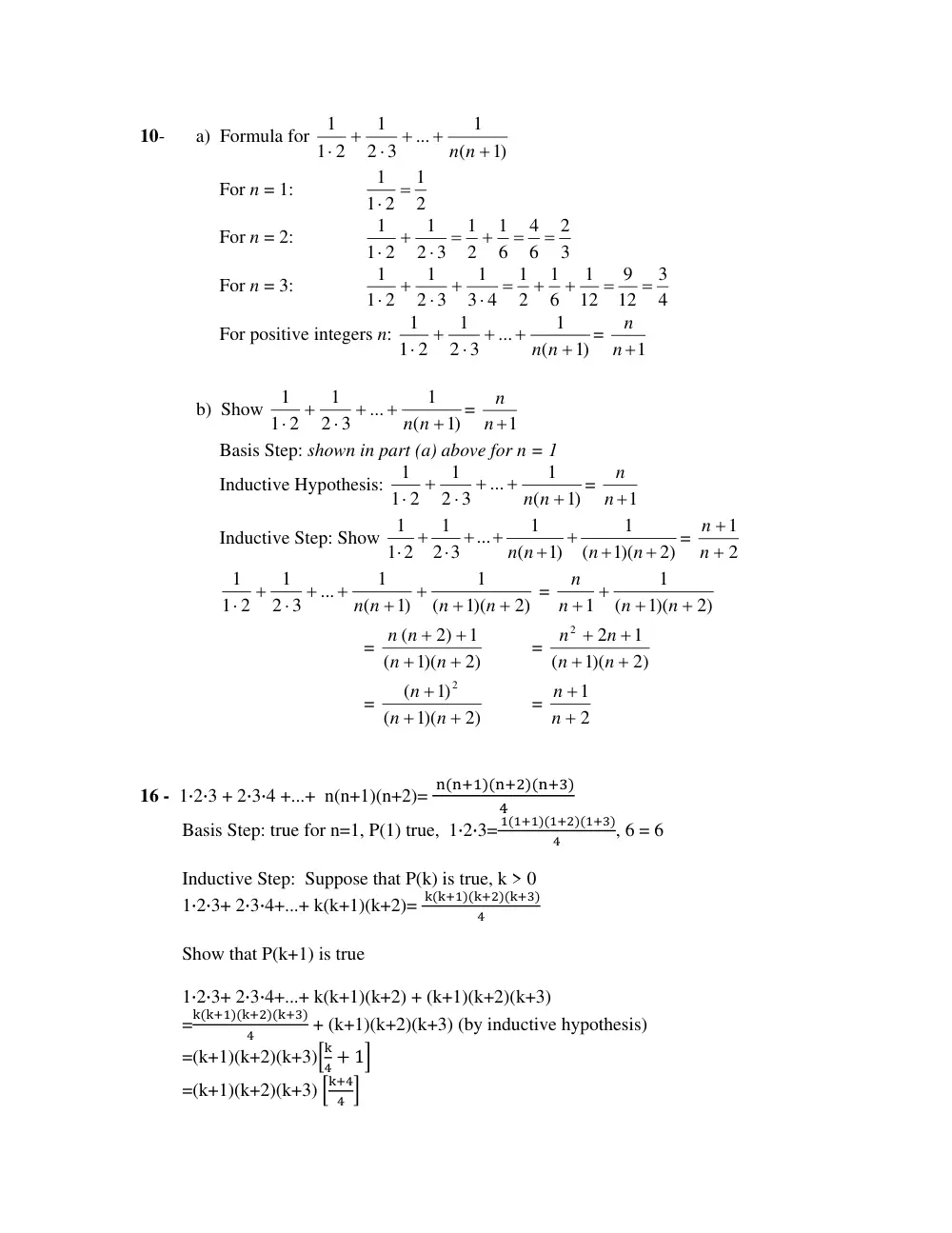
10-
a) Formula for
)1
(
1
...
2 3
1
1 2
1
+
+
+
⋅
+
⋅
n n
For n = 1:
2
1
1 2
1 =
⋅
For n = 2:
3
2
6
4
6
1
2
1
2 3
1
1 2
1
=
=
+
=
⋅
+
⋅
For n = 3:
4
3
12
9
12
1
6
1
2
1
3 4
1
2 3
1
1 2
1
=
=
+
+
=
⋅
+
⋅
+
⋅
For positive integers n:
)1
(
1
...
2 3
1
1 2
1
+
+
+
⋅
+
⋅
n n
=
n +1
n
b) Show
)1
(
1
...
2 3
1
1 2
1
+
+
+
⋅
+
⋅
n n
=
n +1
n
Basis Step: shown in part (a) above for n = 1
Inductive Hypothesis:
)1
(
1
...
2 3
1
1 2
1
+
+
+
⋅
+
⋅
n n
=
n +1
n
Inductive Step: Show
2)
1)(
(
1
)1
(
1
...
2 3
1
1 2
1
+
+
+
+
+
⋅ +
+
⋅
n
n
n n
=
2
1
+
+
n
n
2)
1)(
(
1
)1
(
1
...
2 3
1
1 2
1
+
+
+
+
+
+
⋅
+
⋅
n
n
n n
=
2)
1)(
(
1
1
+
+
+
+
n
n
n
n
=
2)
1)(
(
1
2)
(
+
+
+
+
n
n
n n
=
2)
1)(
(
1
2
2
+
+
+
+
n
n
n
n
=
2)
1)(
(
)1
(
2
+
+
+
n
n
n
=
2
1
+
+
n
n
16 - 1·2·3 + 2·3·4 +...+ n(n+1)(n+2)=
����������������
�
Basis Step: true for n=1, P(1) true, 1·2·3=
����������������
�
, 6 = 6
Inductive Step: Suppose that P(k) is true, k > 0
1·2·3+ 2·3·4+...+ k(k+1)(k+2)=
����������������
�
Show that P(k+1) is true
1·2·3+ 2·3·4+...+ k(k+1)(k+2) + (k+1)(k+2)(k+3)
=
����������������
�
+ (k+1)(k+2)(k+3) (by inductive hypothesis)
=(k+1)(k+2)(k+3)�
�
� � 1�
=(k+1)(k+2)(k+3) �
���
� �
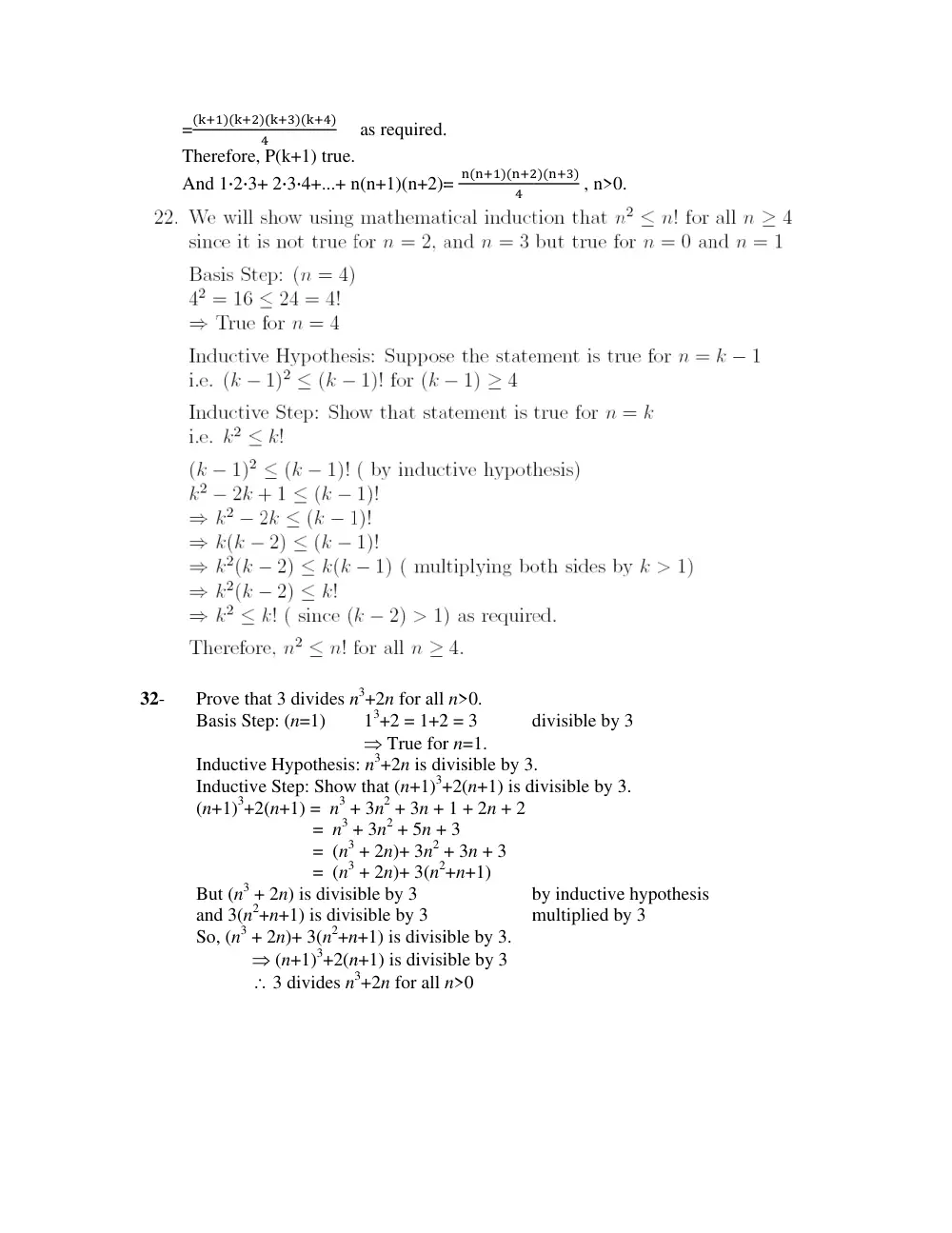
32-
=
�����������
�
Therefore, P
And 1·2·3+
Prove tha
Basis Step
Inductive
Inductive
(n+1)3+2(
But (n3 +
and 3(n2+
So, (n3 +
⇒
∴
����������
�
P(k+1) true.
+ 2·3·4+...+ n
at 3 divides n
p: (n=1)
Hypothesis
Step: Show
(n+1) = n3 +
= n3 +
= (n3
= (n3
2n) is divisi
+n+1) is divi
2n)+ 3(n2+n
⇒ (n+1)3+2(n
3 divides n3
as required.
n(n+1)(n+2)=
n3+2n for all
13+2 = 1+2
⇒ True for
: n3+2n is di
w that (n+1)3+
+ 3n2 + 3n +
+ 3n2 + 5n +
+ 2n)+ 3n2 +
+ 2n)+ 3(n2
ible by 3
sible by 3
n+1) is divisi
n+1) is divisi
3+2n for all
.
=
����������
�
n>0.
2 = 3
d
r n=1.
ivisible by 3
+2(n+1) is d
1 + 2n + 2
+ 3
+ 3n + 3
2+n+1)
b
m
ible by 3.
ible by 3
n>0
������� , n>0
divisible by
.
divisible by 3
by inductive
multiplied b
.
3
3.
e hypothesis
y 3
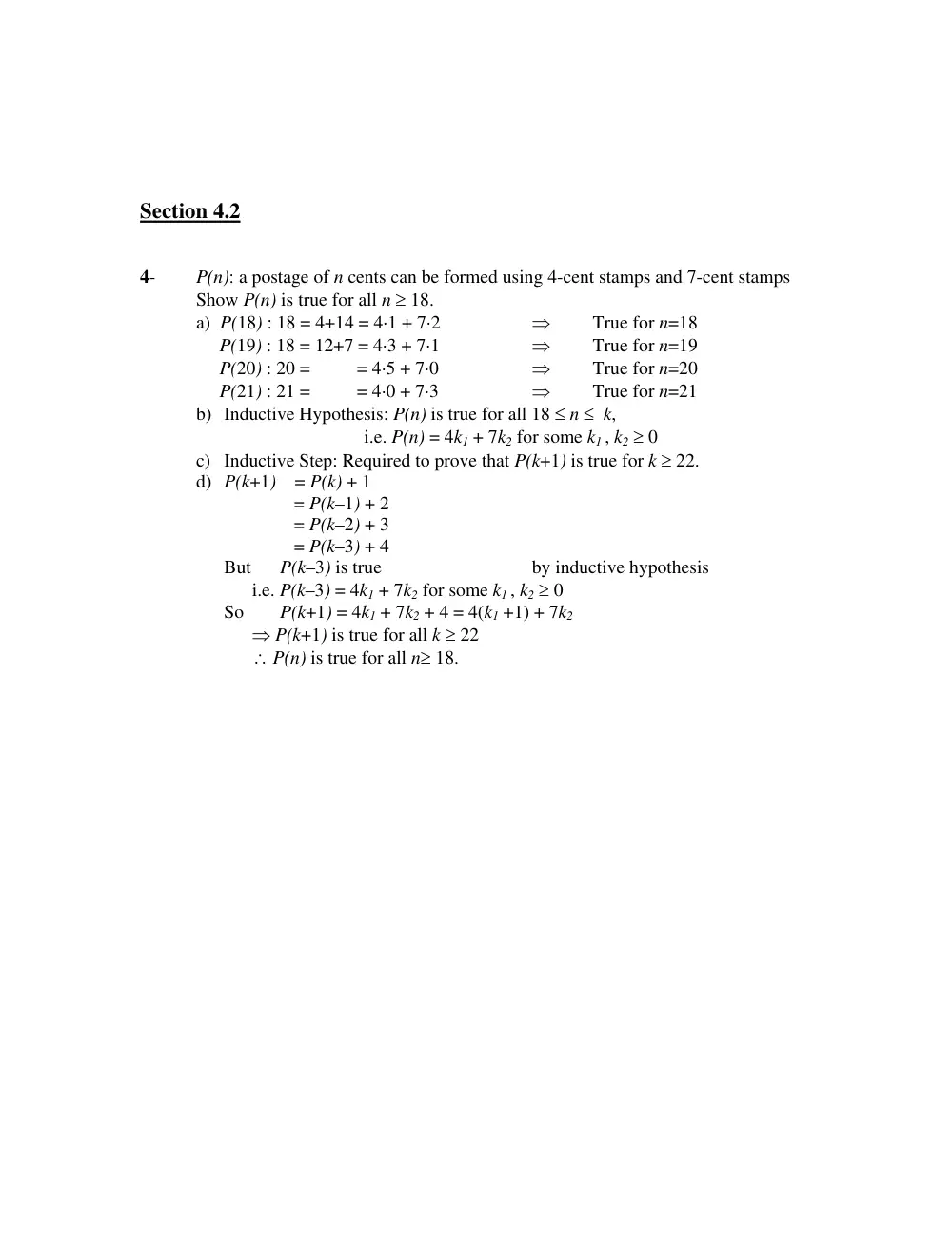
Section 4.2
4-
P(n): a postage of n cents can be formed using 4-cent stamps and 7-cent stamps
Show P(n) is true for all n ≥ 18.
a) P(18) : 18 = 4+14 = 4⋅1 + 7⋅2
⇒
True for n=18
P(19) : 18 = 12+7 = 4⋅3 + 7⋅1
⇒
True for n=19
P(20) : 20 = = 4⋅5 + 7⋅0
⇒
True for n=20
P(21) : 21 = = 4⋅0 + 7⋅3
⇒
True for n=21
b) Inductive Hypothesis: P(n) is true for all 18 ≤ n ≤ k,
i.e. P(n) = 4k1 + 7k2 for some k1 , k2 ≥ 0
c) Inductive Step: Required to prove that P(k+1) is true for k ≥ 22.
d) P(k+1) = P(k) + 1
= P(k–1) + 2
= P(k–2) + 3
= P(k–3) + 4
But P(k–3) is true
by inductive hypothesis
i.e. P(k–3) = 4k1 + 7k2 for some k1 , k2 ≥ 0
So P(k+1) = 4k1 + 7k2 + 4 = 4(k1 +1) + 7k2
⇒ P(k+1) is true for all k ≥ 22
∴ P(n) is true for all n≥ 18.
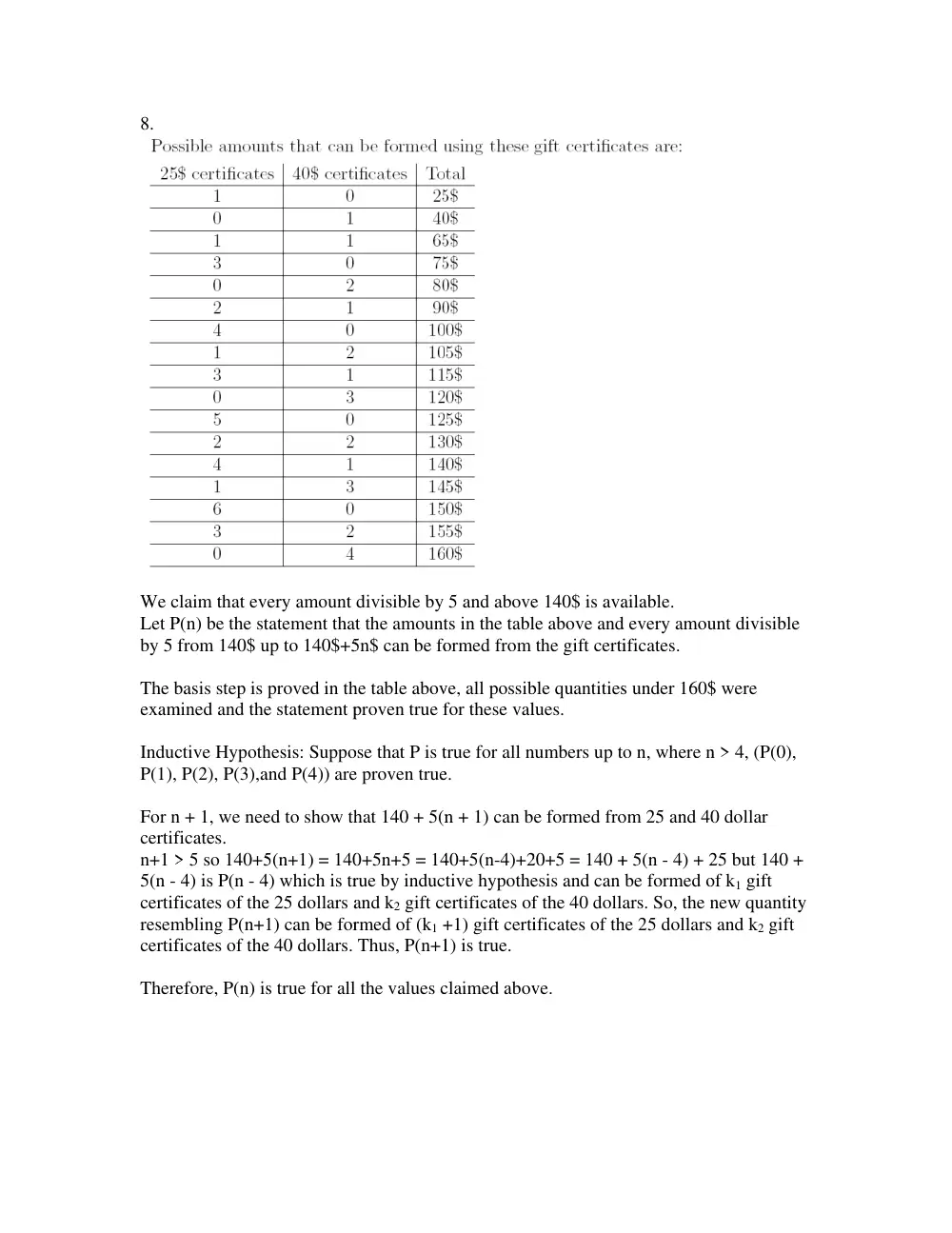
8.
We c
Let P
by 5
The b
exam
Induc
P(1),
For n
certif
n+1 >
5(n -
certif
resem
certif
There
claim that ev
P(n) be the st
from 140$ u
basis step is
mined and the
ctive Hypoth
P(2), P(3),a
n + 1, we nee
ficates.
> 5 so 140+5
4) is P(n - 4
ficates of the
mbling P(n+1
ficates of the
efore, P(n) is
ery amount
tatement that
up to 140$+5
proved in th
e statement p
hesis: Suppo
and P(4)) are
ed to show th
5(n+1) = 140
4) which is tr
e 25 dollars a
1) can be for
e 40 dollars.
s true for all
divisible by
t the amount
5n$ can be fo
he table abov
proven true f
ose that P is t
e proven true
hat 140 + 5(n
0+5n+5 = 14
rue by induc
and k2 gift ce
rmed of (k1 +
Thus, P(n+1
the values c
5 and above
ts in the tabl
ormed from
ve, all possib
for these val
true for all n
e.
n + 1) can b
40+5(n-4)+2
ctive hypothe
ertificates of
+1) gift certi
1) is true.
claimed abov
e 140$ is ava
le above and
the gift certi
ble quantities
lues.
numbers up t
e formed fro
20+5 = 140 +
esis and can
f the 40 doll
ificates of th
ve.
ailable.
d every amou
ificates.
s under 160$
to n, where n
om 25 and 40
+ 5(n - 4) + 2
be formed o
ars. So, the n
he 25 dollars
unt divisible
$ were
n > 4, (P(0),
0 dollar
25 but 140 +
of k1 gift
new quantity
and k2 gift
+
y
Section 4.3
4-
a) f(n+1) = f(n) – f(n-1)
f(0) = f(1) = 1
f(2) = f(1) – f(0) = 1 – 1 = 0
f(3) = f(2) – f(1) = 0 – 1 = -1
f(4) = f(3) – f(2) = (-1) – 0 = -1
f(5) = f(4) – f(3) = (-1) – (-1) = 0
b) f(n+1) = f(n) f(n-1)
f(0) = f(1) = 1
f(2) = f(1) f(0) = (1) (1) = 1
f(3) = f(2) f(1) = (1) (1) = 1
f(4) = f(3) f(2) = (1) (1) = 1
f(5) = f(4) f(3) = (1) (1) = 1
c) f(n+1) = f(n)2 + f(n-1)3
f(0) = f(1) = 1
f(2) = f(1)2 + f(0)3 = (1)2 + (1)3 = 1 + 1 = 2
f(3) = f(2)2 + f(1)3 = (2)2 + (1)3 = 4 + 1 = 5
f(4) = f(3)2 + f(2)3 = (5)2 + (2)3 = 25 + 8 = 33
f(5) = f(4)2 + f(3)3 = (33)2 + (5)3 = 1089 + 125 = 1214
d) f(n+1) = f(n) / f(n-1)
f(0) = f(1) = 1
f(2) = f(1) / f(0) = 1 / 1 = 1
f(3) = f(2) / f(1) = 1 / 1 = 1
f(4) = f(3) / f(2) = 1 / 1 = 1
f(5) = f(4) / f(3) = 1 / 1 = 1
6-
a) f(0) = 1,
f(n) = – f(n-1) for n ≥ 1
Valid:
f(n) = (– 1)n
for n ≥ 1
Proof:
Basis Step:
f(1) = (–1)1 = –1
Inductive Hypothesis:
f(n) = (– 1)n
for n ≥ 1
Inductive Step:
f(n+1) = – f(n) = – (– 1)n = (– 1) (– 1) n = (– 1) n+1
d) f(0) = 0, f(1) = 1
f(n) = 2 f(n-1) for n ≥ 1
Not Valid: defined starting at n=1, but f(1) = 2 f(0) = 2⋅ 0 = 0 ≠ 1.
e) f(0) = 2,
f(n) = f(n-1)
if n is odd and n ≥ 1
f(n) = 2 f(n-2)
if n ≥ 2
Valid:
f(n) =
⎪⎩
⎪⎨
⎧
≥
≥
+
+
0
if n is odd and n
2
if n is even and n 0
2
1) / 2
(n
(n 2) / 2
Proof:
Basis Step:
f(0) = 2 (0+2) / 2 = 21 = 2
f(1) = 2 (1+1) / 2 = 21 = 2 = f(0)
Inductive Hypothesis:
f(n) =
⎪⎩
⎪⎨
⎧
≥
≥
+
+
0
if n is odd and n
2
if n is even and n 0
2
1) / 2
(n
(n 2) / 2
Inductive Step:
• n is even ⇒ f(n) = 2 (n+2) / 2 ⇒ n+1 is odd
⇒ Show f(n+1) = 2 (n+1 +1) / 2 = 2 (n+2) / 2
f(n+1) = f((n+1)-1)
(by recursive definition)
= f(n) = 2 (n+2) / 2
(by induction hypothesis)
True
•
n is odd ⇒ f(n) = 2 (n+1) / 2 ⇒ n+1 is even
⇒ Show f(n+1) = 2 (n+1 +2) / 2 = 2 (n+3) / 2
f(n+1) = 2 f((n+1)-1)
(by recursive definition)
= 2 f(n) = 2⋅ 2 (n+1) / 2
(by induction hypothesis)
= 2 (n+1) / 2 + 1 = 2 (n+1 +2) / 2 = 2 (n+3) / 2
True
10-
Sm(n) is the sum of the integer m and the nonnegative integer n.
Sm(0) = m, Sm(1) = m+1, Sm(2) = m+2 = (m+1)+1, …
Recursive Definition: Sm(0) = m, Sm(n) = Sm(n-1) + 1 for n ≥ 1.
12-
fn is the nth Fibonacci number.
Show f1
2 + f2
2 + … + fn
2 = fn fn+1 (using induction).
Let P(n) be the statement “f1
2 + f2
2 + … + fn
2 = fn fn+1”.
Basis Step: P(1) is true because f1
2 = f1 f1 = f1 f2 since f1 = f2 = 1.
Inductive Hypothesis: Assume P(n) is true, i.e. f1
2 + f2
2 + … + fn
2 = fn fn+1
Inductive Step: Show that P(n+1) is true, i.e. f1
2 + f2
2 + … + fn
2 + fn+1
2 = fn+1 fn+2
P(n+1) = f1
2 + f2
2 + … + fn
2 + fn+1
2
= P(n) + fn+1
2
= fn fn+1 + fn+1
2
(by inductive hypothesis)
= fn+1 ( fn + fn+1 )
= fn+1 fn+2
(by Fibonacci formula)
Thus, f1
2 + f2
2 + … + fn
2 = fn fn+1 is true for all n ≥ 1.
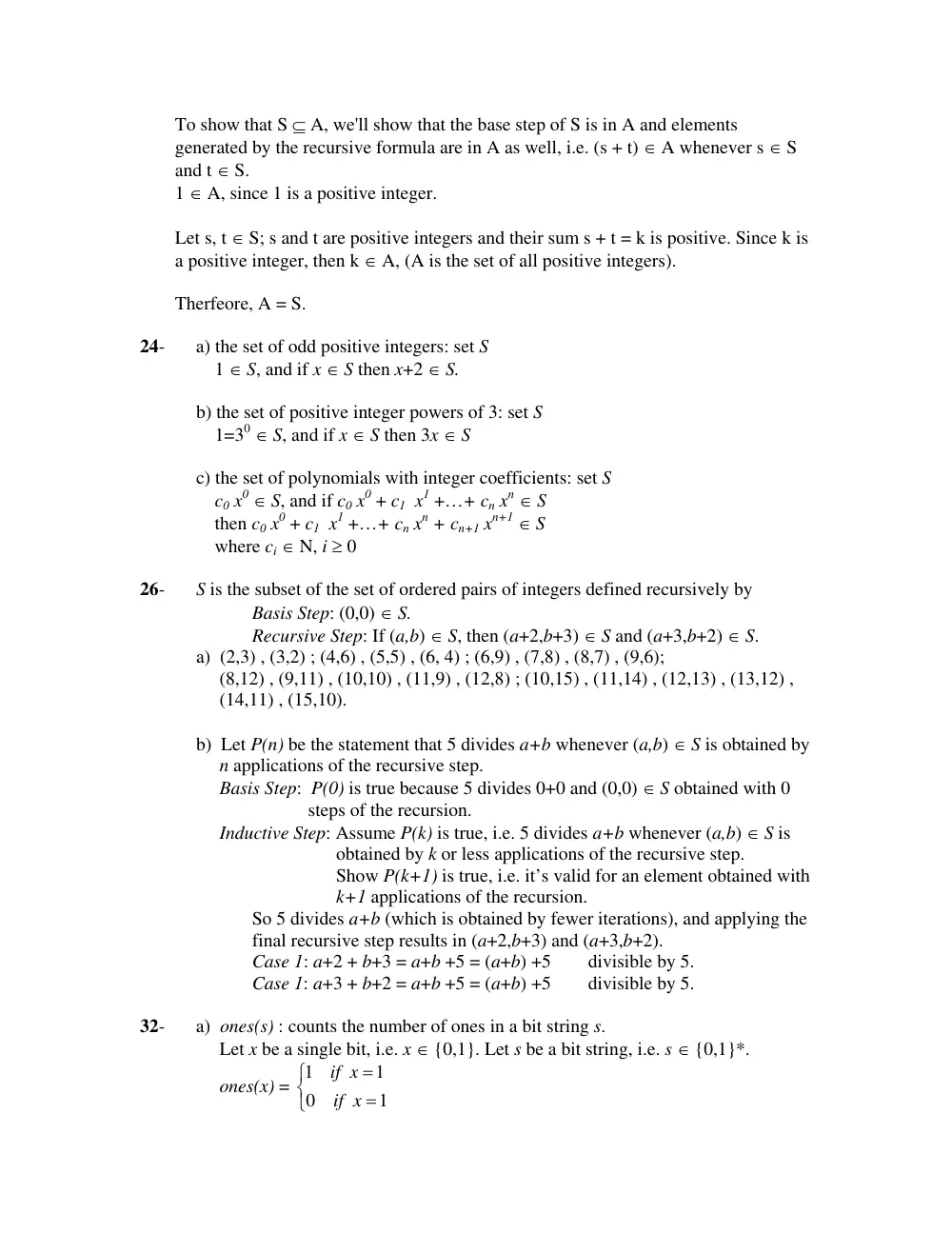
22 - Let A be the set of positive integers. We will show that S = A. We will show that A
⊆ S and S ⊆ A.
We will first show that A is a subset of S.
Let P(n) be the statement that n belongs to S, where n is an element in A.
Basis Step: n = 1, true since 1 ∈ S
Hypothesis: Suppose P(k) is true, i.e. k ∈ S
Inductive Step: Show that P(k + 1) is true.
P(k + 1) is true if (k + 1) ∈ S, but k + 1 = (k) + (1), where k ∈ S and
1 ∈ S and thus (k + 1) ∈ S.
P(n) is true and A ⊆ A.
To show that S ⊆ A, we'll show that the base step of S is in A and elements
generated by the recursive formula are in A as well, i.e. (s + t) ∈ A whenever s ∈ S
and t ∈ S.
1 ∈ A, since 1 is a positive integer.
Let s, t ∈ S; s and t are positive integers and their sum s + t = k is positive. Since k is
a positive integer, then k ∈ A, (A is the set of all positive integers).
Therfeore, A = S.
24-
a) the set of odd positive integers: set S
1 ∈ S, and if x ∈ S then x+2 ∈ S.
b) the set of positive integer powers of 3: set S
1=30 ∈ S, and if x ∈ S then 3x ∈ S
c) the set of polynomials with integer coefficients: set S
c0 x0 ∈ S, and if c0 x0 + c1 x1 +…+ cn xn ∈ S
then c0 x0 + c1 x1 +…+ cn xn + cn+1 xn+1 ∈ S
where ci ∈ N, i ≥ 0
26-
S is the subset of the set of ordered pairs of integers defined recursively by
Basis Step: (0,0) ∈ S.
Recursive Step: If (a,b) ∈ S, then (a+2,b+3) ∈ S and (a+3,b+2) ∈ S.
a) (2,3) , (3,2) ; (4,6) , (5,5) , (6, 4) ; (6,9) , (7,8) , (8,7) , (9,6);
(8,12) , (9,11) , (10,10) , (11,9) , (12,8) ; (10,15) , (11,14) , (12,13) , (13,12) ,
(14,11) , (15,10).
b) Let P(n) be the statement that 5 divides a+b whenever (a,b) ∈ S is obtained by
n applications of the recursive step.
Basis Step: P(0) is true because 5 divides 0+0 and (0,0) ∈ S obtained with 0
steps of the recursion.
Inductive Step: Assume P(k) is true, i.e. 5 divides a+b whenever (a,b) ∈ S is
obtained by k or less applications of the recursive step.
Show P(k+1) is true, i.e. it’s valid for an element obtained with
k+1 applications of the recursion.
So 5 divides a+b (which is obtained by fewer iterations), and applying the
final recursive step results in (a+2,b+3) and (a+3,b+2).
Case 1: a+2 + b+3 = a+b +5 = (a+b) +5
divisible by 5.
Case 1: a+3 + b+2 = a+b +5 = (a+b) +5
divisible by 5.
32-
a) ones(s) : counts the number of ones in a bit string s.
Let x be a single bit, i.e. x ∈ {0,1}. Let s be a bit string, i.e. s ∈ {0,1}*.
ones(x) =
⎩
⎨
⎧
=
=
1
0
1
1
if x
if x
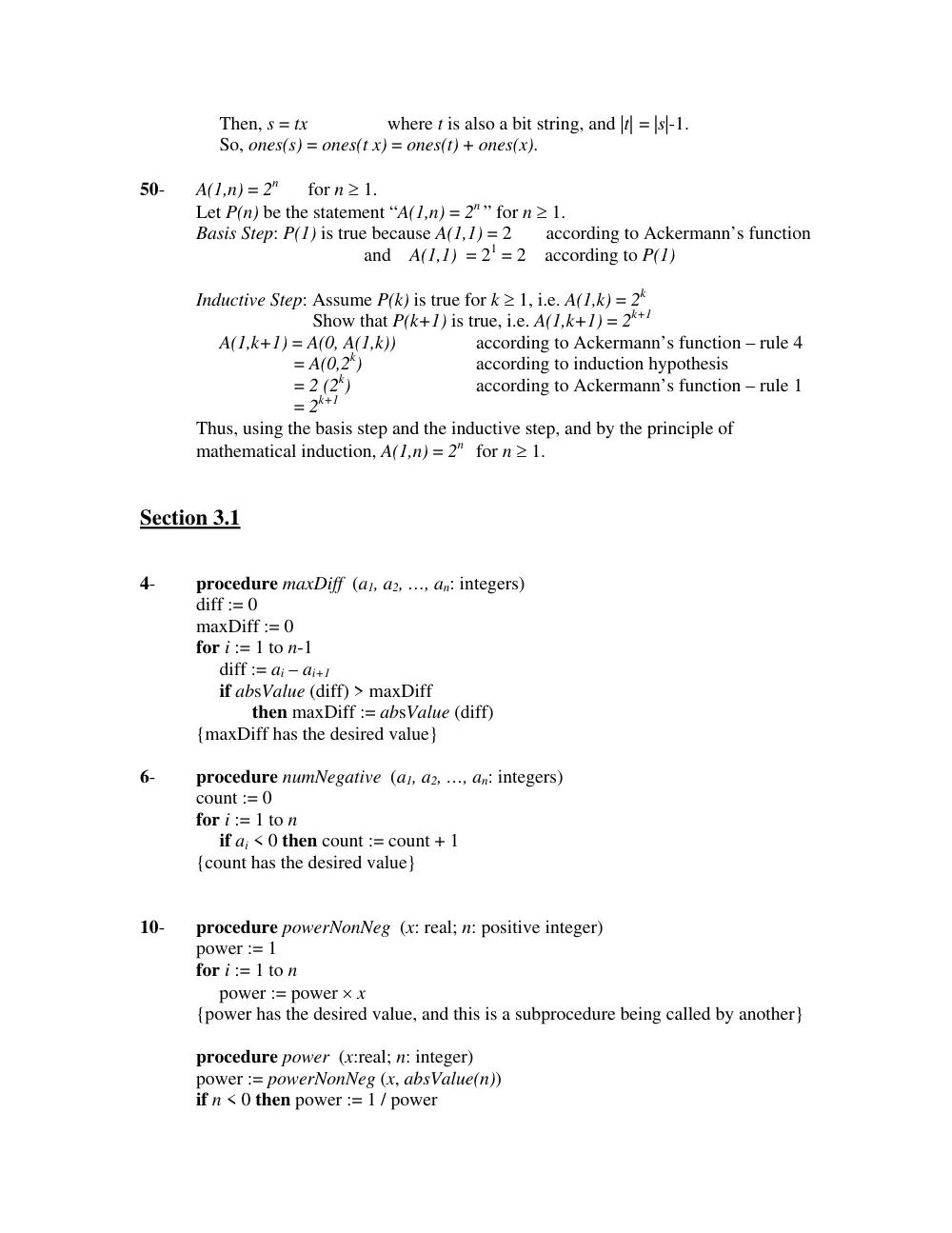
Then, s = tx
where t is also a bit string, and |t| = |s|-1.
So, ones(s) = ones(t x) = ones(t) + ones(x).
50-
A(1,n) = 2n
for n ≥ 1.
Let P(n) be the statement “A(1,n) = 2n ” for n ≥ 1.
Basis Step: P(1) is true because A(1,1) = 2 according to Ackermann’s function
and A(1,1) = 21 = 2 according to P(1)
Inductive Step: Assume P(k) is true for k ≥ 1, i.e. A(1,k) = 2k
Show that P(k+1) is true, i.e. A(1,k+1) = 2k+1
A(1,k+1) = A(0, A(1,k))
according to Ackermann’s function – rule 4
= A(0,2k)
according to induction hypothesis
= 2 (2k)
according to Ackermann’s function – rule 1
= 2k+1
Thus, using the basis step and the inductive step, and by the principle of
mathematical induction, A(1,n) = 2n for n ≥ 1.
Section 3.1
4-
procedure maxDiff (a1, a2, …, an: integers)
diff := 0
maxDiff := 0
for i := 1 to n-1
diff := ai – ai+1
if absValue (diff) > maxDiff
then maxDiff := absValue (diff)
{maxDiff has the desired value}
6-
procedure numNegative (a1, a2, …, an: integers)
count := 0
for i := 1 to n
if ai < 0 then count := count + 1
{count has the desired value}
10-
procedure powerNonNeg (x: real; n: positive integer)
power := 1
for i := 1 to n
power := power × x
{power has the desired value, and this is a subprocedure being called by another}
procedure power (x:real; n: integer)
power := powerNonNeg (x, absValue(n))
if n < 0 then power := 1 / power
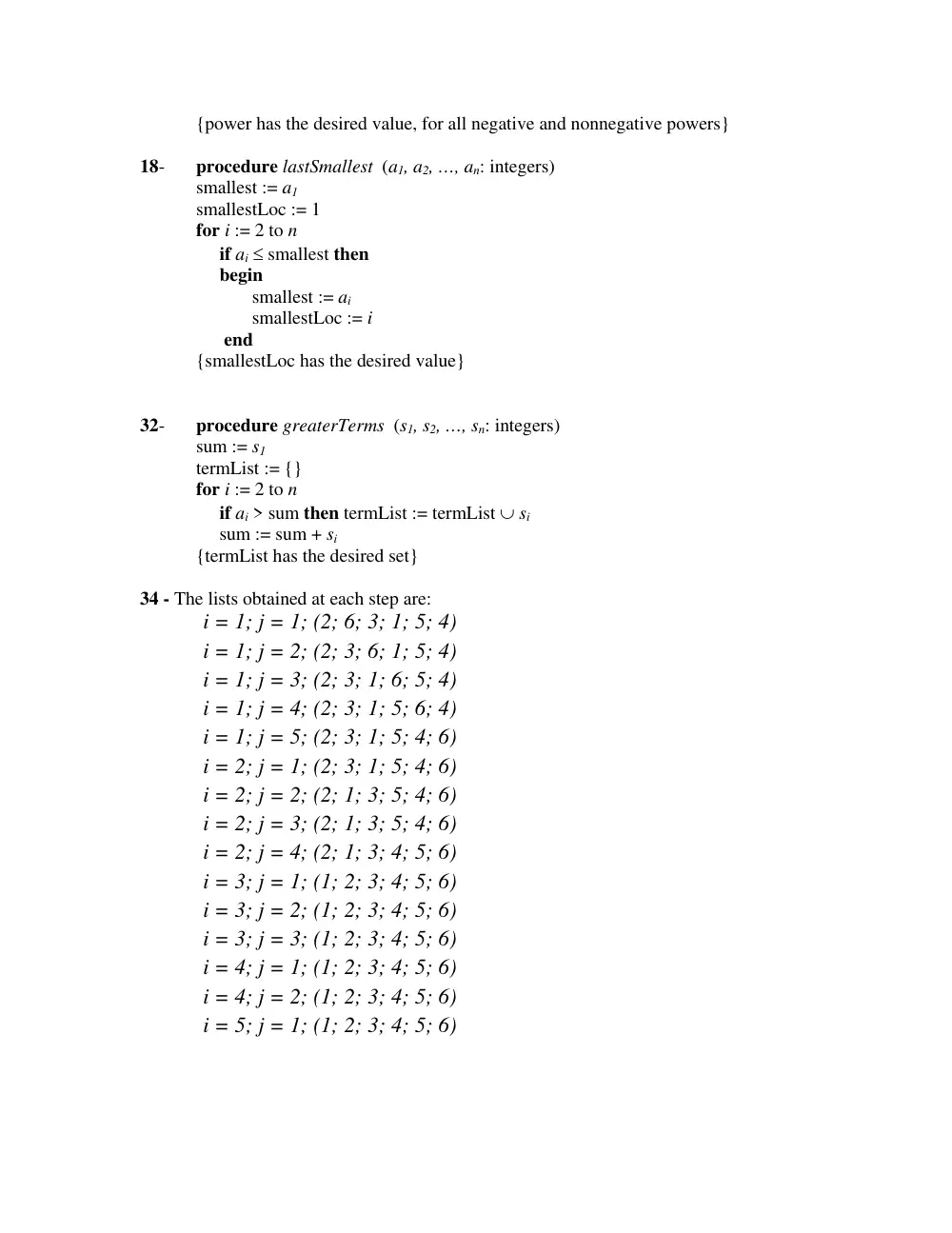
{power has the desired value, for all negative and nonnegative powers}
18-
procedure lastSmallest (a1, a2, …, an: integers)
smallest := a1
smallestLoc := 1
for i := 2 to n
if ai ≤ smallest then
begin
smallest := ai
smallestLoc := i
end
{smallestLoc has the desired value}
32-
procedure greaterTerms (s1, s2, …, sn: integers)
sum := s1
termList := {}
for i := 2 to n
if ai > sum then termList := termList ∪ si
sum := sum + si
{termList has the desired set}
34 - The lists obtained at each step are:
i = 1; j = 1; (2; 6; 3; 1; 5; 4)
i = 1; j = 2; (2; 3; 6; 1; 5; 4)
i = 1; j = 3; (2; 3; 1; 6; 5; 4)
i = 1; j = 4; (2; 3; 1; 5; 6; 4)
i = 1; j = 5; (2; 3; 1; 5; 4; 6)
i = 2; j = 1; (2; 3; 1; 5; 4; 6)
i = 2; j = 2; (2; 1; 3; 5; 4; 6)
i = 2; j = 3; (2; 1; 3; 5; 4; 6)
i = 2; j = 4; (2; 1; 3; 4; 5; 6)
i = 3; j = 1; (1; 2; 3; 4; 5; 6)
i = 3; j = 2; (1; 2; 3; 4; 5; 6)
i = 3; j = 3; (1; 2; 3; 4; 5; 6)
i = 4; j = 1; (1; 2; 3; 4; 5; 6)
i = 4; j = 2; (1; 2; 3; 4; 5; 6)
i = 5; j = 1; (1; 2; 3; 4; 5; 6)