
CMPS 211 Homework Assignment 02 Solution, Fall 2014
American University of Beirut · Discrete Structures · 7 pages · with solution
More CMPS 211 files
- Homework 3 with Solution · Spring 2016Homework · with solutionView
- Homework 6 with Solution · Spring 2016Homework · with solutionView
- Homework 1 with Solution · Spring 2016Homework · with solutionView
- Homework 4 with Solution · Spring 2016Homework · with solutionView
- Homework 5 with Solution · Spring 2016Homework · with solutionView
- Homework 1 · Fall 2015HomeworkView
- Homework 3 · Fall 2015HomeworkView
- Homework 1 Solution · Fall 2015Homework · with solutionView
Show the text of this homework
CMPS
211
–
Fall
2014
1
Assignment
2
Solution
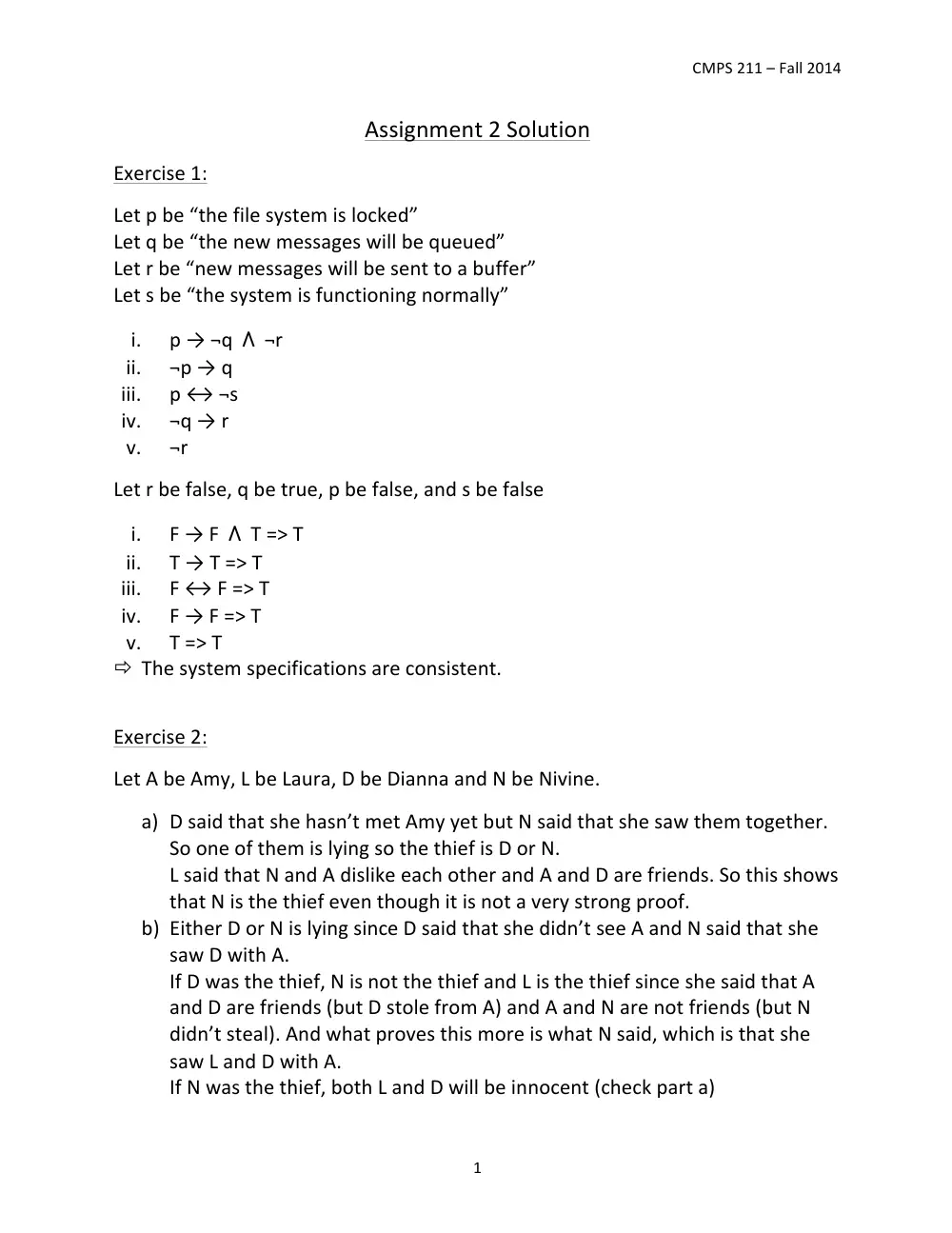
Exercise
1:
Let
p
be
“the
file
system
is
locked”
Let
q
be
“the
new
messages
will
be
queued”
Let
r
be
“new
messages
will
be
sent
to
a
buffer”
Let
s
be
“the
system
is
functioning
normally”
i.
p
→
¬q
∧
¬r
ii.
¬p
→
q
iii.
p
↔
¬s
iv.
¬q
→
r
v.
¬r
Let
r
be
false,
q
be
true,
p
be
false,
and
s
be
false
i.
F
→
F
∧
T
=>
T
ii.
T
→
T
=>
T
iii.
F
↔
F
=>
T
iv.
F
→
F
=>
T
v.
T
=>
T
� The
system
specifications
are
consistent.
Exercise
2:
Let
A
be
Amy,
L
be
Laura,
D
be
Dianna
and
N
be
Nivine.
a) D
said
that
she
hasn’t
met
Amy
yet
but
N
said
that
she
saw
them
together.
So
one
of
them
is
lying
so
the
thief
is
D
or
N.
L
said
that
N
and
A
dislike
each
other
and
A
and
D
are
friends.
So
this
shows
that
N
is
the
thief
even
though
it
is
not
a
very
strong
proof.
b) Either
D
or
N
is
lying
since
D
said
that
she
didn’t
see
A
and
N
said
that
she
saw
D
with
A.
If
D
was
the
thief,
N
is
not
the
thief
and
L
is
the
thief
since
she
said
that
A
and
D
are
friends
(but
D
stole
from
A)
and
A
and
N
are
not
friends
(but
N
didn’t
steal).
And
what
proves
this
more
is
what
N
said,
which
is
that
she
saw
L
and
D
with
A.
If
N
was
the
thief,
both
L
and
D
will
be
innocent
(check
part
a)
CMPS
211
–
Fall
2014
2
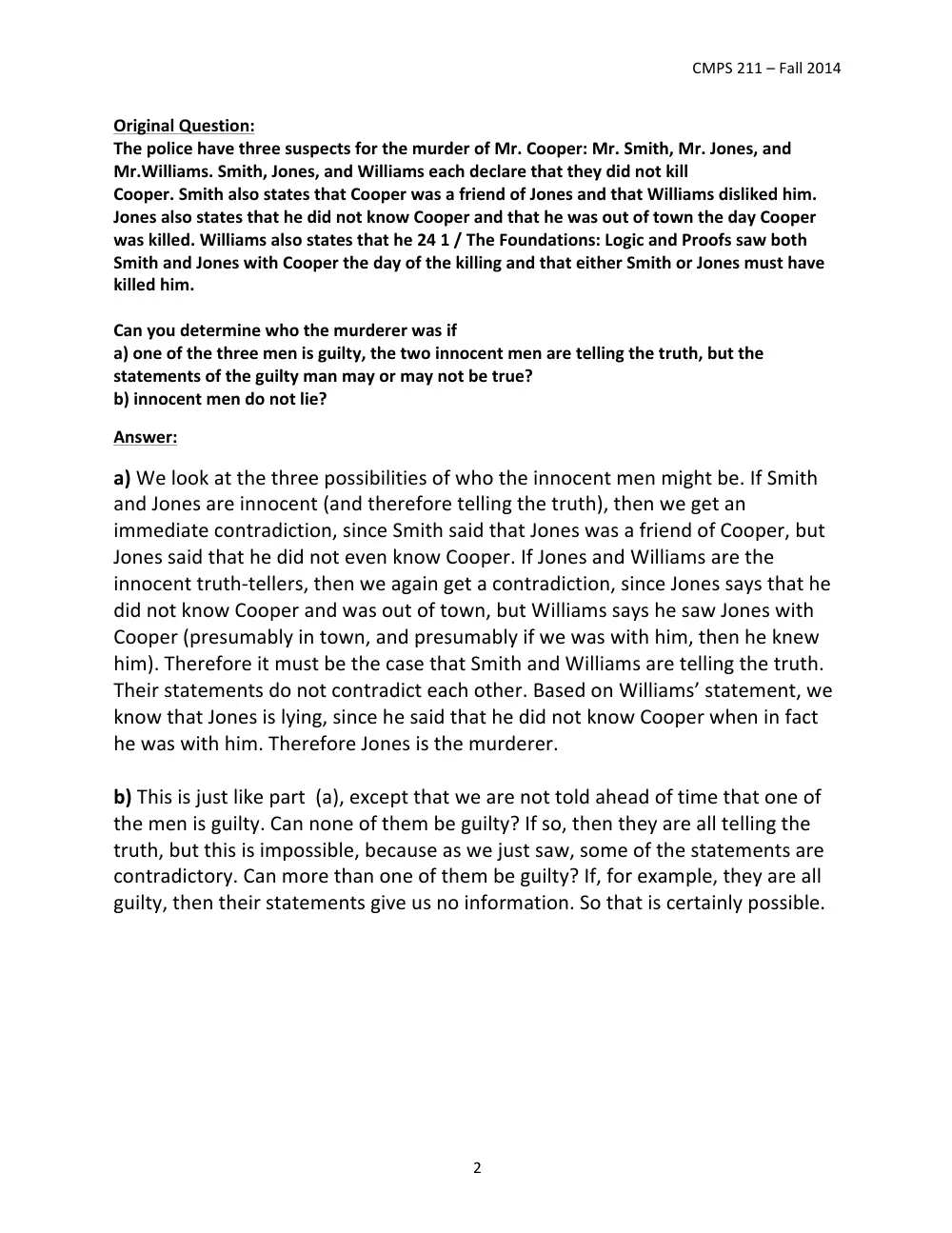
Original
Question:
The
police
have
three
suspects
for
the
murder
of
Mr.
Cooper:
Mr.
Smith,
Mr.
Jones,
and
Mr.Williams.
Smith,
Jones,
and
Williams
each
declare
that
they
did
not
kill
Cooper.
Smith
also
states
that
Cooper
was
a
friend
of
Jones
and
that
Williams
disliked
him.
Jones
also
states
that
he
did
not
know
Cooper
and
that
he
was
out
of
town
the
day
Cooper
was
killed.
Williams
also
states
that
he
24
1
/
The
Foundations:
Logic
and
Proofs
saw
both
Smith
and
Jones
with
Cooper
the
day
of
the
killing
and
that
either
Smith
or
Jones
must
have
killed
him.
Can
you
determine
who
the
murderer
was
if
a)
one
of
the
three
men
is
guilty,
the
two
innocent
men
are
telling
the
truth,
but
the
statements
of
the
guilty
man
may
or
may
not
be
true?
b)
innocent
men
do
not
lie?
Answer:
a)
We
look
at
the
three
possibilities
of
who
the
innocent
men
might
be.
If
Smith
and
Jones
are
innocent
(and
therefore
telling
the
truth),
then
we
get
an
immediate
contradiction,
since
Smith
said
that
Jones
was
a
friend
of
Cooper,
but
Jones
said
that
he
did
not
even
know
Cooper.
If
Jones
and
Williams
are
the
innocent
truth-‐tellers,
then
we
again
get
a
contradiction,
since
Jones
says
that
he
did
not
know
Cooper
and
was
out
of
town,
but
Williams
says
he
saw
Jones
with
Cooper
(presumably
in
town,
and
presumably
if
we
was
with
him,
then
he
knew
him).
Therefore
it
must
be
the
case
that
Smith
and
Williams
are
telling
the
truth.
Their
statements
do
not
contradict
each
other.
Based
on
Williams’
statement,
we
know
that
Jones
is
lying,
since
he
said
that
he
did
not
know
Cooper
when
in
fact
he
was
with
him.
Therefore
Jones
is
the
murderer.
b)
This
is
just
like
part
(a),
except
that
we
are
not
told
ahead
of
time
that
one
of
the
men
is
guilty.
Can
none
of
them
be
guilty?
If
so,
then
they
are
all
telling
the
truth,
but
this
is
impossible,
because
as
we
just
saw,
some
of
the
statements
are
contradictory.
Can
more
than
one
of
them
be
guilty?
If,
for
example,
they
are
all
guilty,
then
their
statements
give
us
no
information.
So
that
is
certainly
possible.
CMPS
211
–
Fall
2014
3
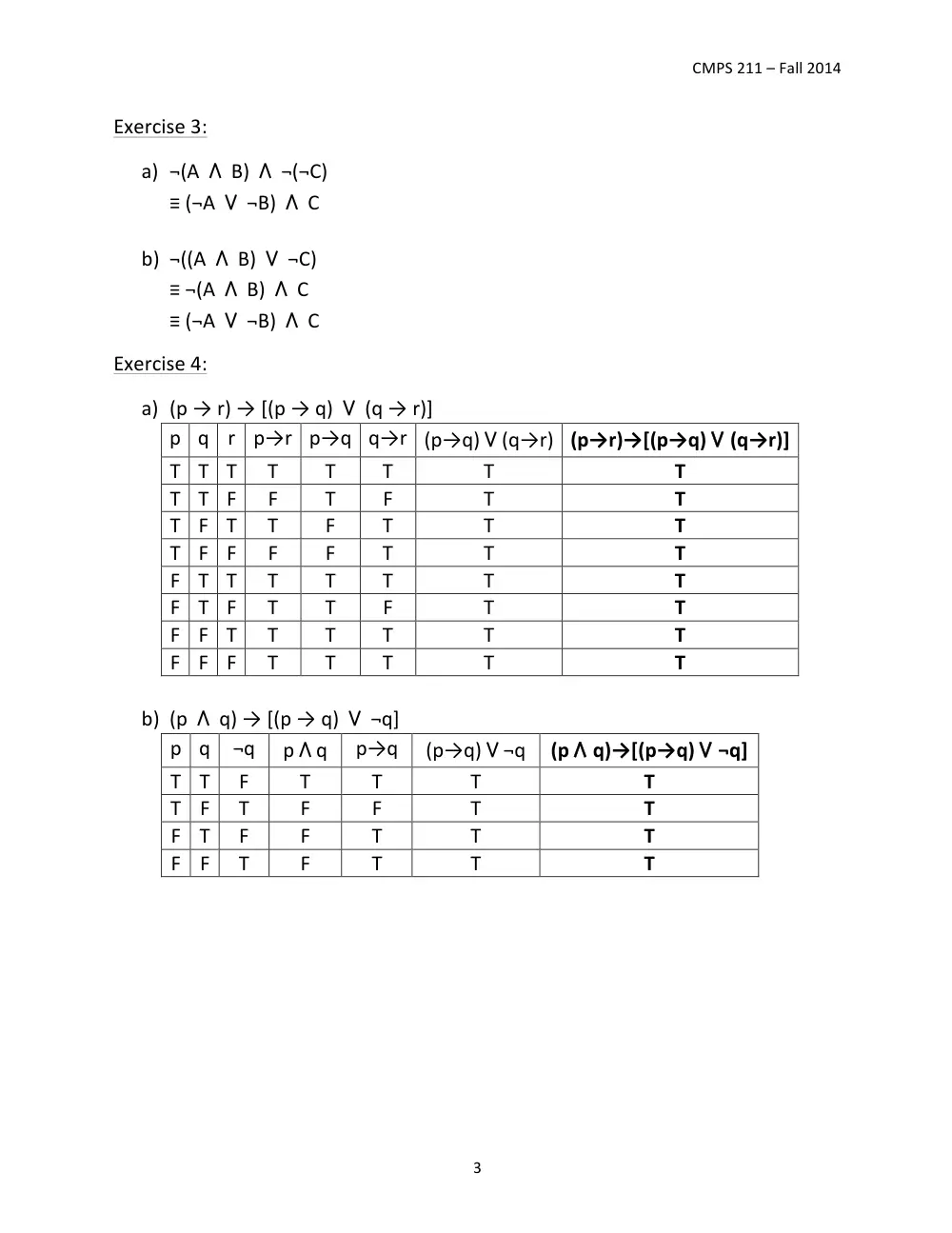
Exercise
3:
a) ¬(A
∧
B)
∧
¬(¬C)
≡
(¬A
∨
¬B)
∧
C
b) ¬((A
∧
B)
∨
¬C)
≡
¬(A
∧
B)
∧
C
≡
(¬A
∨
¬B)
∧
C
Exercise
4:
a) (p
→
r)
→
[(p
→
q)
∨
(q
→
r)]
p
q
r
p→r
p→q
q→r
(p→q)∨(q→r)
(p→r)→[(p→q)∨(q→r)]
T
T
T
T
T
T
T
T
T
T
F
F
T
F
T
T
T
F
T
T
F
T
T
T
T
F
F
F
F
T
T
T
F
T
T
T
T
T
T
T
F
T
F
T
T
F
T
T
F
F
T
T
T
T
T
T
F
F
F
T
T
T
T
T
b) (p
∧
q)
→
[(p
→
q)
∨
¬q]
p
q
¬q
p∧q
p→q
(p→q)∨¬q
(p∧q)→[(p→q)∨¬q]
T
T
F
T
T
T
T
T
F
T
F
F
T
T
F
T
F
F
T
T
T
F
F
T
F
T
T
T
CMPS
211
–
Fall
2014
4
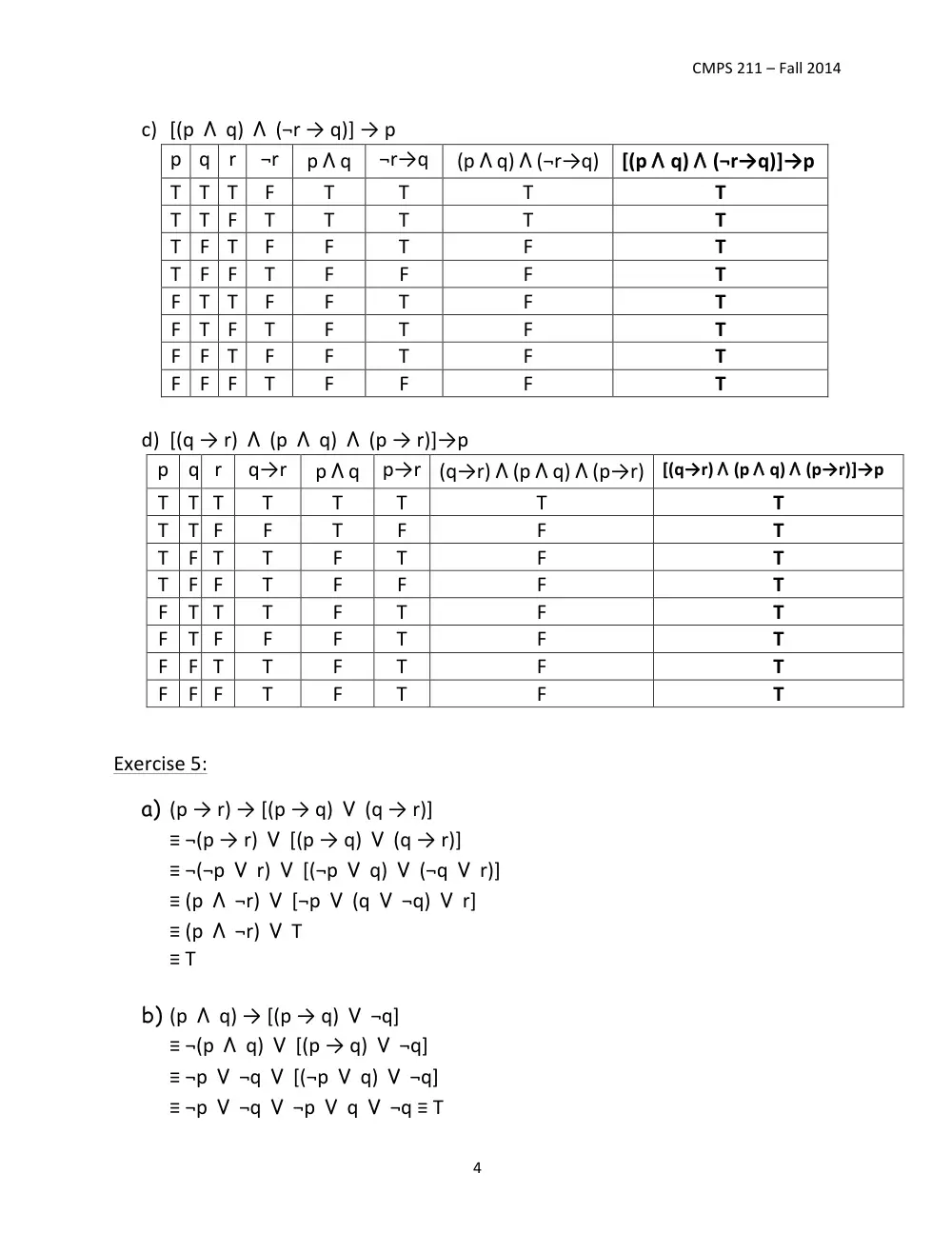
c) [(p
∧
q)
∧
(¬r
→
q)]
→
p
p
q
r
¬r
p∧q
¬r→q
(p∧q)∧(¬r→q)
[(p∧q)∧(¬r→q)]→p
T
T
T
F
T
T
T
T
T
T
F
T
T
T
T
T
T
F
T
F
F
T
F
T
T
F
F
T
F
F
F
T
F
T
T
F
F
T
F
T
F
T
F
T
F
T
F
T
F
F
T
F
F
T
F
T
F
F
F
T
F
F
F
T
d) [(q
→
r)
∧
(p
∧
q)
∧
(p
→
r)]→p
p
q
r
q→r
p∧q
p→r
(q→r)∧(p∧q)∧(p→r)
[(q→r)∧(p∧q)∧(p→r)]→p
T
T
T
T
T
T
T
T
T
T
F
F
T
F
F
T
T
F
T
T
F
T
F
T
T
F
F
T
F
F
F
T
F
T
T
T
F
T
F
T
F
T
F
F
F
T
F
T
F
F
T
T
F
T
F
T
F
F
F
T
F
T
F
T
Exercise
5:
a) (p
→
r)
→
[(p
→
q)
∨
(q
→
r)]
≡
¬(p
→
r)
∨
[(p
→
q)
∨
(q
→
r)]
≡
¬(¬p
∨
r)
∨
[(¬p
∨
q)
∨
(¬q
∨
r)]
≡
(p
∧
¬r)
∨
[¬p
∨
(q
∨
¬q)
∨
r]
≡
(p
∧
¬r)
∨
T
≡
T
b) (p
∧
q)
→
[(p
→
q)
∨
¬q]
≡
¬(p
∧
q)
∨
[(p
→
q)
∨
¬q]
≡
¬p
∨
¬q
∨
[(¬p
∨
q)
∨
¬q]
≡
¬p
∨
¬q
∨
¬p
∨
q
∨
¬q
≡
T
CMPS
211
–
Fall
2014
5
c) [(p
∧
q)
∧
(¬r
→
q)]
→
p
≡
¬[(p
∧
q)
∧
(r
∨
q)]
∨
p
≡
[¬(p
∧
q)
∨
¬(r
∨
q)]
∨
p
≡
¬p
∨
¬q
∨
(¬r
∧
¬q)
∨
p
≡
T
d) [(q
→
r)
∧
(p
∧
q)
∧
(p
→
r)]
→
p
≡
¬[(¬q
∨
r)
∧
(p
∧
q)
∧
(¬p
∨
r)]
∨
p
≡
[¬(¬q
∨
r)
∨
¬(p
∧
q)
∨
¬(¬p
∨
r)]
∨
p
≡
[(q
∧
¬r)
∨
(¬p
∨
¬q)
∨
(p
∧
¬r)]
∨
p
≡
(q
∧
¬r)
∨
(p
∧
¬r)
∨
[p
∨
¬p]
∨
¬q
≡
T
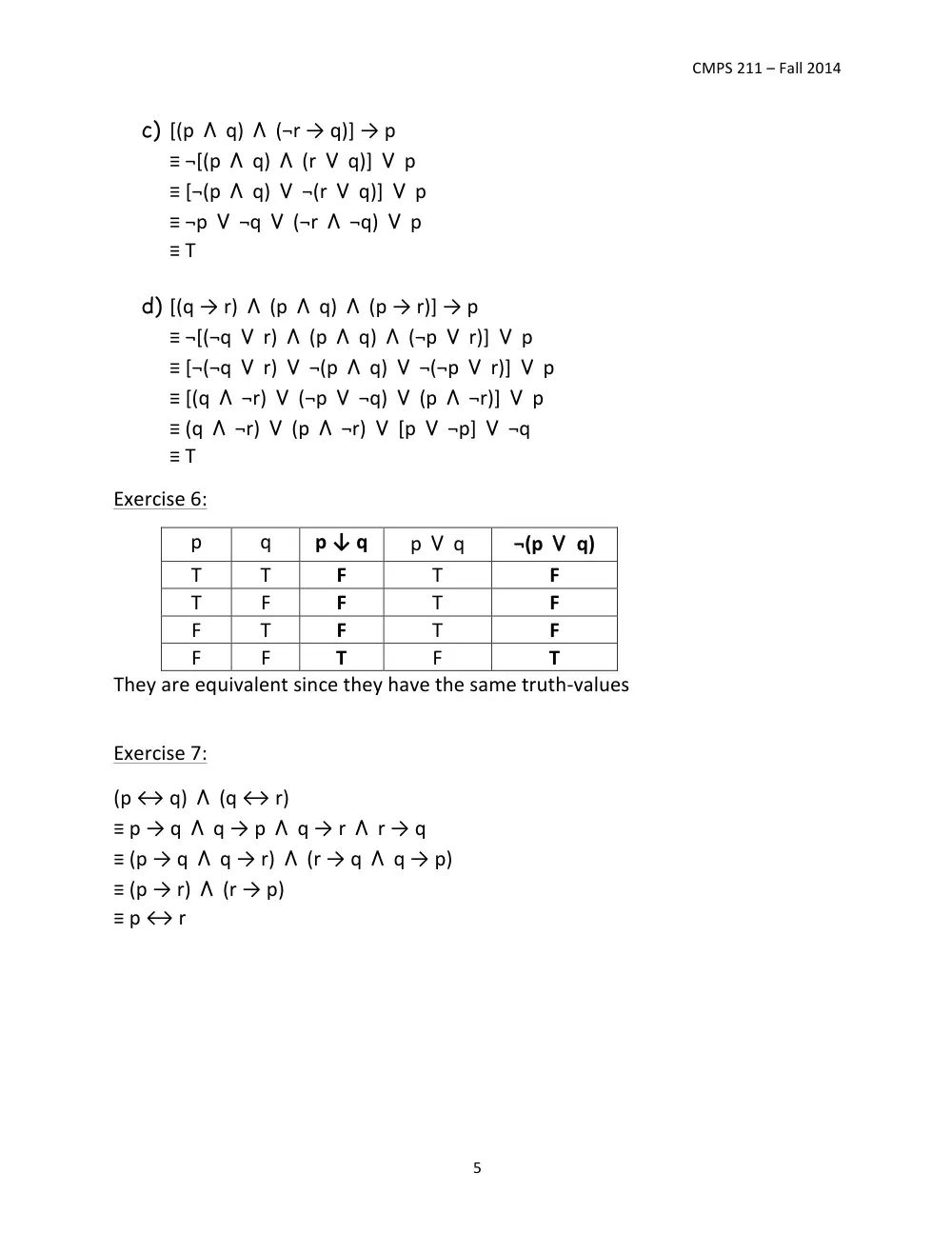
Exercise
6:
p
q
p
↓
q
p
∨
q
¬(p
∨
q)
T
T
F
T
F
T
F
F
T
F
F
T
F
T
F
F
F
T
F
T
They
are
equivalent
since
they
have
the
same
truth-‐values
Exercise
7:
(p
↔
q)
∧
(q
↔
r)
≡
p
→
q
∧
q
→
p
∧
q
→
r
∧
r
→
q
≡
(p
→
q
∧
q
→
r)
∧
(r
→
q
∧
q
→
p)
≡
(p
→
r)
∧
(r
→
p)
≡
p
↔
r
CMPS
211
–
Fall
2014
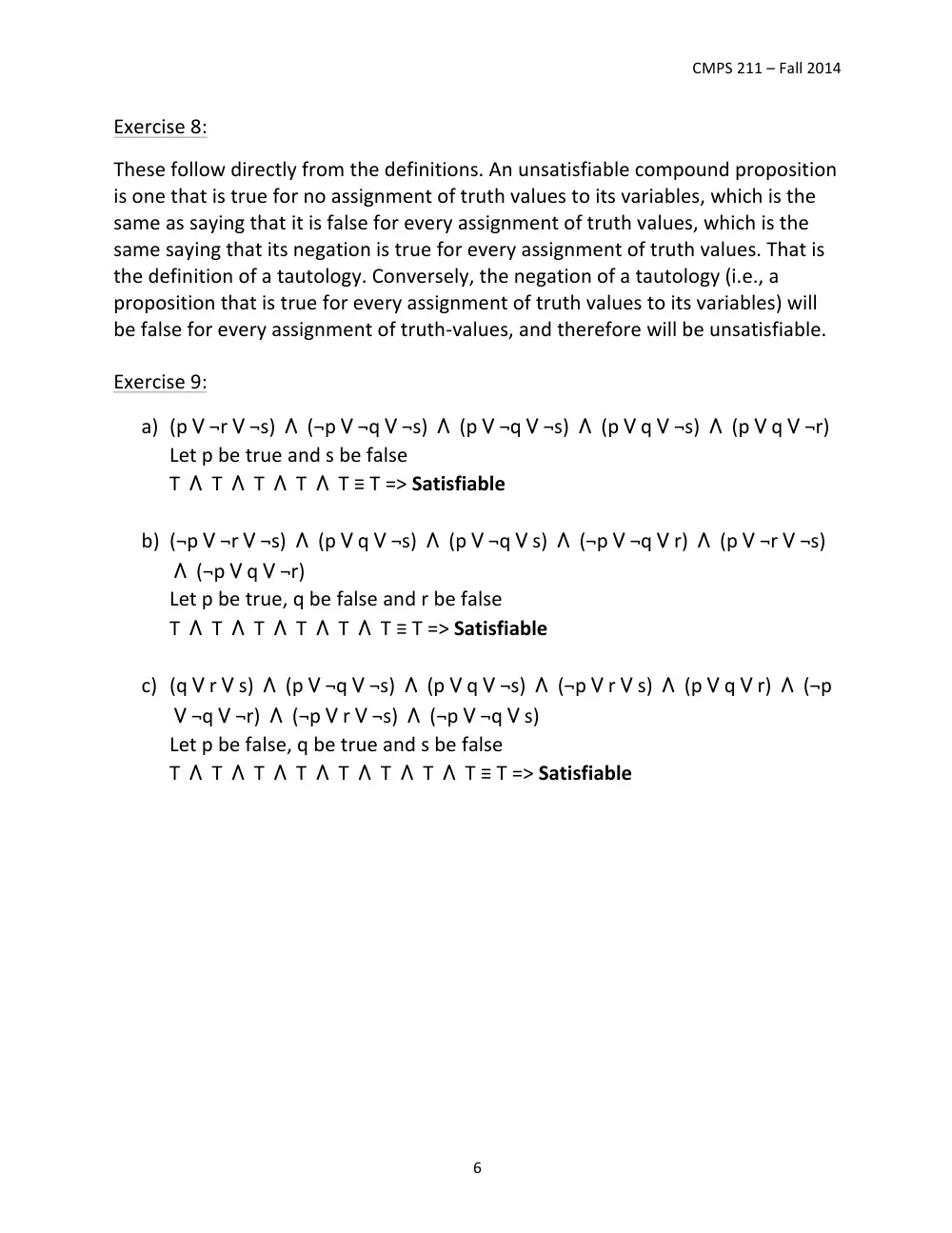
6
Exercise
8:
These
follow
directly
from
the
definitions.
An
unsatisfiable
compound
proposition
is
one
that
is
true
for
no
assignment
of
truth
values
to
its
variables,
which
is
the
same
as
saying
that
it
is
false
for
every
assignment
of
truth
values,
which
is
the
same
saying
that
its
negation
is
true
for
every
assignment
of
truth
values.
That
is
the
definition
of
a
tautology.
Conversely,
the
negation
of
a
tautology
(i.e.,
a
proposition
that
is
true
for
every
assignment
of
truth
values
to
its
variables)
will
be
false
for
every
assignment
of
truth-‐values,
and
therefore
will
be
unsatisfiable.
Exercise
9:
a) (p∨¬r∨¬s)
∧
(¬p∨¬q∨¬s)
∧
(p∨¬q∨¬s)
∧
(p∨q∨¬s)
∧
(p∨q∨¬r)
Let
p
be
true
and
s
be
false
T
∧
T
∧
T
∧
T
∧
T
≡
T
=>
Satisfiable
b) (¬p∨¬r∨¬s)
∧
(p∨q∨¬s)
∧
(p∨¬q∨s)
∧
(¬p∨¬q∨r)
∧
(p∨¬r∨¬s)
∧
(¬p∨q∨¬r)
Let
p
be
true,
q
be
false
and
r
be
false
T
∧
T
∧
T
∧
T
∧
T
∧
T
≡
T
=>
Satisfiable
c) (q∨r∨s)
∧
(p∨¬q∨¬s)
∧
(p∨q∨¬s)
∧
(¬p∨r∨s)
∧
(p∨q∨r)
∧
(¬p
∨¬q∨¬r)
∧
(¬p∨r∨¬s)
∧
(¬p∨¬q∨s)
Let
p
be
false,
q
be
true
and
s
be
false
T
∧
T
∧
T
∧
T
∧
T
∧
T
∧
T
∧
T
≡
T
=>
Satisfiable
CMPS
211
–
Fall
2014
7
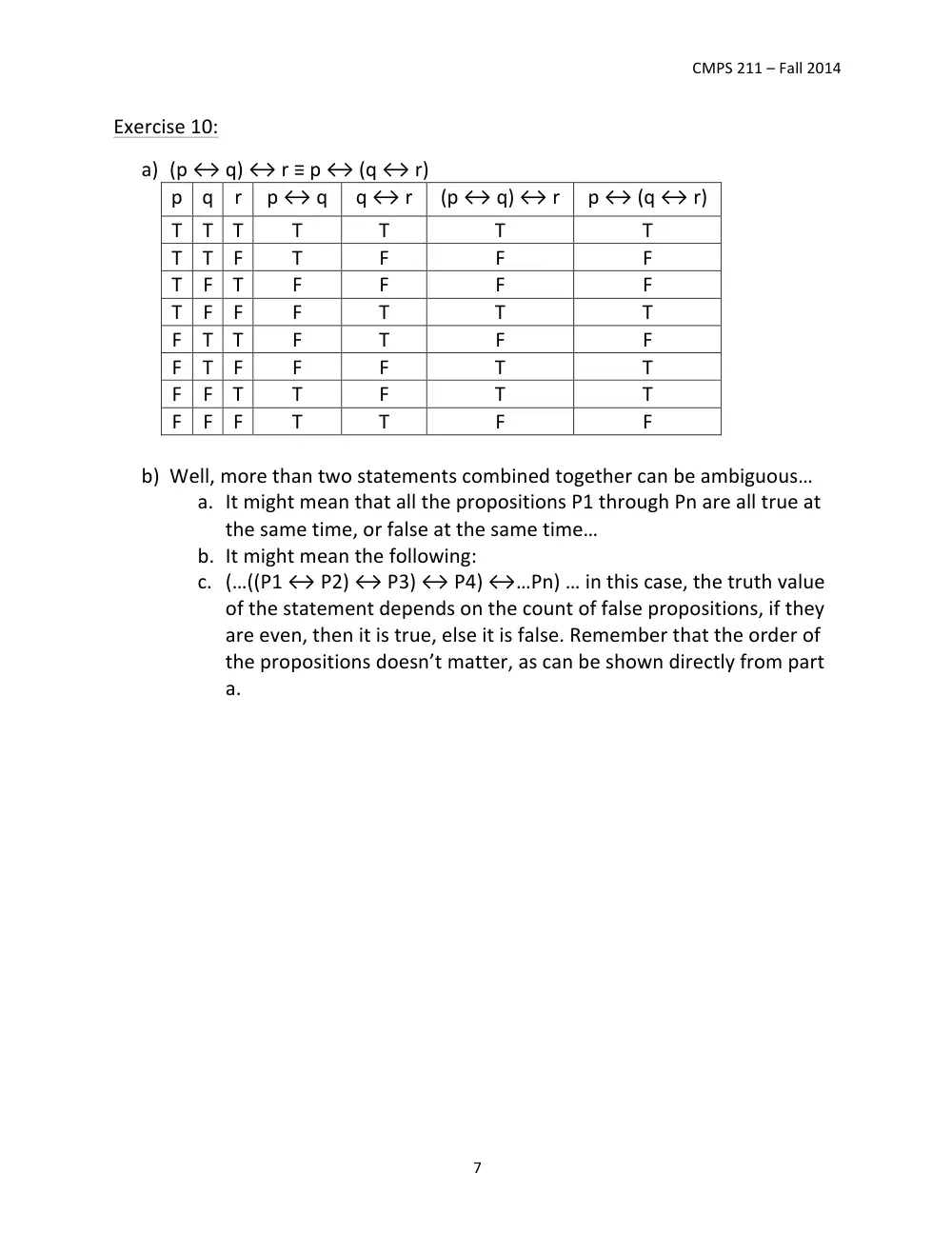
Exercise
10:
a) (p
↔
q)
↔
r
≡
p
↔
(q
↔
r)
p
q
r
p
↔
q
q
↔
r
(p
↔
q)
↔
r
p
↔
(q
↔
r)
T
T
T
T
T
T
T
T
T
F
T
F
F
F
T
F
T
F
F
F
F
T
F
F
F
T
T
T
F
T
T
F
T
F
F
F
T
F
F
F
T
T
F
F
T
T
F
T
T
F
F
F
T
T
F
F
b) Well,
more
than
two
statements
combined
together
can
be
ambiguous…
a. It
might
mean
that
all
the
propositions
P1
through
Pn
are
all
true
at
the
same
time,
or
false
at
the
same
time…
b. It
might
mean
the
following:
c. (…((P1
↔
P2)
↔
P3)
↔
P4)
↔…Pn)
…
in
this
case,
the
truth
value
of
the
statement
depends
on
the
count
of
false
propositions,
if
they
are
even,
then
it
is
true,
else
it
is
false.
Remember
that
the
order
of
the
propositions
doesn’t
matter,
as
can
be
shown
directly
from
part
a.