
CMPS 211 Homework Assignment 04 Solution, Fall 2014
American University of Beirut · Discrete Structures · 7 pages · with solution
More CMPS 211 files
- Homework 3 with Solution · Spring 2016Homework · with solutionView
- Homework 6 with Solution · Spring 2016Homework · with solutionView
- Homework 1 with Solution · Spring 2016Homework · with solutionView
- Homework 4 with Solution · Spring 2016Homework · with solutionView
- Homework 5 with Solution · Spring 2016Homework · with solutionView
- Homework 1 · Fall 2015HomeworkView
- Homework 3 · Fall 2015HomeworkView
- Homework 1 Solution · Fall 2015Homework · with solutionView
Show the text of this homework
CMPS
211
–
Fall
2014
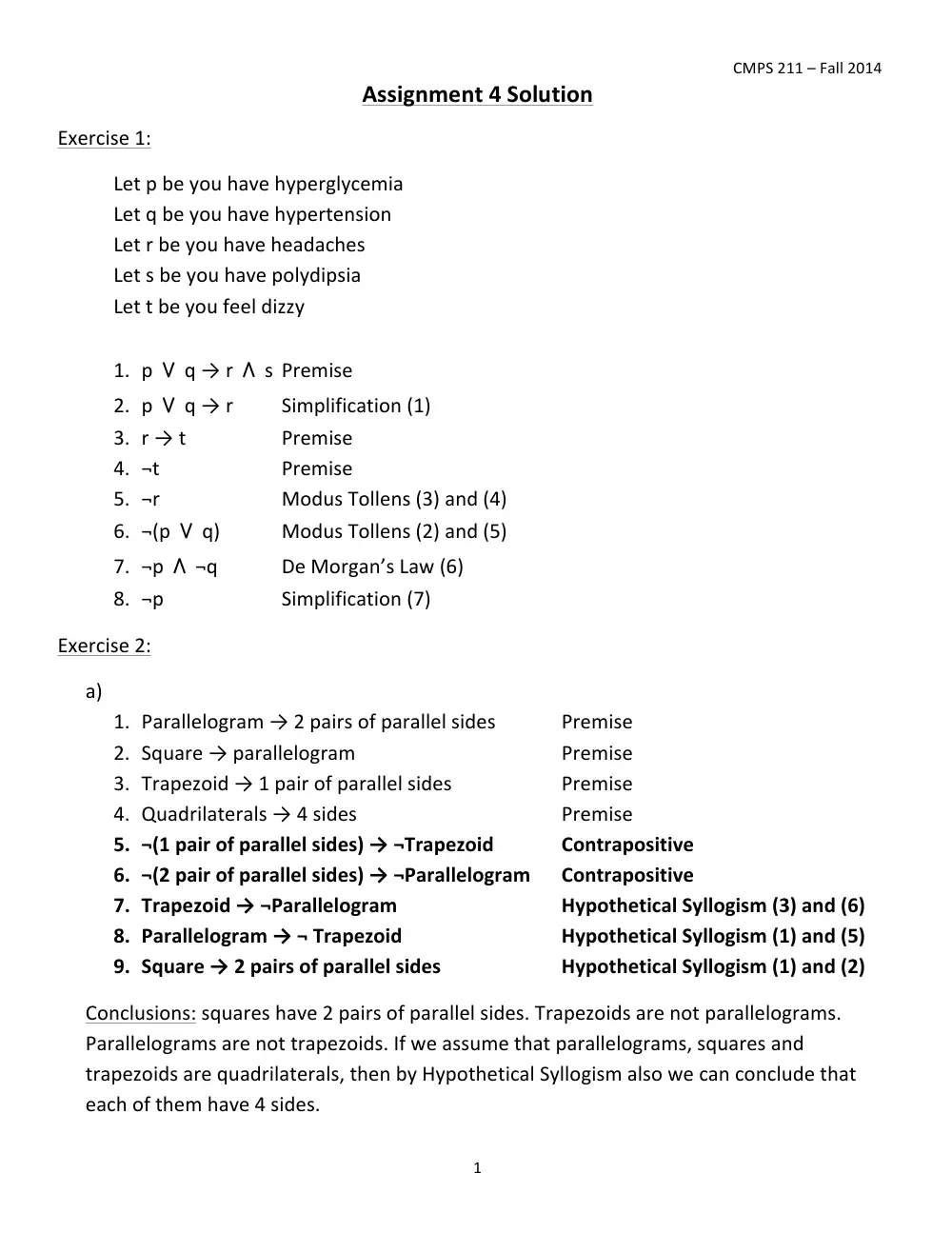
1
Assignment
4
Solution
Exercise
1:
Let
p
be
you
have
hyperglycemia
Let
q
be
you
have
hypertension
Let
r
be
you
have
headaches
Let
s
be
you
have
polydipsia
Let
t
be
you
feel
dizzy
1. p
∨
q
→
r
∧
s
Premise
2. p
∨
q
→
r
Simplification
(1)
3. r
→
t
Premise
4. ¬t
Premise
5. ¬r
Modus
Tollens
(3)
and
(4)
6. ¬(p
∨
q)
Modus
Tollens
(2)
and
(5)
7. ¬p
∧
¬q
De
Morgan’s
Law
(6)
8. ¬p
Simplification
(7)
Exercise
2:
a)
1. Parallelogram
→
2
pairs
of
parallel
sides
Premise
2. Square
→
parallelogram
Premise
3. Trapezoid
→
1
pair
of
parallel
sides
Premise
4. Quadrilaterals
→
4
sides
Premise
5. ¬(1
pair
of
parallel
sides)
→
¬Trapezoid
Contrapositive
6. ¬(2
pair
of
parallel
sides)
→
¬Parallelogram
Contrapositive
7. Trapezoid
→
¬Parallelogram
Hypothetical
Syllogism
(3)
and
(6)
8. Parallelogram
→
¬
Trapezoid
Hypothetical
Syllogism
(1)
and
(5)
9. Square
→
2
pairs
of
parallel
sides
Hypothetical
Syllogism
(1)
and
(2)
Conclusions:
squares
have
2
pairs
of
parallel
sides.
Trapezoids
are
not
parallelograms.
Parallelograms
are
not
trapezoids.
If
we
assume
that
parallelograms,
squares
and
trapezoids
are
quadrilaterals,
then
by
Hypothetical
Syllogism
also
we
can
conclude
that
each
of
them
have
4
sides.
CMPS
211
–
Fall
2014
2
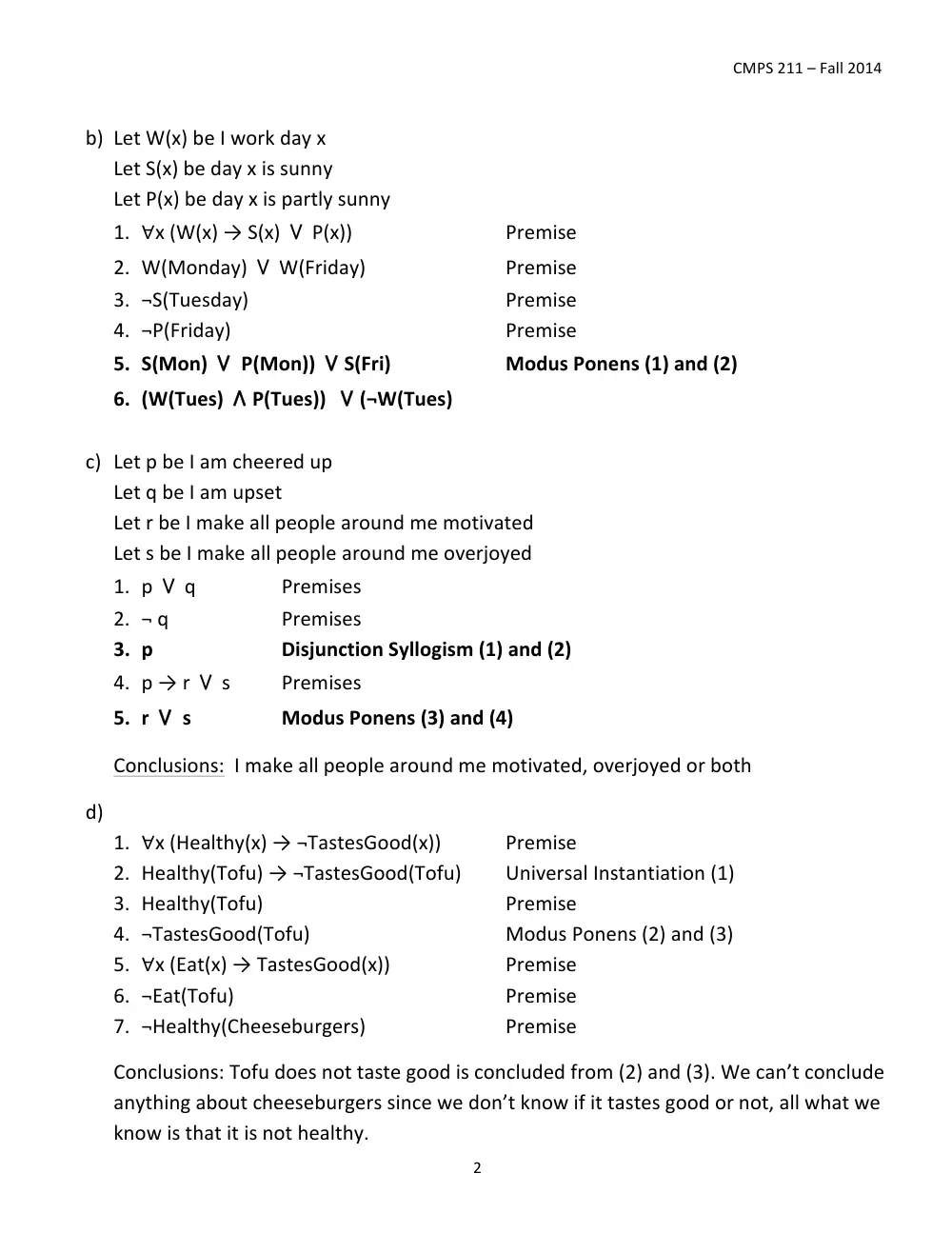
b) Let
W(x)
be
I
work
day
x
Let
S(x)
be
day
x
is
sunny
Let
P(x)
be
day
x
is
partly
sunny
1. ∀x
(W(x)
→
S(x)
∨
P(x))
Premise
2. W(Monday)
∨
W(Friday)
Premise
3. ¬S(Tuesday)
Premise
4. ¬P(Friday)
Premise
5. S(Mon)
∨
P(Mon))
∨S(Fri)
Modus
Ponens
(1)
and
(2)
6. (W(Tues)
∧P(Tues))
∨(¬W(Tues)
c) Let
p
be
I
am
cheered
up
Let
q
be
I
am
upset
Let
r
be
I
make
all
people
around
me
motivated
Let
s
be
I
make
all
people
around
me
overjoyed
1. p
∨
q
Premises
2. ¬
q
Premises
3. p
Disjunction
Syllogism
(1)
and
(2)
4. p
→
r
∨
s
Premises
5. r
∨
s
Modus
Ponens
(3)
and
(4)
Conclusions:
I
make
all
people
around
me
motivated,
overjoyed
or
both
d)
1. ∀x
(Healthy(x)
→
¬TastesGood(x))
Premise
2. Healthy(Tofu)
→
¬TastesGood(Tofu)
Universal
Instantiation
(1)
3. Healthy(Tofu)
Premise
4. ¬TastesGood(Tofu)
Modus
Ponens
(2)
and
(3)
5. ∀x
(Eat(x)
→
TastesGood(x))
Premise
6. ¬Eat(Tofu)
Premise
7. ¬Healthy(Cheeseburgers)
Premise
Conclusions:
Tofu
does
not
taste
good
is
concluded
from
(2)
and
(3).
We
can’t
conclude
anything
about
cheeseburgers
since
we
don’t
know
if
it
tastes
good
or
not,
all
what
we
know
is
that
it
is
not
healthy.
CMPS
211
–
Fall
2014
3
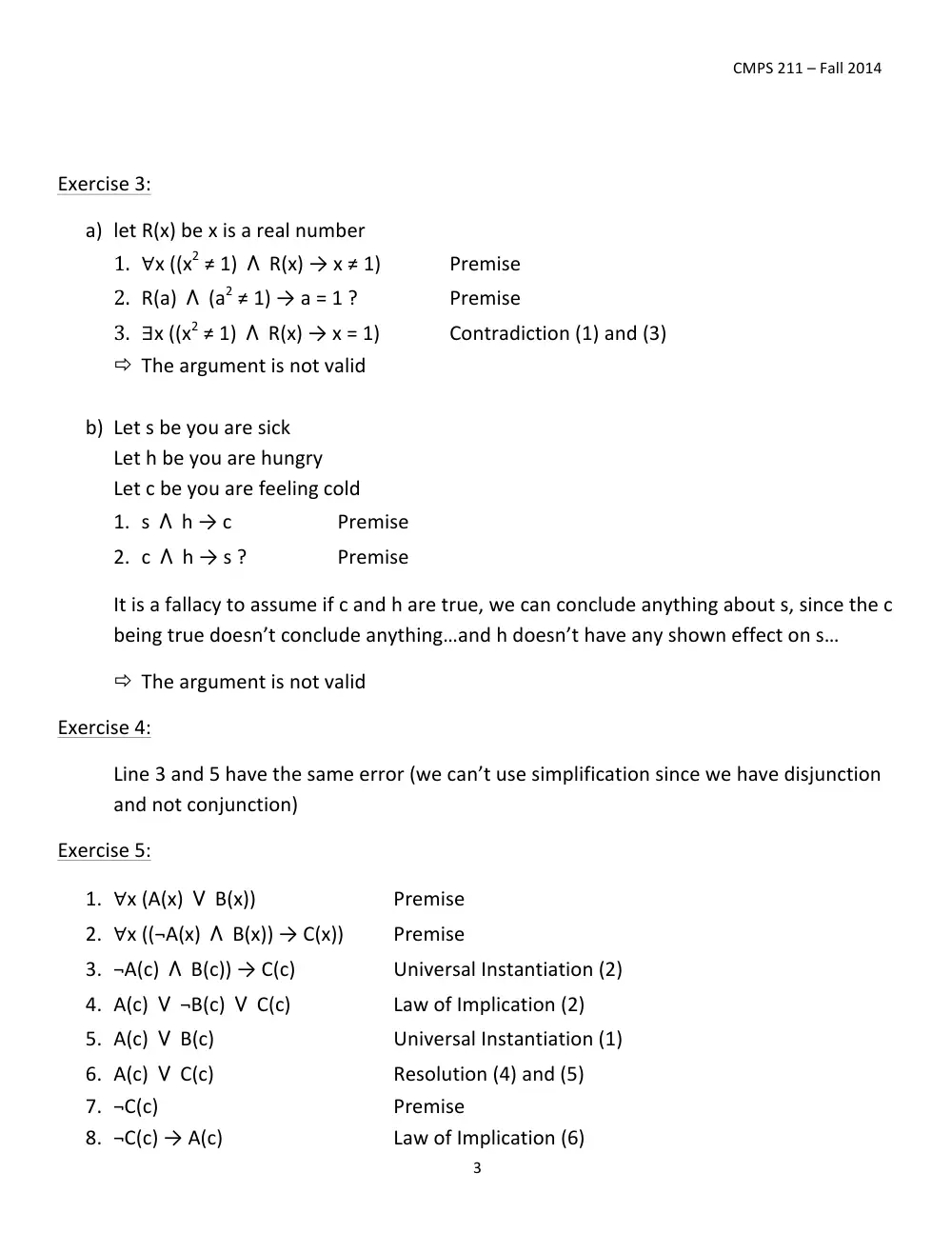
Exercise
3:
a) let
R(x)
be
x
is
a
real
number
1. ∀x
((x2
≠
1)
∧
R(x)
→
x
≠
1)
Premise
2. R(a)
∧
(a2
≠
1)
→
a
=
1
?
Premise
3. ∃x
((x2
≠
1)
∧
R(x)
→
x
=
1)
Contradiction
(1)
and
(3)
� The
argument
is
not
valid
b) Let
s
be
you
are
sick
Let
h
be
you
are
hungry
Let
c
be
you
are
feeling
cold
1. s
∧
h
→
c
Premise
2. c
∧
h
→
s
?
Premise
It
is
a
fallacy
to
assume
if
c
and
h
are
true,
we
can
conclude
anything
about
s,
since
the
c
being
true
doesn’t
conclude
anything…and
h
doesn’t
have
any
shown
effect
on
s…
� The
argument
is
not
valid
Exercise
4:
Line
3
and
5
have
the
same
error
(we
can’t
use
simplification
since
we
have
disjunction
and
not
conjunction)
Exercise
5:
1. ∀x
(A(x)
∨
B(x))
Premise
2. ∀x
((¬A(x)
∧
B(x))
→
C(x))
Premise
3. ¬A(c)
∧
B(c))
→
C(c)
Universal
Instantiation
(2)
4. A(c)
∨
¬B(c)
∨
C(c)
Law
of
Implication
(2)
5. A(c)
∨
B(c)
Universal
Instantiation
(1)
6. A(c)
∨
C(c)
Resolution
(4)
and
(5)
7. ¬C(c)
Premise
8. ¬C(c)
→
A(c)
Law
of
Implication
(6)
CMPS
211
–
Fall
2014
4
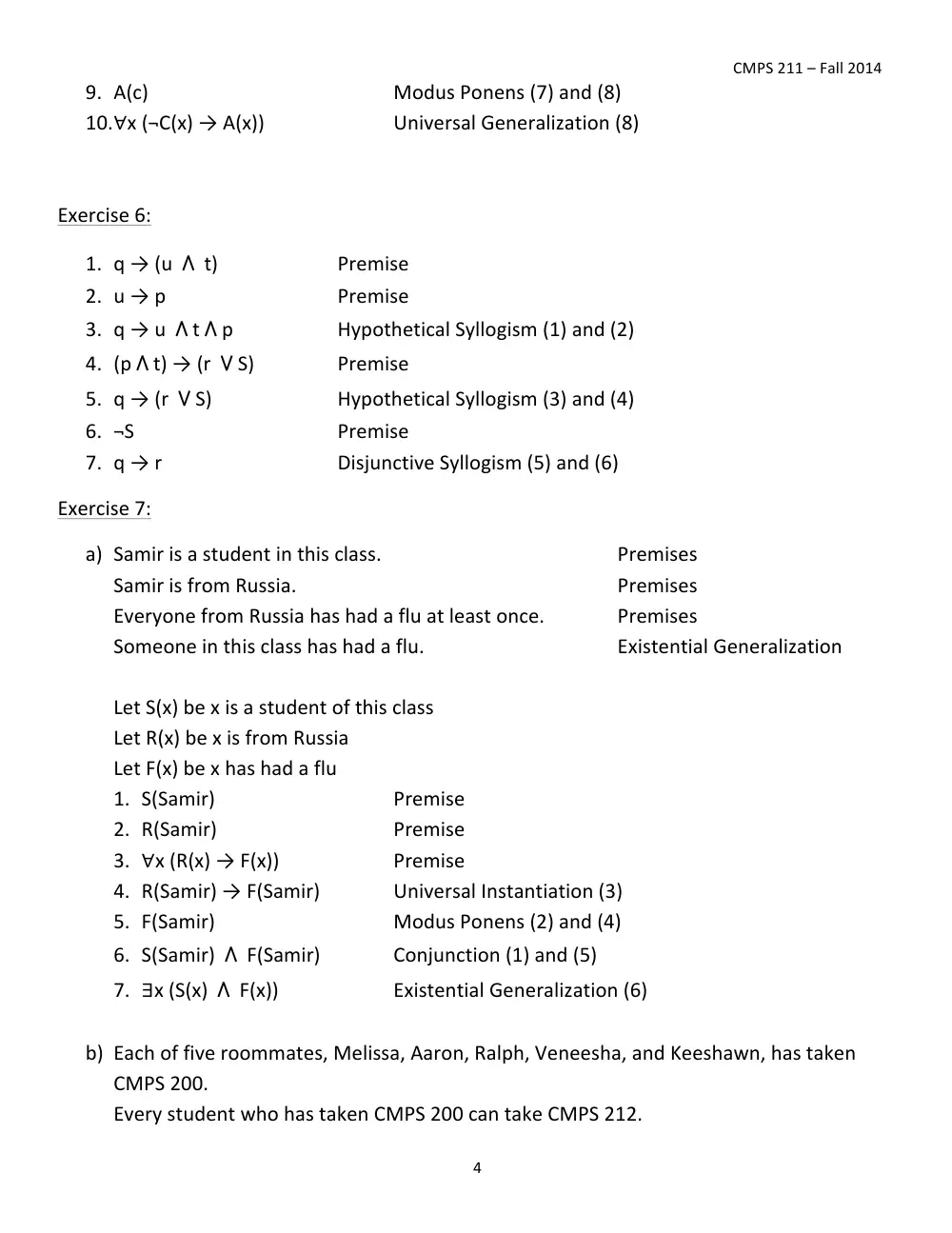
9. A(c)
Modus
Ponens
(7)
and
(8)
10. ∀x
(¬C(x)
→
A(x))
Universal
Generalization
(8)
Exercise
6:
1. q
→
(u
∧
t)
Premise
2. u
→
p
Premise
3. q
→
u
∧t∧p
Hypothetical
Syllogism
(1)
and
(2)
4. (p∧t)
→
(r
∨S)
Premise
5. q
→
(r
∨S)
Hypothetical
Syllogism
(3)
and
(4)
6. ¬S
Premise
7. q
→
r
Disjunctive
Syllogism
(5)
and
(6)
Exercise
7:
a) Samir
is
a
student
in
this
class.
Premises
Samir
is
from
Russia.
Premises
Everyone
from
Russia
has
had
a
flu
at
least
once.
Premises
Someone
in
this
class
has
had
a
flu.
Existential
Generalization
Let
S(x)
be
x
is
a
student
of
this
class
Let
R(x)
be
x
is
from
Russia
Let
F(x)
be
x
has
had
a
flu
1. S(Samir)
Premise
2. R(Samir)
Premise
3. ∀x
(R(x)
→
F(x))
Premise
4. R(Samir)
→
F(Samir)
Universal
Instantiation
(3)
5. F(Samir)
Modus
Ponens
(2)
and
(4)
6. S(Samir)
∧
F(Samir)
Conjunction
(1)
and
(5)
7. ∃x
(S(x)
∧
F(x))
Existential
Generalization
(6)
b) Each
of
five
roommates,
Melissa,
Aaron,
Ralph,
Veneesha,
and
Keeshawn,
has
taken
CMPS
200.
Every
student
who
has
taken
CMPS
200
can
take
CMPS
212.
CMPS
211
–
Fall
2014
5
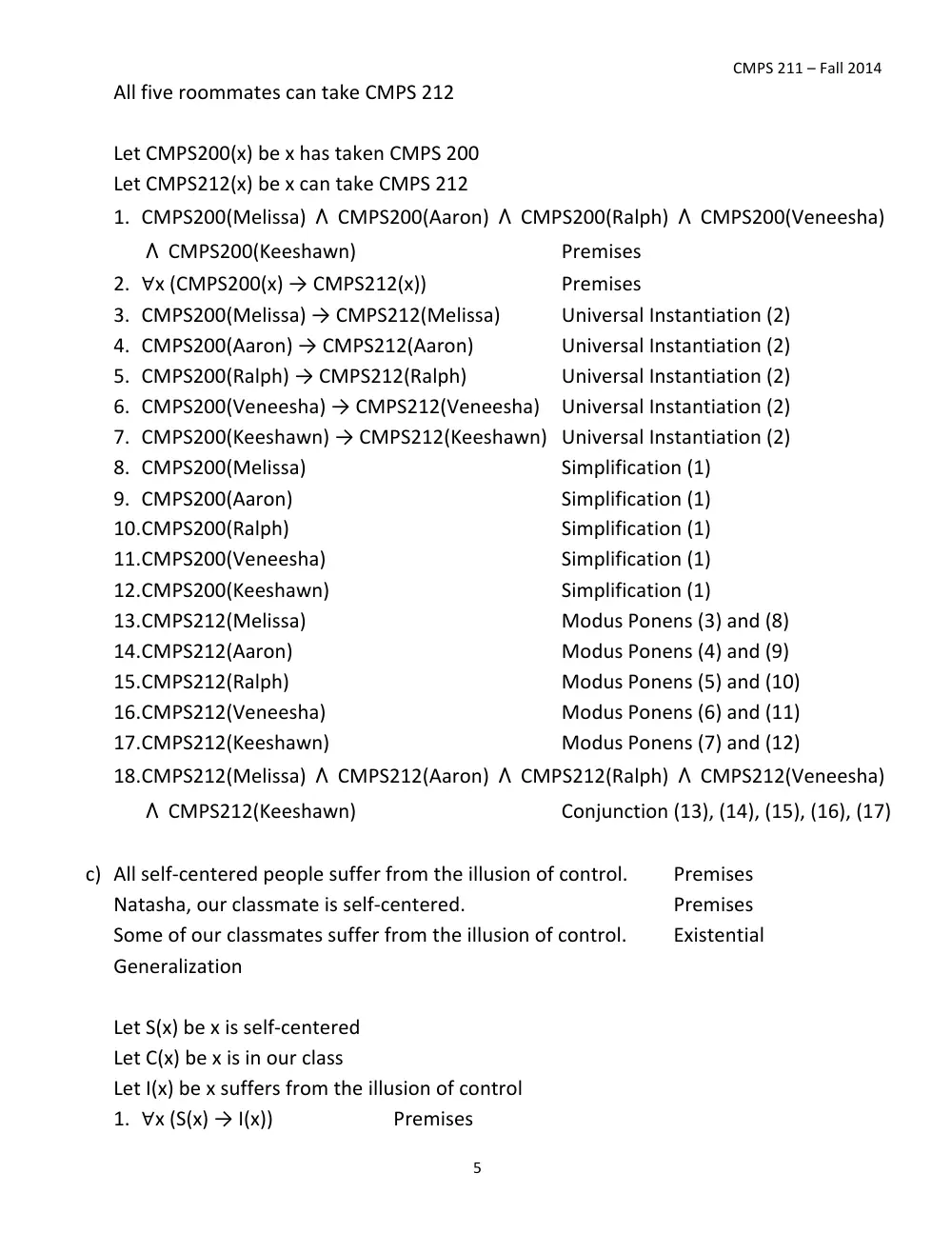
All
five
roommates
can
take
CMPS
212
Let
CMPS200(x)
be
x
has
taken
CMPS
200
Let
CMPS212(x)
be
x
can
take
CMPS
212
1. CMPS200(Melissa)
∧
CMPS200(Aaron)
∧
CMPS200(Ralph)
∧
CMPS200(Veneesha)
∧
CMPS200(Keeshawn)
Premises
2. ∀x
(CMPS200(x)
→
CMPS212(x))
Premises
3. CMPS200(Melissa)
→
CMPS212(Melissa)
Universal
Instantiation
(2)
4. CMPS200(Aaron)
→
CMPS212(Aaron)
Universal
Instantiation
(2)
5. CMPS200(Ralph)
→
CMPS212(Ralph)
Universal
Instantiation
(2)
6. CMPS200(Veneesha)
→
CMPS212(Veneesha)
Universal
Instantiation
(2)
7. CMPS200(Keeshawn)
→
CMPS212(Keeshawn)
Universal
Instantiation
(2)
8. CMPS200(Melissa)
Simplification
(1)
9. CMPS200(Aaron)
Simplification
(1)
10. CMPS200(Ralph)
Simplification
(1)
11. CMPS200(Veneesha)
Simplification
(1)
12. CMPS200(Keeshawn)
Simplification
(1)
13. CMPS212(Melissa)
Modus
Ponens
(3)
and
(8)
14. CMPS212(Aaron)
Modus
Ponens
(4)
and
(9)
15. CMPS212(Ralph)
Modus
Ponens
(5)
and
(10)
16. CMPS212(Veneesha)
Modus
Ponens
(6)
and
(11)
17. CMPS212(Keeshawn)
Modus
Ponens
(7)
and
(12)
18. CMPS212(Melissa)
∧
CMPS212(Aaron)
∧
CMPS212(Ralph)
∧
CMPS212(Veneesha)
∧
CMPS212(Keeshawn)
Conjunction
(13),
(14),
(15),
(16),
(17)
c) All
self-‐centered
people
suffer
from
the
illusion
of
control.
Premises
Natasha,
our
classmate
is
self-‐centered.
Premises
Some
of
our
classmates
suffer
from
the
illusion
of
control.
Existential
Generalization
Let
S(x)
be
x
is
self-‐centered
Let
C(x)
be
x
is
in
our
class
Let
I(x)
be
x
suffers
from
the
illusion
of
control
1. ∀x
(S(x)
→
I(x))
Premises
CMPS
211
–
Fall
2014
6
2. S(Natasha)
→
I(Natasha)
Universal
Instantiation
(1)
3. S(Natasha)
Premises
4. C(Natasha)
Premises
5. I(Natasha)
Modus
Ponens
(2)
and
(3)
6. C(Natasha)
∧
I(Natasha)
Conjunction
(4)
and
(5)
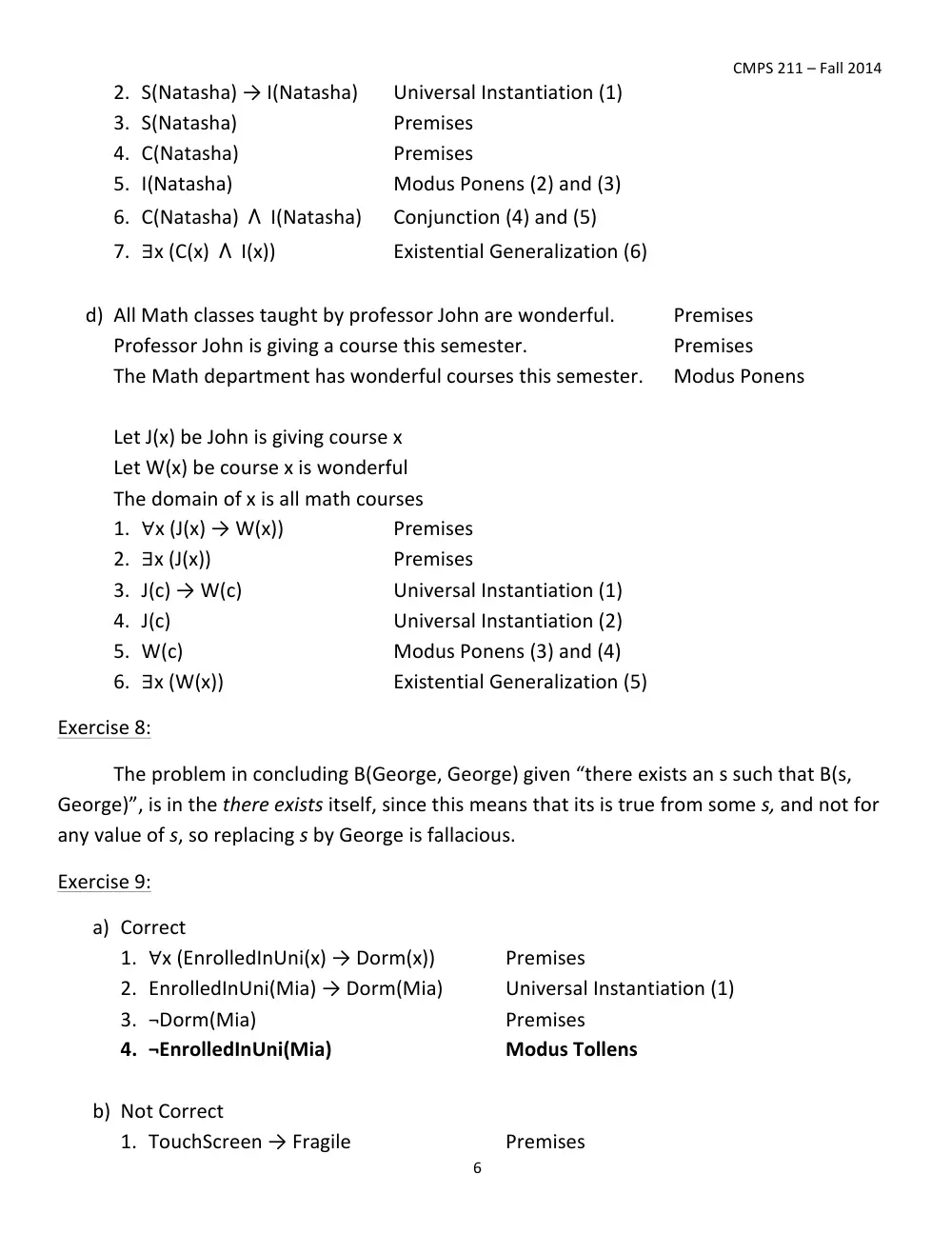
7. ∃x
(C(x)
∧
I(x))
Existential
Generalization
(6)
d) All
Math
classes
taught
by
professor
John
are
wonderful.
Premises
Professor
John
is
giving
a
course
this
semester.
Premises
The
Math
department
has
wonderful
courses
this
semester.
Modus
Ponens
Let
J(x)
be
John
is
giving
course
x
Let
W(x)
be
course
x
is
wonderful
The
domain
of
x
is
all
math
courses
1. ∀x
(J(x)
→
W(x))
Premises
2. ∃x
(J(x))
Premises
3. J(c)
→
W(c)
Universal
Instantiation
(1)
4. J(c)
Universal
Instantiation
(2)
5. W(c)
Modus
Ponens
(3)
and
(4)
6. ∃x
(W(x))
Existential
Generalization
(5)
Exercise
8:
The
problem
in
concluding
B(George,
George)
given
“there
exists
an
s
such
that
B(s,
George)”,
is
in
the
there
exists
itself,
since
this
means
that
its
is
true
from
some
s,
and
not
for
any
value
of
s,
so
replacing
s
by
George
is
fallacious.
Exercise
9:
a) Correct
1. ∀x
(EnrolledInUni(x)
→
Dorm(x))
Premises
2. EnrolledInUni(Mia)
→
Dorm(Mia)
Universal
Instantiation
(1)
3. ¬Dorm(Mia)
Premises
4. ¬EnrolledInUni(Mia)
Modus
Tollens
b) Not
Correct
1. TouchScreen
→
Fragile
Premises
CMPS
211
–
Fall
2014
7
2. ¬TouchScreen
Premises
We
can’t
conclude
anything
about
the
laptop
since
the
hypothesis
is
false
(the
conclusion
can
have
any
truth
value)
c) Not
Correct
1. Android
→
Java
Premises
2. Java
Premises
We
can’t
conclude
anything
about
the
phone
since
the
conclusion
is
true
(the
hypothesis
can
have
any
truth
value)
d) Correct
1. Plant
→
ProduceGlucose
Premises
2. Palm
→
Plants
Premises
3. Palm
→
ProduceGlucose
Hypothetical
Syllogism
Exercise
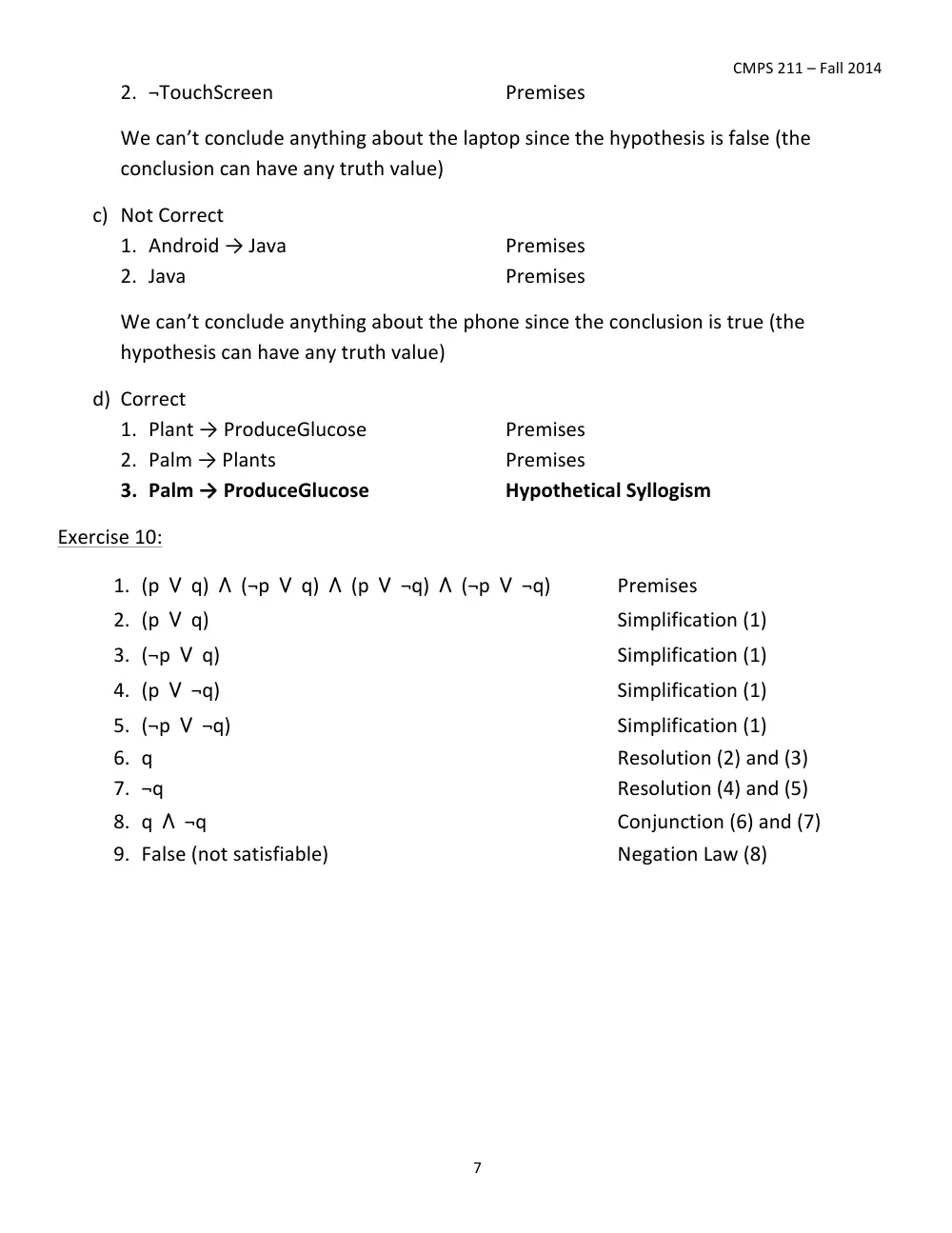
10:
1. (p
∨
q)
∧
(¬p
∨
q)
∧
(p
∨
¬q)
∧
(¬p
∨
¬q)
Premises
2. (p
∨
q)
Simplification
(1)
3. (¬p
∨
q)
Simplification
(1)
4. (p
∨
¬q)
Simplification
(1)
5. (¬p
∨
¬q)
Simplification
(1)
6. q
Resolution
(2)
and
(3)
7. ¬q
Resolution
(4)
and
(5)
8. q
∧
¬q
Conjunction
(6)
and
(7)
9. False
(not
satisfiable)
Negation
Law
(8)