
CMPS 211 Homework Assignment 07 Solution, Fall 2014
American University of Beirut · Discrete Structures · 5 pages · with solution
More CMPS 211 files
- Homework 3 with Solution · Spring 2016Homework · with solutionView
- Homework 6 with Solution · Spring 2016Homework · with solutionView
- Homework 1 with Solution · Spring 2016Homework · with solutionView
- Homework 4 with Solution · Spring 2016Homework · with solutionView
- Homework 5 with Solution · Spring 2016Homework · with solutionView
- Homework 1 · Fall 2015HomeworkView
- Homework 3 · Fall 2015HomeworkView
- Homework 1 Solution · Fall 2015Homework · with solutionView
Show the text of this homework
CMPS 211 – Fall 2014
Assignment 7 Solution
1
Assignment 7 Solution
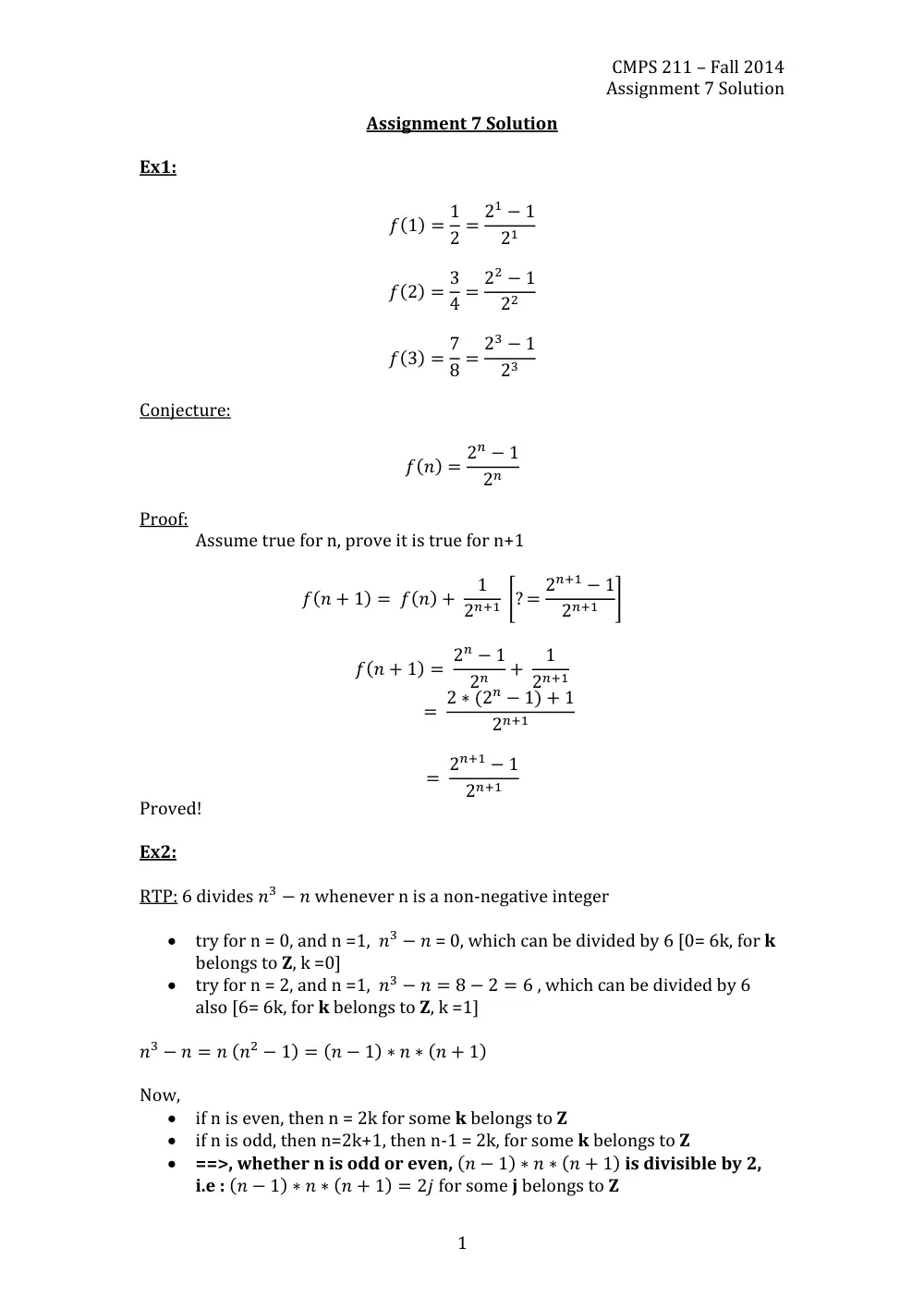
Ex1:
𝑓(1) = 1
2 = 21 − 1
21
𝑓(2) = 3
4 = 22 − 1
22
𝑓(3) = 7
8 = 23 − 1
23
Conjecture:
𝑓(𝑛) = 2𝑛 − 1
2𝑛
Proof:
Assume true for n, prove it is true for n+1
𝑓(𝑛 + 1) = 𝑓(𝑛) +
1
2𝑛+1 [? = 2𝑛+1 − 1
2𝑛+1
]
𝑓(𝑛 + 1) = 2𝑛 − 1
2𝑛
+
1
2𝑛+1
= 2 ∗ (2𝑛 − 1) + 1
2𝑛+1
= 2𝑛+1 − 1
2𝑛+1
Proved!
Ex2:
RTP: 6 divides 𝑛3 − 𝑛 whenever n is a non-negative integer
try for n = 0, and n =1, 𝑛3 − 𝑛 = 0, which can be divided by 6 [0= 6k, for k
belongs to Z, k =0]
try for n = 2, and n =1, 𝑛3 − 𝑛 = 8 − 2 = 6 , which can be divided by 6
also [6= 6k, for k belongs to Z, k =1]
𝑛3 − 𝑛 = 𝑛 (𝑛2 − 1) = (𝑛 − 1) ∗ 𝑛 ∗ (𝑛 + 1)
Now,
if n is even, then n = 2k for some k belongs to Z
if n is odd, then n=2k+1, then n-1 = 2k, for some k belongs to Z
==>, whether n is odd or even, (𝑛 − 1) ∗ 𝑛 ∗ (𝑛 + 1) is divisible by 2,
i.e : (𝑛 − 1) ∗ 𝑛 ∗ (𝑛 + 1) = 2𝑗 for some j belongs to Z
CMPS 211 – Fall 2014
Assignment 7 Solution
2
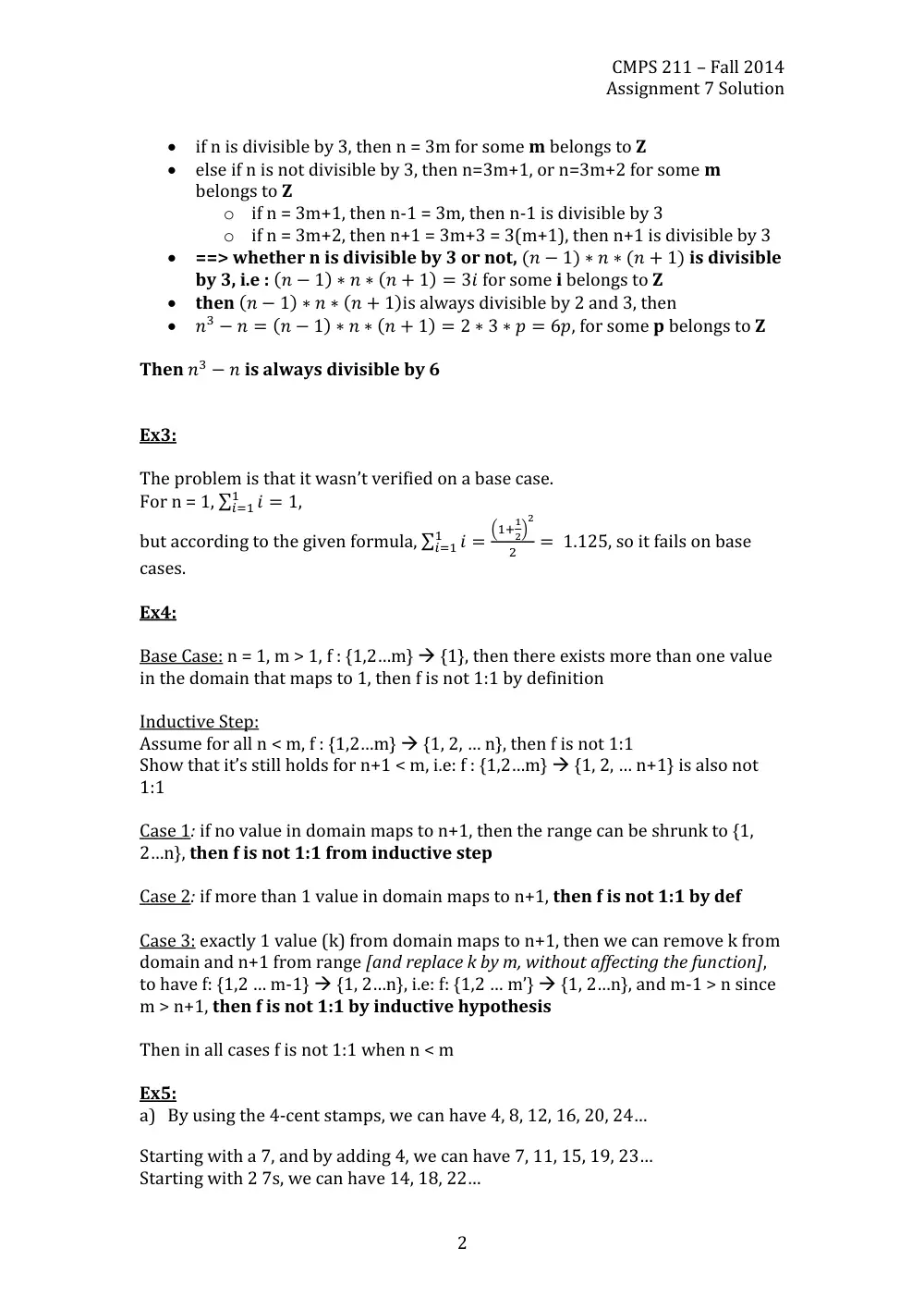
if n is divisible by 3, then n = 3m for some m belongs to Z
else if n is not divisible by 3, then n=3m+1, or n=3m+2 for some m
belongs to Z
o if n = 3m+1, then n-1 = 3m, then n-1 is divisible by 3
o if n = 3m+2, then n+1 = 3m+3 = 3(m+1), then n+1 is divisible by 3
==> whether n is divisible by 3 or not, (𝑛 − 1) ∗ 𝑛 ∗ (𝑛 + 1) is divisible
by 3, i.e : (𝑛 − 1) ∗ 𝑛 ∗ (𝑛 + 1) = 3𝑖 for some i belongs to Z
then (𝑛 − 1) ∗ 𝑛 ∗ (𝑛 + 1)is always divisible by 2 and 3, then
𝑛3 − 𝑛 = (𝑛 − 1) ∗ 𝑛 ∗ (𝑛 + 1) = 2 ∗ 3 ∗ 𝑝 = 6𝑝, for some p belongs to Z
Then 𝑛3 − 𝑛 is always divisible by 6
Ex3:
The problem is that it wasn’t verified on a base case.
For n = 1, ∑
𝑖
1
𝑖=1 = 1,
but according to the given formula, ∑
𝑖
1
𝑖=1 =
(1+1
2)
2
2
= 1.125, so it fails on base
cases.
Ex4:
Base Case: n = 1, m > 1, f : {1,2…m} {1}, then there exists more than one value
in the domain that maps to 1, then f is not 1:1 by definition
Inductive Step:
Assume for all n < m, f : {1,2…m} {1, 2, … n}, then f is not 1:1
Show that it’s still holds for n+1 < m, i.e: f : {1,2…m} {1, 2, … n+1} is also not
1:1
Case 1: if no value in domain maps to n+1, then the range can be shrunk to {1,
2…n}, then f is not 1:1 from inductive step
Case 2: if more than 1 value in domain maps to n+1, then f is not 1:1 by def
Case 3: exactly 1 value (k) from domain maps to n+1, then we can remove k from
domain and n+1 from range [and replace k by m, without affecting the function],
to have f: {1,2 … m-1} {1, 2…n}, i.e: f: {1,2 … m’} {1, 2…n}, and m-1 > n since
m > n+1, then f is not 1:1 by inductive hypothesis
Then in all cases f is not 1:1 when n < m
Ex5:
a) By using the 4-cent stamps, we can have 4, 8, 12, 16, 20, 24…
Starting with a 7, and by adding 4, we can have 7, 11, 15, 19, 23…
Starting with 2 7s, we can have 14, 18, 22…
CMPS 211 – Fall 2014
Assignment 7 Solution
3
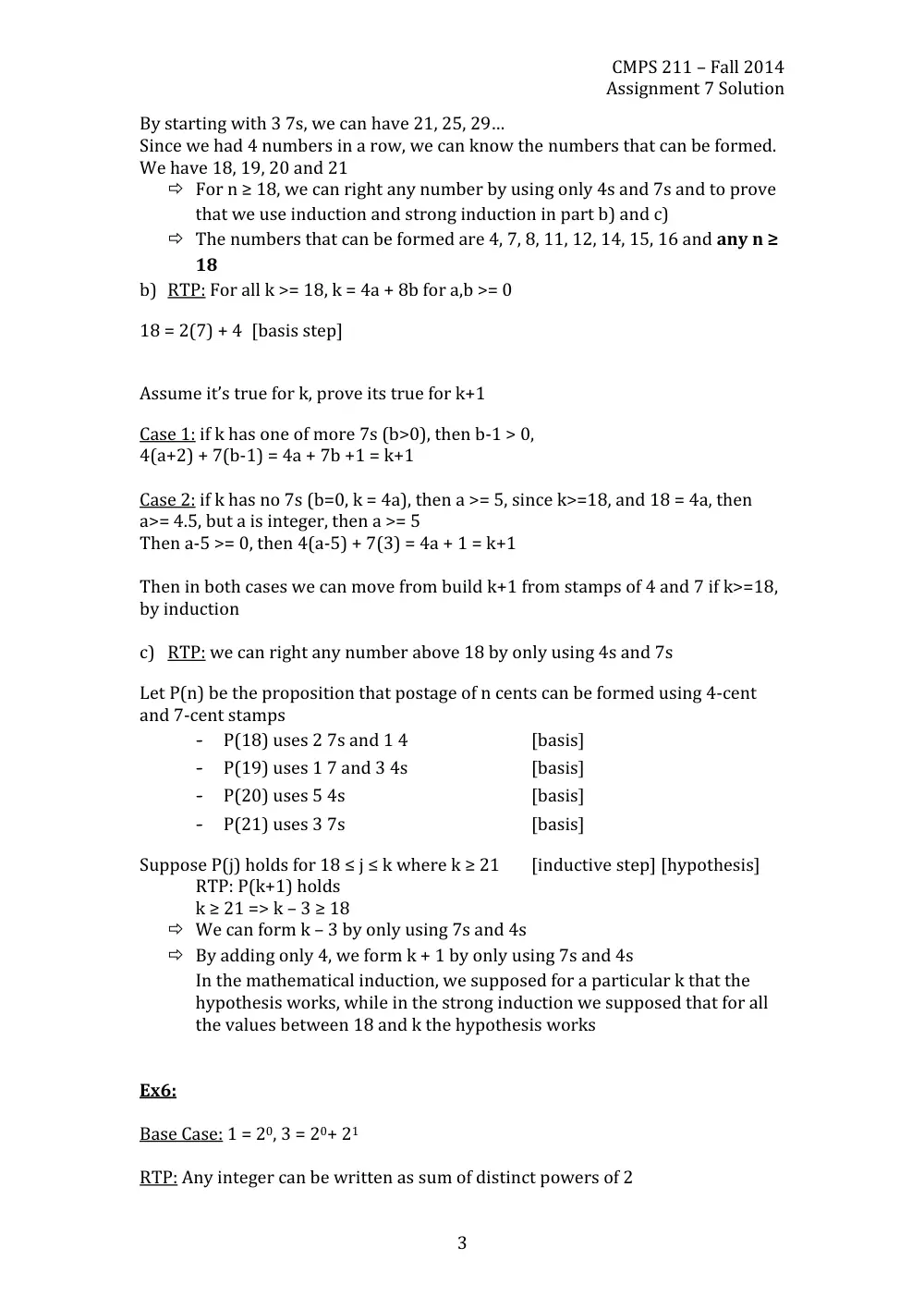
By starting with 3 7s, we can have 21, 25, 29…
Since we had 4 numbers in a row, we can know the numbers that can be formed.
We have 18, 19, 20 and 21
For n ≥ 18, we can right any number by using only 4s and 7s and to prove
that we use induction and strong induction in part b) and c)
The numbers that can be formed are 4, 7, 8, 11, 12, 14, 15, 16 and any n ≥
18
b) RTP: For all k >= 18, k = 4a + 8b for a,b >= 0
18 = 2(7) + 4 [basis step]
Assume it’s true for k, prove its true for k+1
Case 1: if k has one of more 7s (b>0), then b-1 > 0,
4(a+2) + 7(b-1) = 4a + 7b +1 = k+1
Case 2: if k has no 7s (b=0, k = 4a), then a >= 5, since k>=18, and 18 = 4a, then
a>= 4.5, but a is integer, then a >= 5
Then a-5 >= 0, then 4(a-5) + 7(3) = 4a + 1 = k+1
Then in both cases we can move from build k+1 from stamps of 4 and 7 if k>=18,
by induction
c) RTP: we can right any number above 18 by only using 4s and 7s
Let P(n) be the proposition that postage of n cents can be formed using 4-cent
and 7-cent stamps
-
P(18) uses 2 7s and 1 4
[basis]
-
P(19) uses 1 7 and 3 4s
[basis]
-
P(20) uses 5 4s
[basis]
-
P(21) uses 3 7s
[basis]
Suppose P(j) holds for 18 ≤ j ≤ k where k ≥ 21
[inductive step] [hypothesis]
RTP: P(k+1) holds
k ≥ 21 => k – 3 ≥ 18
We can form k – 3 by only using 7s and 4s
By adding only 4, we form k + 1 by only using 7s and 4s
In the mathematical induction, we supposed for a particular k that the
hypothesis works, while in the strong induction we supposed that for all
the values between 18 and k the hypothesis works
Ex6:
Base Case: 1 = 20, 3 = 20+ 21
RTP: Any integer can be written as sum of distinct powers of 2
CMPS 211 – Fall 2014
Assignment 7 Solution
4
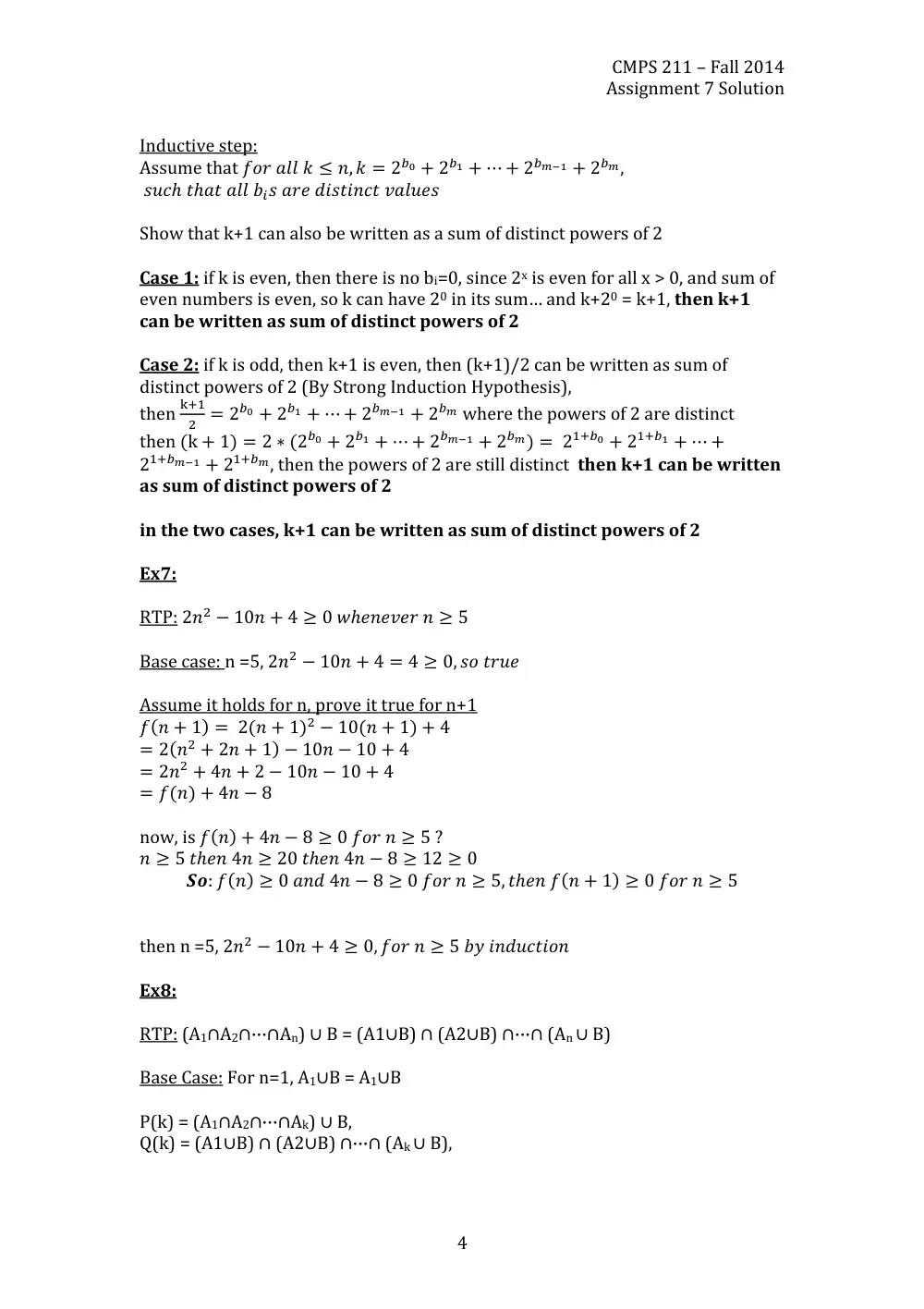
Inductive step:
Assume that 𝑓𝑜𝑟 𝑎𝑙𝑙 𝑘 ≤ 𝑛, 𝑘 = 2𝑏0 + 2𝑏1 + ⋯ + 2𝑏𝑚−1 + 2𝑏𝑚,
𝑠𝑢𝑐ℎ 𝑡ℎ𝑎𝑡 𝑎𝑙𝑙 𝑏𝑖𝑠 𝑎𝑟𝑒 𝑑𝑖𝑠𝑡𝑖𝑛𝑐𝑡 𝑣𝑎𝑙𝑢𝑒𝑠
Show that k+1 can also be written as a sum of distinct powers of 2
Case 1: if k is even, then there is no bi=0, since 2x is even for all x > 0, and sum of
even numbers is even, so k can have 20 in its sum… and k+20 = k+1, then k+1
can be written as sum of distinct powers of 2
Case 2: if k is odd, then k+1 is even, then (k+1)/2 can be written as sum of
distinct powers of 2 (By Strong Induction Hypothesis),
then
k+1
2 = 2𝑏0 + 2𝑏1 + ⋯ + 2𝑏𝑚−1 + 2𝑏𝑚 where the powers of 2 are distinct
then (k + 1) = 2 ∗ (2𝑏0 + 2𝑏1 + ⋯ + 2𝑏𝑚−1 + 2𝑏𝑚) = 21+𝑏0 + 21+𝑏1 + ⋯ +
21+𝑏𝑚−1 + 21+𝑏𝑚, then the powers of 2 are still distinct then k+1 can be written
as sum of distinct powers of 2
in the two cases, k+1 can be written as sum of distinct powers of 2
Ex7:
RTP: 2𝑛2 − 10𝑛 + 4 ≥ 0 𝑤ℎ𝑒𝑛𝑒𝑣𝑒𝑟 𝑛 ≥ 5
Base case: n =5, 2𝑛2 − 10𝑛 + 4 = 4 ≥ 0, 𝑠𝑜 𝑡𝑟𝑢𝑒
Assume it holds for n, prove it true for n+1
𝑓(𝑛 + 1) = 2(𝑛 + 1)2 − 10(𝑛 + 1) + 4
= 2(𝑛2 + 2𝑛 + 1) − 10𝑛 − 10 + 4
= 2𝑛2 + 4𝑛 + 2 − 10𝑛 − 10 + 4
= 𝑓(𝑛) + 4𝑛 − 8
now, is 𝑓(𝑛) + 4𝑛 − 8 ≥ 0 𝑓𝑜𝑟 𝑛 ≥ 5 ?
𝑛 ≥ 5 𝑡ℎ𝑒𝑛 4𝑛 ≥ 20 𝑡ℎ𝑒𝑛 4𝑛 − 8 ≥ 12 ≥ 0
𝑺𝒐: 𝑓(𝑛) ≥ 0 𝑎𝑛𝑑 4𝑛 − 8 ≥ 0 𝑓𝑜𝑟 𝑛 ≥ 5, 𝑡ℎ𝑒𝑛 𝑓(𝑛 + 1) ≥ 0 𝑓𝑜𝑟 𝑛 ≥ 5
then n =5, 2𝑛2 − 10𝑛 + 4 ≥ 0, 𝑓𝑜𝑟 𝑛 ≥ 5 𝑏𝑦 𝑖𝑛𝑑𝑢𝑐𝑡𝑖𝑜𝑛
Ex8:
RTP: (A1∩A2∩···∩An) ∪ B = (A1∪B) ∩ (A2∪B) ∩···∩ (An ∪ B)
Base Case: For n=1, A1∪B = A1∪B
P(k) = (A1∩A2∩···∩Ak) ∪ B,
Q(k) = (A1∪B) ∩ (A2∪B) ∩···∩ (Ak ∪ B),
CMPS 211 – Fall 2014
Assignment 7 Solution
5
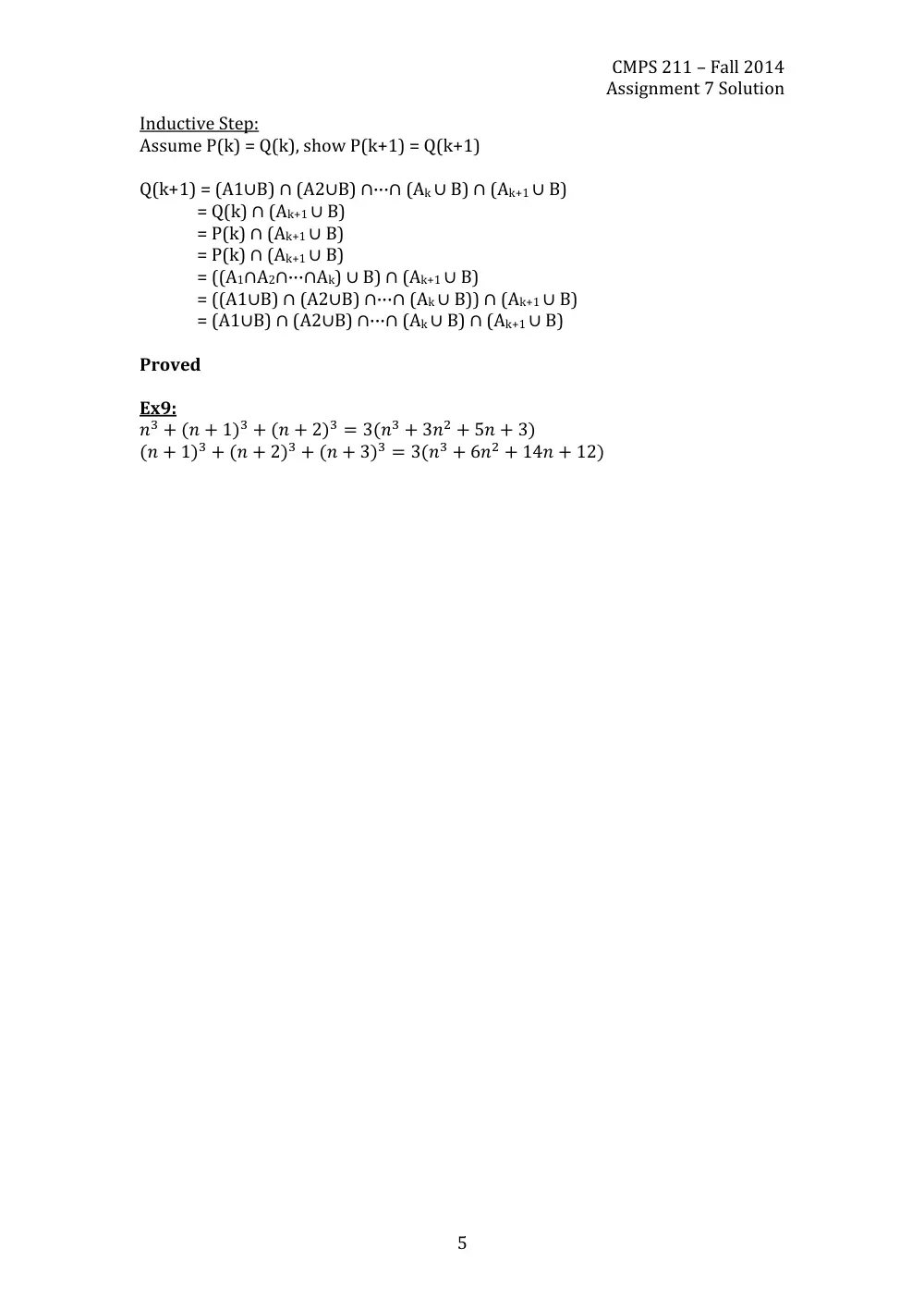
Inductive Step:
Assume P(k) = Q(k), show P(k+1) = Q(k+1)
Q(k+1) = (A1∪B) ∩ (A2∪B) ∩···∩ (Ak ∪ B) ∩ (Ak+1 ∪ B)
= Q(k) ∩ (Ak+1 ∪ B)
= P(k) ∩ (Ak+1 ∪ B)
= P(k) ∩ (Ak+1 ∪ B)
= ((A1∩A2∩···∩Ak) ∪ B) ∩ (Ak+1 ∪ B)
= ((A1∪B) ∩ (A2∪B) ∩···∩ (Ak ∪ B)) ∩ (Ak+1 ∪ B)
= (A1∪B) ∩ (A2∪B) ∩···∩ (Ak ∪ B) ∩ (Ak+1 ∪ B)
Proved
Ex9:
𝑛3 + (𝑛 + 1)3 + (𝑛 + 2)3 = 3(𝑛3 + 3𝑛2 + 5𝑛 + 3)
(𝑛 + 1)3 + (𝑛 + 2)3 + (𝑛 + 3)3 = 3(𝑛3 + 6𝑛2 + 14𝑛 + 12)