
CMPS 211 Homework Assignment 2, Fall 2014
American University of Beirut · Discrete Structures · 3 pages
More CMPS 211 files
- Homework 3 with Solution · Spring 2016Homework · with solutionView
- Homework 6 with Solution · Spring 2016Homework · with solutionView
- Homework 1 with Solution · Spring 2016Homework · with solutionView
- Homework 4 with Solution · Spring 2016Homework · with solutionView
- Homework 5 with Solution · Spring 2016Homework · with solutionView
- Homework 1 · Fall 2015HomeworkView
- Homework 3 · Fall 2015HomeworkView
- Homework 1 Solution · Fall 2015Homework · with solutionView
Show the text of this homework
American
University
of
Beirut
Department
of
Computer
Science
CMPS
211
–
Discrete
Mathematics
–
Fall
14/15
Please solve the following exercises and submit BEFORE 8:00 am of
Tuesday 23 September.
Exercise 1
(10 points)
Are these system specifications consistent? “If the file system is locked, then new
messages will be neither queued nor sent to a buffer. If the file system is not locked, then
new messages will be queued. If the file system is locked, then the system is not
functioning normally, and conversely. If new messages are not queued, then they will be
sent to the message buffer. New messages will not be sent to the message buffer.”
Exercise 2
(10 points)
In the beginning of the semester, Amy was newly assigned to a room in the university
dorms with 3 other girls: Laura, Dianna and Nivine. After spending the first day in the
dorm, Amy got her ring stolen, so she called the head of security guards in the university.
The guard held the 3 other girls as suspects for robbing Amy. However, each of the 3
denied that they stole the ring. Laura also stated that Amy was a friend of Dianna and that
Nivine disliked and envied Amy. Dianna on the other hand stated that she had not met
Amy yet and that she was in her hometown the day Amy was robbed. Finally, Nivine said
that she saw both Laura and Dianna with Amy the day of the robbing and that either
Laura or Dianna must have robbed Amy.
Can you determine who the thief was if
a) one of the three girls was guilty, the two innocent girls were telling the truth, but the
statements of the guilty girl may or may not have been true?
b) innocent girls did not lie?
Exercise 3
(10 points)
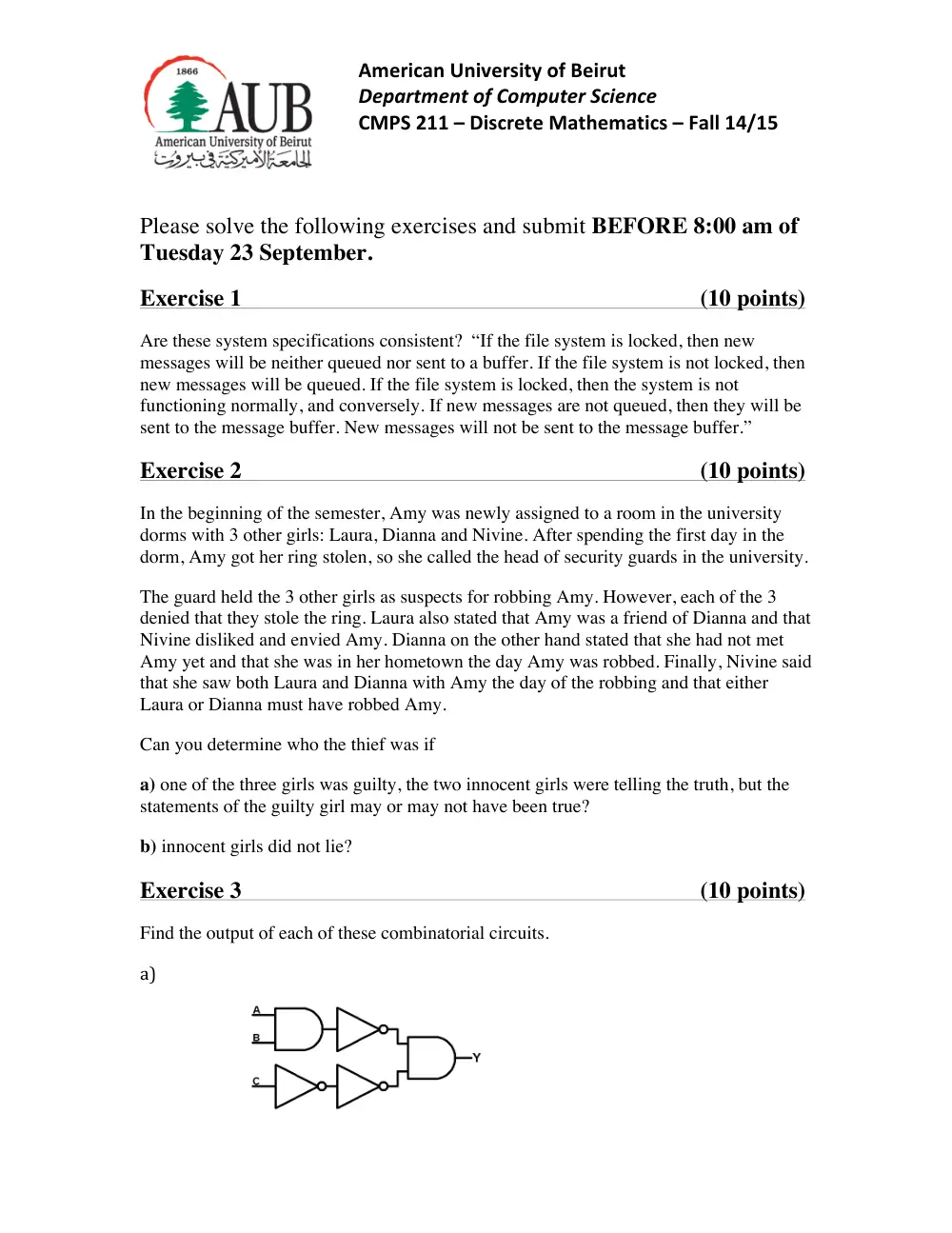
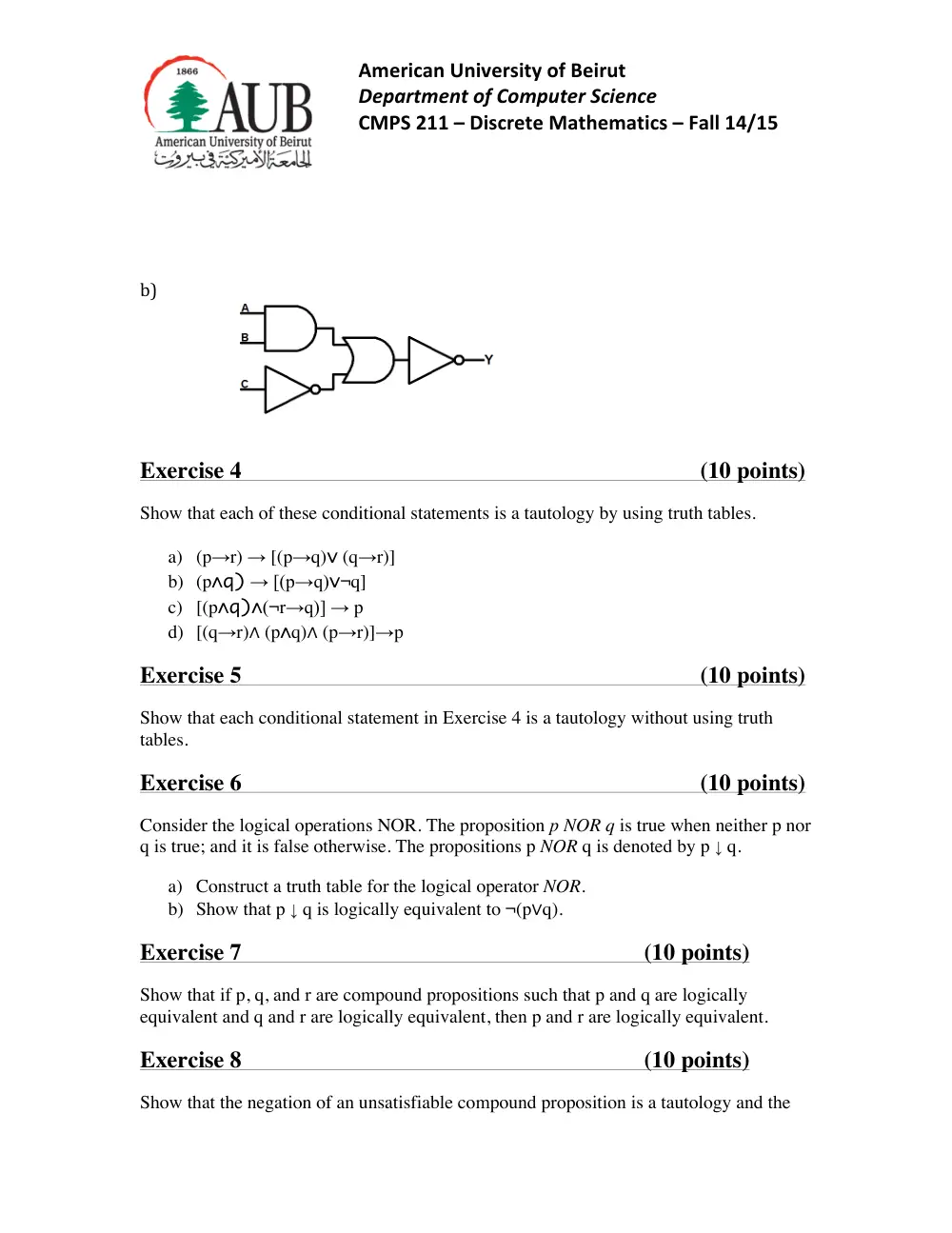
Find the output of each of these combinatorial circuits.
a)
American
University
of
Beirut
Department
of
Computer
Science
CMPS
211
–
Discrete
Mathematics
–
Fall
14/15
b)
Exercise 4
(10 points)
Show that each of these conditional statements is a tautology by using truth tables.
a) (p→r) → [(p→q)∨ (q→r)]
b) (p∧q) → [(p→q)∨¬q]
c) [(p∧q)∧(¬r→q)] → p
d) [(q→r)∧ (p∧q)∧ (p→r)]→p
Exercise 5
(10 points)
Show that each conditional statement in Exercise 4 is a tautology without using truth
tables.
Exercise 6
(10 points)
Consider the logical operations NOR. The proposition p NOR q is true when neither p nor
q is true; and it is false otherwise. The propositions p NOR q is denoted by p ↓ q.
a) Construct a truth table for the logical operator NOR.
b) Show that p ↓ q is logically equivalent to ¬(p∨q).
Exercise 7
(10 points)
Show that if p, q, and r are compound propositions such
that p and q are logically
equivalent and q and r are logically equivalent, then p and r are logically equivalent.
Exercise 8
(10 points)
Show that the negation of an unsatisfiable compound proposition is a tautology and the
American
University
of
Beirut
Department
of
Computer
Science
CMPS
211
–
Discrete
Mathematics
–
Fall
14/15
negation of a compound proposition that is a tautology is unsatisfiable.
Exercise 9
(10 points)
Determine whether each of these compound propositions is satisfiable.
a) (p∨¬r∨¬s)∧(¬p ∨ ¬q ∨ ¬s)∧(p∨¬q∨¬s)∧ (p ∨ q ∨ ¬s) ∧ (p∨q∨¬r)
b) (¬p ∨ ¬r ∨ ¬s)∧(p∨q∨¬s)∧(p∨¬q∨ s)∧(¬p∨¬q∨r)∧(p ∨ ¬r ∨ ¬s)∧( ¬p ∨ q ∨ ¬r)
c) (q∨r∨s)∧(p∨¬q∨¬s)∧(p∨q∨¬s)∧(¬p∨r∨s)∧(p∨q∨r)∧( ¬p∨¬q∨¬r)∧(¬p ∨ r ∨ ¬s)∧ (¬p
∨ ¬q ∨ s)
Exercise 10
(10 points)
a) Show that the biconditionals operation is associative, i.e., (p_1 ↔ p_2) ↔ p_3 is
equivalent to p_1 ↔ (p_2 ↔ p_3)
(b) What is the meaning of p_1 ↔ p_2 ↔ ... ↔ p_n?