
CMPS 211 Homework Assignment 3 Solution, Spring 2013
American University of Beirut · Discrete Structures · 6 pages · with solution

More CMPS 211 files
- Homework 3 with Solution · Spring 2016Homework · with solutionView
- Homework 6 with Solution · Spring 2016Homework · with solutionView
- Homework 1 with Solution · Spring 2016Homework · with solutionView
- Homework 4 with Solution · Spring 2016Homework · with solutionView
- Homework 5 with Solution · Spring 2016Homework · with solutionView
- Homework 1 · Fall 2015HomeworkView
- Homework 3 · Fall 2015HomeworkView
- Homework 1 Solution · Fall 2015Homework · with solutionView
Show the text of this homework
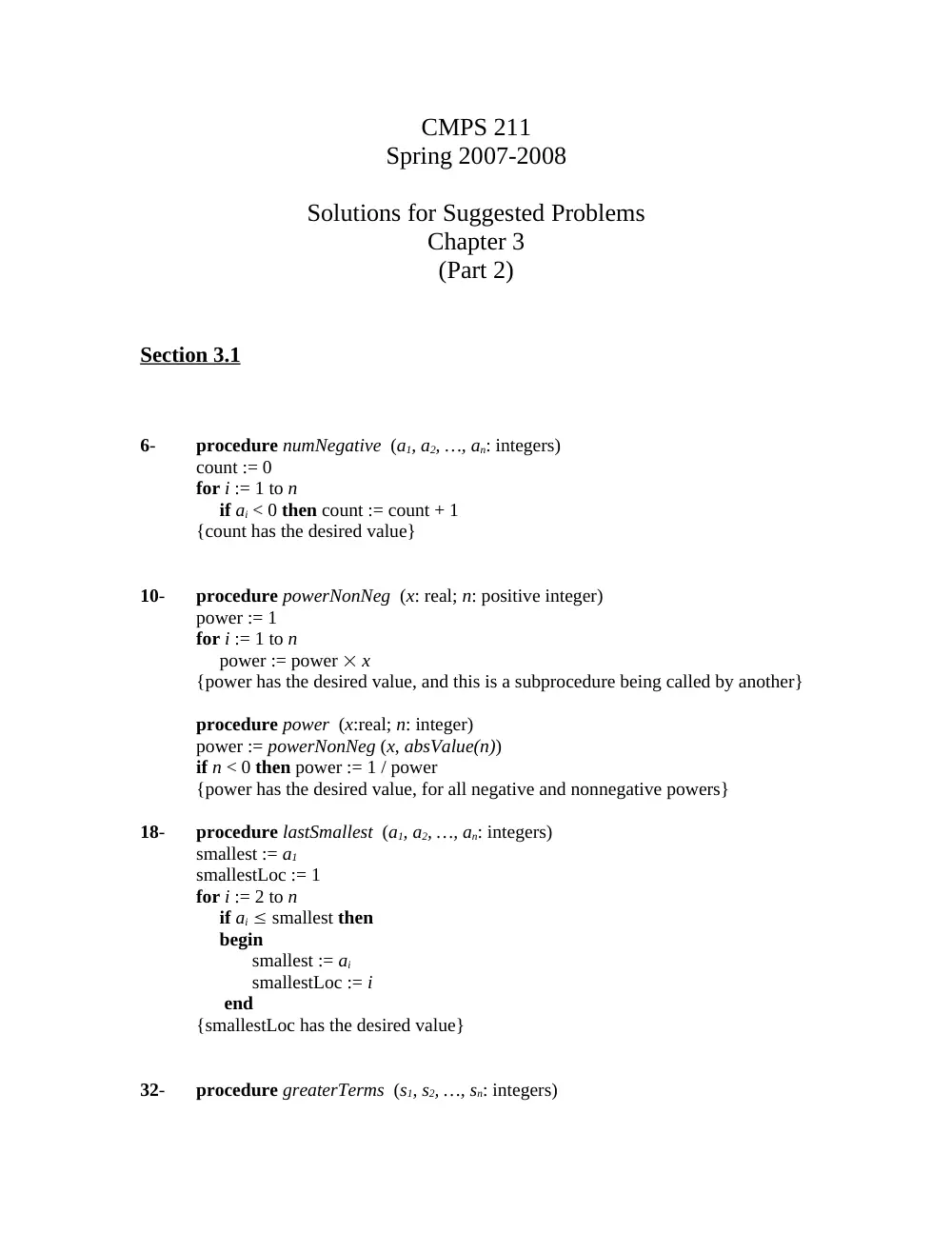
CMPS 211
Spring 2007-2008
Solutions for Suggested Problems
Chapter 3
(Part 2)
Section 3.1
6-
procedure numNegative (a1, a2, …, an: integers)
count := 0
for i := 1 to n
if ai < 0 then count := count + 1
{count has the desired value}
10-
procedure powerNonNeg (x: real; n: positive integer)
power := 1
for i := 1 to n
power := power x
{power has the desired value, and this is a subprocedure being called by another}
procedure power (x:real; n: integer)
power := powerNonNeg (x, absValue(n))
if n < 0 then power := 1 / power
{power has the desired value, for all negative and nonnegative powers}
18-
procedure lastSmallest (a1, a2, …, an: integers)
smallest := a1
smallestLoc := 1
for i := 2 to n
if ai smallest then
begin
smallest := ai
smallestLoc := i
end
{smallestLoc has the desired value}
32-
procedure greaterTerms (s1, s2, …, sn: integers)
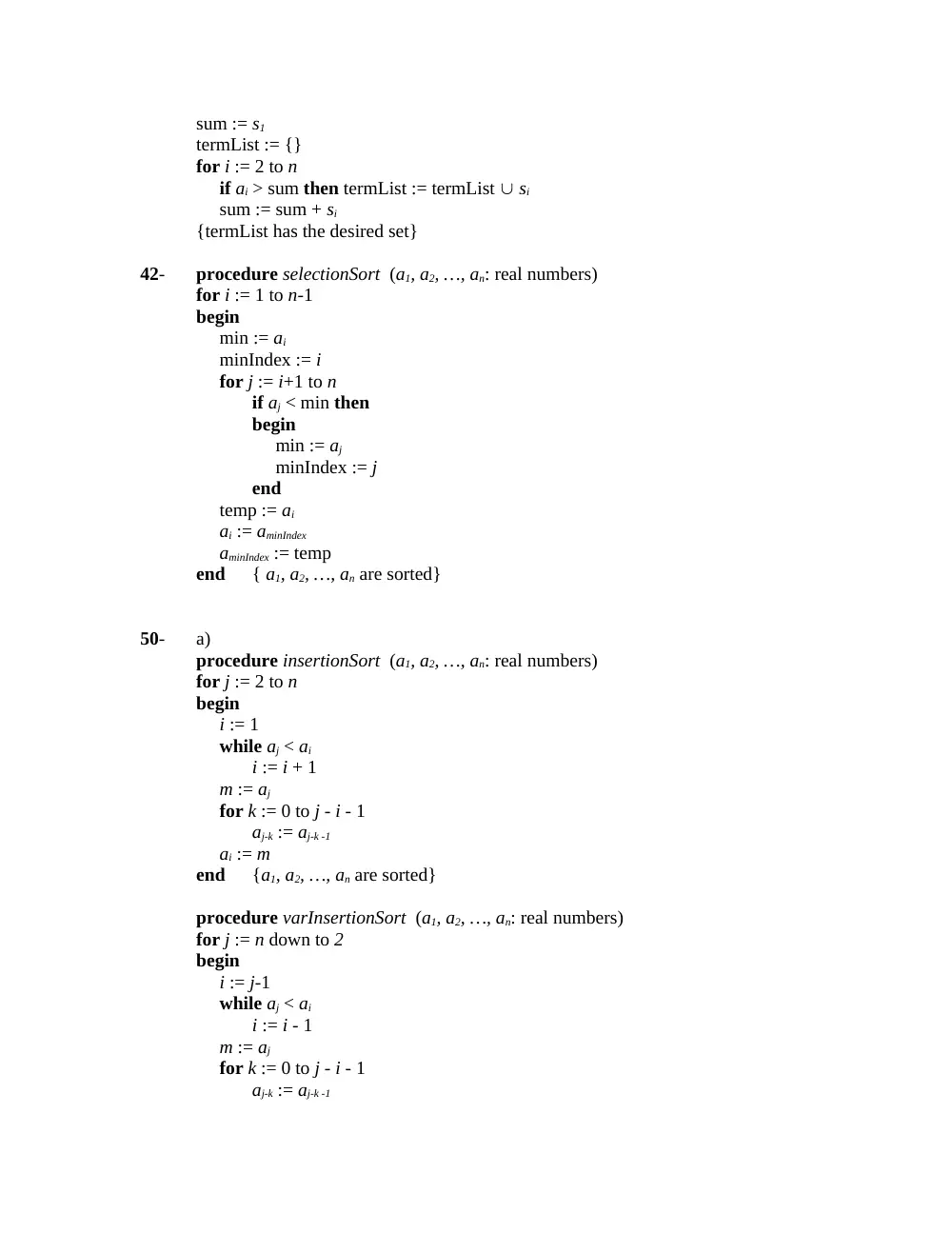
sum := s1
termList := {}
for i := 2 to n
if ai > sum then termList := termList si
sum := sum + si
{termList has the desired set}
42-
procedure selectionSort (a1, a2, …, an: real numbers)
for i := 1 to n-1
begin
min := ai
minIndex := i
for j := i+1 to n
if aj < min then
begin
min := aj
minIndex := j
end
temp := ai
ai := aminIndex
aminIndex := temp
end
{ a1, a2, …, an are sorted}
50-
a)
procedure insertionSort (a1, a2, …, an: real numbers)
for j := 2 to n
begin
i := 1
while aj < ai
i := i + 1
m := aj
for k := 0 to j - i - 1
aj-k := aj-k -1
ai := m
end
{a1, a2, …, an are sorted}
procedure varInsertionSort (a1, a2, …, an: real numbers)
for j := n down to 2
begin
i := j-1
while aj < ai
i := i - 1
m := aj
for k := 0 to j - i - 1
aj-k := aj-k -1
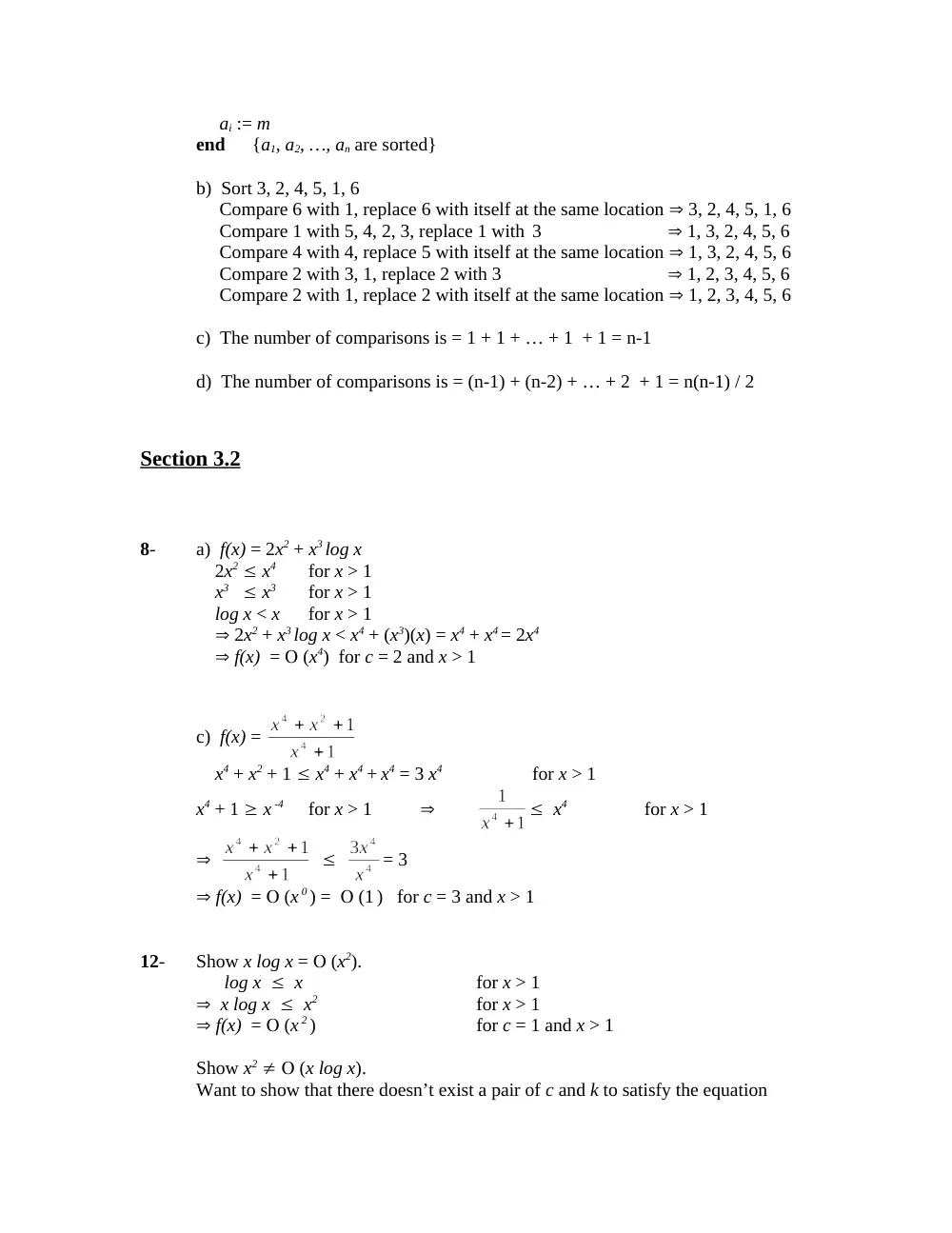
ai := m
end
{a1, a2, …, an are sorted}
b) Sort 3, 2, 4, 5, 1, 6
Compare 6 with 1, replace 6 with itself at the same location 3, 2, 4, 5, 1, 6
Compare 1 with 5, 4, 2, 3, replace 1 with 3
1, 3, 2, 4, 5, 6
Compare 4 with 4, replace 5 with itself at the same location 1, 3, 2, 4, 5, 6
Compare 2 with 3, 1, replace 2 with 3
1, 2, 3, 4, 5, 6
Compare 2 with 1, replace 2 with itself at the same location 1, 2, 3, 4, 5, 6
c) The number of comparisons is = 1 + 1 + … + 1 + 1 = n-1
d) The number of comparisons is = (n-1) + (n-2) + … + 2 + 1 = n(n-1) / 2
Section 3.2
8-
a) f(x) = 2x2 + x3 log x
2x2 x4
for x > 1
x3 x3
for x > 1
log x < x
for x > 1
2x2 + x3 log x < x4 + (x3)(x) = x4 + x4 = 2x4
f(x) = (x4) for c = 2 and x > 1
c) f(x) =
x4 + x2 + 1 x4 + x4 + x4 = 3 x4
for x > 1
x4 + 1 x -4
for x > 1
x4
for x > 1
= 3
f(x) = (x 0 ) = (1 ) for c = 3 and x > 1
12-
Show x log x = (x2).
log x x
for x > 1
x log x x2
for x > 1
f(x) = (x 2 )
for c = 1 and x > 1
Show x2 (x log x).
Want to show that there doesn’t exist a pair of c and k to satisfy the equation
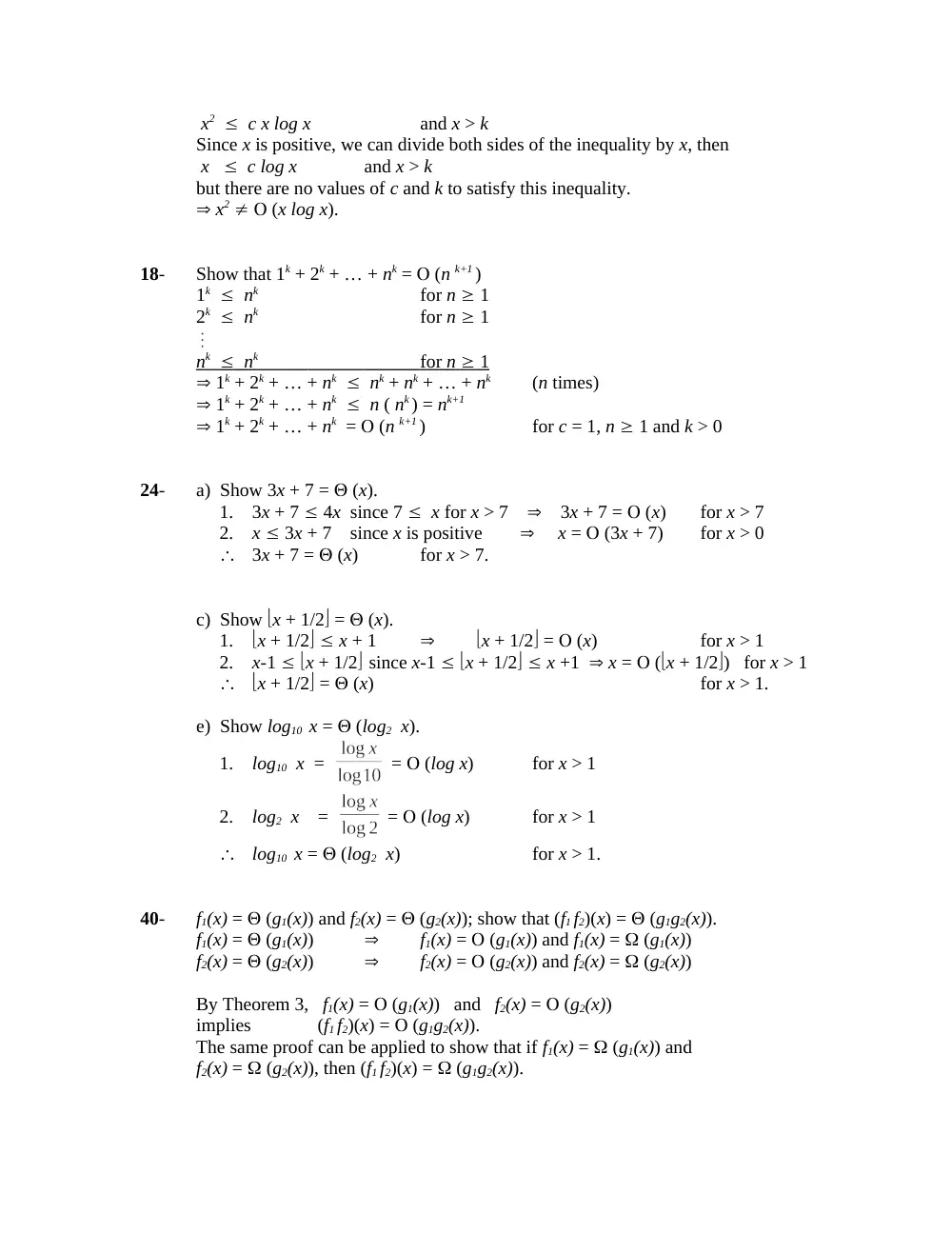
x2 c x log x
and x > k
Since x is positive, we can divide both sides of the inequality by x, then
x c log x
and x > k
but there are no values of c and k to satisfy this inequality.
x2 (x log x).
18-
Show that 1k + 2k + … + nk = (n k+1 )
1k nk
for n 1
2k nk
for n 1
n k
n k
for
n
1
1k + 2k + … + nk nk + nk + … + nk
(n times)
1k + 2k + … + nk n ( nk ) = nk+1
1k + 2k + … + nk = (n k+1 )
for c = 1, n 1 and k > 0
24-
a) Show 3x + 7 = (x).
1.
3x + 7 4x since 7 x for x > 7 3x + 7 = (x)
for x > 7
2.
x 3x + 7 since x is positive x = (3x + 7)
for x > 0
3x + 7 = (x)
for x > 7.
c) Show x + 1/2 = (x).
1.
x + 1/2 x + 1
x + 1/2 = (x)
for x > 1
2.
x-1 x + 1/2 since x-1 x + 1/2 x +1 x = (x + 1/2) for x > 1
x + 1/2 = (x)
for x > 1.
e) Show log10 x = (log2 x).
1.
log10 x =
= (log x)
for x > 1
2.
log2 x =
= (log x)
for x > 1
log10 x = (log2 x)
for x > 1.
40-
f1(x) = (g1(x)) and f2(x) = (g2(x)); show that (f1 f2)(x) = (g1g2(x)).
f1(x) = (g1(x))
f1(x) = (g1(x)) and f1(x) = (g1(x))
f2(x) = (g2(x))
f2(x) = (g2(x)) and f2(x) = (g2(x))
By Theorem 3, f1(x) = (g1(x)) and f2(x) = (g2(x))
implies
(f1 f2)(x) = (g1g2(x)).
The same proof can be applied to show that if f1(x) = (g1(x)) and
f2(x) = (g2(x)), then (f1 f2)(x) = (g1g2(x)).
Since (f1 f2)(x) = (g1g2(x)) and (f1 f2)(x) = (g1g2(x)), then by the definition of
“big-theta”, (f1 f2)(x) = (g1g2(x)).
Section 3.3
4-
To find
by successive squaring requires k+1 multiplications.
To find
by multiplying x by itself requires 2k multiplications.
The first approach is naturally more efficient.
8-
a) Evaluating
at x = 2:
Input: c = 2, a0 = 1, a1 = 1, a2 = 3.
0.
y = 3
initialization of y
1.
i = 1, y = 32 + 1 = 7
first iteration in for loop
2.
i = 2, y = 72 + 1 = 15
second iteration in for loop
Final Answer: y = 15
b) In each iteration of the for loop, one multiplication and one addition are used,
so the total number of multiplications and additions in the algorithm is n
multiplications and n additions.
12-
a) To find the maximum of a sequence of n integers:
always requires n-1 comparisons; traverse list from 2 to n, comparing at each
iteration
b) To locate an element in a list of n terms with linear search:
Least number of comparisons is 1; occurs if the element to be located is the
first element in the list
c) To locate an element in a list of n terms with binary search:
Least number of comparisons is 1; occurs if the element to be located is the
first element inspected, i.e. the middle element in the list
20-
procedure greaterTerms (s1, s2, …, sn: integers)
sum := s1
termList := {}
for i := 2 to n
if ai > sum then termList := termList si
sum := sum + si
{termList has the desired set}
The procedure developed in this exercise traverses the entire list, comparing each
term with the sum of the previous terms. It performs n-1 iterations in the for loop
and n-1 comparisons worst-case time complexity = O (n).
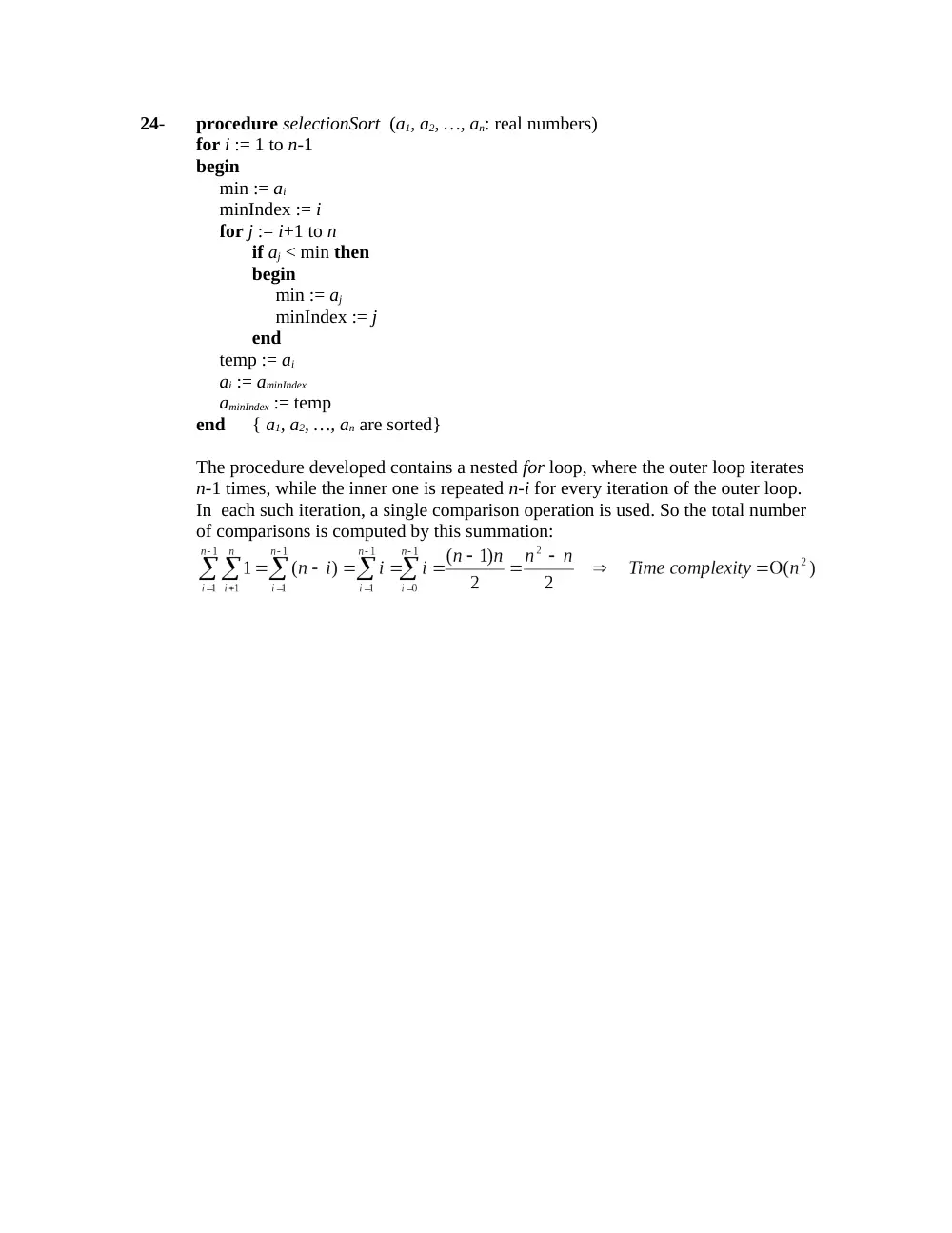
24-
procedure selectionSort (a1, a2, …, an: real numbers)
for i := 1 to n-1
begin
min := ai
minIndex := i
for j := i+1 to n
if aj < min then
begin
min := aj
minIndex := j
end
temp := ai
ai := aminIndex
aminIndex := temp
end
{ a1, a2, …, an are sorted}
The procedure developed contains a nested for loop, where the outer loop iterates
n-1 times, while the inner one is repeated n-i for every iteration of the outer loop.
In each such iteration, a single comparison operation is used. So the total number
of comparisons is computed by this summation: