
CMPS 211 Homework Assignment 4, Fall 2014
American University of Beirut · Discrete Structures · 4 pages

More CMPS 211 files
- Homework 3 with Solution · Spring 2016Homework · with solutionView
- Homework 6 with Solution · Spring 2016Homework · with solutionView
- Homework 1 with Solution · Spring 2016Homework · with solutionView
- Homework 4 with Solution · Spring 2016Homework · with solutionView
- Homework 5 with Solution · Spring 2016Homework · with solutionView
- Homework 1 · Fall 2015HomeworkView
- Homework 3 · Fall 2015HomeworkView
- Homework 1 Solution · Fall 2015Homework · with solutionView
Show the text of this homework
American
University
of
Beirut
Department
of
Computer
Science
CMPS
211
–
Discrete
Mathematics
–
Fall
14/15
Please solve the following exercises and submit BEFORE 8:00 am of
Tuesday, October 7th.
Rules of submission:
• Write your name, Section number and Professor name in
your submission
• Submit a softcopy or photocopy to Moodle before the
deadline.
• If your assignment is handwritten, submit the hardcopy
paper to Bliss 210B, before Thursday 9th Oct.
• If your assignment is typed, print it 2 pages per sheet, and
preferably double sided, and submit it to Bliss 210B also,
before Thursday 9th Oct.
• If the door is closed, pass it under the door.
Failing to submit a hardcopy of you assignment by Thursday will
result in deducting points from your assignment.
Exercise 1
(10 points)
Use rules of inference to show that the hypotheses “If you have hyperglycemia or
hypertension, then you will have headaches and polydipsia.” “If you have headaches,
then you will feel dizzy” and “You don’t feel dizzy” imply the conclusion “You don’t
have hyperglycemia.”
Exercise 2
(10 points)
For each of these sets of premises, what relevant conclusion or conclusions can be
drawn? Explain the rules of inference used to obtain each conclusion from the premises.
a) “All parallelograms have 2 pairs of parallel sides”, “Squares are parallelograms”,
“Trapezoids have only 1 pair of parallel sides” “Quadrilaterals have 4 sides”
b) “If I work, it is either sunny or partly sunny.” “I worked last Monday or I worked last
Friday.” “It was not sunny on Tuesday.” “It was not partly sunny on Friday.”
c) “I am cheered up or I am upset”, “I am not upset”, “If I am cheered up, I make all
American
University
of
Beirut
Department
of
Computer
Science
CMPS
211
–
Discrete
Mathematics
–
Fall
14/15
people around me motivated or overjoyed.”
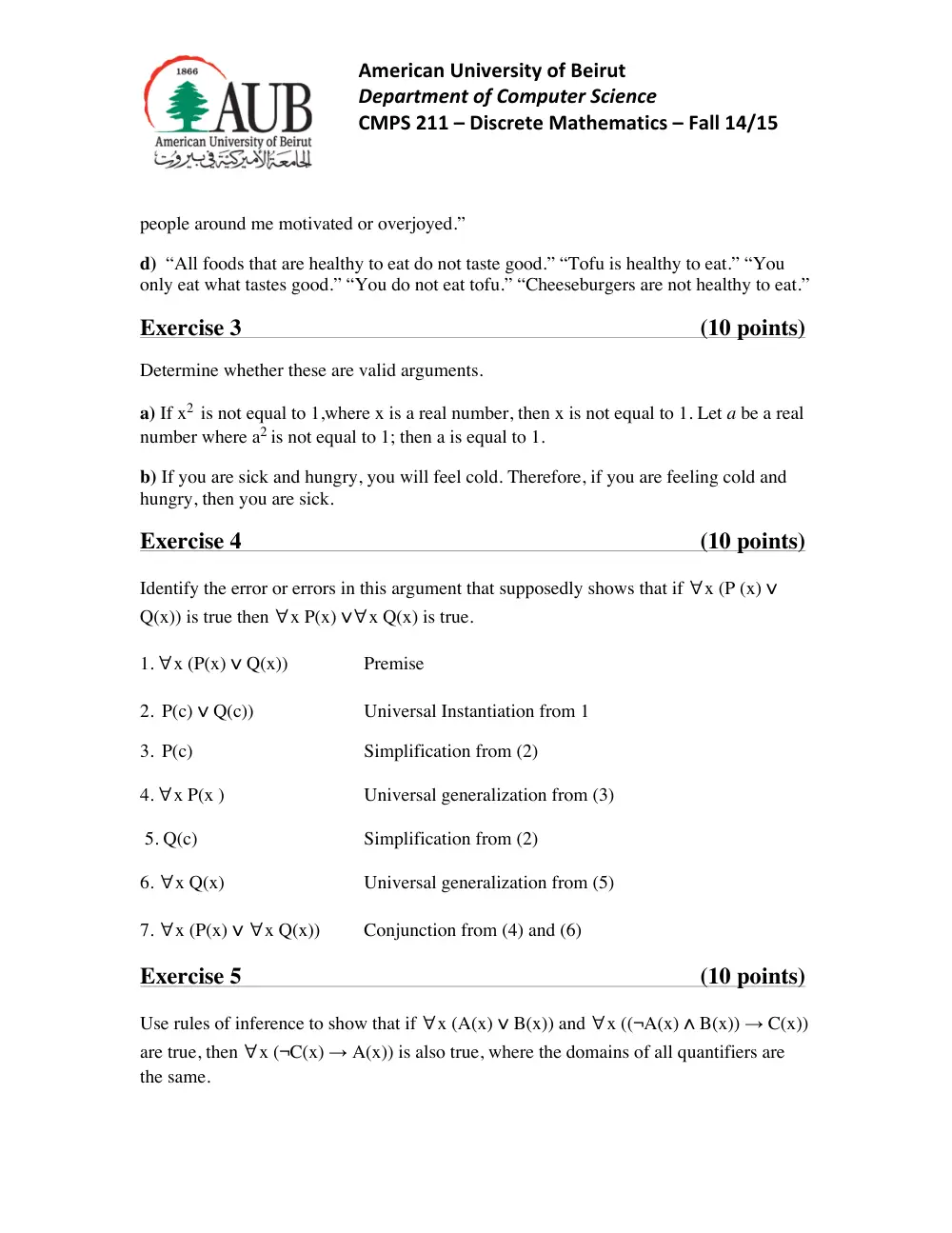
d) “All foods that are healthy to eat do not taste good.” “Tofu is healthy to eat.” “You
only eat what tastes good.” “You do not eat tofu.” “Cheeseburgers are not healthy to eat.”
Exercise 3
(10 points)
Determine whether these are valid arguments.
a) If x2 is not equal to 1,where x is a real number, then x is not equal to 1. Let a be a real
number where a2 is not equal to 1; then a is equal to 1.
b) If you are sick and hungry, you will feel cold. Therefore, if you are feeling cold and
hungry, then you are sick.
Exercise 4
(10 points)
Identify the error or errors in this argument that supposedly shows that if ∀x (P (x) ∨
Q(x)) is true then ∀x P(x) ∨∀x Q(x) is true.
1. ∀x (P(x) ∨ Q(x))
Premise
2. P(c) ∨ Q(c))
Universal Instantiation from 1
3. P(c)
Simplification from (2)
4. ∀x P(x )
Universal generalization from (3)
5. Q(c)
Simplification from (2)
6. ∀x Q(x)
Universal generalization from (5)
7. ∀x (P(x) ∨ ∀x Q(x))
Conjunction from (4) and (6)
Exercise 5
(10 points)
Use rules of inference to show that if ∀x (A(x) ∨ B(x)) and ∀x ((¬A(x) ∧ B(x)) → C(x))
are true, then ∀x (¬C(x) → A(x)) is also true, where the domains of all quantifiers are
the same.
American
University
of
Beirut
Department
of
Computer
Science
CMPS
211
–
Discrete
Mathematics
–
Fall
14/15
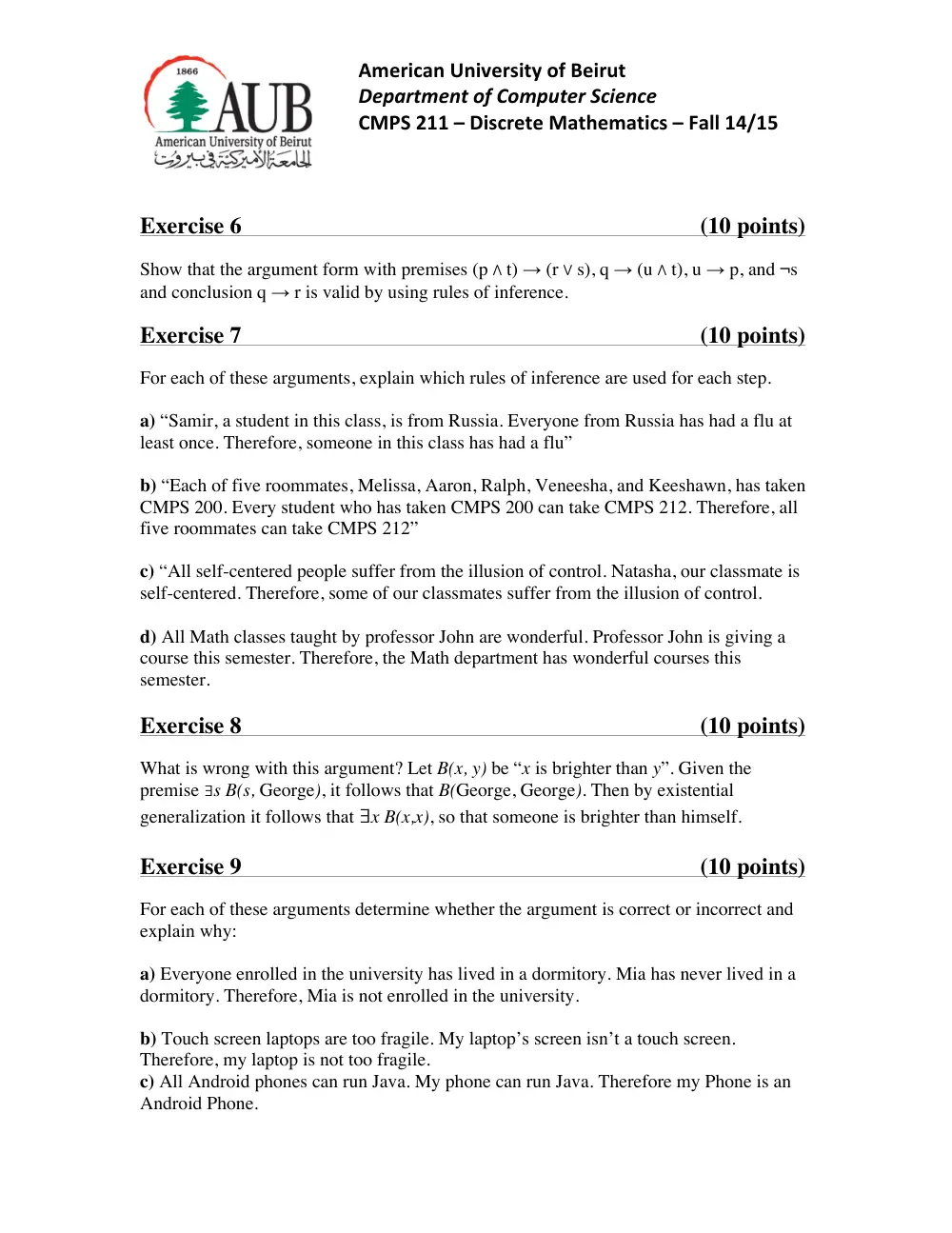
Exercise 6
(10 points)
Show that the argument form with premises (p ∧ t) → (r ∨ s), q → (u ∧ t), u → p, and ¬s
and conclusion q → r is valid by using rules of inference.
Exercise 7
(10 points)
For each of these arguments, explain which rules of inference are used for each step.
a) “Samir, a student in this class, is from Russia. Everyone from Russia has had a flu at
least once. Therefore, someone in this class has had a flu”
b) “Each of five roommates, Melissa, Aaron, Ralph, Veneesha, and Keeshawn, has taken
CMPS 200. Every student who has taken CMPS 200 can take CMPS 212. Therefore, all
five roommates can take CMPS 212”
c) “All self-centered people suffer from the illusion of control. Natasha, our classmate is
self-centered. Therefore, some of our classmates suffer from the illusion of control.
d) All Math classes taught by professor John are wonderful. Professor John is giving a
course this semester. Therefore, the Math department has wonderful courses this
semester.
Exercise 8
(10 points)
What is wrong with this argument? Let B(x, y) be “x is brighter than y”. Given the
premise ∃s B(s, George), it follows that B(George, George). Then by existential
generalization it follows that ∃x B(x,x), so that someone is brighter than himself.
Exercise 9
(10 points)
For each of these arguments determine whether the argument is correct or incorrect and
explain why:
a) Everyone enrolled in the university has lived in a dormitory. Mia has never lived in a
dormitory. Therefore, Mia is not enrolled in the university.
b) Touch screen laptops are too fragile. My laptop’s screen isn’t a touch screen.
Therefore, my laptop is not too fragile.
c) All Android phones can run Java. My phone can run Java. Therefore my Phone is an
Android Phone.
American
University
of
Beirut
Department
of
Computer
Science
CMPS
211
–
Discrete
Mathematics
–
Fall
14/15
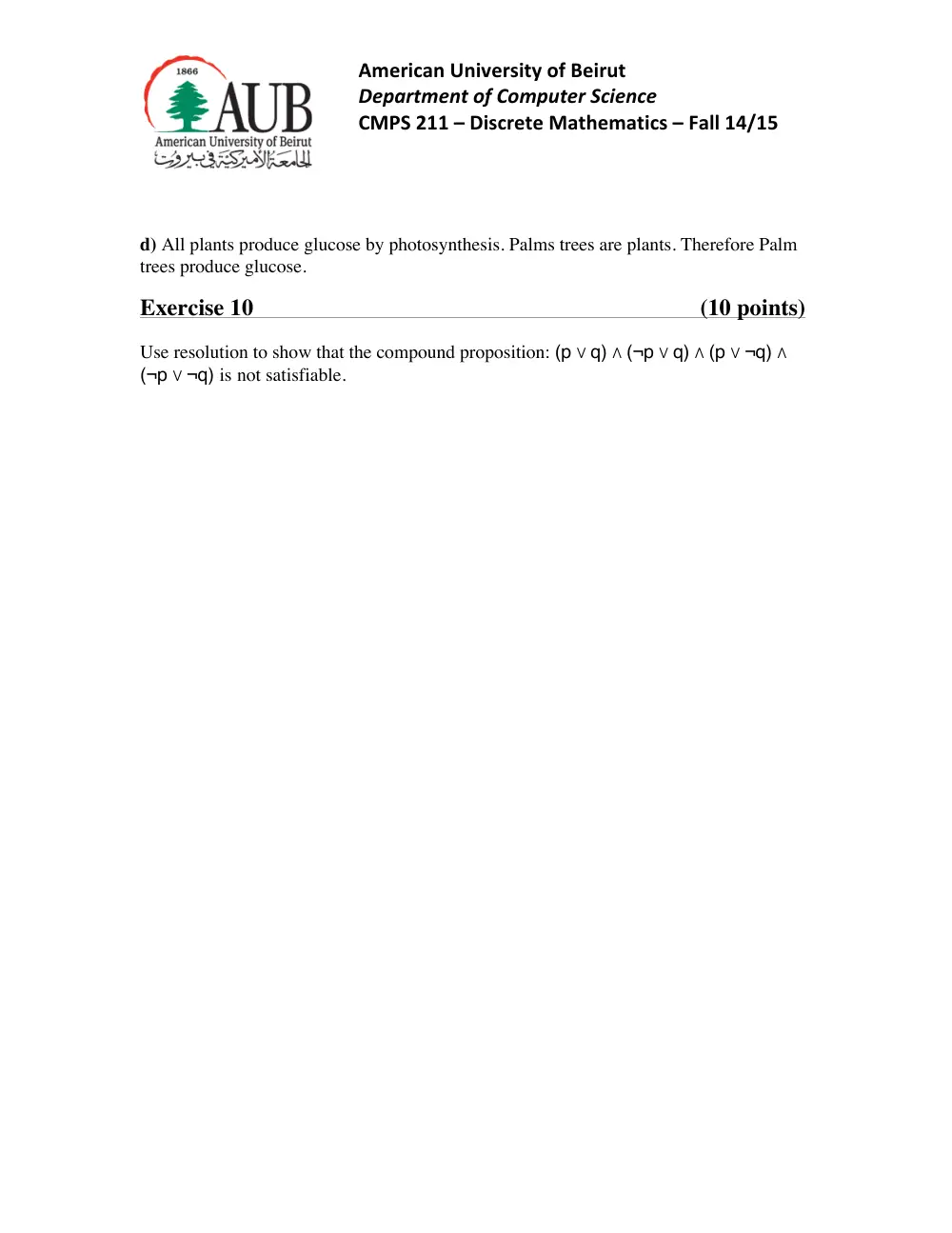
d) All plants produce glucose by photosynthesis. Palms trees are plants. Therefore Palm
trees produce glucose.
Exercise 10
(10 points)
Use resolution to show that the compound proposition: (p ∨ q) ∧ (¬p ∨ q) ∧ (p ∨ ¬q) ∧
(¬p ∨ ¬q) is not satisfiable.