
CMPS 211 Homework Solution 10, Fall 2014
American University of Beirut · Discrete Structures · 4 pages · with solution


More CMPS 211 files
- Homework 3 with Solution · Spring 2016Homework · with solutionView
- Homework 6 with Solution · Spring 2016Homework · with solutionView
- Homework 1 with Solution · Spring 2016Homework · with solutionView
- Homework 4 with Solution · Spring 2016Homework · with solutionView
- Homework 5 with Solution · Spring 2016Homework · with solutionView
- Homework 1 · Fall 2015HomeworkView
- Homework 3 · Fall 2015HomeworkView
- Homework 1 Solution · Fall 2015Homework · with solutionView
Show the text of this homework
Ayman Al Zaatari
11 December 2014
CMPS 211 - Assignment 10 Solution
1
Assignment 10 Solution
Ex1:
procedure mult (n: positive integer, x: integer)
if n=0 then return 0
else return x + mult (n-1, x)
{output is nx}
O(n)
Ex2:
procedure summation (n: positive integer)
if n=1 then return 1
else return n + summation (n-1)
{output is the sum of the first n positive integers}
Basis step: for n=1, summation = 1
Inductive step: hypothesis: suppose that till n=k summation (n) = 1+2+3+4… +k
RTP it is true for k+1
summation (k+1) = summation (k) + k+1 = 1+2+3+4… +k+ (k+1)
Ex3:
procedure max (a1, a2, a3, …, an: integers)
if n=1 then return a1
subSetmax := max (a1, a2, a3, …, an-1)
if an ≥ subSetmax then
return an
else
return subSetmax
{output is maximum of the set}
O(n)
Ayman Al Zaatari
11 December 2014
CMPS 211 - Assignment 10 Solution
2
Ex4:
procedure mode(a1, a2, ....an:integers, i: integer, n: integer, mode_location: integer)
if i = 0
return a[mode_location]
if countMode(a1, a2, ....an, i, n, 0) >= countMode(a1, a2, ....an, mode_location, n, 0)
return mode (a, i-1, n, i)
else
return mode(a, i-1, n, mode_location)
procedure countMode (a1, a2, ....an:integers, i: integer, n: integer, count: integer)
if n = 0
return count
if an-1 = ai
count := count + 1
return countMode(a1, a2, ....an, n-1, count)
Note:
- i is used traverse the index of the array a (index starts at 0)
- n is the length of the array a
- mode_location is used to specify the location of the mode
- “count” is used to count the occurrences
of the elements in the array a
Example: mode ({1, 2, 10, 3,
3, 3, 1, 4, 5, 5}, 9, 10, 0) 3
Ex 5:
procedure multiply(x, y: nonnegative integers)
if y = 0 then
return 0
else if y is even then
return 2*multiply (x, y/2)
else
return 2*multiply (x, (y−1)/2) + x
it is proved by strong induction
basis step: multiply (x, 0) = 0 = 0x and multiply (x, 1) = multiply (x, 0) +x = x = 1x
inductive step: suppose that for 0 ≤ y ≤ k xy=multiply (x, y)
-if k is odd, k+1 is even
multiply (x, k+1) = 2*multiply(x, (k+1)/2) = 2 x(k+1)/2 = x(k+1)
[since 0 ≤ (k+1)/2 ≤ k]
-if k is even, k+1 is odd
multiply (x, k+1) = 2*multiply(x, (k)/2) = 2 xk/2 + x = xk+x = x(k+1)
[since 0 ≤ k/2 ≤ k]
then in both cases multiply(x, k+1) gives x*(k+1), then its correct
Ayman Al Zaatari
11 December 2014
CMPS 211 - Assignment 10 Solution
3
Ex6:
procedure power (a: real number, n: positive integer)
if n=0
return a
else
pow:= power(a, n-1)
return pow * pow
{output a2^n} O(n)
Ex7:
procedure a (n: non negative integer)
if n=0,
return 1
else if n=1
return 2
else if n=2
return 3
else
return a(n-1) + a(n-2) + a(n-3)
Ex 8:
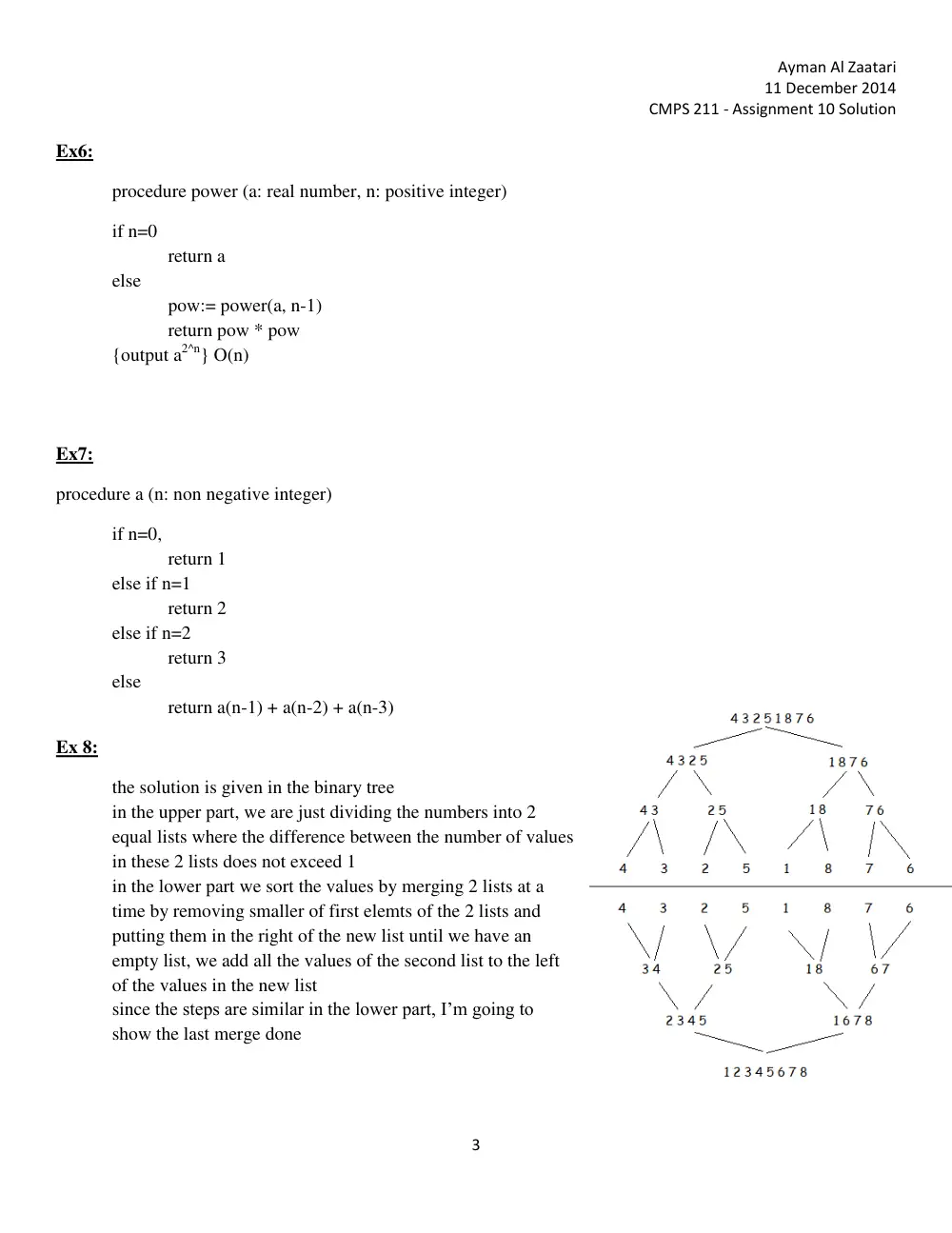
the solution is given in the binary tree
in the upper part, we are just dividing the numbers into 2
equal lists where the difference between the number of values
in these 2 lists does not exceed 1
in the lower part we sort the values by merging 2 lists at a
time by removing smaller of first elemts of the 2 lists and
putting them in the right of the new list until we have an
empty list, we add all the values of the second list to the left
of the values in the new list
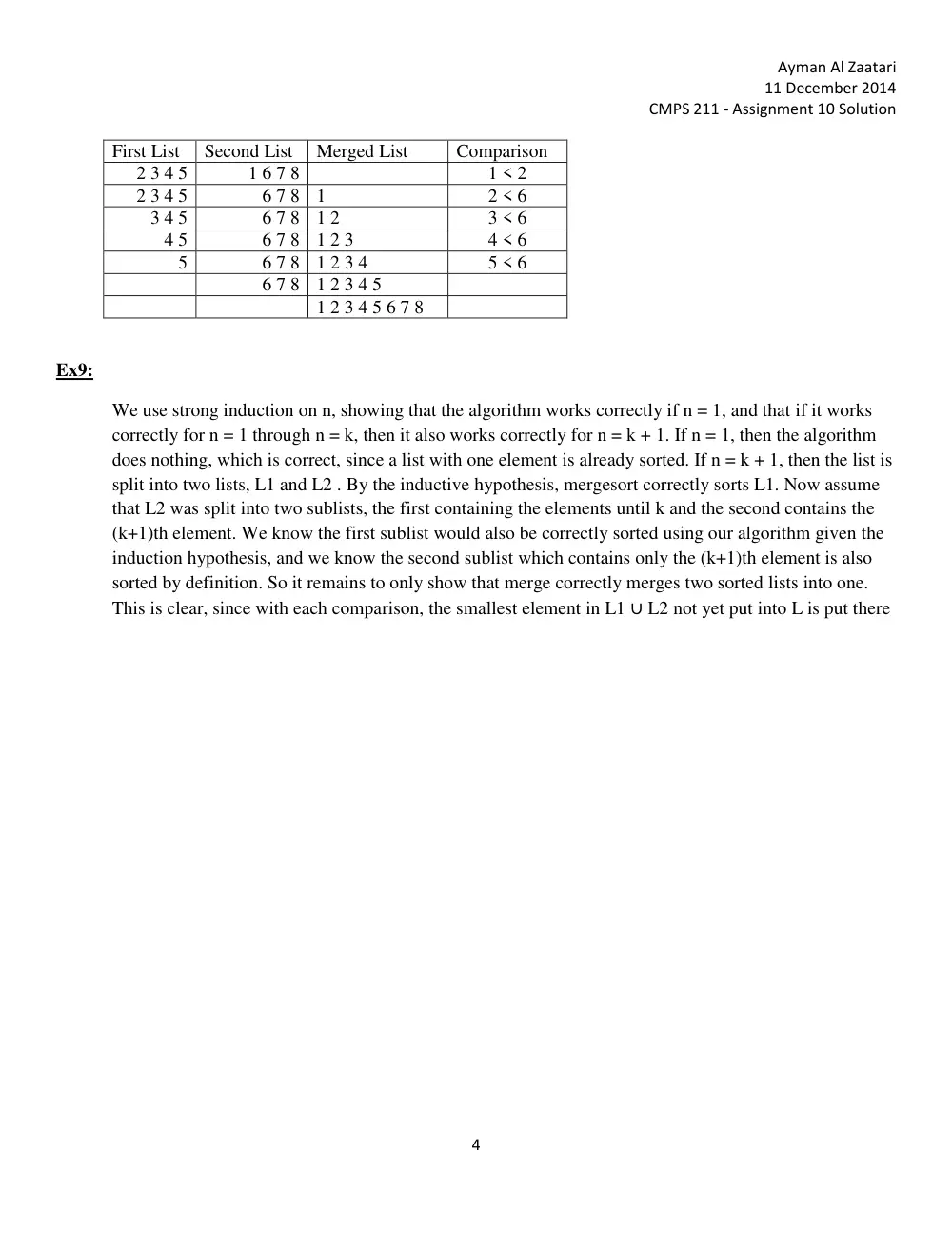
since the steps are similar in the lower part, I’m going to
show the last merge done
Ayman Al Zaatari
11 December 2014
CMPS 211 - Assignment 10 Solution
4
First List
Second List
Merged List
Comparison
2 3 4 5
1 6 7 8
1 < 2
2 3 4 5
6 7 8 1
2 < 6
3 4 5
6 7 8 1 2
3 < 6
4 5
6 7 8 1 2 3
4 < 6
5
6 7 8 1 2 3 4
5 < 6
6 7 8 1 2 3 4 5
1 2 3 4 5 6 7 8
Ex9:
We use strong induction on n, showing that the algorithm works correctly if n = 1, and that if it works
correctly for n = 1 through n = k, then it also works correctly for n = k + 1. If n = 1, then the algorithm
does nothing, which is correct, since a list with one element is already sorted. If n = k + 1, then the list is
split into two lists, L1 and L2 . By the inductive hypothesis, mergesort correctly sorts L1. Now assume
that L2 was split into two sublists, the first containing the elements until k and the second contains the
(k+1)th element. We know the first sublist would also be correctly sorted using our algorithm given the
induction hypothesis, and we know the second sublist which contains only the (k+1)th element is also
sorted by definition. So it remains to only show that merge correctly merges two sorted lists into one.
This is clear, since with each comparison, the smallest element in L1 ∪ L2 not yet put into L is put there