
CMPS 211 Homework Solution 9, Fall 2014
American University of Beirut · Discrete Structures · 4 pages · with solution

More CMPS 211 files
- Homework 3 with Solution · Spring 2016Homework · with solutionView
- Homework 6 with Solution · Spring 2016Homework · with solutionView
- Homework 1 with Solution · Spring 2016Homework · with solutionView
- Homework 4 with Solution · Spring 2016Homework · with solutionView
- Homework 5 with Solution · Spring 2016Homework · with solutionView
- Homework 1 · Fall 2015HomeworkView
- Homework 3 · Fall 2015HomeworkView
- Homework 1 Solution · Fall 2015Homework · with solutionView
Show the text of this homework
Ayman Al Zaatari
11 December 2014
Assignment 9 Solution
1
Assignment 9 Solution
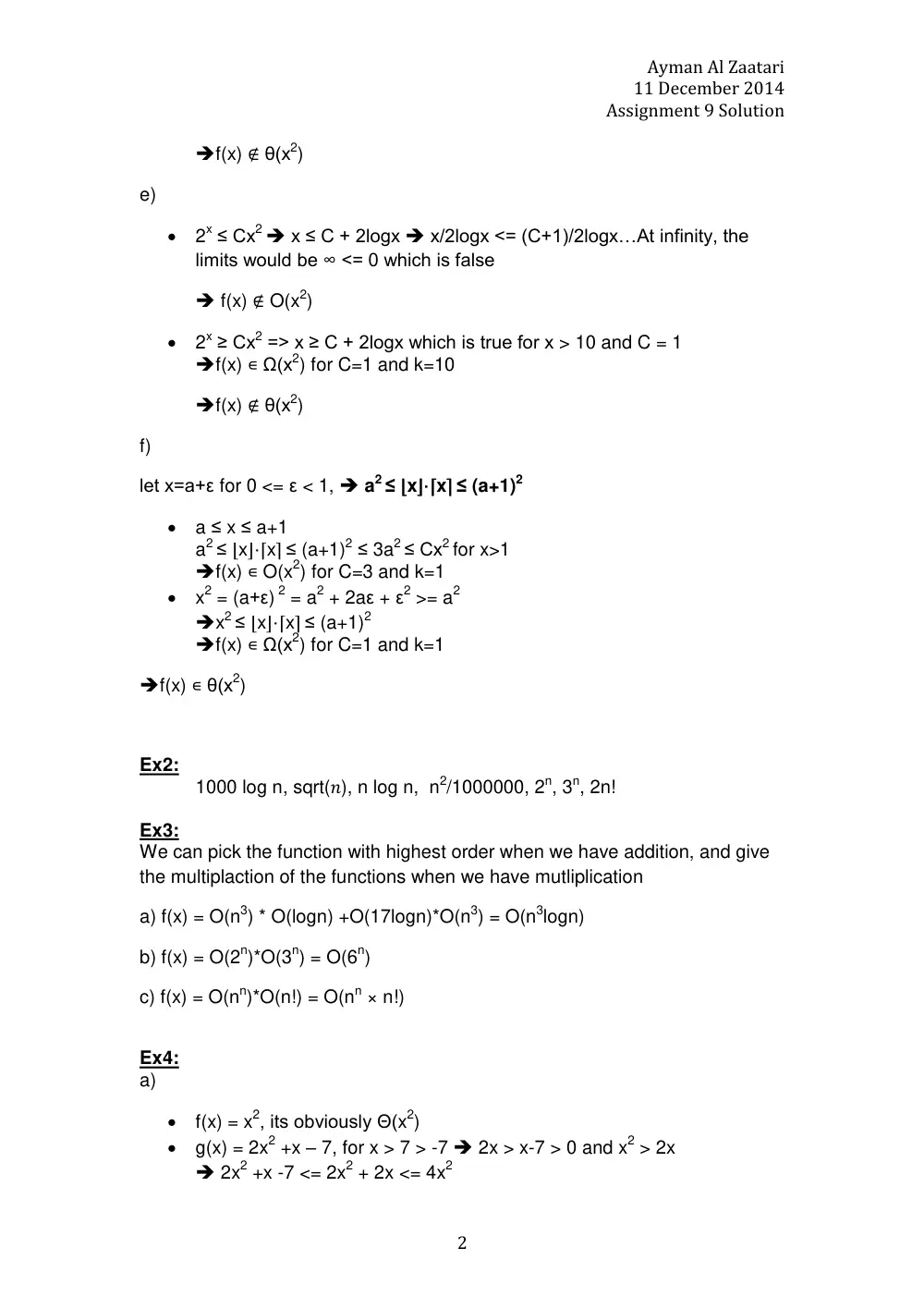
Ex1:
a)
18 <= x 17x + 11 <= 18x +x <= x2
17x + 11 <= C x2
f(x) ∊ O(x2) for k=18 and C=1
If f(x) ∉ Ω(x2) 17x + 11 > C x2 for C >0 and x >=k
x > 18 18x >= 17x + x > 17x + 11 18x > Cx2
dividing by x, 18 > Cx => x < C1 , for C1 = C/18, but x > k =>
impossible
f(x) ∉ Ω(x2)
f(x) ∉ θ(x2)
b)
x2 + 1000 ≤ 1000x2 for x>1000
f(x) ∊ O(x2) for C=1000 and k=1000
x2 + 1000 ≥ x2 for x>1000
f(x) ∊ Ω(x2) for C=1 and k=1000
f(x) ∊ θ(x2) for k=1000
c)
logx < x x logx ≤ x2 for x > 1
f(x) ∊ O(x2) for k=1 and C=1
Assume f(x) ∊ Ω(x2) xlogx >= C x2 such that C>0, |
logx >= Cx logx/x >= C , but we know that the limit at infinity = 0,
false Assumption
f(x) ∉ Ω(x2)
f(x) ∉ θ(x2)
d)
x4/2 ≤ Cx2 x2 ≤ 2C x <Sqrt(2C)
f(x) ∉ O(x2)
x4/2 ≥ Cx2 => x2 ≥ 2C for C=1 and k=2
f(x) ∊ Ω(x2) for C=1 and k=2
Ayman Al Zaatari
11 December 2014
Assignment 9 Solution
2
f(x) ∉ θ(x2)
e)
2x ≤ Cx2 x ≤ C + 2logx x/2logx <= (C+1)/2logx…At infinity, the
limits would be ∞ <= 0 which is false
f(x) ∉ O(x2)
2x ≥ Cx2 => x ≥ C + 2logx which is true for x > 10 and C = 1
f(x) ∊ Ω(x2) for C=1 and k=10
f(x) ∉ θ(x2)
f)
let x=a+ε for 0 <= ε < 1, a2 ≤ ⌊x⌋·⌈x⌉ ≤ (a+1)2
a ≤ x ≤ a+1
a2 ≤ ⌊x⌋·⌈x⌉ ≤ (a+1)2 ≤ 3a2 ≤ Cx2 for x>1
f(x) ∊ O(x2) for C=3 and k=1
x2 = (a+ε) 2 = a2 + 2aε + ε2 >= a2
x2 ≤ ⌊x⌋·⌈x⌉ ≤ (a+1)2
f(x) ∊ Ω(x2) for C=1 and k=1
f(x) ∊ θ(x2)
Ex2:
1000 log n, sqrt(𝑛), n log n, n2/1000000, 2n, 3n, 2n!
Ex3:
We can pick the function with highest order when we have addition, and give
the multiplaction of the functions when we have mutliplication
a) f(x) = O(n3) * O(logn) +O(17logn)*O(n3) = O(n3logn)
b) f(x) = O(2n)*O(3n) = O(6n)
c) f(x) = O(nn)*O(n!) = O(nn × n!)
Ex4:
a)
f(x) = x2, its obviously Θ(x2)
g(x) = 2x2 +x – 7, for x > 7 > -7 2x > x-7 > 0 and x2 > 2x
2x2 +x -7 <= 2x2 + 2x <= 4x2
Ayman Al Zaatari
11 December 2014
Assignment 9 Solution
3
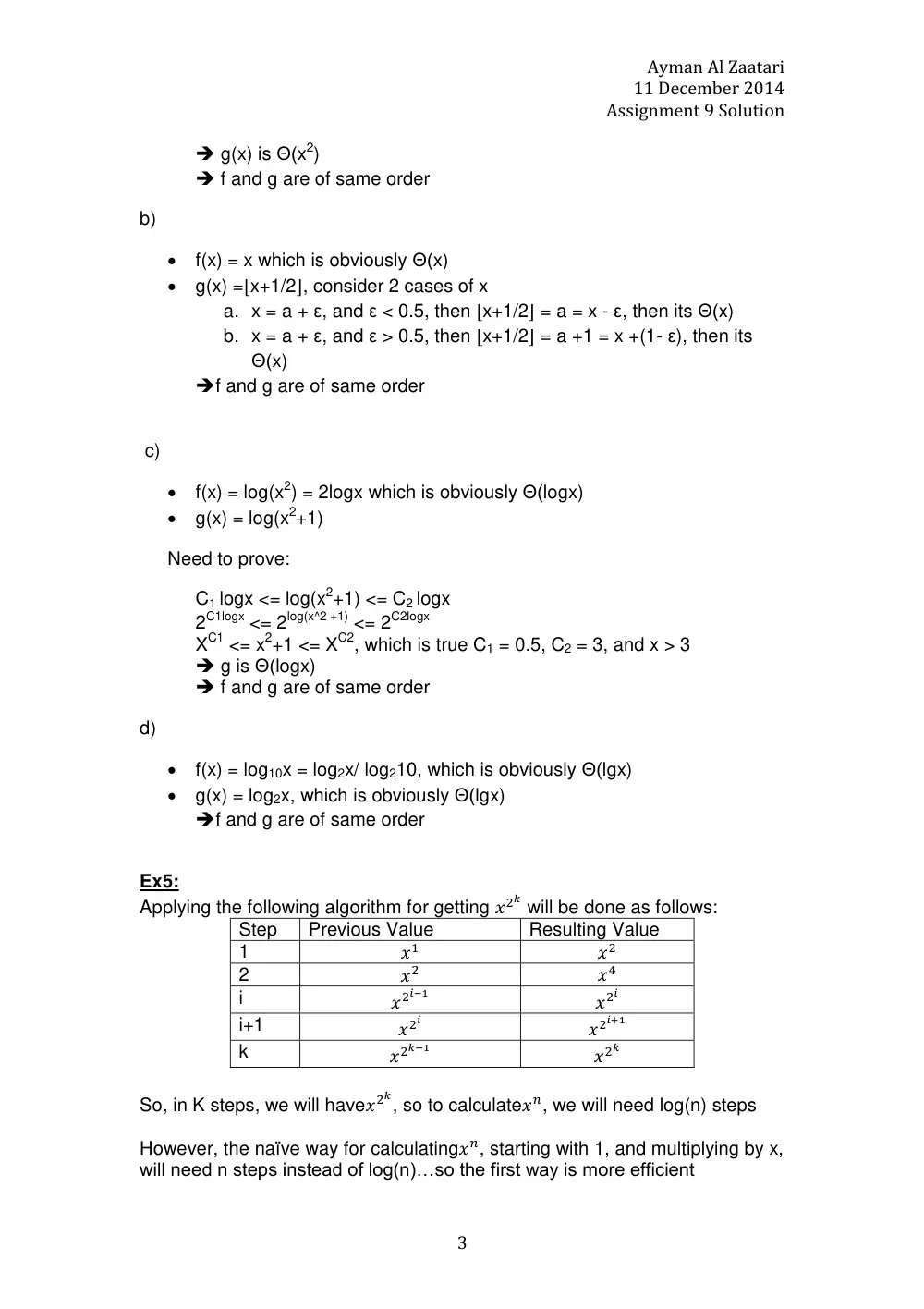
g(x) is Θ(x2)
f and g are of same order
b)
f(x) = x which is obviously Θ(x)
g(x) =⌊x+1/2⌋, consider 2 cases of x
a. x = a + ε, and ε < 0.5, then ⌊x+1/2⌋ = a = x - ε, then its Θ(x)
b. x = a + ε, and ε > 0.5, then ⌊x+1/2⌋ = a +1 = x +(1- ε), then its
Θ(x)
f and g are of same order
c)
f(x) = log(x2) = 2logx which is obviously Θ(logx)
g(x) = log(x2+1)
Need to prove:
C1 logx <= log(x2+1) <= C2 logx
2C1logx <= 2log(x^2 +1) <= 2C2logx
XC1 <= x2+1 <= XC2, which is true C1 = 0.5, C2 = 3, and x > 3
g is Θ(logx)
f and g are of same order
d)
f(x) = log10x = log2x/ log210, which is obviously Θ(lgx)
g(x) = log2x, which is obviously Θ(lgx)
f and g are of same order
Ex5:
Applying the following algorithm for getting will be done as follows:
Step
Previous Value
Resulting Value
1
2
i
i+1
k
So, in K steps, we will have , so to calculate , we will need log(n) steps
However, the naïve way for calculating , starting with 1, and multiplying by x,
will need n steps instead of log(n)…so the first way is more efficient
Ayman Al Zaatari
11 December 2014
Assignment 9 Solution
4
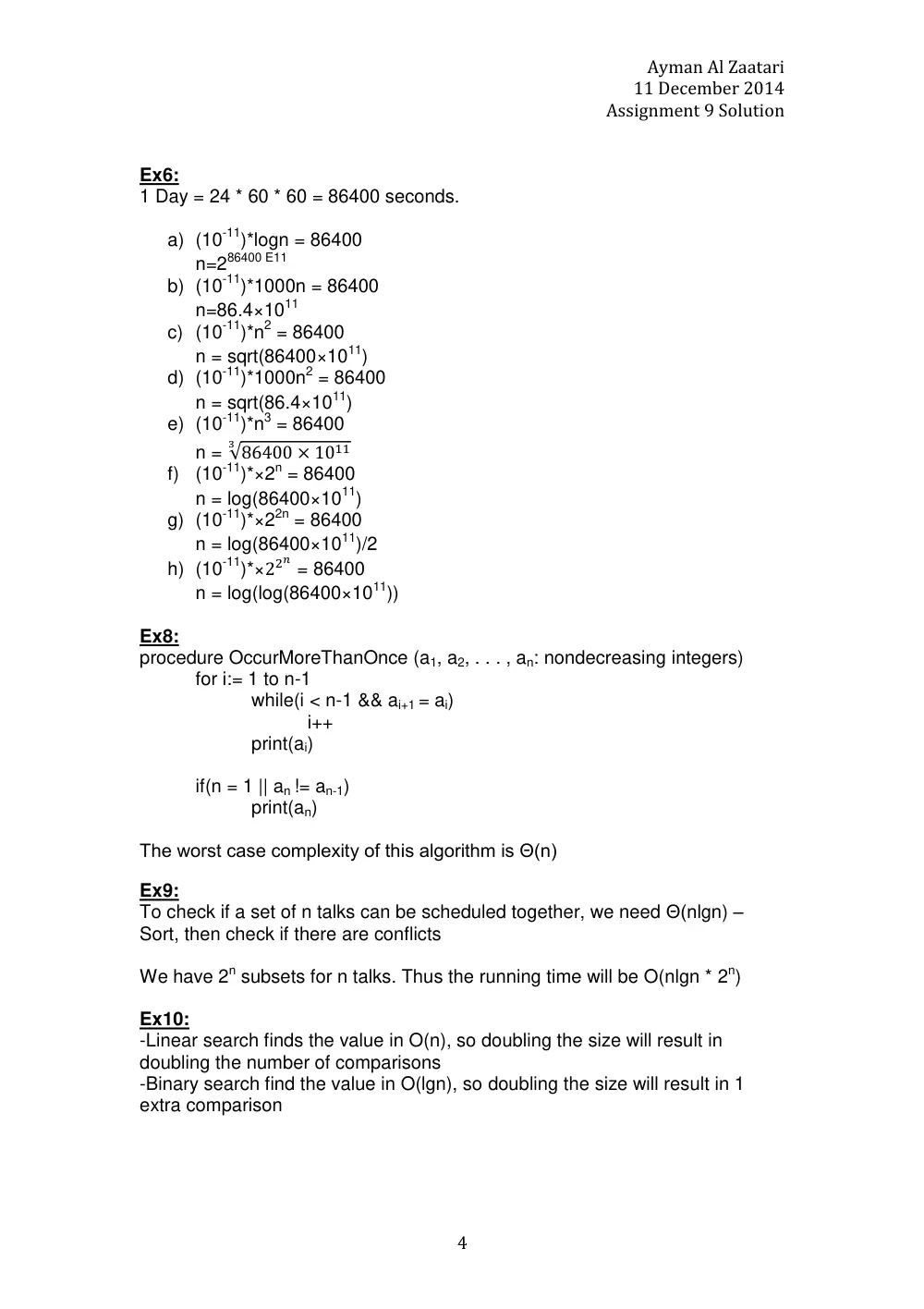
Ex6:
1 Day = 24 * 60 * 60 = 86400 seconds.
a) (10-11)*logn = 86400
n=286400 E11
b) (10-11)*1000n = 86400
n=86.4×10¹¹
c) (10-11)*n2 = 86400
n = sqrt(86400×1011)
d) (10-11)*1000n2 = 86400
n = sqrt(86.4×10¹¹)
e) (10-11)*n3 = 86400
n = √
f) (10-11)*×2n = 86400
n = log(86400×1011)
g) (10-11)*×22n = 86400
n = log(86400×1011)/2
h) (10-11)*× = 86400
n = log(log(86400×1011))
Ex8:
procedure OccurMoreThanOnce (a1, a2, . . . , an: nondecreasing integers)
for i:= 1 to n-1
while(i < n-1 && ai+1 = ai)
i++
print(ai)
if(n = 1 || an
!= an-1)
print(an)
The worst case complexity of this algorithm is Θ(n)
Ex9:
To check if a set of n talks can be scheduled together, we need Θ(nlgn) –
Sort, then check if there are conflicts
We have 2n subsets for n talks. Thus the running time will be O(nlgn * 2n)
Ex10:
-Linear search finds the value in O(n), so doubling the size will result in
doubling the number of comparisons
-Binary search find the value in O(lgn), so doubling the size will result in 1
extra comparison