
CMPS 212 Final, Fall 2002
American University of Beirut · Intermediate Programming with Data Structures · 13 pages



Showing the first 10 of 13 pages. Download the PDF to see all of it.
More CMPS 212 files
Show the text of this final exam
CMPS 212 Intermediate Programming
with Data Structures
FINAL EXAM
Winter 2002-2003
Department of Mathematics & Computer Science .
American University of Beirut
Each question is worth 20 points for a total of 100
Please read the questions carefully BEFORE you start.
All questions must be asked in the first hour of the exam.
(a) Consider the definition of the Binary Tree abstract data type shown below:
class BinTree { :
Integer data; // data field
BinTree left; // link to left subtree
BinTree right; // link to right subtree
public void doubleAllQ) { ...}
public BinTree evenOdd() { ... }
}
Complete the methods doubleAll() and evenOdd(). The method doubleAllQ doubles all the
data elements in the tree. The method evenOdd( returns a binary tree that where every node
has either a 0, if the node at that position in the original binary tree was even, and 1 if the node at
that position was odd (you can assume you have two boolean functions isEven(Integer i) and
isOdd(Integer i).
ica
(2) (a) Write a pure (non-destructive) recursive Java method ‘public int sum(Vector v)’ that
takes a Vector v, and returns the sum of all the Integer elements in v.
(b) Using the method defined in (a), write a pure (non-destructive) recursive Java method
‘public Vector sumAlI(Vector v)’ that takes a Vector of vectors, v, and returns a vector
containing the sum of every vector in v.
(3) Write the pseudo code of heap sort (of a heap stored in an array), and show why heap sort
has O(n log n) complexity.
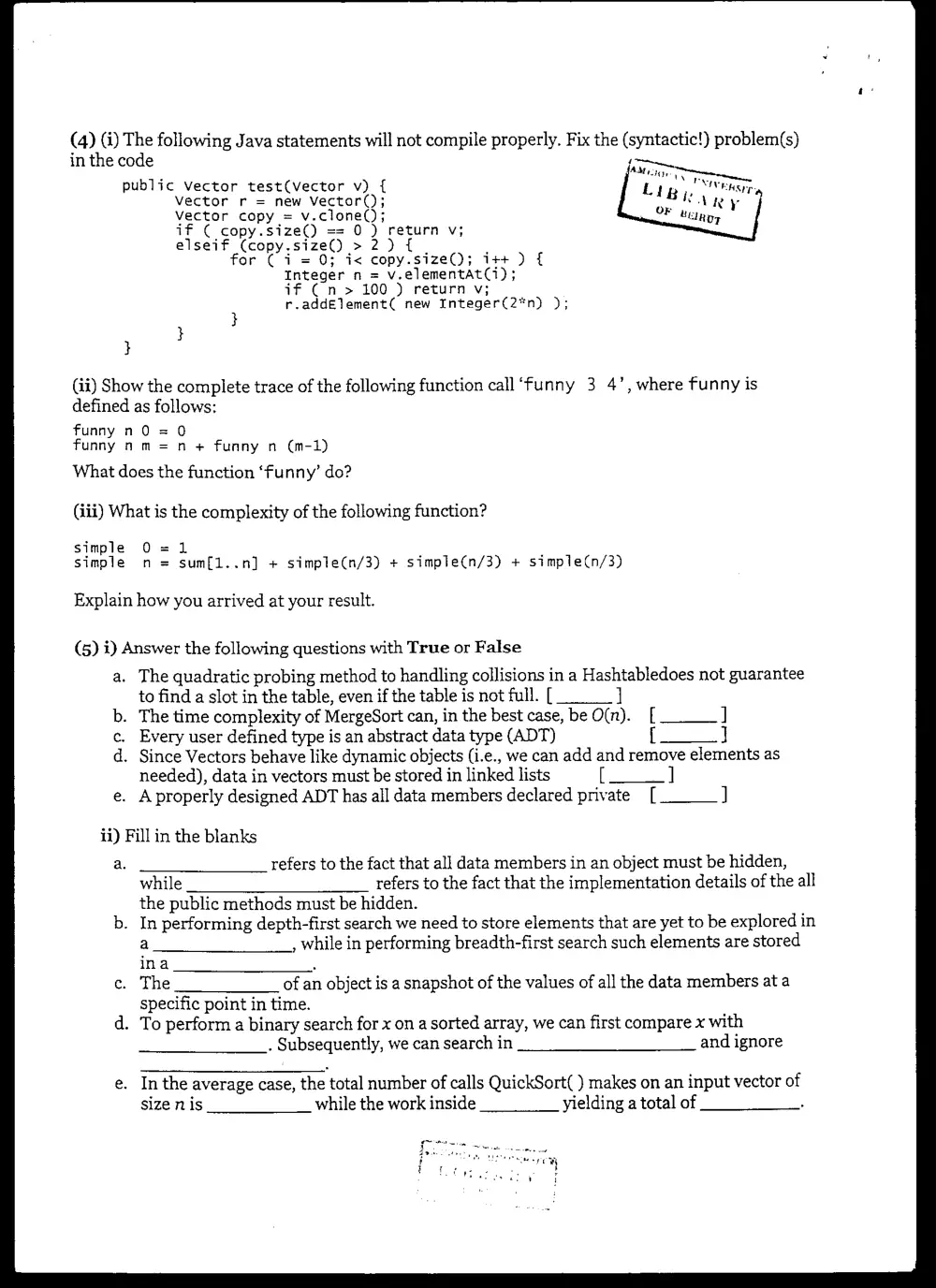
(4) (i) The following Java statements will not compile properly. Fix the (syntactic!) problem(s)
in the code
public vector test(vector v) {
vector r = new Vector();
vector copy = v.clone();
if ( copy.sizeQ) == 0 ) return v;
elseif (copy.size() > 2) { .
for Ci = 0; i< copy.sizeQ); i++) {
Integer n = v.elementat(i);
if (n> 100 ) return v;
r.addelement( new Integer(2*n) );
}
(ii) Show the complete trace of the following function call ‘funny 3 4’, where funny is
defined as follows:
funny nO 0
funny nm =n + funny n (m-1)
What does the function ‘funny’ do?
(iii) What is the complexity of the following function?
simple 0 1
simple n sum(1..n] + simple(n/3) + simpte(n/3) + simple(n/3)
Explain how you arrived at your result.
(5) i) Answer the following questions with True or False
a. The quadratic probing method to handling collisions in a Hashtabledoes not guarantee
to find a slot in the table, even if the table is not full. [ ]
. The time complexity of MergeSort can, in the best case, be O(n). [ ]
. Every user defined type is an abstract data type (ADT) { ]
. Since Vectors behave like dynamic objects (i.e., we can add and remove elements as
needed), data in vectors must be stored in linked lists [ ]
e. A properly designed ADT has all data members declared private [ ]
ii) Fill in the blanks
a. refers to the fact that all data members in an object must be hidden,
while refers to the fact that the implementation details of the all
the public methods must be hidden.
. In performing depth-first search we need to store elements that are yet to be explored in
a , while in performing breadth-first search such elements are stored
ina .
. The of an object is a snapshot of the values of all the data members at a
specific point in time.
. To perform a binary search for x on a sorted array, we can first compare x with
. Subsequently, we can search in and ignore
. Inthe average case, the total number of calls QuickSort( ) makes on an input vector of
size nis while the work inside yielding a total of
Qaiieas UNIVERSIT
LIBRA RY
ey BUIRET
CMPS 212 — Final Exam - Fali 2004
Name: Username: Section
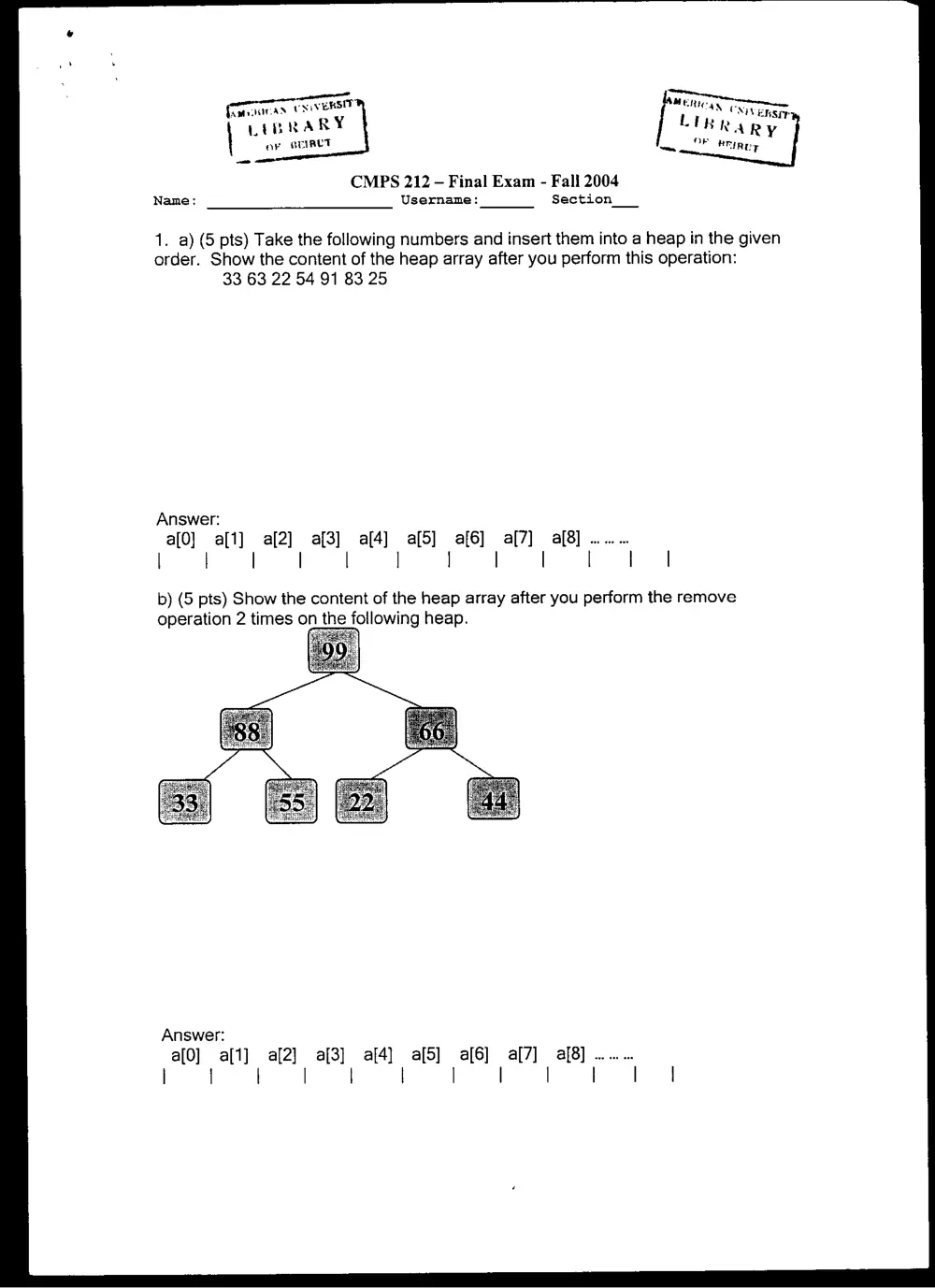
1. a) (5 pts) Take the following numbers and insert them into a heap in the given
order. Show the content of the heap array after you perform this operation:
33 63 22 54 91 83 25
Answer:
a0] ali] a[2] a[3] [4] af5] a[6] a[7] a[8]
| | | | | | | | |
b) (5 pts) Show the content of the heap array after you perform the remove
operation 2 times o following heap.
Answer:
a(O] alt] a[2] a3] a[4] a[5] a[6] al[7] ag] ......
| | | | | | | | | |
2. (5 pts) Consider the following 2 recursive methods on an integer array data
with n integers:
public static int mystery1(int[] data, int n) {
int sum;
if (n <= 0) return 0;
else {
sum = mystery1 (data, n-1);
return sum;
}
public static int mystery2(int] data, int n) {
int sum;
if (n <= 0) return 0;
else {
if (data[n-1] % 2 == 0)
sum = mystery2(data, n-1) + 1;
else
sum = mystery2(data, n-1);
return sum;
What is the final return value of each of these methods if they are calied with the
following parameters : data = {2, 2, 3, 3, 3, 4,4, 4, 44,n=9?
Answer for mystery 1():
Answer for mystery2( ):
3. (5 pts) A hash table is created to store integer keys using a hash function
h(k). The current state of the hash table is shown below. All keys were inserted
without any collisions.
INDEX 0 10} 11 | 12
KEY 62 | 11 | 38
HAS_BEEN_USED | F TI TIT
a) What is h(k)?
Answer:
b) At what position will the key 23 be stored in the hash table using h(k)
above if linear probing is used to resolve collisions?
Answer:
c) At what position will the key 23 be stored in the original hash table (which
does not include 23) if double hashing is used to resolve collisions,
assuming hy(k) = h(k) and ha(k) = 1 + (k mod 11) ?
Answer:
4. (5 pts) What is the time complexity (Big-Oh notation) of the following algorithm,
which takes as input an unsorted integer array arr [j] of size n Assume
heapSort(), insertionSort() and mergeSort() are functions for Heap Sort, Insertion
Sort and Merge Sort respectively. Also assume that n is an even integer. Explain
your answer.
mySort(int] arr) {
sort the lower half of arr using heapSort();
sort the upper half of avr using insertionSort();
merge both halves by using the merge operation as defined for mergeSort();
}
5. (5 pts) Given A[] [] which is an n-by-n matrix of integers. What the complexity
of the given code as a function of n?
int i = 0;
int j = 0;
while (i< n && j <n)
{
if (O== (Alii) % 2))
i++;
else
jtt;
ey
6. (4 pts) Given a singly linked list with references to its head and tail. Which one
of the following set of statements moves the head node to the end of the list.
) tail.link = head;
) tail.link = head; tail = head; head = head.link; tail.link = null;
) tail.link = head; head.link = null; head = head.link; tail = head;
) tail. link = head; head = head.link; tail.link = null;
a
b
c
d
7. (5 pts) A binary search tree T has the following pre-order sequence: 42137658.
Draw the tree T.
8. (3 pts) In terms of computational complexity, what data structure would be
most suitable for the following scenario? You are required to store 7 ClassA
objects where ClassA has a keyattribute to use for comparison. The objects will
be presented to you in ascending order and must be stored in ascending order.
After all of the objects have been stored, the data structure may have to be
searched numerous times for particular ClassA objects. No additional objects will
need to be added to the data structure. Pick one of the following answers then
justify your answer.
(a) an array of length 1000 of ClassA references
(b) an array of length 7 of ClassA references
(c) a linked list of ClassA references
(d) a stack of ClassA references
(e) a queue of ClassA references
Justification:
9. (3 pts) How can a computer system ensure that a user has entered the correct
password without actually storing the password itself anywhere?
10. (3 pts) What does this method compute?
public int foo(int n)
{
if (n <= 1)
return 1;
else
return 5 + foo(n-1);
}
a) foo(n) = the nth Fibonacci number
b) foo(n) = 5*n
c) foo(n) = n>
d) foo(n) = 5"
e) none of the above
11. (4 pts) Provide an implementation of the recursive method rec() defined as:
rec(0) = 37
rec(1) = 73
rec(n) = n/ (rec(n-1) + rec(n-2))
12. (2 pts) Name one application of priority queues:
13. (6 pts) Draw the Control Flow Graph of the following code where the tabel
denotes the basic block number:
bt: int x = 1;
b1: int y = 2;
b1: int z = 3;
bt: if (1 == x)
{
b2: X= 2;
b2: if (2 == y)
{
b3: y=3;
b3: if (3 == z)
{
b4: 2=4;
}
}
}
b5: System.out.printin(“z = “ + z);
14. (5 pts) Show the state of the following B-Tree after inserting 6 in it.
10 | 50 |
15. (4 pts) Starting with an empty binary search tree, show its state after inserting
the following nodes in the given order: 56 34 42 3812
16. (5 pts) Given a binary search tree built by inserting the following nodes in the
given order: 99 75 40 39 832.
a) What is the height of the tree?
b) Why is it not desirable to have a tree that looks as such?