
CMPS 212 Final, Spring 2013
American University of Beirut · Intermediate Programming with Data Structures · 12 pages · Dr. Wassim El Hajj






Showing the first 10 of 12 pages. Download the PDF to see all of it.
More CMPS 212 files
Show the text of this final exam
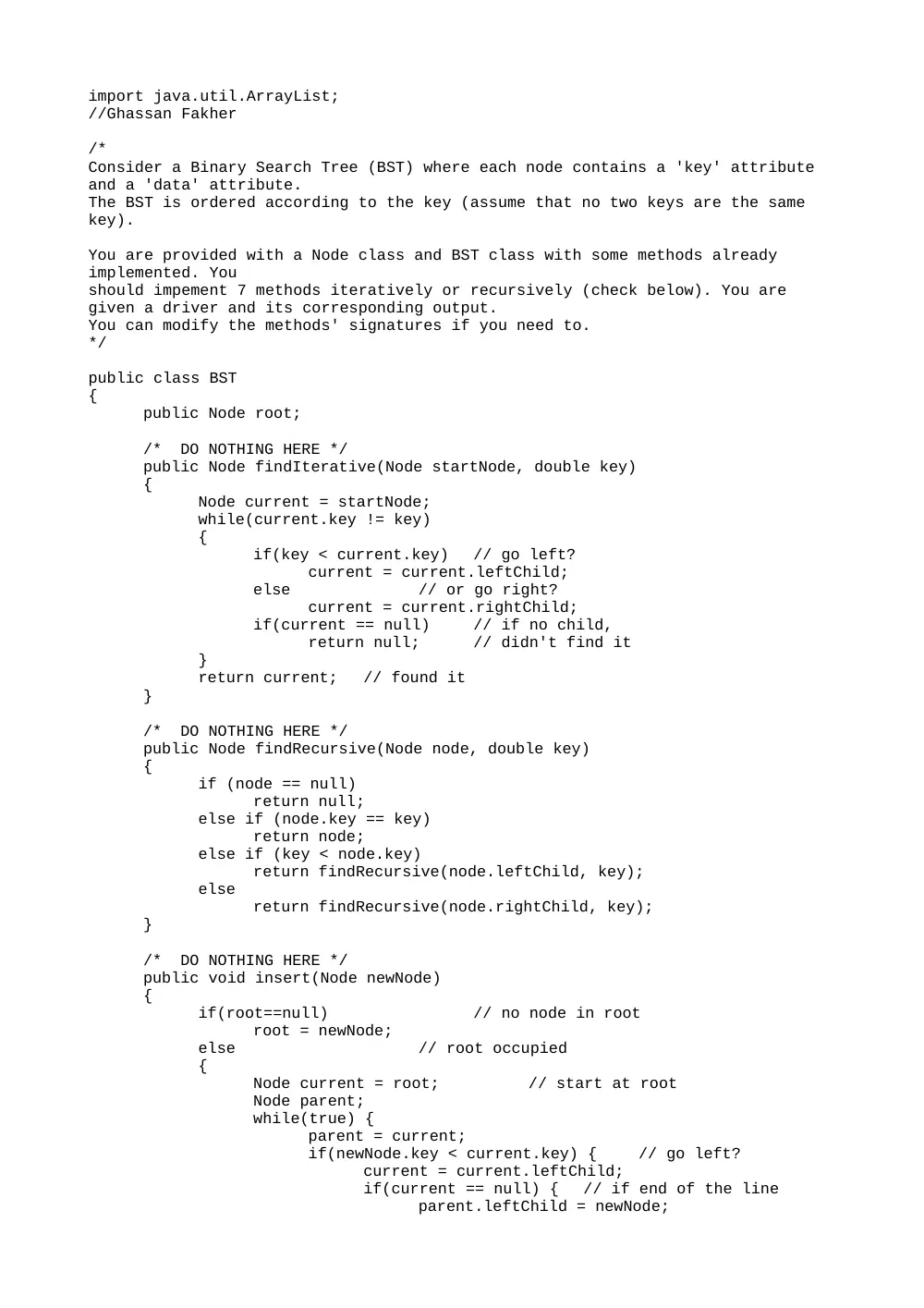
import java.util.ArrayList;
//Ghassan Fakher
/*
Consider a Binary Search Tree (BST) where each node contains a 'key' attribute
and a 'data' attribute.
The BST is ordered according to the key (assume that no two keys are the same
key).
You are provided with a Node class and BST class with some methods already
implemented. You
should impement 7 methods iteratively or recursively (check below). You are
given a driver and its corresponding output.
You can modify the methods' signatures if you need to.
*/
public class BST
{
public Node root;
/* DO NOTHING HERE */
public Node findIterative(Node startNode, double key)
{
Node current = startNode;
while(current.key != key)
{
if(key < current.key)
// go left?
current = current.leftChild;
else
// or go right?
current = current.rightChild;
if(current == null)
// if no child,
return null;
// didn't find it
}
return current;
// found it
}
/* DO NOTHING HERE */
public Node findRecursive(Node node, double key)
{
if (node == null)
return null;
else if (node.key == key)
return node;
else if (key < node.key)
return findRecursive(node.leftChild, key);
else
return findRecursive(node.rightChild, key);
}
/* DO NOTHING HERE */
public void insert(Node newNode)
{
if(root==null)
// no node in root
root = newNode;
else
// root occupied
{
Node current = root;
// start at root
Node parent;
while(true) {
parent = current;
if(newNode.key < current.key) {
// go left?
current = current.leftChild;
if(current == null) {
// if end of the line
parent.leftChild = newNode;
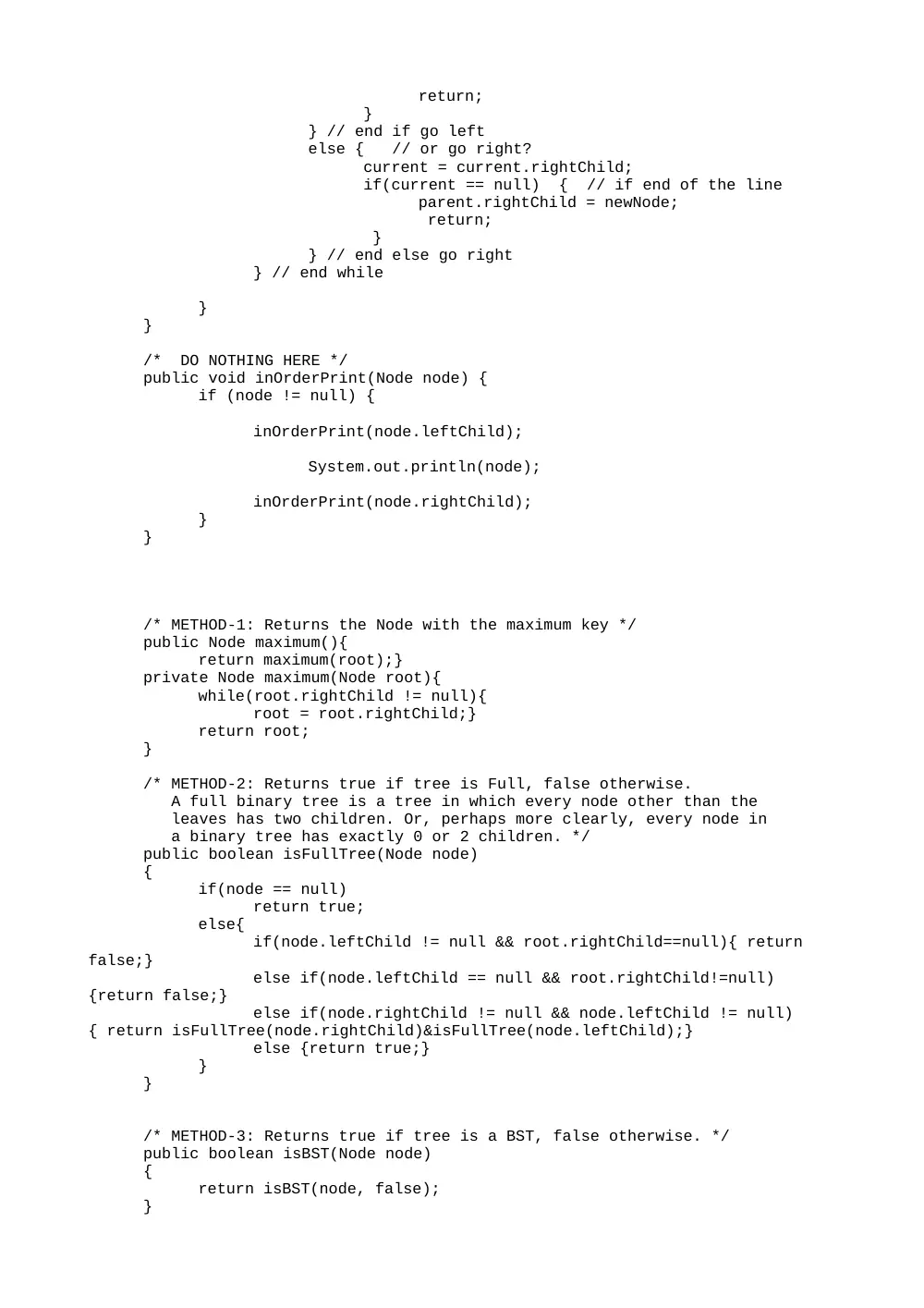
return;
}
} // end if go left
else { // or go right?
current = current.rightChild;
if(current == null) { // if end of the line
parent.rightChild = newNode;
return;
}
} // end else go right
} // end while
}
}
/* DO NOTHING HERE */
public void inOrderPrint(Node node) {
if (node != null) {
inOrderPrint(node.leftChild);
System.out.println(node);
inOrderPrint(node.rightChild);
}
}
/* METHOD-1: Returns the Node with the maximum key */
public Node maximum(){
return maximum(root);}
private Node maximum(Node root){
while(root.rightChild != null){
root = root.rightChild;}
return root;
}
/* METHOD-2: Returns true if tree is Full, false otherwise.
A full binary tree is a tree in which every node other than the
leaves has two children. Or, perhaps more clearly, every node in
a binary tree has exactly 0 or 2 children. */
public boolean isFullTree(Node node)
{
if(node == null)
return true;
else{
if(node.leftChild != null && root.rightChild==null){ return
false;}
else if(node.leftChild == null && root.rightChild!=null)
{return false;}
else if(node.rightChild != null && node.leftChild != null)
{ return isFullTree(node.rightChild)&isFullTree(node.leftChild);}
else {return true;}
}
}
/* METHOD-3: Returns true if tree is a BST, false otherwise. */
public boolean isBST(Node node)
{
return isBST(node, false);
}
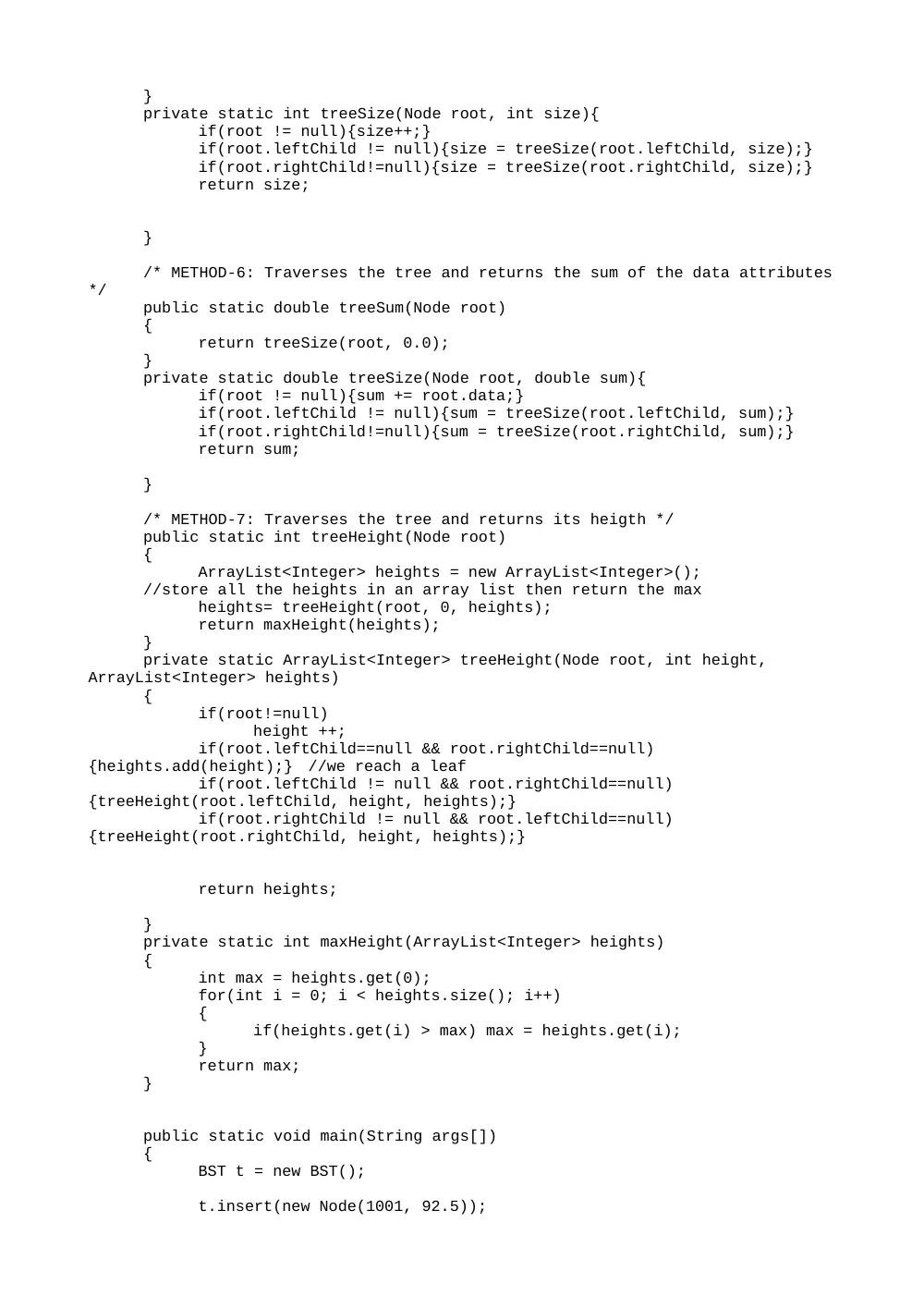
private boolean isBST(Node node, boolean bst)
{
if(node.rightChild != null){
if(node.key<node.rightChild.key){bst = true;}
else bst = false;
bst = bst & isBST(node.rightChild, bst);
}
else bst = true;
if(node.leftChild !=null){
if(node.key > node.leftChild.key){bst = true;}
else bst = false;
bst = bst & isBST(node.leftChild, bst);}
else bst = true;
return bst;
}
/* METHOD-4: Returns true if both trees are similar in keys and data,
false otherwise */
public boolean areSimilar(Node node1, Node node2){
return areSimilar(node1, node2, false);
}
private boolean areSimilar(Node node1, Node node2, boolean similar){
if((node1.key==node2.key) && (node1.data == node2.data)){similar =
true;}
else similar = false;
if(node1.rightChild != null && node2.rightChild != null){
similar = similar & areSimilar(node1.rightChild,
node2.rightChild, similar);
}
if(node1.leftChild != null && node2.leftChild != null){
similar = similar & areSimilar(node1.leftChild,
node2.leftChild, similar);
}
return similar;
}
/* METHOD-5: Traverses the tree and returns the number of nodes traversed
*/
public static int treeSize(Node root)
{
return treeSize(root, 0);
}
private static int treeSize(Node root, int size){
if(root != null){size++;}
if(root.leftChild != null){size = treeSize(root.leftChild, size);}
if(root.rightChild!=null){size = treeSize(root.rightChild, size);}
return size;
}
/* METHOD-6: Traverses the tree and returns the sum of the data attributes
*/
public static double treeSum(Node root)
{
return treeSize(root, 0.0);
}
private static double treeSize(Node root, double sum){
if(root != null){sum += root.data;}
if(root.leftChild != null){sum = treeSize(root.leftChild, sum);}
if(root.rightChild!=null){sum = treeSize(root.rightChild, sum);}
return sum;
}
/* METHOD-7: Traverses the tree and returns its heigth */
public static int treeHeight(Node root)
{
ArrayList<Integer> heights = new ArrayList<Integer>();
//store all the heights in an array list then return the max
heights= treeHeight(root, 0, heights);
return maxHeight(heights);
}
private static ArrayList<Integer> treeHeight(Node root, int height,
ArrayList<Integer> heights)
{
if(root!=null)
height ++;
if(root.leftChild==null && root.rightChild==null)
{heights.add(height);}
//we reach a leaf
if(root.leftChild != null && root.rightChild==null)
{treeHeight(root.leftChild, height, heights);}
if(root.rightChild != null && root.leftChild==null)
{treeHeight(root.rightChild, height, heights);}
return heights;
}
private static int maxHeight(ArrayList<Integer> heights)
{
int max = heights.get(0);
for(int i = 0; i < heights.size(); i++)
{
if(heights.get(i) > max) max = heights.get(i);
}
return max;
}
public static void main(String args[])
{
BST t = new BST();
t.insert(new Node(1001, 92.5));
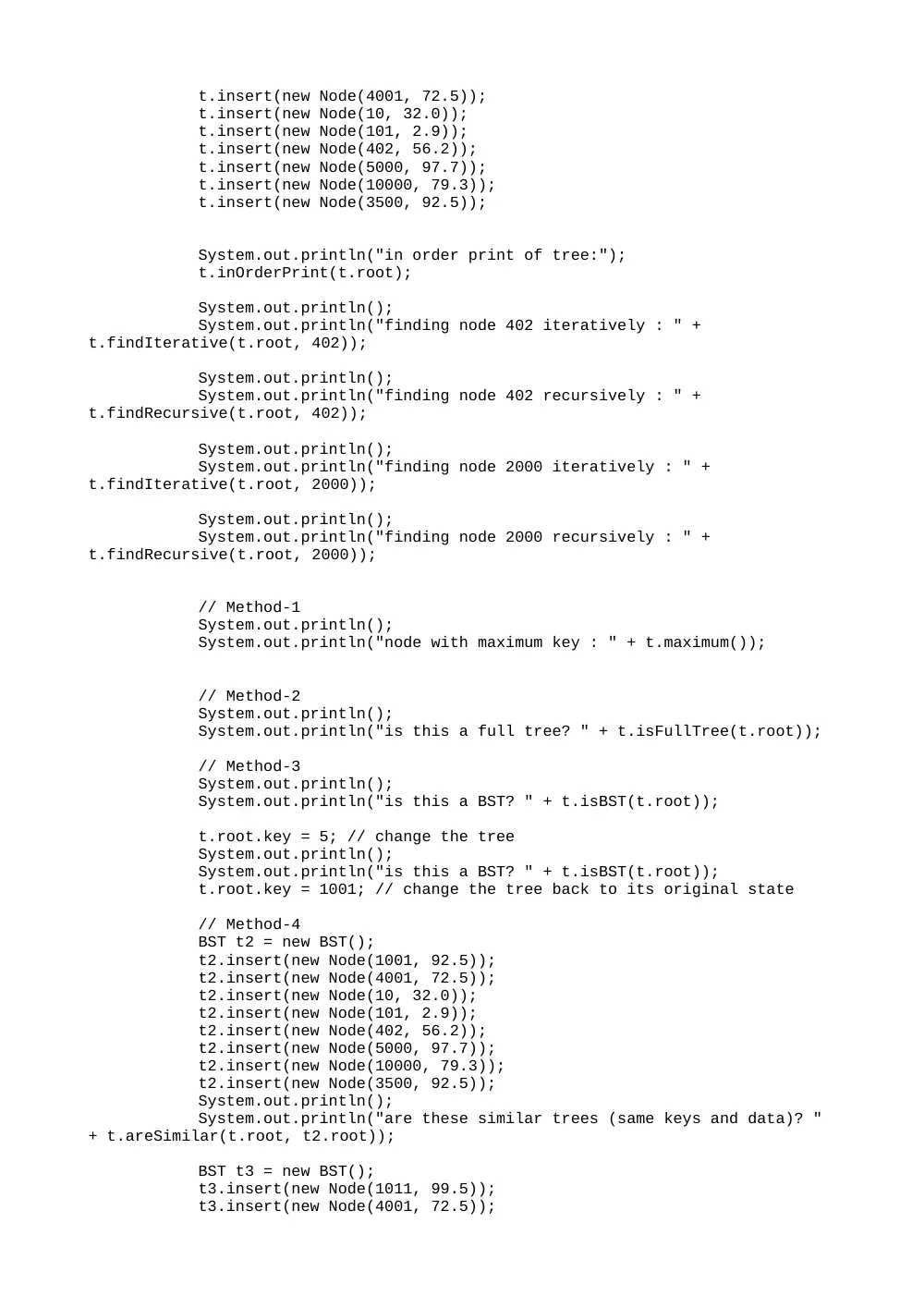
t.insert(new Node(4001, 72.5));
t.insert(new Node(10, 32.0));
t.insert(new Node(101, 2.9));
t.insert(new Node(402, 56.2));
t.insert(new Node(5000, 97.7));
t.insert(new Node(10000, 79.3));
t.insert(new Node(3500, 92.5));
System.out.println("in order print of tree:");
t.inOrderPrint(t.root);
System.out.println();
System.out.println("finding node 402 iteratively : " +
t.findIterative(t.root, 402));
System.out.println();
System.out.println("finding node 402 recursively : " +
t.findRecursive(t.root, 402));
System.out.println();
System.out.println("finding node 2000 iteratively : " +
t.findIterative(t.root, 2000));
System.out.println();
System.out.println("finding node 2000 recursively : " +
t.findRecursive(t.root, 2000));
// Method-1
System.out.println();
System.out.println("node with maximum key : " + t.maximum());
// Method-2
System.out.println();
System.out.println("is this a full tree? " + t.isFullTree(t.root));
// Method-3
System.out.println();
System.out.println("is this a BST? " + t.isBST(t.root));
t.root.key = 5; // change the tree
System.out.println();
System.out.println("is this a BST? " + t.isBST(t.root));
t.root.key = 1001; // change the tree back to its original state
// Method-4
BST t2 = new BST();
t2.insert(new Node(1001, 92.5));
t2.insert(new Node(4001, 72.5));
t2.insert(new Node(10, 32.0));
t2.insert(new Node(101, 2.9));
t2.insert(new Node(402, 56.2));
t2.insert(new Node(5000, 97.7));
t2.insert(new Node(10000, 79.3));
t2.insert(new Node(3500, 92.5));
System.out.println();
System.out.println("are these similar trees (same keys and data)? "
+ t.areSimilar(t.root, t2.root));
BST t3 = new BST();
t3.insert(new Node(1011, 99.5));
t3.insert(new Node(4001, 72.5));
t3.insert(new Node(10, 32.0));
t3.insert(new Node(101, 2.9));
t3.insert(new Node(402, 56.2));
t3.insert(new Node(6000, 90.7));
t3.insert(new Node(10000, 79.3));
t3.insert(new Node(3500, 92.5));
System.out.println();
System.out.println("are these similar trees (same keys and data)? "
+ t.areSimilar(t.root, t3.root));
// Method-5
System.out.println();
System.out.println("size of tree (number of nodes) : " +
t.treeSize(t.root));
// Method-6
System.out.println();
System.out.println("sum of tree (sum of data values) : " +
t.treeSum(t.root));
// Method-7
System.out.println();
System.out.println("tree height : " + t.treeHeight(t.root));
}
}
/* THE EXPECTED OUTPUT FOR THIS DRIVER LOOKS AS FOLLOWS:
in order print of tree:
10 32.0
101 2.9
402 56.2
1001 92.5
3500 92.5
4001 72.5
5000 97.7
10000 79.3
finding node 402 iteratively : 402 56.2
finding node 402 recursively : 402 56.2
finding node 2000 iteratively : null
finding node 2000 recursively : null
node with maximum key : 10000 79.3
is this a full tree? false
is this a BST? true
is this a BST? false
are these similar trees (same keys and data)? true
are these similar trees (same keys and data)? false
size of tree (number of nodes) : 8
sum of tree (sum of data values) : 525.6
tree height : 3
*/
import java.util.ArrayList;
public class CustomFibonacci {
public static void main(String[] args)
{
customFibo(14);
}
public static void customFibo(int n)
{
ArrayList<Integer> fibo = new ArrayList<Integer>();
if(n < 5)
{
for(int i = 1; i <= n; i++)
{
fibo.add(i);
}
System.out.print(fibo.get(0));
for(int i = 1; i < n; i++)
{
System.out.print(", " + fibo.get(i));
}
}
else
{
for(int i = 1; i <= 4; i++)
{
fibo.add(i);
}
customFibo(n, fibo, 0);
}
}
private static void customFibo(int n, ArrayList<Integer> fibo, int
current)
{
if(n > fibo.size())
{
fibo.add(fibo.get(current) + fibo.get(current + 1));
current ++;
customFibo(n, fibo, current);
}
else
{
System.out.print(fibo.get(0));
for(int i = 1; i < fibo.size(); i++)
{
System.out.print(", " + fibo.get(i) );
}
}
}
}
import javax.swing.text.html.HTMLDocument.Iterator;
// REMOVE THE TWO COMMENTS BELOW WHEN YOU ARE DONE WITH IMPLEMENTING THE
"reorder" METHOD
public class Reordering {
// a test client
public static void main(String[] args) {
Queue<Integer> q = new Queue<Integer>();
q.enqueue(1);
q.enqueue(2);
q.enqueue(-2);
q.enqueue(4);
q.enqueue(-5);
q.enqueue(8);
q.enqueue(-8);
q.enqueue(12);
q.enqueue(-15);
q.enqueue(23);
System.out.println(q);
reorder(q); // you should implement the following method
System.out.println(q); // this should print the new ordered list
}
public static void reorder(Queue<Integer> q)
{
//we will have to iterate this queue from front, when we encounter a
negative number we enqueue it
java.util.Iterator<Integer> itr = q.iterator();
Queue<Integer> pos = new Queue<Integer>();
Queue<Integer> neg = new Queue<Integer>();
for(int i = q.size(); i > 0; i--)
{
if(itr.next() < 0)
{
q.enqueue(q.dequeue());
}
else
{
}
}
for(int i = 0; i < neg.size(); i++)
{
q.enqueue(neg.dequeue());
}
for(int i = 0; i < pos.size(); i++)
{
q.enqueue(pos.dequeue());
}
System.out.println(q.toString());
}
}