
CMPS 212 Final, Fall 2004
American University of Beirut · Intermediate Programming with Data Structures · 15 pages
Showing the first 10 of 15 pages. Download the PDF to see all of it.
More CMPS 212 files
Show the text of this final exam
CMPS 212 Final Exam
American University of Beirut
Department of Computer Science
Date: January 29%, 2004
This is a closed book exam
You have two hours to finish
Answer in the spaces provided. Use additional sheet when needed.
No electronic devices are allowed
The questions are not all of equal difficulty, do the easy ones first.
Good Luck
Name
Student #
Section
Part I: Multiple Choices
Part III: Concept questions
Part IV: Programming
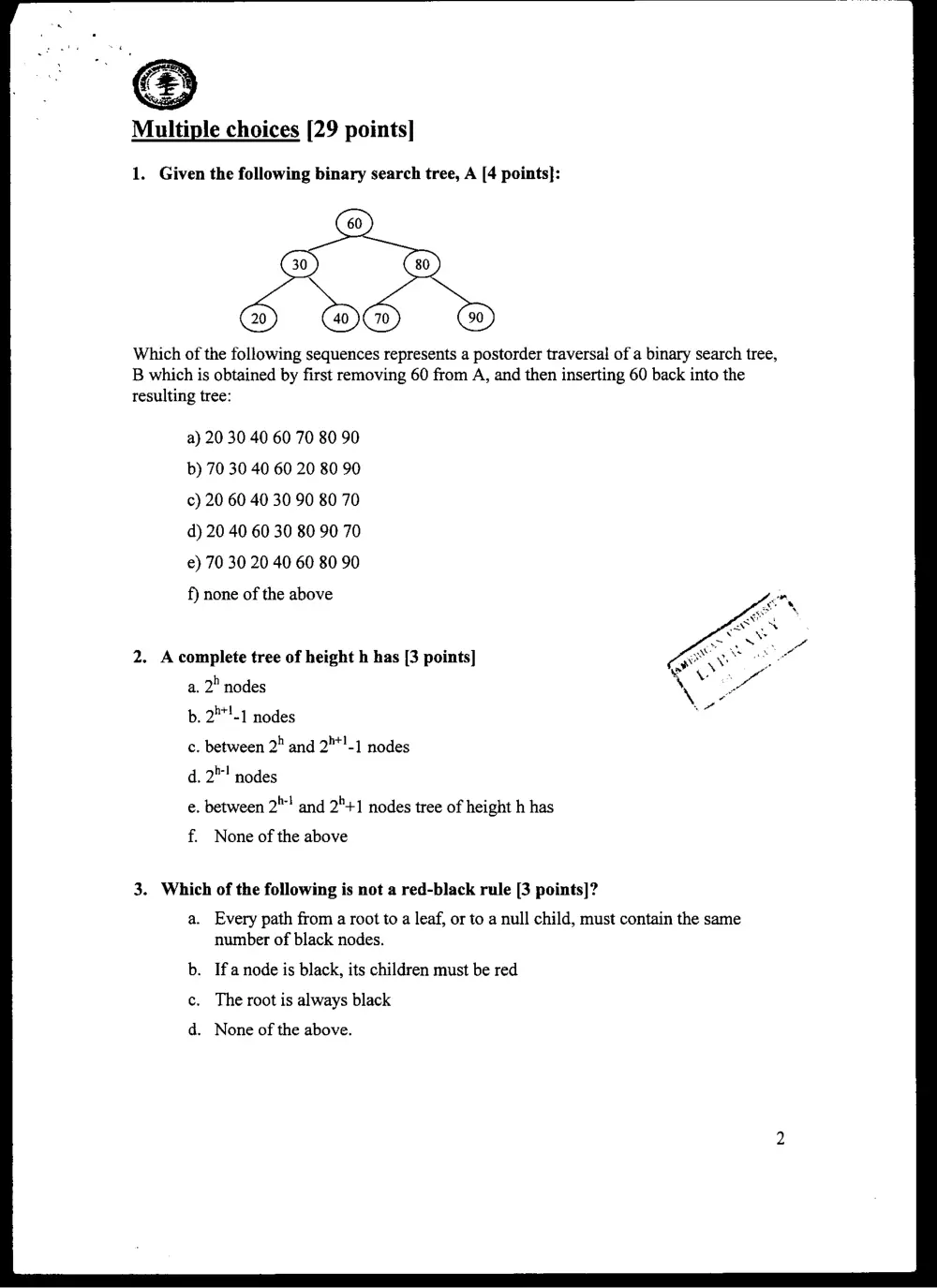
Multiple choices [29 points]
1. Given the following binary search tree, A [4 points]:
Which of the following sequences represents a postorder traversal of a binary search tree,
B which is obtained by first removing 60 from A, and then inserting 60 back into the
resulting tree:
a) 20 30 40 60 70 80 90
b) 70 30 40 60 20 80 90
c) 20 60 40 30 90 80 70
d) 20 40 60 30 80 90 70
e) 70 30 20 40 60 80 90
f) none of the above
2. A complete tree of height h has [3 points]
a. 2" nodes
b. 2°*!.1 nodes
c. between 2" and 2"*!_1 nodes
d. 2™! nodes
e. between 2"! and 2"+1 nodes tree of height h has
f. None of the above
3. Which of the following is not a red-black rule [3 points]?
a. Every path from a root to a leaf, or to a null child, must contain the same
number of black nodes.
. Ifanode is black, its children must be red
The root is always black
. None of the above.
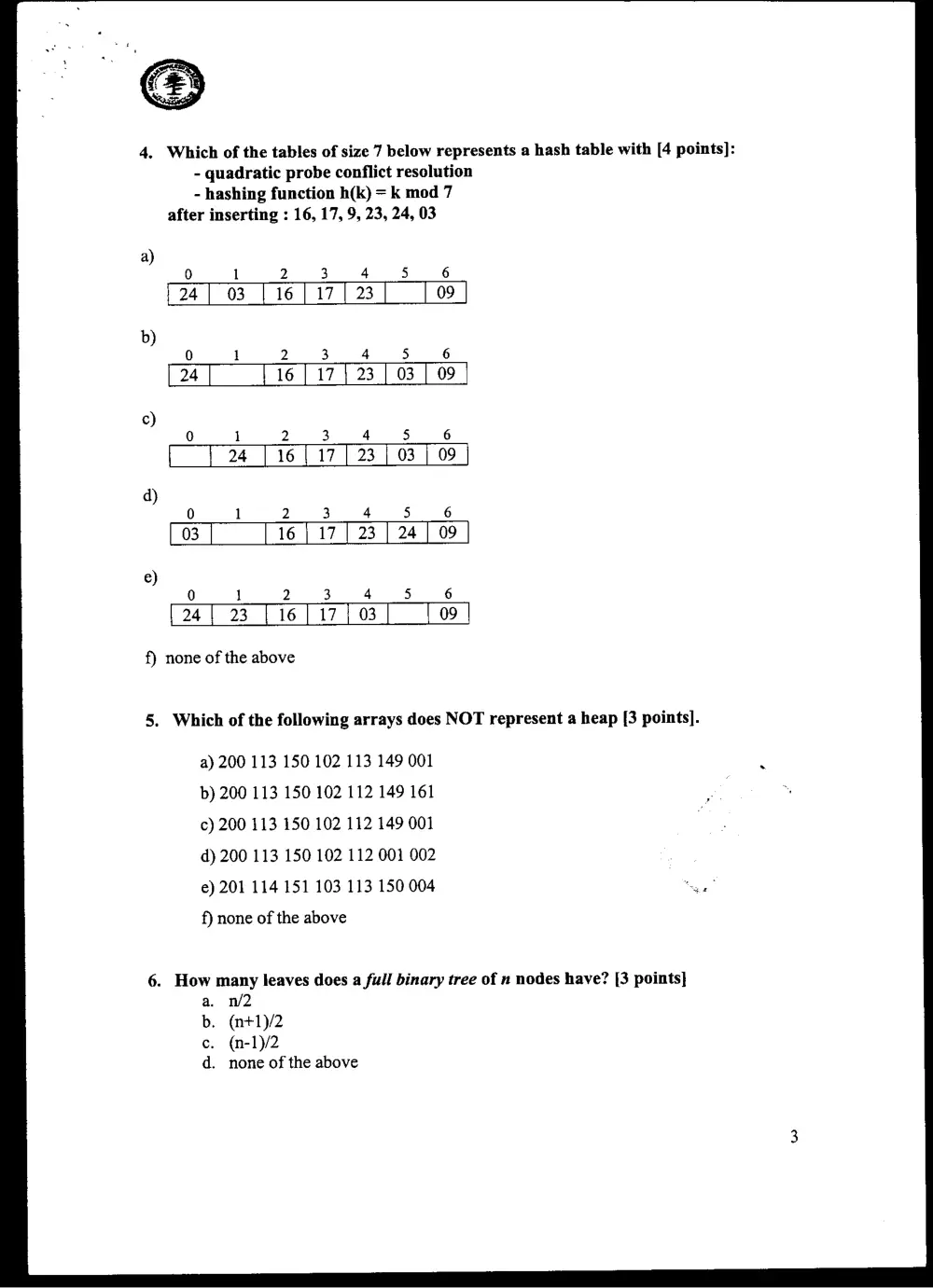
4, Which of the tables of size 7 below represents a hash table with [4 points]:
- quadratic probe conflict resolution
- hashing function h(k) = k mod 7
after inserting : 16, 17, 9, 23, 24, 03
a)
0 1 2 3 4 5 6
24 | 03 | 16 | 17 | 23 09
b)
0 1 2 3 4 5 6
24 16 | 17 | 23 | 03 | 09
c)
0 1 2 3 4 5 6
24 | 16 [ 17 | 23 | 03 | 09
d)
0 1 2 3 4 =«5 6
03 16 | 17 | 23 | 24 | 09
e)
0 1 2 3 4 5 6
24 | 23 | 16] 17 | 03 09
f) none of the above
5. Which of the following arrays does NOT represent a heap [3 points].
a) 200 113 150 102 113 149 001
b) 200 113 150 102 112 149 161
c) 200 113 150 102 112 149 001
d) 200 113 150 102 112 001 002
e) 201 114 151 103 113 150 004
f) none of the above
6. How many leaves does a full binary tree of n nodes have? [3 points}
a. n/2
b. (nt1)/2
c. (n-1)/2
d. none of the above
e- none of the above
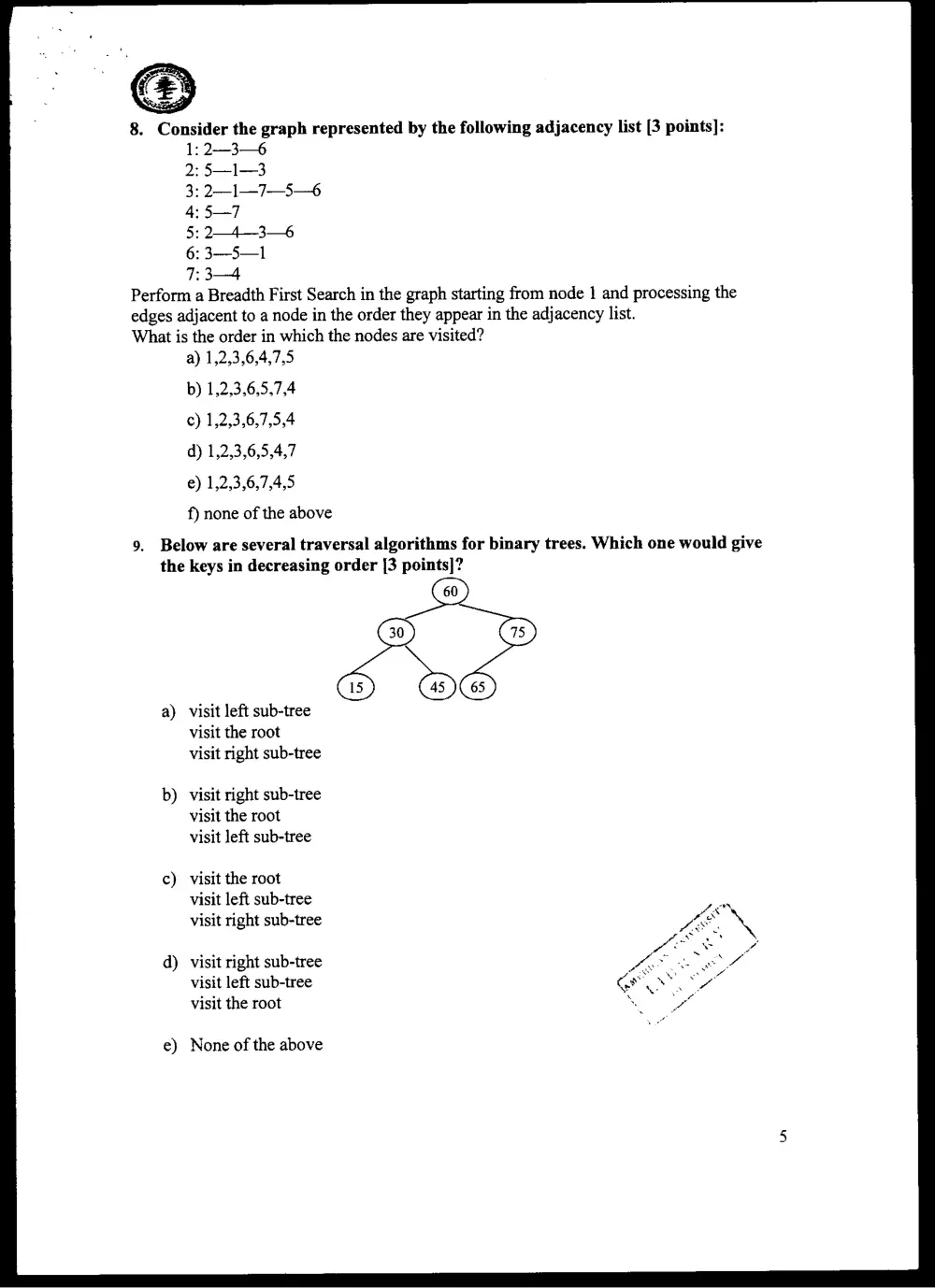
8. Consider the graph represented by the following adjacency list [3 points]:
1: 2—3—6
7 5—1—3
:2—1—7—5—6
257
:2-4-3—6
:3—5—1
734
Perform a Breadth First Search in the graph starting from node 1 and processing the
edges adjacent to a node in the order they appear in the adjacency list.
What is the order in which the nodes are visited?
a) 1,2,3,6,4,7,5
b) 1,2,3,6,5,7,4
c) 1,2,3,6,7,5,4
d) 1,2,3,6,5,4,7
e) 1,2,3,6,7,4,5
f) none of the above
9. Below are several traversal algorithms for binary trees. Which one would give
the keys in decreasing order [3 points]?
ore
visit left sub-tree
visit the root
visit right sub-tree
visit right sub-tree
visit the root
visit left sub-tree
visit the root
visit left sub-tree
visit right sub-tree
visit right sub-tree
visit left sub-tree
visit the root
None of the above
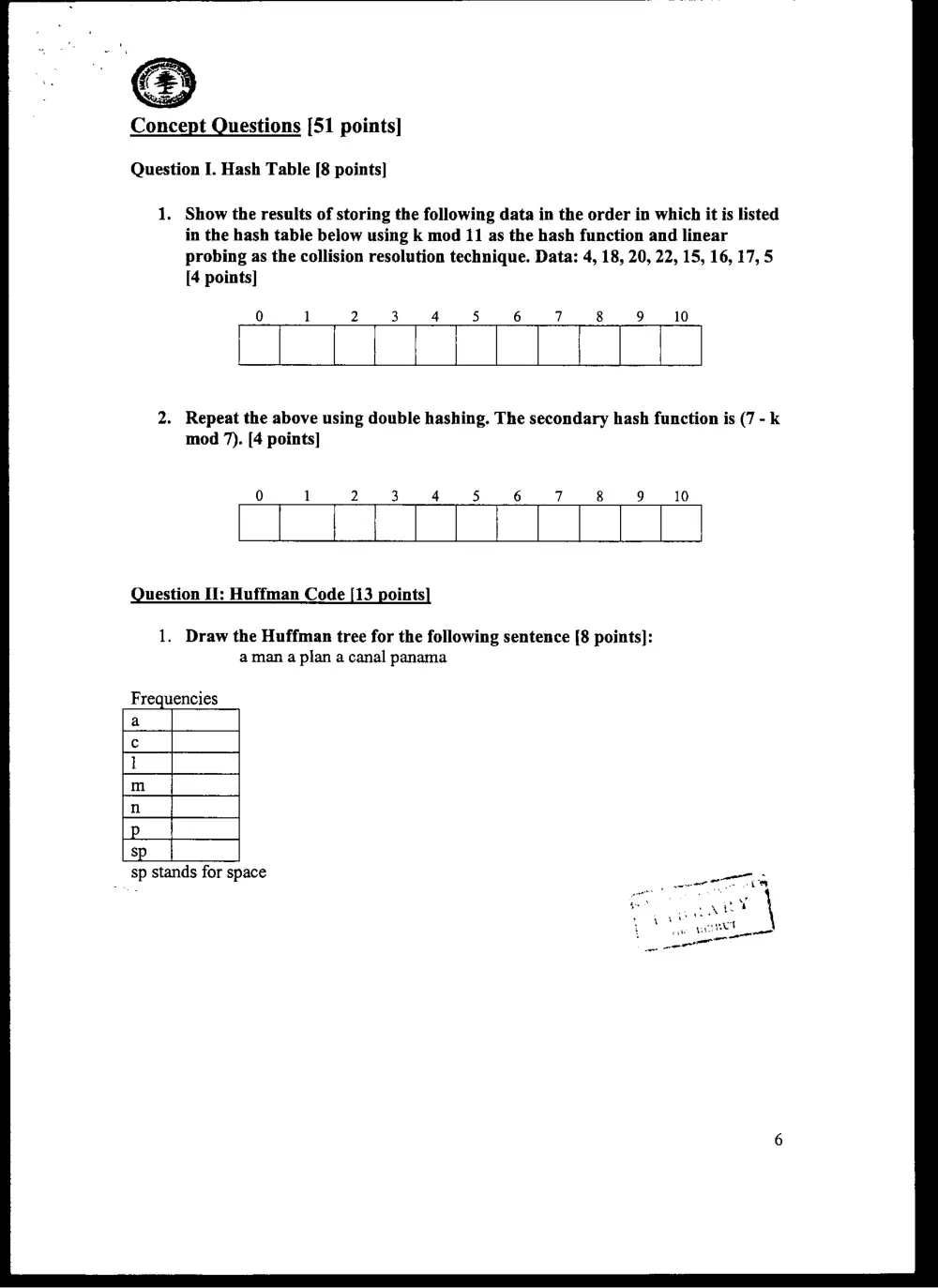
Concept Questions [51 points]
Question I. Hash Table [8 points]
1. Show the results of storing the following data in the order in which it is listed
in the hash table below using k mod 11 as the hash function and linear
probing as the collision resolution technique. Data: 4, 18, 20, 22, 15, 16, 17,5
[4 points]
0 1 2 3 4 5 6 7 8 9 10
2. Repeat the above using double hashing. The secondary hash function is (7 - k
mod 7). [4 points]
Question II: Huffman Code [13 points]
1. Draw the Huffman tree for the following sentence [8 points):
aman a plan a canal panama
Frequencies
bs | Jg |~o |p
sp
sp stands for space
2. How would the word “man” be encoded using your Huffman code? [3 points]
3. Why is it always possible to reconstruct a message that has been encoded
using a Huffman code? [3 points]
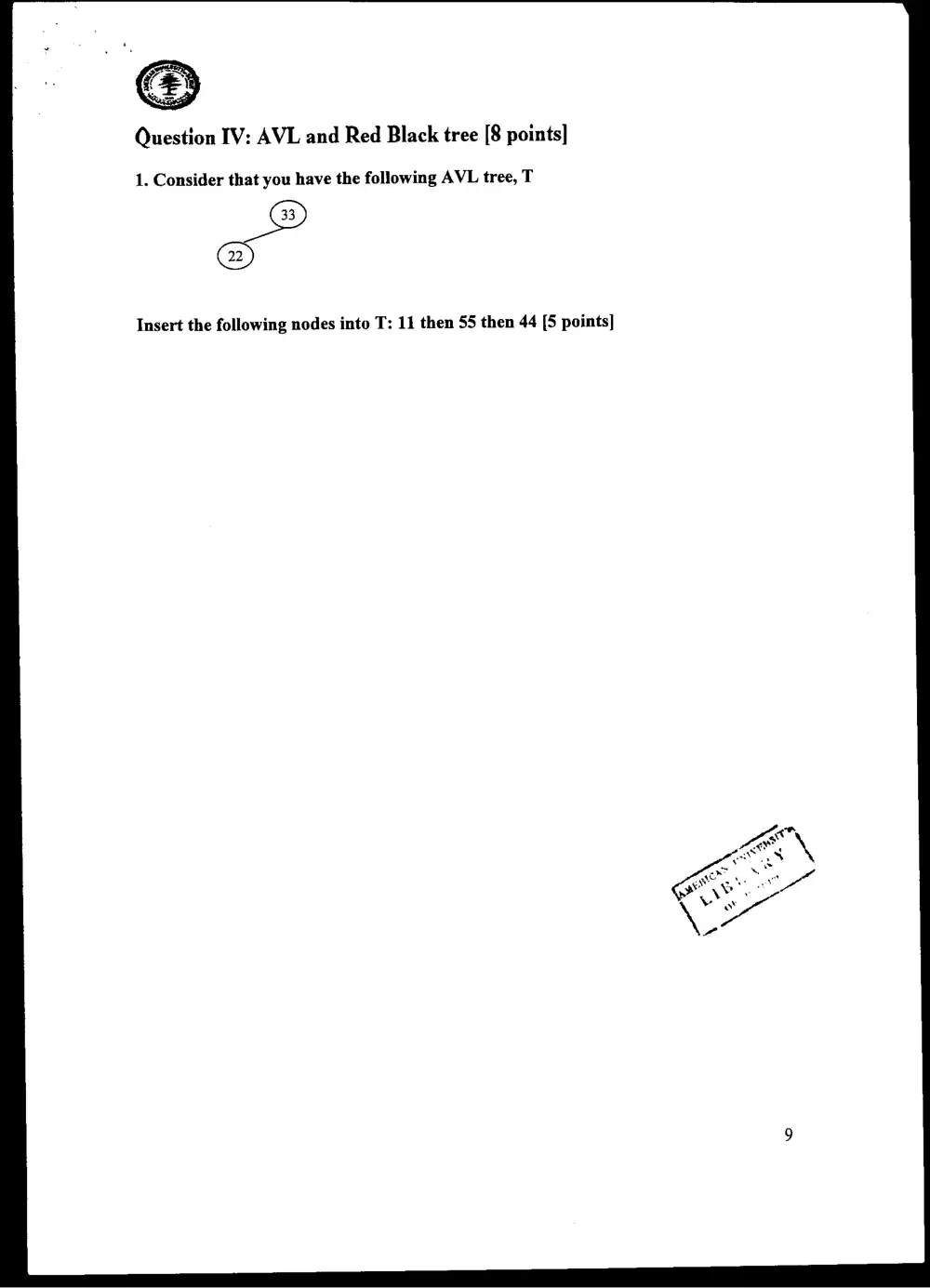
Question IV: AVL and Red Black tree [8 points]
1. Consider that you have the following AVL tree, T
Insert the following nodes into T: 11 then 55 then 44 [5 points]
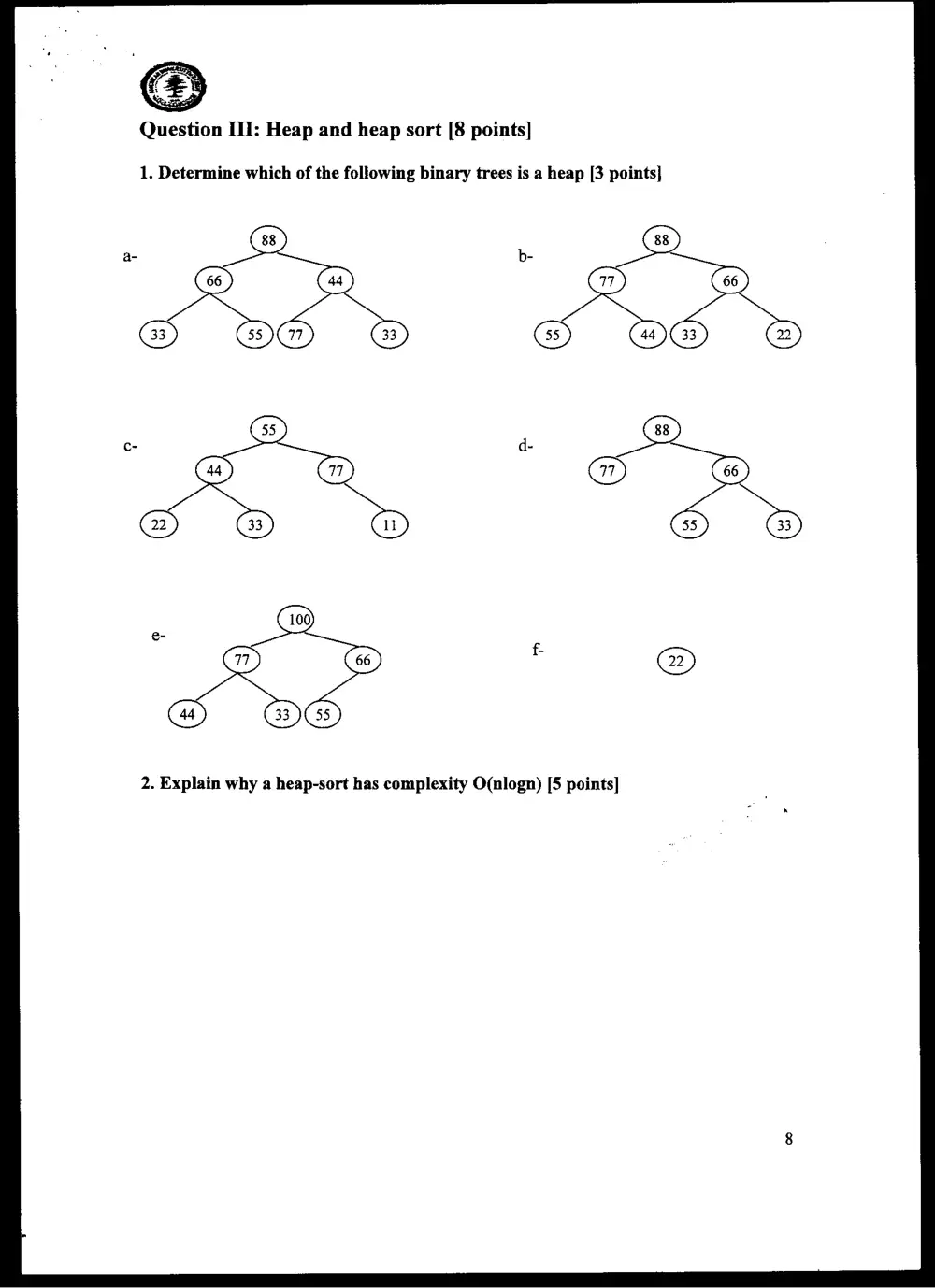
Question III: Heap and heap sort [8 points]
1. Determine which of the following binary trees is a heap [3 points]
ete | TS
Choa)
Cm (66) ; @
GS)
2. Explain why a heap-sort has complexity O(nlogn) [5 points]
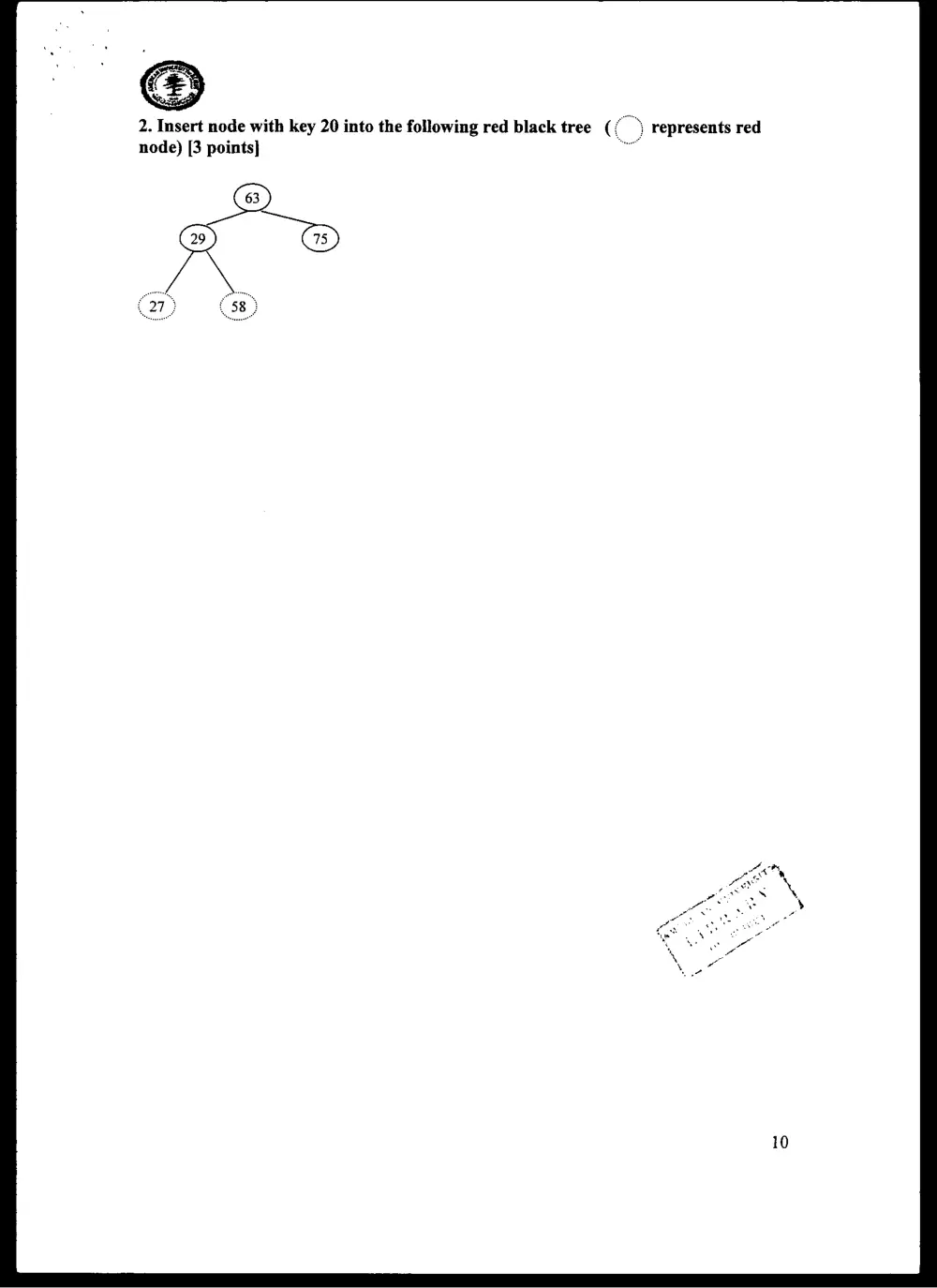
2. Insert node with key 20 into the following red black tree
node) [3 points]
represents red
10