
CMPS 282 Final, Fall 2005
American University of Beirut · Software Engineering · 11 pages
Showing the first 10 of 11 pages. Download the PDF to see all of it.
More CMPS 282 files
Show the text of this final exam
January 28, 2006 CMPS 282 Final Exam
Marcel R. karam 1/11
CMPS 282 Final Exam
January 28, 06
2hour exam
Student Name: __________________________ Student ID:_________________
Signature: ______________________________ Section: _____1_____________
There are eleven pages, including this one. The test is out of 100 marks, and the value of each
question is provided. Please use this information to manage your time effectively.
Question 1: ______/10
Question 2: ______/15
Question 3: ______/10
Question 4: ______/25
Question 5: ______/20
Question 6: ______/25
Total: ____________/100
January 28, 2006 CMPS 282 Final Exam
Marcel R. karam 2/11
Question 1: True or False [10 marks]
Answer by placing either a T or F for True and False, respectively. Incorrect answers incur a pen-
alty at a floor (2:1) ratio.
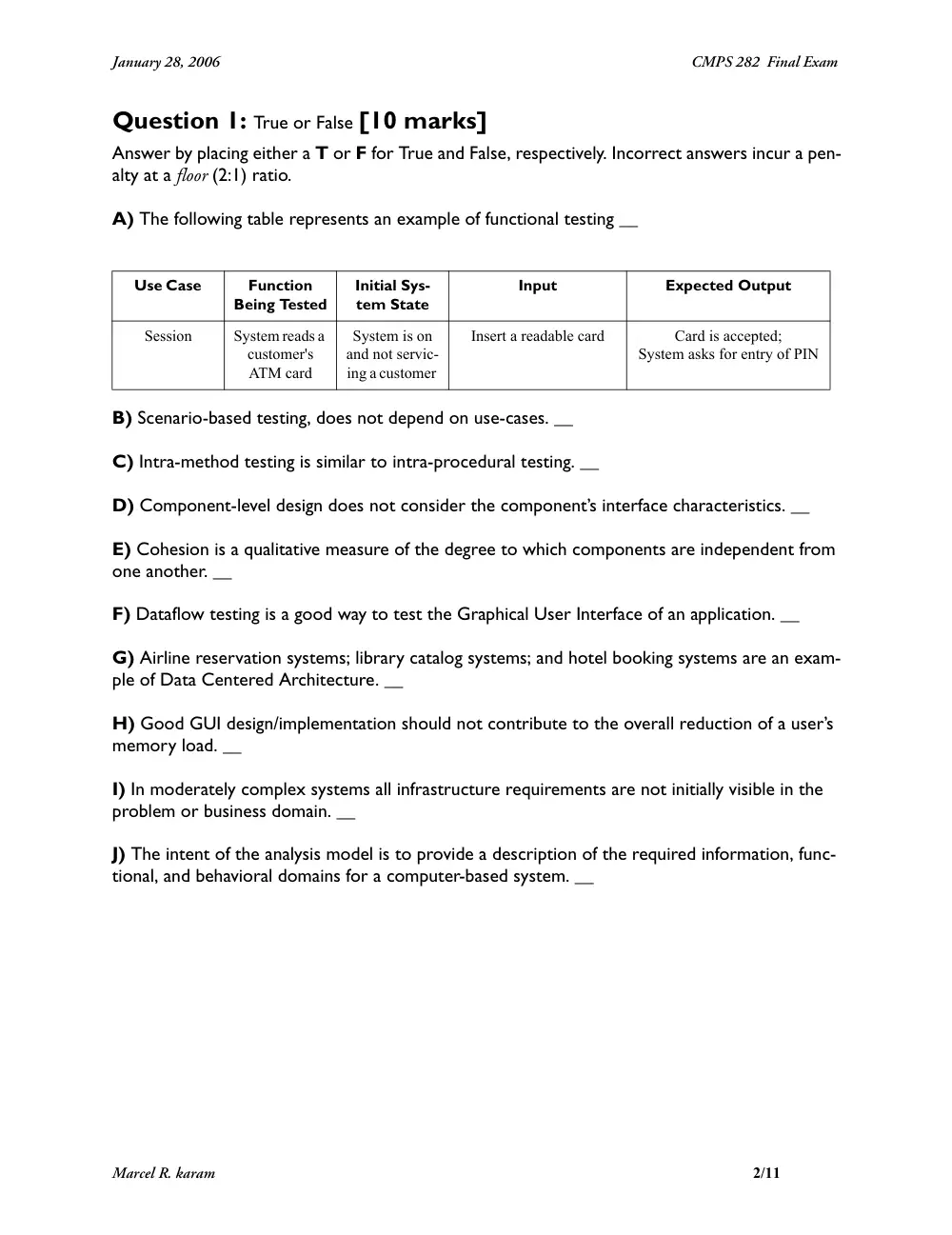
A) The following table represents an example of functional testing __
B) Scenario-based testing, does not depend on use-cases. __
C) Intra-method testing is similar to intra-procedural testing. __
D) Component-level design does not consider the component’s interface characteristics. __
E) Cohesion is a qualitative measure of the degree to which components are independent from
one another. __
F) Dataflow testing is a good way to test the Graphical User Interface of an application. __
G) Airline reservation systems; library catalog systems; and hotel booking systems are an exam-
ple of Data Centered Architecture. __
H) Good GUI design/implementation should not contribute to the overall reduction of a user’s
memory load. __
I) In moderately complex systems all infrastructure requirements are not initially visible in the
problem or business domain. __
J) The intent of the analysis model is to provide a description of the required information, func-
tional, and behavioral domains for a computer-based system. __
Use Case
Function
Being Tested
Initial Sys-
tem State
Input
Expected Output
Session
System reads a
customer's
ATM card
System is on
and not servic-
ing a customer
Insert a readable card
Card is accepted;
System asks for entry of PIN
January 28, 2006 CMPS 282 Final Exam
Marcel R. karam 3/11
Question 2 Analysis & Modeling [15 marks]
A) It is well established that use-cases play an important part of the requirements engineering
process. Describe their weaknesses. [3 marks]
______________________________________________________________________________
______________________________________________________________________________
______________________________________________________________________________
______________________________________________________________________________
______________________________________________________________________________
B) What are the steps needed to build an object-behavior model? [4 marks]
______________________________________________________________________________
______________________________________________________________________________
______________________________________________________________________________
______________________________________________________________________________
______________________________________________________________________________
C) List the elements of the structured analysis model and explain the role of each element. [3
marks]
______________________________________________________________________________
______________________________________________________________________________
______________________________________________________________________________
______________________________________________________________________________
______________________________________________________________________________
______________________________________________________________________________
______________________________________________________________________________
January 28, 2006 CMPS 282 Final Exam
Marcel R. karam 4/11
D) An ATM machine can be started or shut down by the bank. The ATM machine will service
one client at a time. To interact with the ATM machine, the client initiates a session by inserting
an ATM card and enters a personal identification number (PIN). The data will then be sent to the
bank for validation as part of each transaction. Once authenticated, the client is able to with-
draw, deposit to any account linked to the card and enter the amount of the deposit into the
ATM. A client is also able to make money transfer between any two accounts linked to the card,
and inquire about the balance. A client is always able to abort a transaction in progress by press-
ing the Cancel key. Every transaction, including the authentication is verified by the bank. Create
a use case analysis model of the above system. [5 marks]
January 28, 2006 CMPS 282 Final Exam
Marcel R. karam 5/11
Question 3 Design [10 marks]
A) How does the object-oriented view of component-level design differ from the traditional
view? [5 marks]
______________________________________________________________________________
______________________________________________________________________________
______________________________________________________________________________
______________________________________________________________________________
______________________________________________________________________________
______________________________________________________________________________
______________________________________________________________________________
B) Describe the differences between a design pattern and a framework. Give examples to illus-
trate your answer. [5 marks]
______________________________________________________________________________
______________________________________________________________________________
______________________________________________________________________________
______________________________________________________________________________
______________________________________________________________________________
January 28, 2006 CMPS 282 Final Exam
Marcel R. karam 6/11
Question 4 Design Patterns [25 marks]
A) Which pattern is more appropriate to use, when objects (from various classes in a hierarchy)
need to be generated at runtime. Give an OO example. Code is required. [8 marks]
_____________________________________________________________________________
______________________________________________________________________________
______________________________________________________________________________
______________________________________________________________________________
______________________________________________________________________________
B) Give an example of the use of singleton pattern. OO Code is required. [8 marks]
______________________________________________________________________________
______________________________________________________________________________
______________________________________________________________________________
______________________________________________________________________________
C) Give a scenario where the use of the observer pattern is desired. Give an OO example.
Code is required. [9 marks].
______________________________________________________________________________
______________________________________________________________________________
______________________________________________________________________________
______________________________________________________________________________
______________________________________________________________________________
January 28, 2006 CMPS 282 Final Exam
Marcel R. karam 7/11
Question 5 GUI [20 marks]
A) Describe the main differences between mental and conceptual models. [5 marks]
______________________________________________________________________________
______________________________________________________________________________
______________________________________________________________________________
______________________________________________________________________________
______________________________________________________________________________
______________________________________________________________________________
______________________________________________________________________________
______________________________________________________________________________
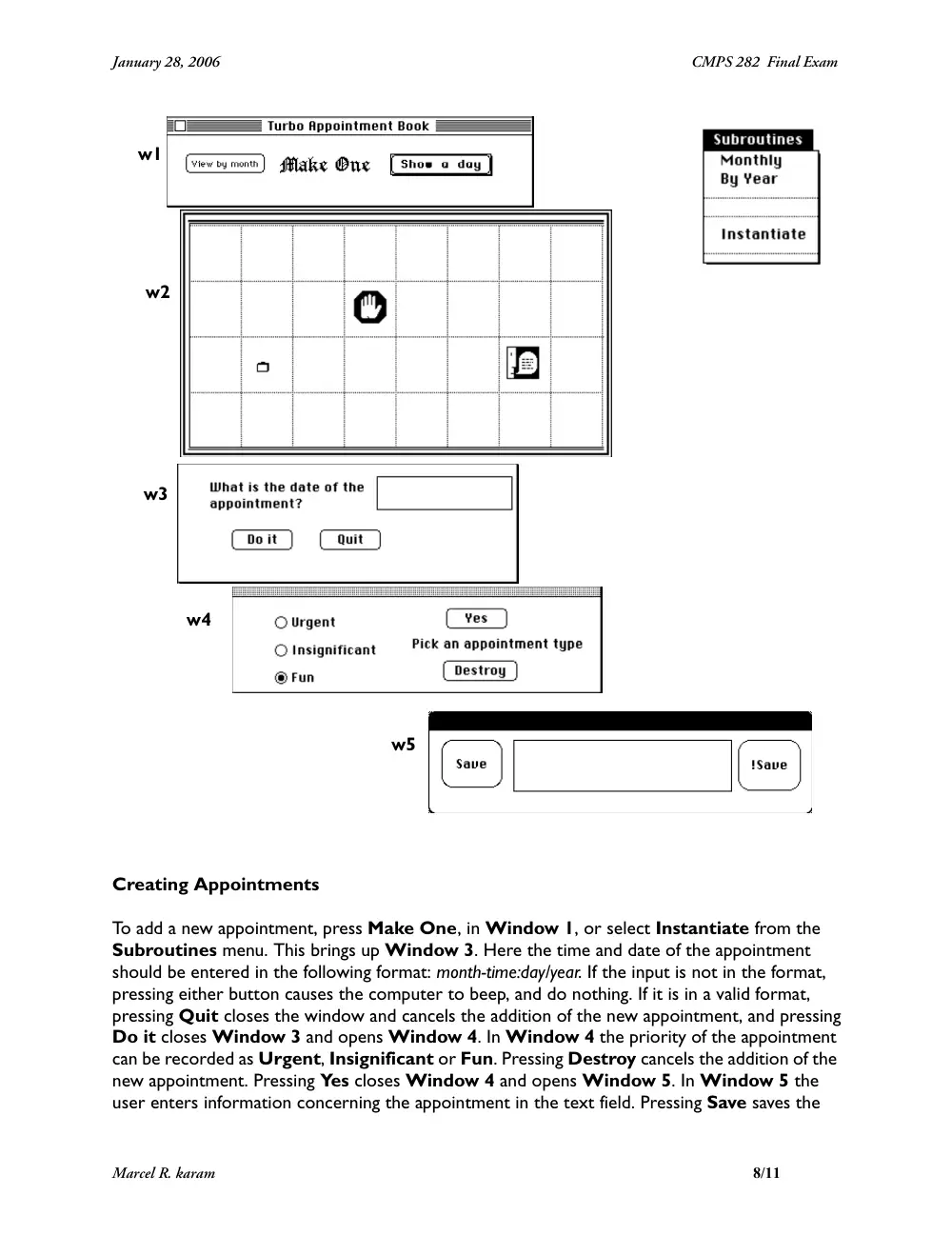
B) On Page 8/10 are some of the windows and menus from a program for a computerized
appointment book. A description of the functionality of this program is given below. Very briefly,
and in point form, identify the problems in this interface. For each problem, you should indicate
which of the design principles below is violated. Do not recommend ways to improve the inter-
face — just identify the problems. [15 marks]
DESIGN PRINCIPLE
i) Use both knowledge in the world and in the head.
ii) Simplify the structure of tasks.
iii) Make things visible.
iv) Get the mappings right.
v) Exploit the power of constraints.
vi) Design for error.
vii) Standardise.
INTERFACE DESCRIPTION
This program provides the following functionality:
•
Can record appointments for any time/day/month/year.
•
Allows viewing of appointments by day, month or year.
•
Provides for different priorities of appointments.
When run, the program displays Window 1. There are standard menus for File and Edit (not
shown), and a third menu, called Subroutines
January 28, 2006 CMPS 282 Final Exam
Marcel R. karam 8/11
Creating Appointments
To add a new appointment, press Make One, in Window 1, or select Instantiate from the
Subroutines menu. This brings up Window 3. Here the time and date of the appointment
should be entered in the following format: month-time:day/year. If the input is not in the format,
pressing either button causes the computer to beep, and do nothing. If it is in a valid format,
pressing Quit closes the window and cancels the addition of the new appointment, and pressing
Do it closes Window 3 and opens Window 4. In Window 4 the priority of the appointment
can be recorded as Urgent, Insignificant or Fun. Pressing Destroy cancels the addition of the
new appointment. Pressing Yes closes Window 4 and opens Window 5. In Window 5 the
user enters information concerning the appointment in the text field. Pressing Save saves the
w1
w2
w3
w4
w5
January 28, 2006 CMPS 282 Final Exam
Marcel R. karam 9/11
appointment and closes Window 5. Pressing !Save saves the appointment and discards any
other appointments which had been defined on the same day.
Viewing Appointments
To view appointments by day, press the button Show a day in Window 1. To view by month,
press the button View by month, or select the menu item Monthly. To view by year, select the
menu item By Year. To keep this question from getting too long, only viewing by month is
described here, and you do not have to design view by day and by year for your interface. View
by month is shown in Window 2. To select which month to view, type in the number of the
month immediately after pressing View by month, or selecting the Monthly menu item. Each
box in the grid represents a day. The icons indicate days with appointments, with the type of icon
indicating the priority as follows:
= Fun,
= Insignificant, and
= Urgent. Double
clicking on a day brings up the view by day window for that day.
______________________________________________________________________________
______________________________________________________________________________
______________________________________________________________________________
______________________________________________________________________________
______________________________________________________________________________
______________________________________________________________________________
______________________________________________________________________________
______________________________________________________________________________
______________________________________________________________________________
______________________________________________________________________________
______________________________________________________________________________
______________________________________________________________________________
______________________________________________________________________________
______________________________________________________________________________
______________________________________________________________________________
January 28, 2006 CMPS 282 Final Exam
Marcel R. karam 10/11
Question 6 Testing [25 marks]
Given a control flow graph (CFG) G(V,E), where V is the number of vertices, and E the number of
edges.
A) Draw the CFG for the following code: [3 marks]
Void main(){
int a,b;
a=5;
b=a/2;
if(b < 3){
a--;
printf("%d", a);
}
else {
b--
printf("%d", b);
}
B) Extract the all-dus with regards to variables a and b. Also explain dead code. [4 marks]
______________________________________________________________________________
______________________________________________________________________________
______________________________________________________________________________
C) Give a C example that shows, and prove that all-node testing is weaker than all branches. You
should draw the CFG [4 marks].
________________________________________
________________________________________
________________________________________
________________________________________
________________________________________
________________________________________
January 28, 2006 CMPS 282 Final Exam
Marcel R. karam 11/11
D) What does the cyclomatic complexity of a CFG indicate. [2 marks]
______________________________________________________________________________
______________________________________________________________________________
______________________________________________________________________________
______________________________________________________________________________
______________________________________________________________________________
E) A lower cyclomatic complexity is an indication of what? elaborate. [1 marks]
______________________________________________________________________________
______________________________________________________________________________
F) What are the challenges of OO testing. Give an example of each. [5 marks]
______________________________________________________________________________
______________________________________________________________________________
______________________________________________________________________________
______________________________________________________________________________
G) What is the difference between bottom-up and top-down testing. Explain [2 marks]
______________________________________________________________________________
______________________________________________________________________________
______________________________________________________________________________
______________________________________________________________________________
H) What is inter-class testing? Explain. [4 marks]
______________________________________________________________________________
______________________________________________________________________________
______________________________________________________________________________
______________________________________________________________________________