
CMPS 284 Final, Fall 2003
American University of Beirut · Computer Networks · 12 pages
Showing the first 10 of 12 pages. Download the PDF to see all of it.
More CMPS 284 files
Show the text of this final exam
mERCaS ENIETESIT
LIBRARY
OF ET ROT
CMPS 284 Final Exam
American University of Beirut
Department of Computer Science
Date: January 27" 2004
This is a CLOSED BOOK: notes, textbooks, AND calculators are NOT permitted.
You have two hours to finish
Answer in the spaces provided. Use additional sheet when needed.
The questions are not all of equal difficulty, do the easy ones first.
Good Luck
Name
Student #
Section
Problem 1 /18 marks
Problem 2 /12 marks
Problem 3 /22 marks
Problem 4 /23 marks
Problem 5 /25 marks
ERICAN UNTVERSIT
LIBRARY
oF RTT
ae eerie
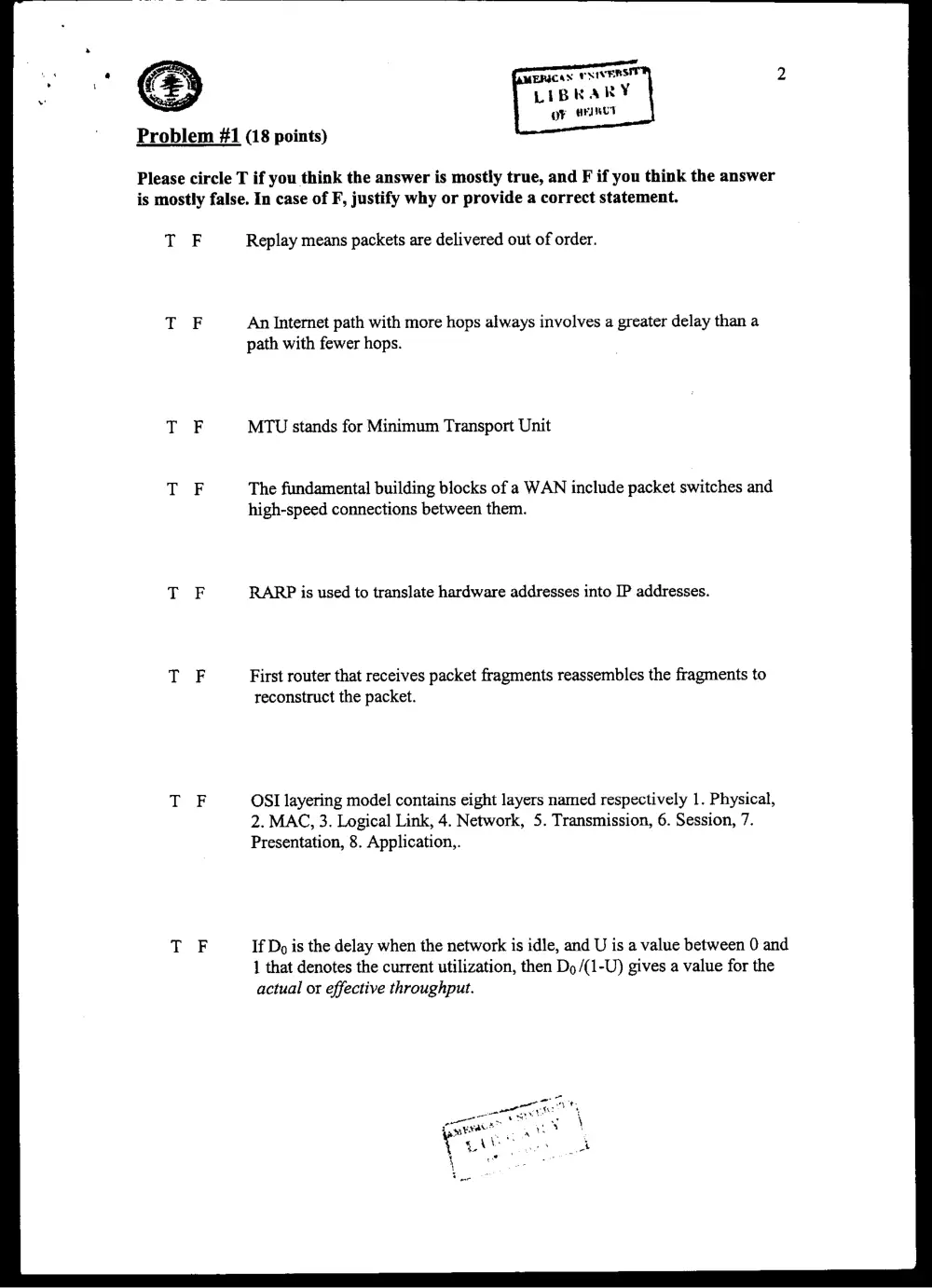
Problem #1 (18 points)
Please circle T if you think the answer is mostly true, and F if you think the answer
is mostly false. In case of F, justify why or provide a correct statement.
T F Replay means packets are delivered out of order.
An Internet path with more hops always involves a greater delay than a
path with fewer hops.
MTU stands for Minimum Transport Unit
The fundamental building blocks of a WAN include packet switches and
high-speed connections between them.
RARP is used to translate hardware addresses into IP addresses.
First router that receives packet fragments reassembles the fragments to
reconstruct the packet.
OSI layering model contains eight layers named respectively 1. Physical,
2. MAC, 3. Logical Link, 4. Network, 5. Transmission, 6. Session, 7.
Presentation, 8. Application,.
If Do is the delay when the network is idle, and U is a value between 0 and
1 that denotes the current utilization, then Do /(1-U) gives a value for the
actual or effective throughput.
ENIGAS ENIV SS!
LIBKA..Y 3
OF HEIREF
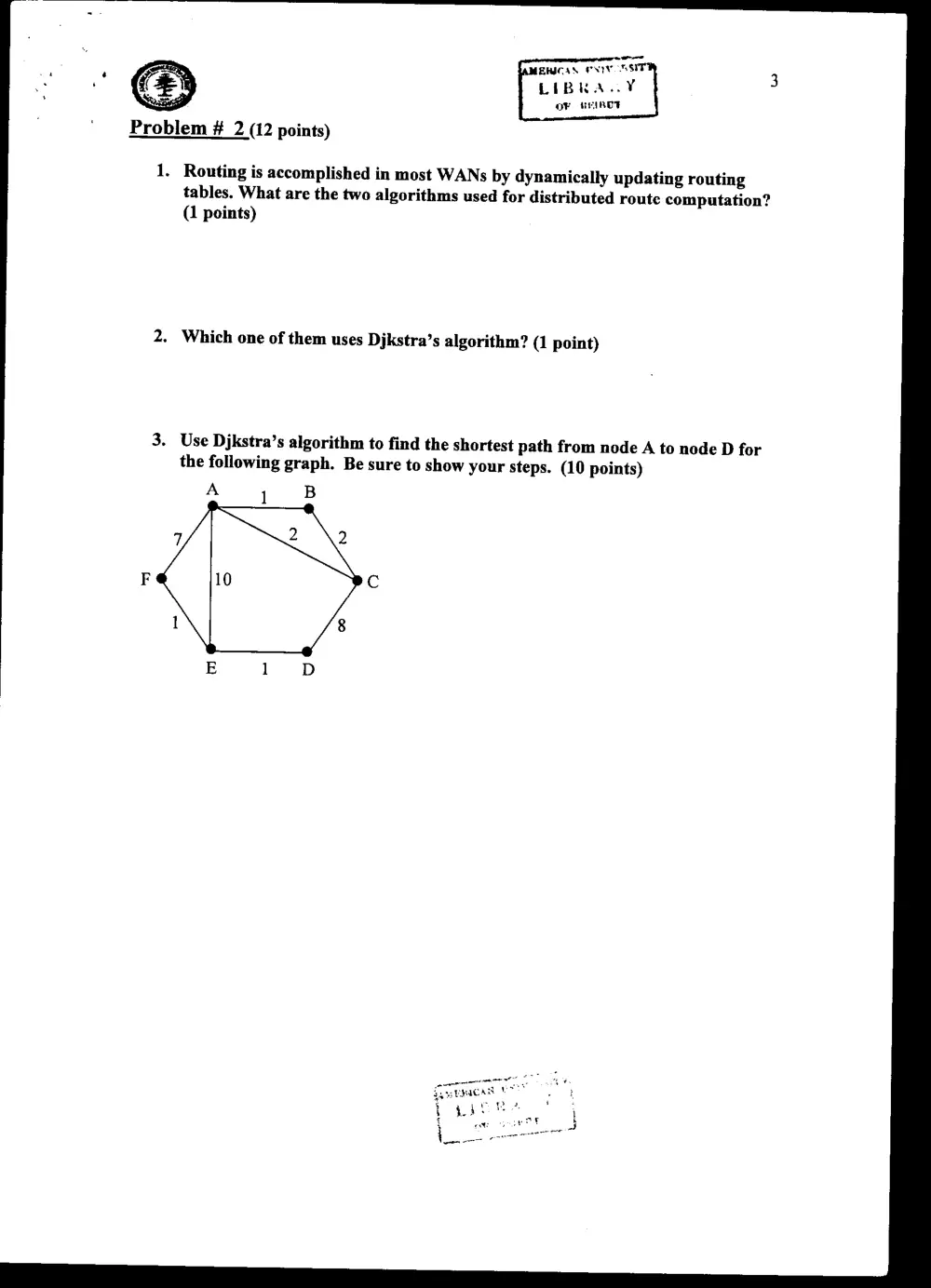
Problem # 2 (12 points)
1. Routing is accomplished in most WANs by dynamically updating routing
tables. What are the two algorithms used for distributed route computation?
(1 points)
2. Which one of them uses Djkstra’s algorithm? (1 point)
3. Use Djkstra’s algorithm to find the shortest path from node A to node D for
the following graph. Be sure to show your steps. (10 points)
ee yt
Supacas ee"
Pages
i
MERICAN UNIVERSIT
LIBKARY
OF BEIT
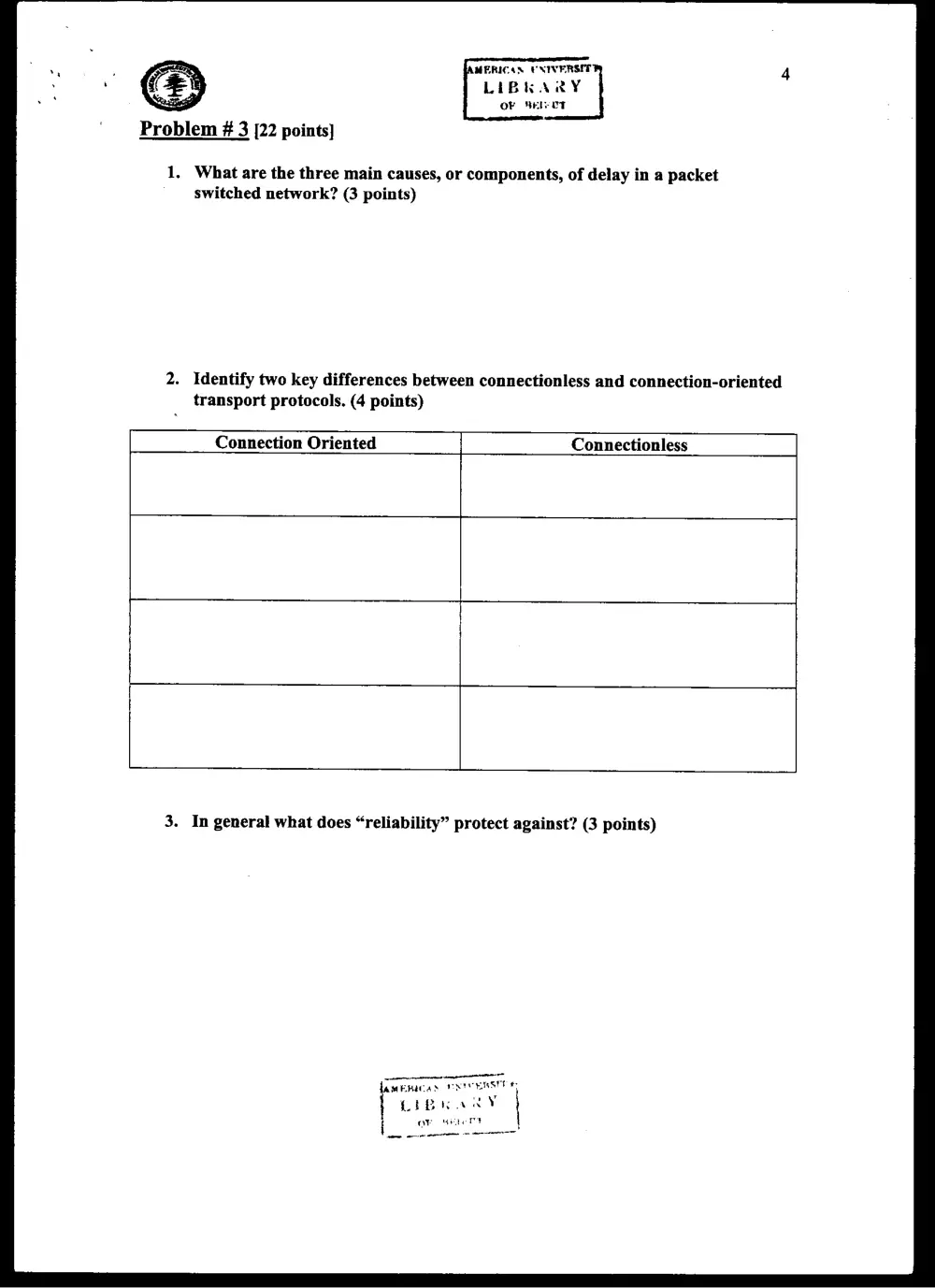
1. What are the three main causes, or components, of delay in a packet
switched network? (3 points)
Problem # 3 [22 points]
2. Identify two key differences between connectionless and connection-oriented
transport protocols. (4 points)
Connection Oriented Connectionless
3. In general what does “reliability” protect against? (3 points)
cae
fAMemicas UXICERSTE
LIBRARY
oY ater
:
LIBKARY
AMERICAS CSIVERSIT
OP EERKOT
4. Is it possible to have two entirely different Internet-layer protocols be
simultaneously supported by a single Network Interface layer? Explain your
answer. (3 points)
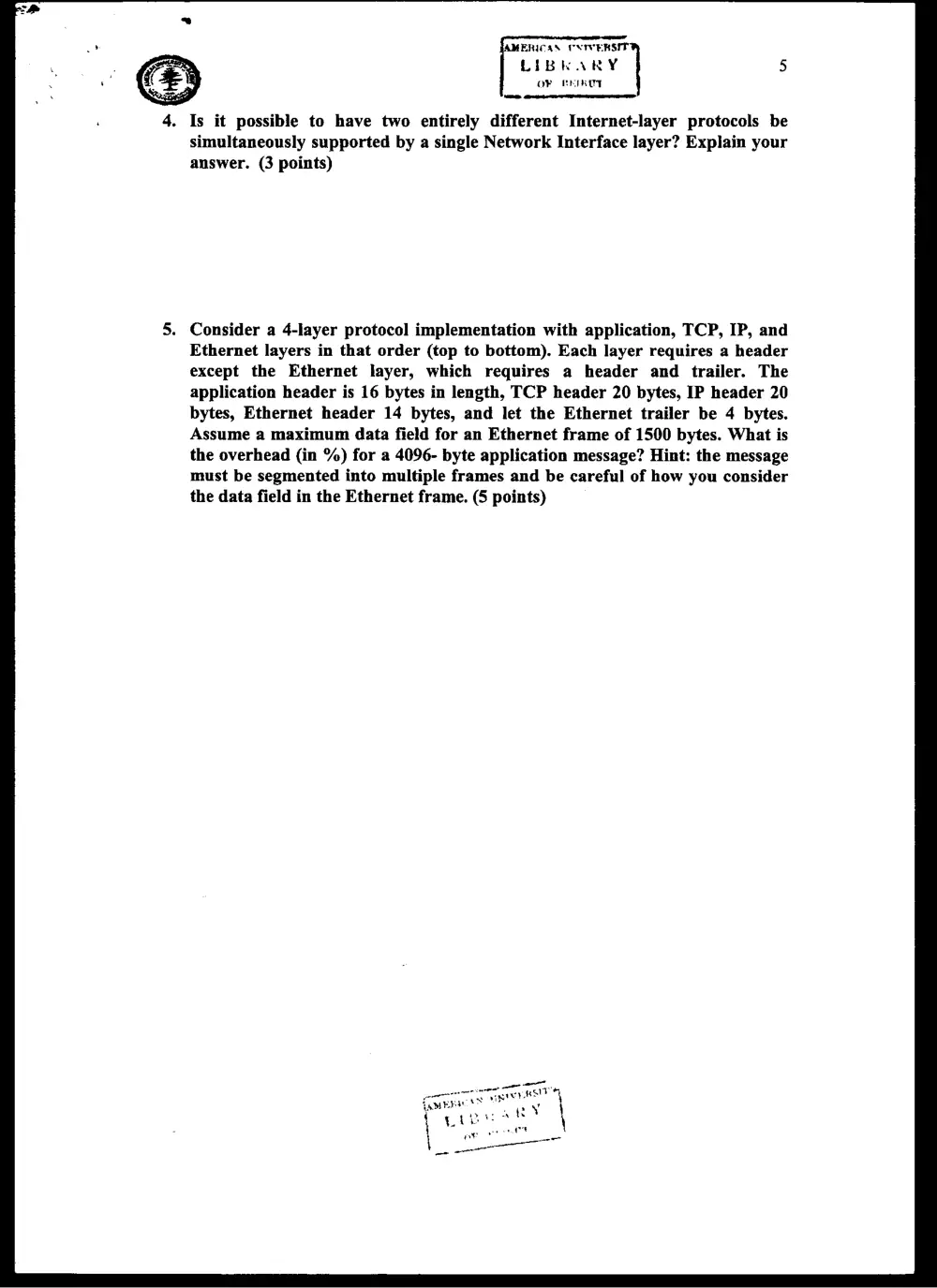
. Consider a 4-layer protocol implementation with application, TCP, IP, and
Ethernet layers in that order (top to bottom). Each layer requires a header
except the Ethernet layer, which requires a header and trailer. The
application header is 16 bytes in length, TCP header 20 bytes, IP header 20
bytes, Ethernet header 14 bytes, and let the Ethernet trailer be 4 bytes.
Assume a maximum data field for an Ethernet frame of 1500 bytes. What is
the overhead (in %) for a 4096- byte application message? Hint: the message
must be segmented into multiple frames and be careful of how you consider
the data field in the Ethernet frame. (5 points)
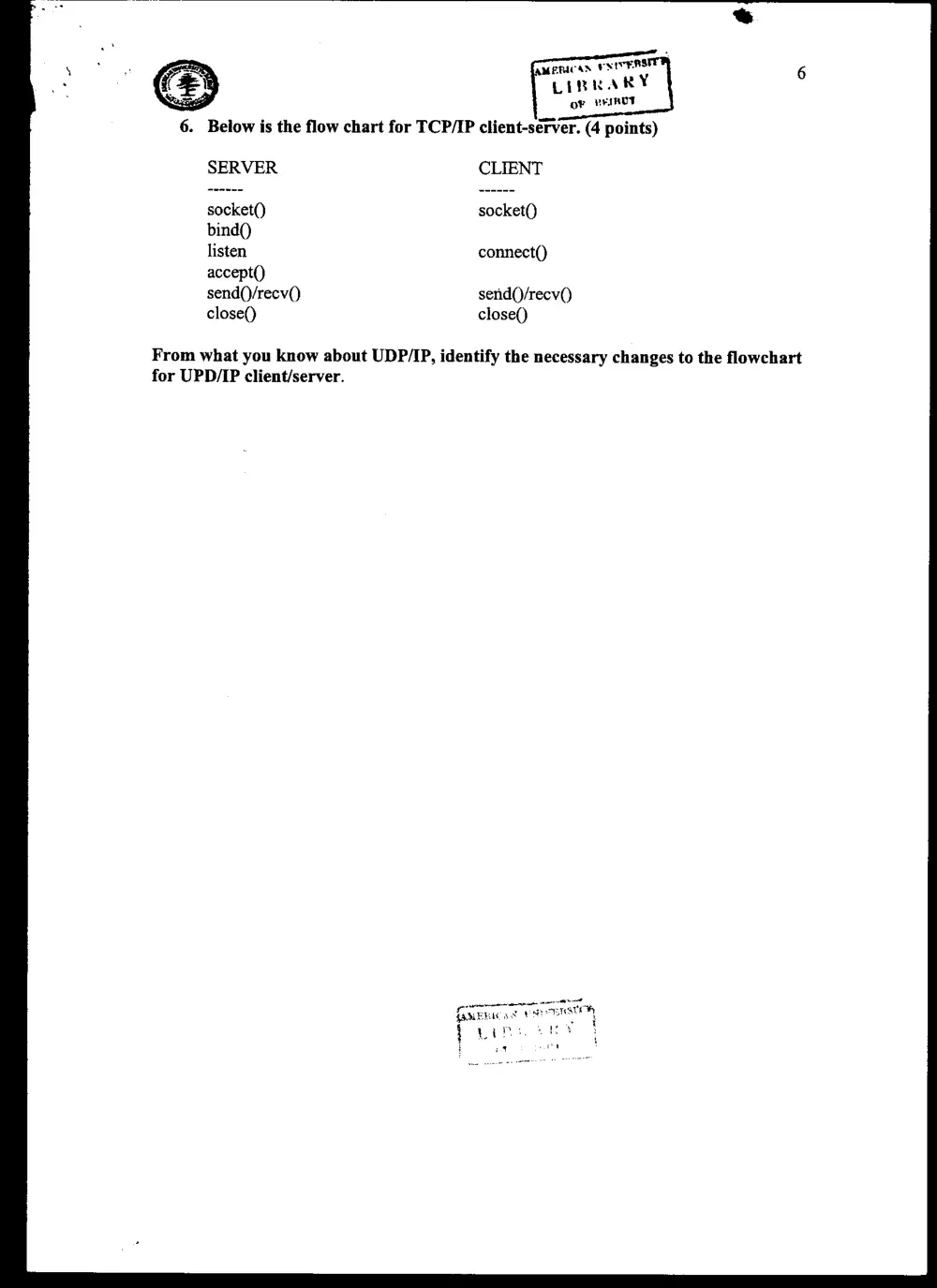
socketQ) socket()
bindQ
listen connect()
accept()
send(Q/recv() sendQ/recv0)
closeQ close()
From what you know about UDP/IP, identify the necessary changes to the flowchart
for UPD/IP client/server.
ERICAN UNIVERS!
LIBRARY
OF HEIRUT
Problem #4 [23 points}
1. Describes the difference between TCP and UDP. (4points)
2. What is a three-way handshake and when does TCP use it? (4 points)
MERICAS TNIVERSIE
LIBRARY
oF BEFRUT
3. Give a brief definition of positive acknowledgement with retransmission. How
does TCP use positive acknowledgement with retransmission? (4 points)
4. How does TCP help to reduce network congestion? (3 points)
oY bEJAUT
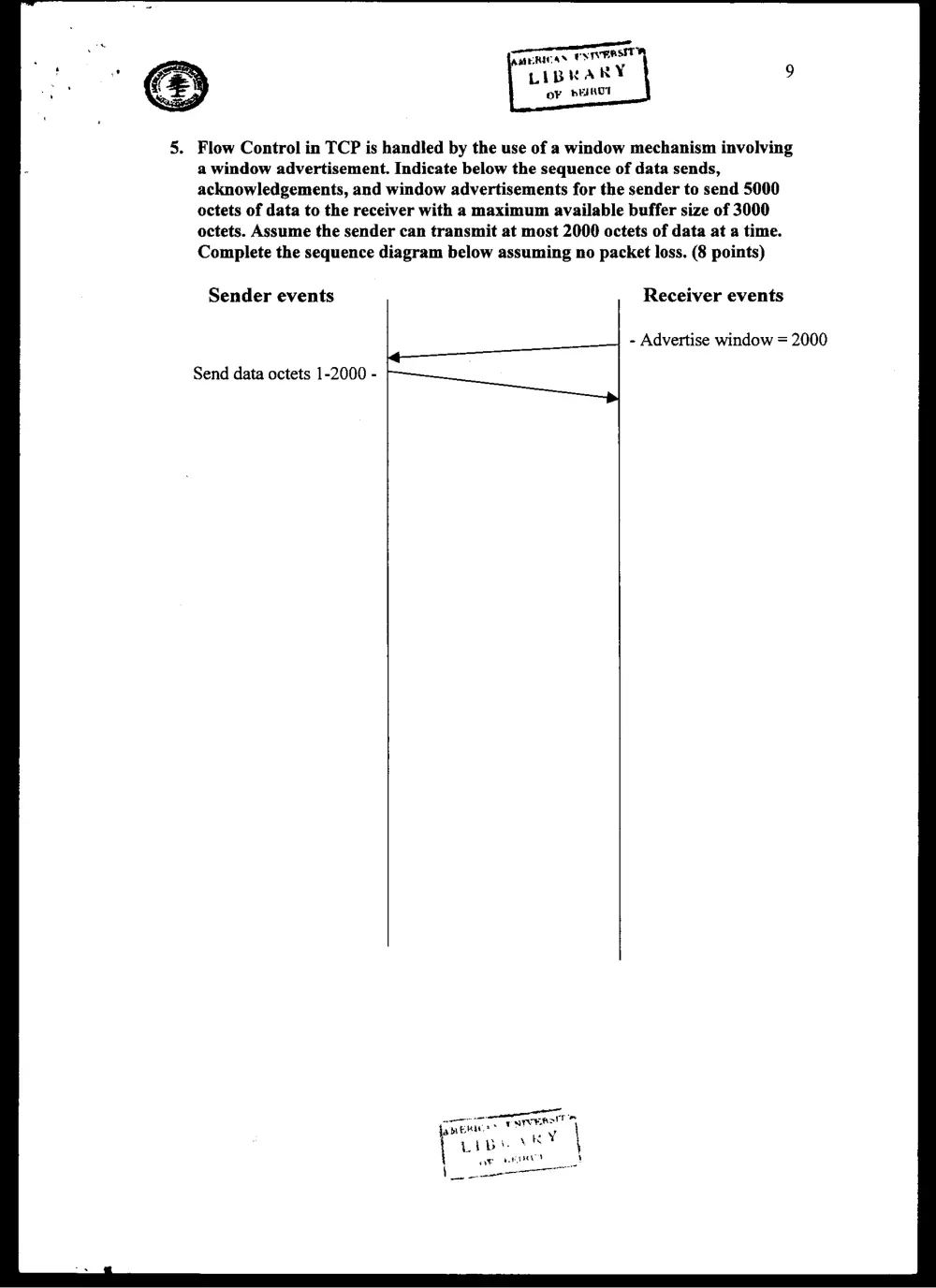
. Flow Control in TCP is handled by the use of a window mechanism involving
a window advertisement. Indicate below the sequence of data sends,
acknowledgements, and window advertisements for the sender to send 5000
octets of data to the receiver with a maximum available buffer size of 3000
octets. Assume the sender can transmit at most 2000 octets of data at a time.
Complete the sequence diagram below assuming no packet loss. (8 points)
Sender events Receiver events
- Advertise window = 2000
—
Send data octets 1-2000 - > +
(jnewe- TTarekes! Ts
Lips vk
aye ee \
——"
_—
EF
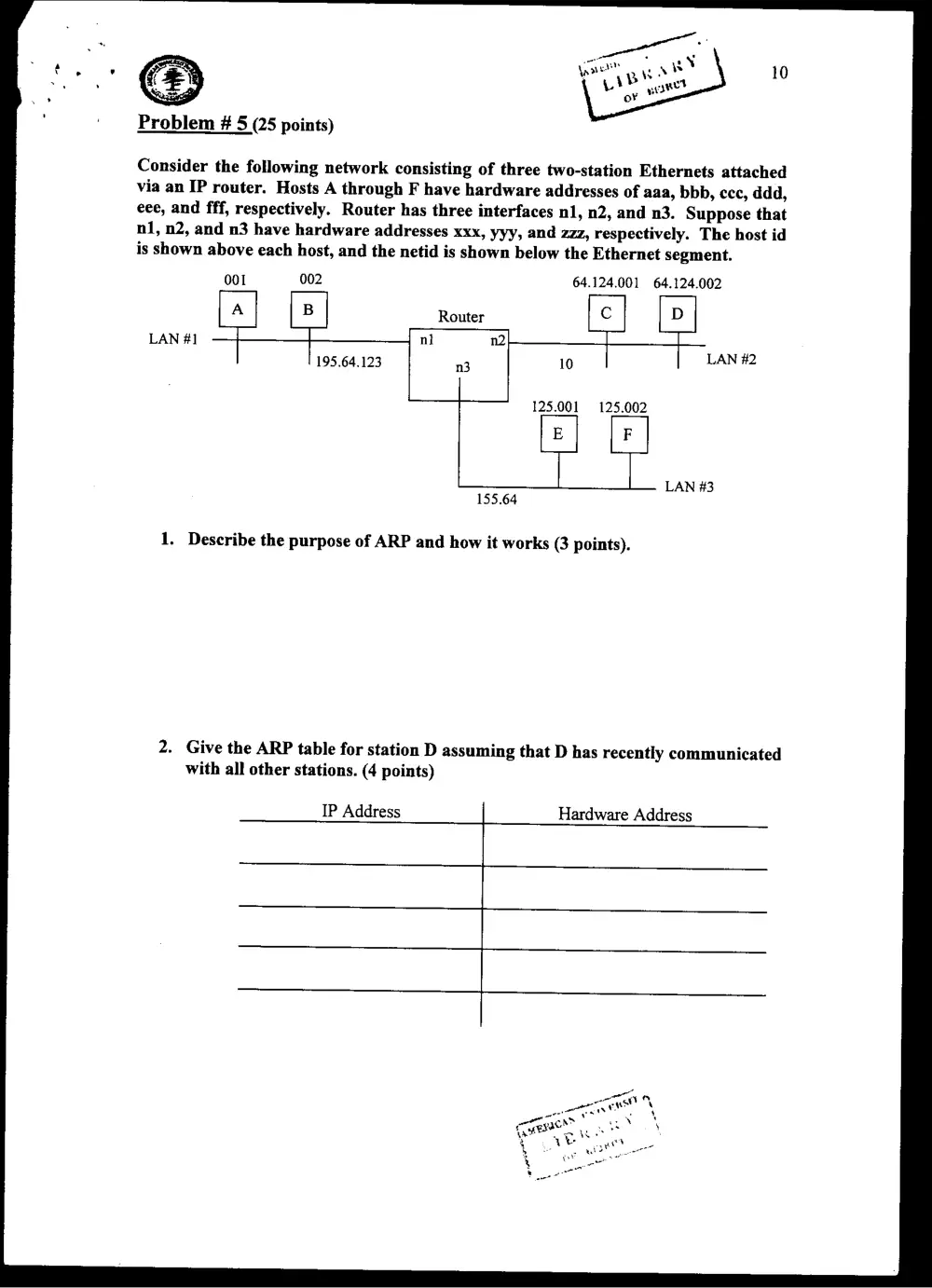
Problem # 5 (25 points)
Consider the following network consisting of three two-station Ethernets attached
via an IP router. Hosts A through F have hardware addresses of aaa, bbb, ccc, ddd,
eee, and fff, respectively. Router has three interfaces nl, n2, and n3. Suppose that
nl, n2, and n3 have hardware addresses xxx, yyy, and zzz, respectively. The host id
is shown above each host, and the netid is shown below the Ethernet segment.
001 002 64.124.001 64.124.002
A B Router c D
ni n2
195,64.123 2B 10
125.001 125.002
E F
155.64
1. Describe the purpose of ARP and how it works (3 points).
2. Give the ARP table for station D assuming that D has recently communicated
with all other stations. (4 points)
IP Address Hardware Address