
CMPS 284 Midterm No Solution, Fall 2014
American University of Beirut · Computer Networks · 5 pages · Dr. Ahmad Dhaini · with solution
More CMPS 284 files
Show the text of this exam
Faculty of Arts & Sciences
Department of Computer Science
CMPS 284—Computer Networks
Time: 75 minutes
1. List the 5 layers defined in TCP/IP Model and state the main functions of each layer. [10 points]
2. What is the main advantage of peer to peer interaction compared to client/server interaction? [5 points]
3. What does multiplexing mean in computer networks? What does demultiplexing mean? [5 points]
4. In a client-server computing environment, what happens if the server was to start-up after the client has
started? (the computing environment might be a connectionless or a connection-oriented environment). [5
points]
5. Suppose Alice, with a Web-based e-mail account (such as Hotmail or gmail), sends a message to Bob, who
accesses his mail from his mail server using POP3. Discuss how the message gets from Alice's host to
Bob's host. Be sure to list the series of application-layer protocols that are used to move the message
between the two hosts. [10 points]
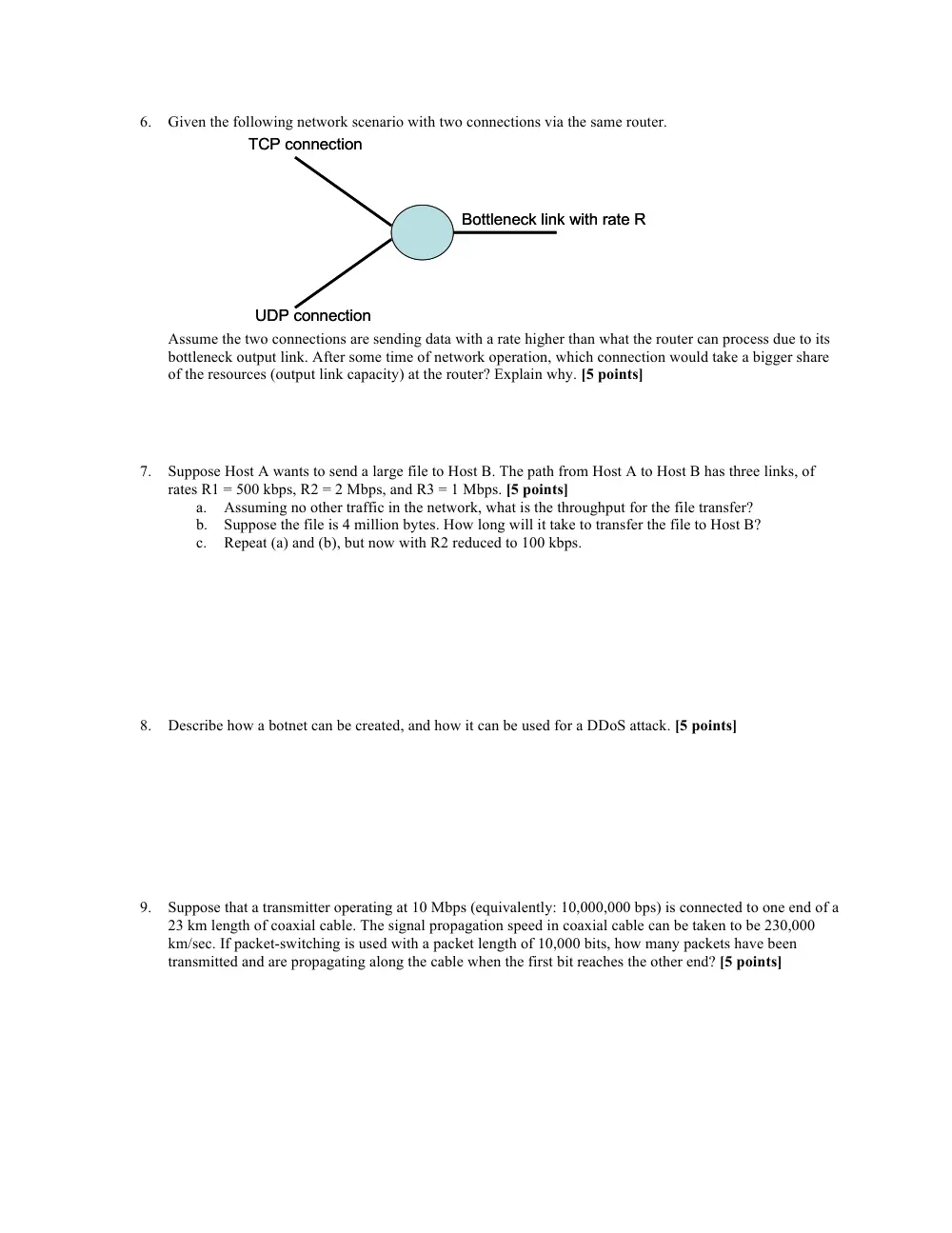
6. Given the following network scenario with two connections via the same router.
Assume the two connections are sending data with a rate higher than what the router can process due to its
bottleneck output link. After some time of network operation, which connection would take a bigger share
of the resources (output link capacity) at the router? Explain why. [5 points]
7. Suppose Host A wants to send a large file to Host B. The path from Host A to Host B has three links, of
rates R1 = 500 kbps, R2 = 2 Mbps, and R3 = 1 Mbps. [5 points]
a.
Assuming no other traffic in the network, what is the throughput for the file transfer?
b. Suppose the file is 4 million bytes. How long will it take to transfer the file to Host B?
c.
Repeat (a) and (b), but now with R2 reduced to 100 kbps.
8. Describe how a botnet can be created, and how it can be used for a DDoS attack. [5 points]
9. Suppose that a transmitter operating at 10 Mbps (equivalently: 10,000,000 bps) is connected to one end of a
23 km length of coaxial cable. The signal propagation speed in coaxial cable can be taken to be 230,000
km/sec. If packet-switching is used with a packet length of 10,000 bits, how many packets have been
transmitted and are propagating along the cable when the first bit reaches the other end? [5 points]
TCP connection
UDP connection
Bottleneck link with rate R
TCP connection
UDP connection
Bottleneck link with rate R
10. HTTP: [5 points]
a.
In http, explain the objective of the ETag field
b. How is it different from the "last modified" field
11. BitTorrent: [15 points]
a.
In BitTorrent, suppose Alice provides chunks to Bob throughout a 30-second interval. Will Bob
necessarily return the favor and provide chunks to Alice in this same interval? Why or why not? (5
pts)
b. Consider a new peer Alice that joins BitTorrent without possessing any chunks. Without any
chunks, she cannot become a top-four uploader for any of the other peers, since she has nothing to
upload. How then will Alice get her first chunk? (5 pts)
c.
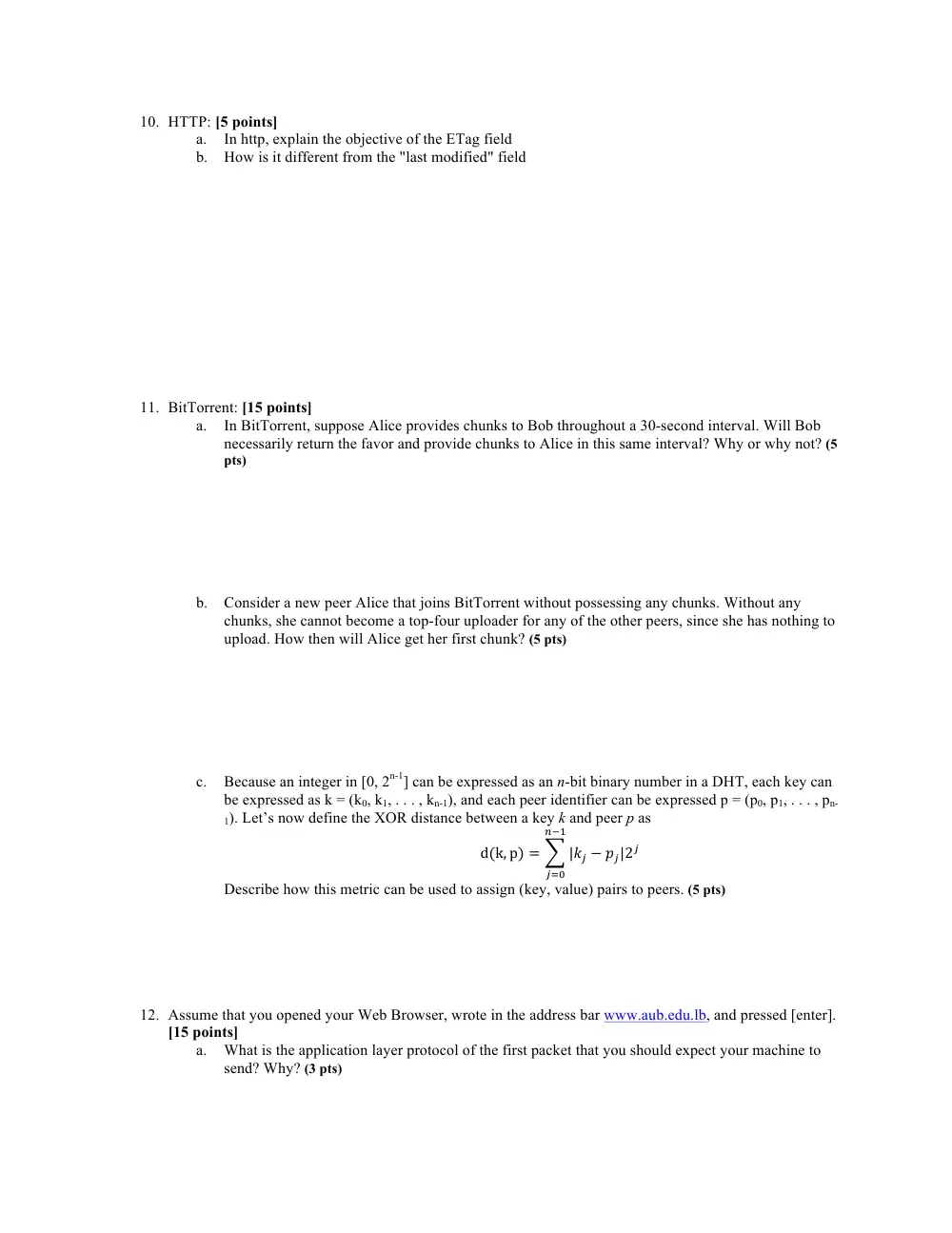
Because an integer in [0, 2n-1] can be expressed as an n-bit binary number in a DHT, each key can
be expressed as k = (k0, k1, . . . , kn-1), and each peer identifier can be expressed p = (p0, p1, . . . , pn-
1). Let’s now define the XOR distance between a key k and peer p as
d(k, p) =
|𝑘! − 𝑝!|2!
!!!
!!!
Describe how this metric can be used to assign (key, value) pairs to peers. (5 pts)
12. Assume that you opened your Web Browser, wrote in the address bar www.aub.edu.lb, and pressed [enter].
[15 points]
a.
What is the application layer protocol of the first packet that you should expect your machine to
send? Why? (3 pts)
b. Assume AUB uses a proxy server, will web caching reduce the delay for all objects requested or
for only some of the objects? Why? (3 pts)
c.
How is the web caching (proxy server) functionality implemented using the HTTP protocol
messages? (3 pts)
d. Assume that the aub website has 6 images and 1 Java applet. The Java applet retrieves 3 more
images before it can run. Ignore the objects’ transmission time and connection termination time
1. How many messages must be sent when using non-persistent HTTP before this web
page can be viewed ? How many RTTs? Justify your answer. (3 pts)
2. Would you expect persistent connections and pipelining to give you a bigger benefit
over non-persistent connections in a high bit rate network or a low bit rate network?
Justify your answer. (3 pts)
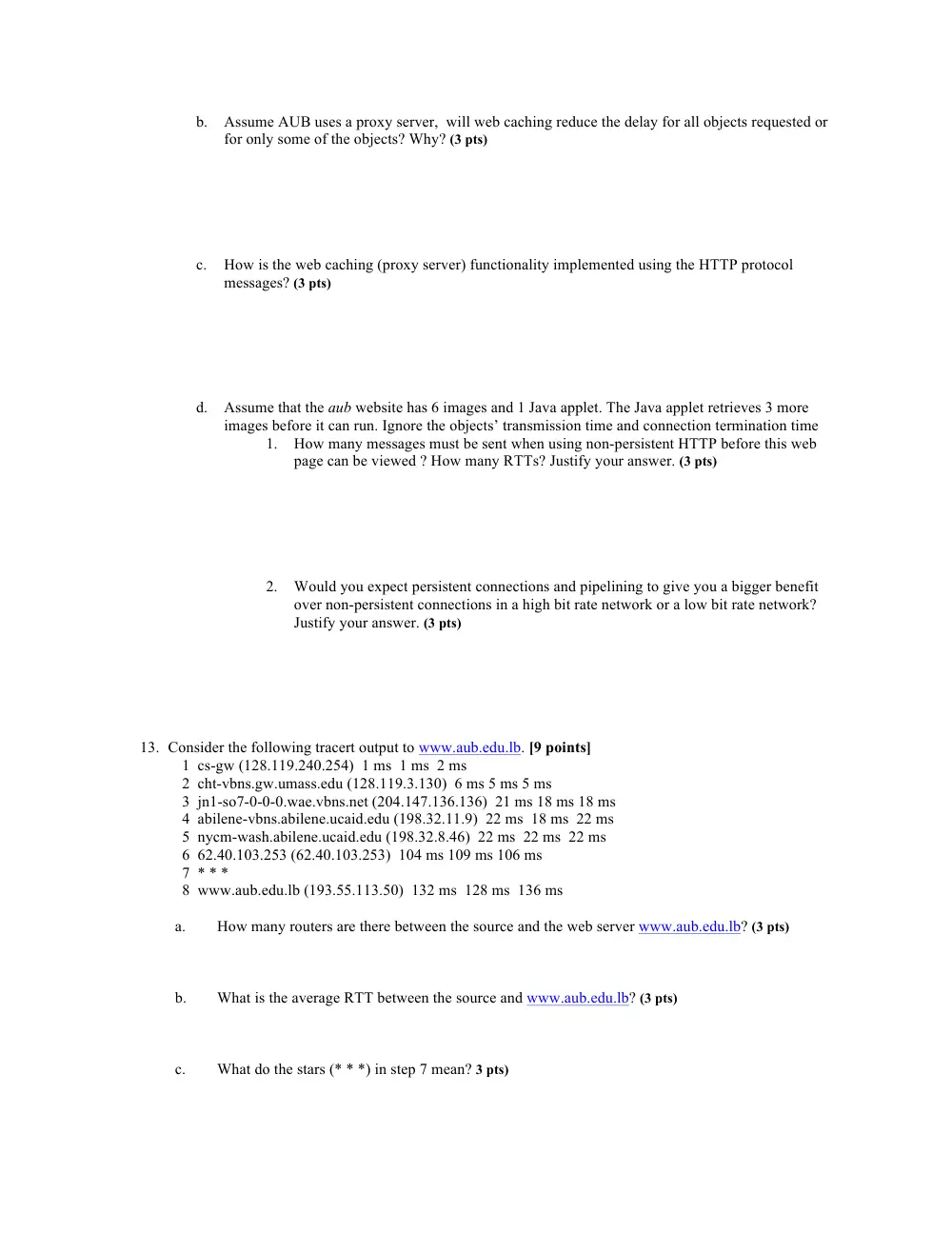
13. Consider the following tracert output to www.aub.edu.lb. [9 points]
1 cs-gw (128.119.240.254) 1 ms 1 ms 2 ms
2 cht-vbns.gw.umass.edu (128.119.3.130) 6 ms 5 ms 5 ms
3 jn1-so7-0-0-0.wae.vbns.net (204.147.136.136) 21 ms 18 ms 18 ms
4 abilene-vbns.abilene.ucaid.edu (198.32.11.9) 22 ms 18 ms 22 ms
5 nycm-wash.abilene.ucaid.edu (198.32.8.46) 22 ms 22 ms 22 ms
6 62.40.103.253 (62.40.103.253) 104 ms 109 ms 106 ms
7 * * *
8 www.aub.edu.lb (193.55.113.50) 132 ms 128 ms 136 ms
a.
How many routers are there between the source and the web server www.aub.edu.lb? (3 pts)
b.
What is the average RTT between the source and www.aub.edu.lb? (3 pts)
c.
What do the stars (* * *) in step 7 mean? 3 pts)
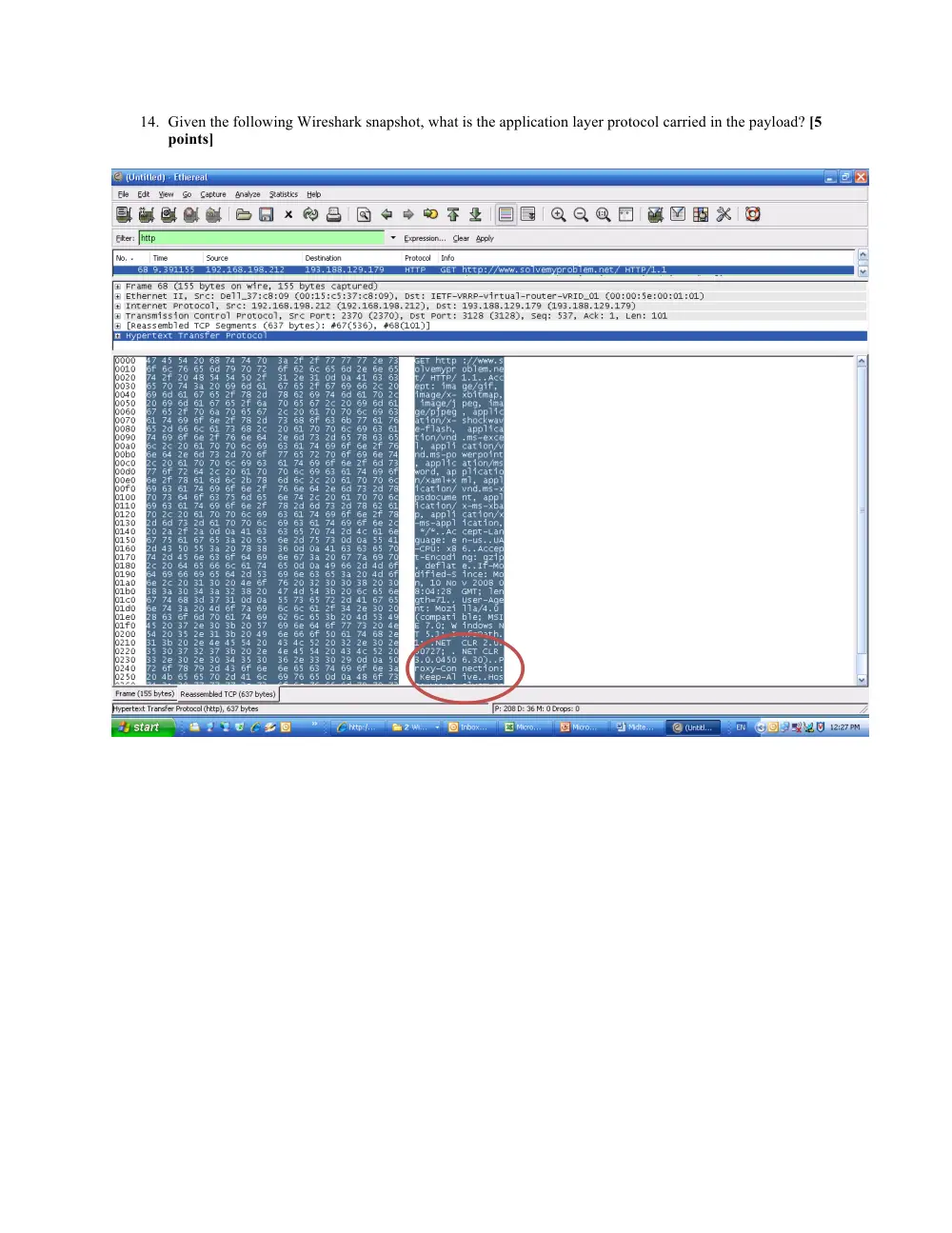
14. Given the following Wireshark snapshot, what is the application layer protocol carried in the payload? [5
points]