
CMPS 284 Final, Fall 2005
American University of Beirut · Computer Networks · 10 pages

More CMPS 284 files
Show the text of this final exam
Faculty of Arts & Sciences
Department of Computer Science
CMPS 284 Computer Networks
Fall 2005 2006
Wednesday, February 01, 2006
Final Exam
Version 1
Name:
Student Id:
Signature:
Duration: 120 minutes
Section:
Instructions
•
There are 6 problems and 10 pages. Make sure you have all of them.
•
The exam is closed book, closed notes, closed calculators, and closed neighbors.
•
Answer questions in the space provided.
•
The questions not sorted by difficulty. Scan the whole exam before you start working.
•
Your handwriting should be readable so it can be graded. Include all work or justification for partial credit.
Problem 1
25
Problem 2
13
Problem 3
7
Problem 4
30
Problem 5
14
Problem 6
10
Total
100
Final Exam (2006-02-01)
Initials:
CMPS 284
2 of 10
Problem 1-[25 points]
True or False questions. Circle T if you think that the answer is mostly correct or F if you think that the
answer is mostly incorrect. Note that two wrong answers cancel a correct one.
ICMP, ARP, DNS and TCP run over IP.
T F
The length of an IPv4 datagram header can vary depending on the options used. The largest
possible IP header size is 20 bytes .
T F
The header length field in an IPv4 datagram contains the size of an IP header measured in
number of words
T F
Domain names are hierarchical, with the most significant name on the extreme left.
T F
Throughput in a network is usually measured in bits per second, and is a fundamental
property of networks which can be measured quantitatively.
T F
A signal requires a small amount of time to travel across a wire. The time is generally
proportional to the distance traveled. Such delays are called the switching delays.
T F
Routers can have more than four interfaces.
T F
If D0 is the delay when the network is idle, and U is a value between 0 and 1 that denotes the
current utilization, then D0 /(1-U) gives a value for the effective delay.
T F
arpa is a special DNS top level domain that is used for translating names into IP addresses.
T F
RARP is an Internet layer protocol that can be used by IP to send control information.
T F
The DNS client is often referred to as DNS agent.
T F
To write a connectionless server the following sequence of system calls is required: socket(),
bind(), listen(), recvfrom(), sendto(), and closesocket()
T F
DHCPREQUEST message can be sent from a DHCP client to DHCP servers for requesting
the parameters offered by one of the servers and declining other offers.
T F
Data overrun may occur when the receiving computer is faster than the sending computer.
T F
www.largebank.com and www.largebank.ny.us can have the same IP address.
T F
A useful socket function is Gethostbyname. This function takes as an argument an IP address
in dotted decimal notation, and returns a domain name.
T F
ARP can be used in point-to-point networks the same way it is used in local area networks.
T F
Distance vector is a broadcast-based protocol while link-state is a multicast based protocol.
T F
When a DNS server receives a DNS iterative query from a client then it must do whatever
possible to translate the name in the query into an IP address and returns the result to the
client.
T F
Bootp protocol does not require any manual configuration when assigning IP addresses to
computers.
T F
Final Exam (2006-02-01)
Initials:
CMPS 284
3 of 10
Problem 2-[13 points]
Multiple Choice Questions. Circle what you believe is the BEST answer.
1. Assume a system with fixed-length 250-byte packets where each packet contains 25 bytes
of headers and trailers (thus, the data payload is 225 bytes). Packets with less payload
than 225 bytes are "padded out" to a full length payload. For a 600 byte message, the
overhead (in %) in this system is :
a. 80%
b. 11%
c. 20%
d. 40%
e. none of the above
2. DHCP supports the following three mechanisms for IP address allocation:
a. dynamic allocation, manual allocation, and on-demand allocation.
b. permanent allocation, dynamic allocation, and automatic allocation.
c. manual allocation, on-demand allocation, and permanent allocation.
d. manual allocation, dynamic allocation, and permanent allocation.
e. none of the above.
3. ICMP never returns errors for
a. ICMP error messages.
b. a datagram destined for an IP broadcast address.
c. a fragment other than the first.
d. all of the above.
e. none of the above.
4. ICMP time exceeded can be sent by a host when
a. a datagram is processed and its time-to-live reaches 0 then the host discards it
and notifies the sender.
b. if reassembly timer expires before all fragments from a given datagram arrives,
the destination discards the datagram and notifies the sender.
c. all of the above
d. the TCP timer for a message expires.
e. none of the above
5. The size of the largest UDP message that can fit into a single Ethernet frame is
a. 1480 octets
b. 1500 octets
c. 1472 octets
d. 65535 octets
e. none of the above
Final Exam (2006-02-01)
Initials:
CMPS 284
4 of 10
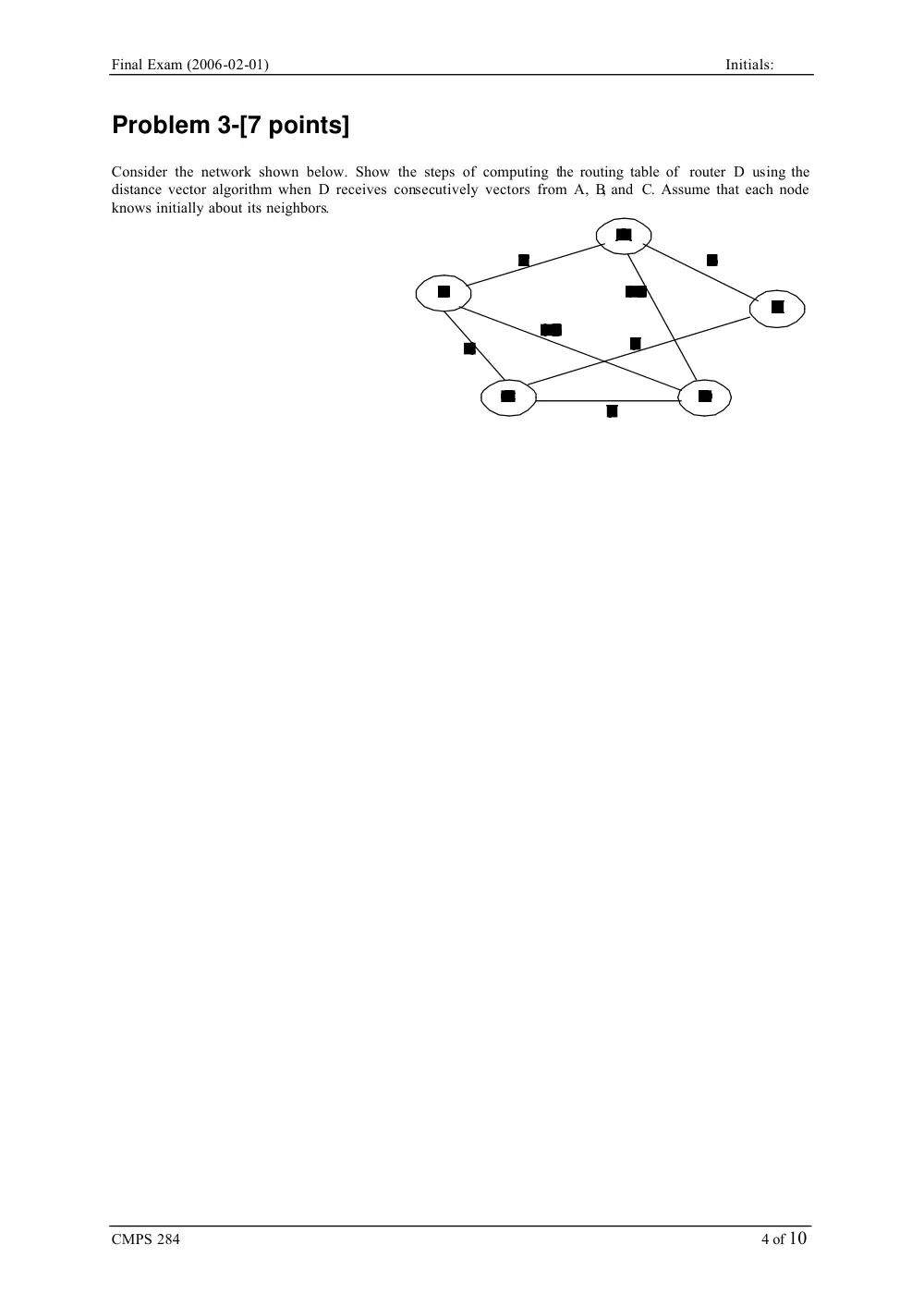
Problem 3-[7 points]
Consider the network shown below. Show the steps of computing the routing table of router D using the
distance vector algorithm when D receives consecutively vectors from A, B, and C. Assume that each node
knows initially about its neighbors.
Final Exam (2006-02-01)
Initials:
CMPS 284
5 of 10
Problem 4-[30 points]
Answer the following questions. Make your answer as short as possible as you will not get credit for long
answers.
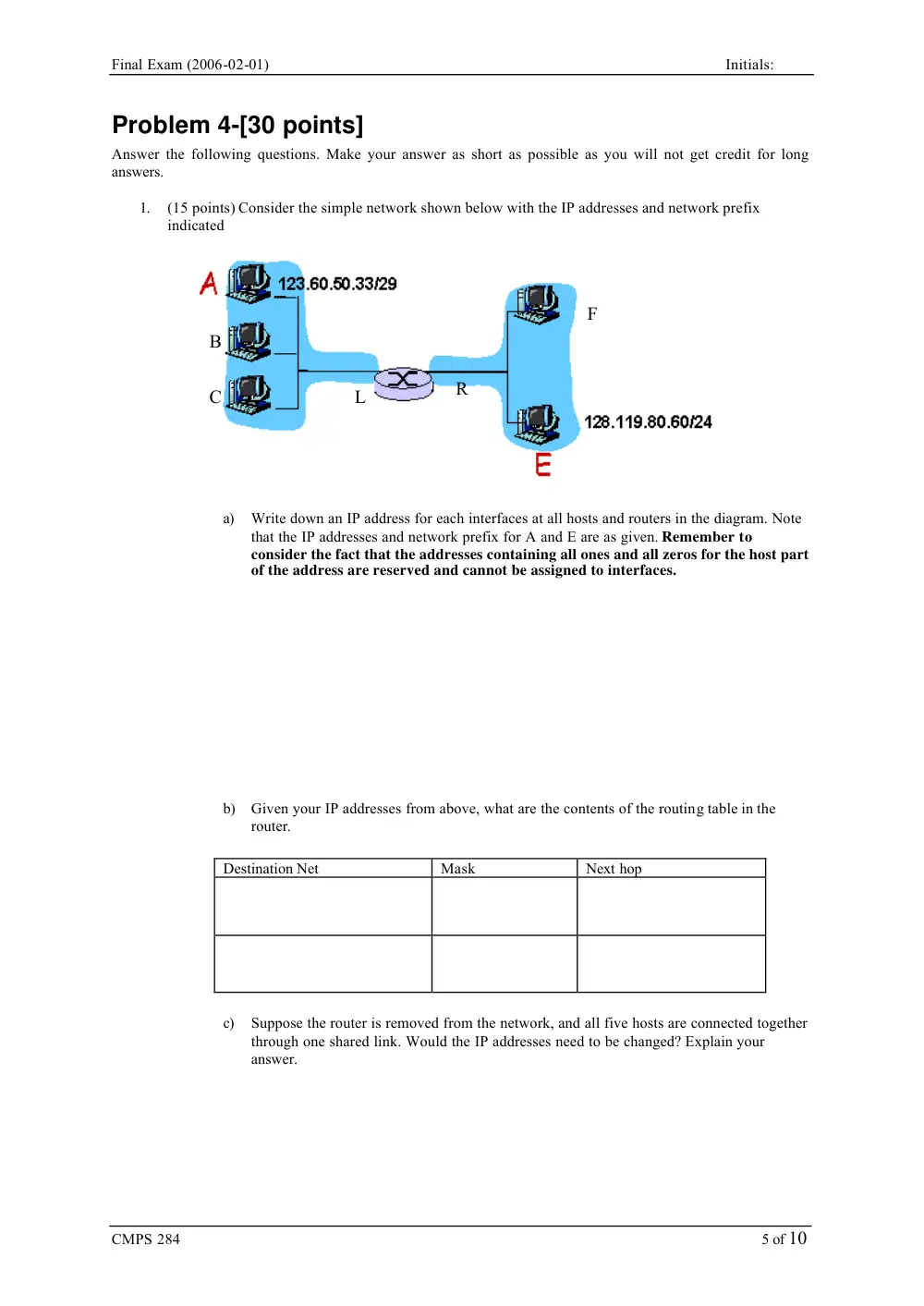
1. (15 points) Consider the simple network shown below with the IP addresses and network prefix
indicated
a) Write down an IP address for each interfaces at all hosts and routers in the diagram. Note
that the IP addresses and network prefix for A and E are as given. Remember to
consider the fact that the addresses containing all ones and all zeros for the host part
of the address are reserved and cannot be assigned to interfaces.
b) Given your IP addresses from above, what are the contents of the routing table in the
router.
Destination Net
Mask
Next hop
c) Suppose the router is removed from the network, and all five hosts are connected together
through one shared link. Would the IP addresses need to be changed? Explain your
answer.
B
C
R
L
F
Final Exam (2006-02-01)
Initials:
CMPS 284
6 of 10
2. (3 points) consider the following IP address 172.16.10.50/27
a.
What is the network part value of this address?
b. What is the host part value?
c.
Provide the range of IP addresses that can be assigned to hosts in this network?
3. State to which class each of the addresses blow belongs to. If the address is a special address, explain
its meaning and why it is used. (6 points).
a) 130.233.224.51
b) 127.0.0.1
c) 193.254.254.255
d) 0.0.0.0
e) 255.255.255.255
f)
255.255.240.0
Final Exam (2006-02-01)
Initials:
CMPS 284
7 of 10
4. Consider sending an IP packet of 3000 bytes into a link that has an MTU size of 500 bytes. Suppose
that the original datagram is stamped with the identification number 422. How many fragments are
generated? What are the values of the total length, fragmentation offset, fragmentation flags (D and M)
of each fragment? (6 points)
Final Exam (2006-02-01)
Initials:
CMPS 284
8 of 10
Problem 5 [14 points]
Answer the following questions. Make your answer as short as possible as you will not get credit for long
answers.
1. (7 points) Following are 7 functions. Identify which layer of the TCP/IP model each function is most
likely to belong to. It is possible that a function cannot be mapped to any layer. If this is the case,
explain why.
a) Recovering lost packets between two nodes separated by multiple hops
b) Defining the pin-outs in a connector used to attach to a network cable
c) Providing an interface to a visual packet monitoring program
d) Translating between names and IP addresses
e) Finding the shortest path between two nodes separated by multiple hops
f)
Providing communication between processes running on end-systems on possibly different
networks
g) Interconnecting networks that use different technologies, including different physical addressing
formats
2. (3 points) UDP versus TCP
a.
Give two advantage for the connectionless UDP protocol over the connection oriented TCP
protocol.
b. What is the main advantage of the connection-oriented TCP protocol over the connectionless UDP
protocol?
Final Exam (2006-02-01)
Initials:
CMPS 284
9 of 10
3. How does TCP detect a lost packet? What actions are taken when a loss is detected? (4 points)
Final Exam (2006-02-01)
Initials:
CMPS 284
10 of 10
Problem 6 [10 points]
Answer the following questions. Make your answer as short as possible as you will not get credit for long
answers.
1. DNS name servers can be accessed on UDP port 53 as well as on TCP port 53. When is each protocol used
and why? (4 point)
2. DHCP permit servers to be located on different subnetworks. If a computer is restricted to using broadcast
addresses before it obtains an IP address, How can a computer send DHCP messages to a server on another
subnetwork? (2 points).
3. Assume that all root servers in DNS are successfully attacked and are brought down. What effect will this
have on the use of the Internet in the short and long term?(4 points)