
CMPS 377 Final, Fall 2001
American University of Beirut · Database Management Systems · 15 pages


Showing the first 10 of 15 pages. Download the PDF to see all of it.
More CMPS 377 files
Show the text of this final exam
AMERICAN CNIVERSIT
LIBRARY
OF BEIRUT
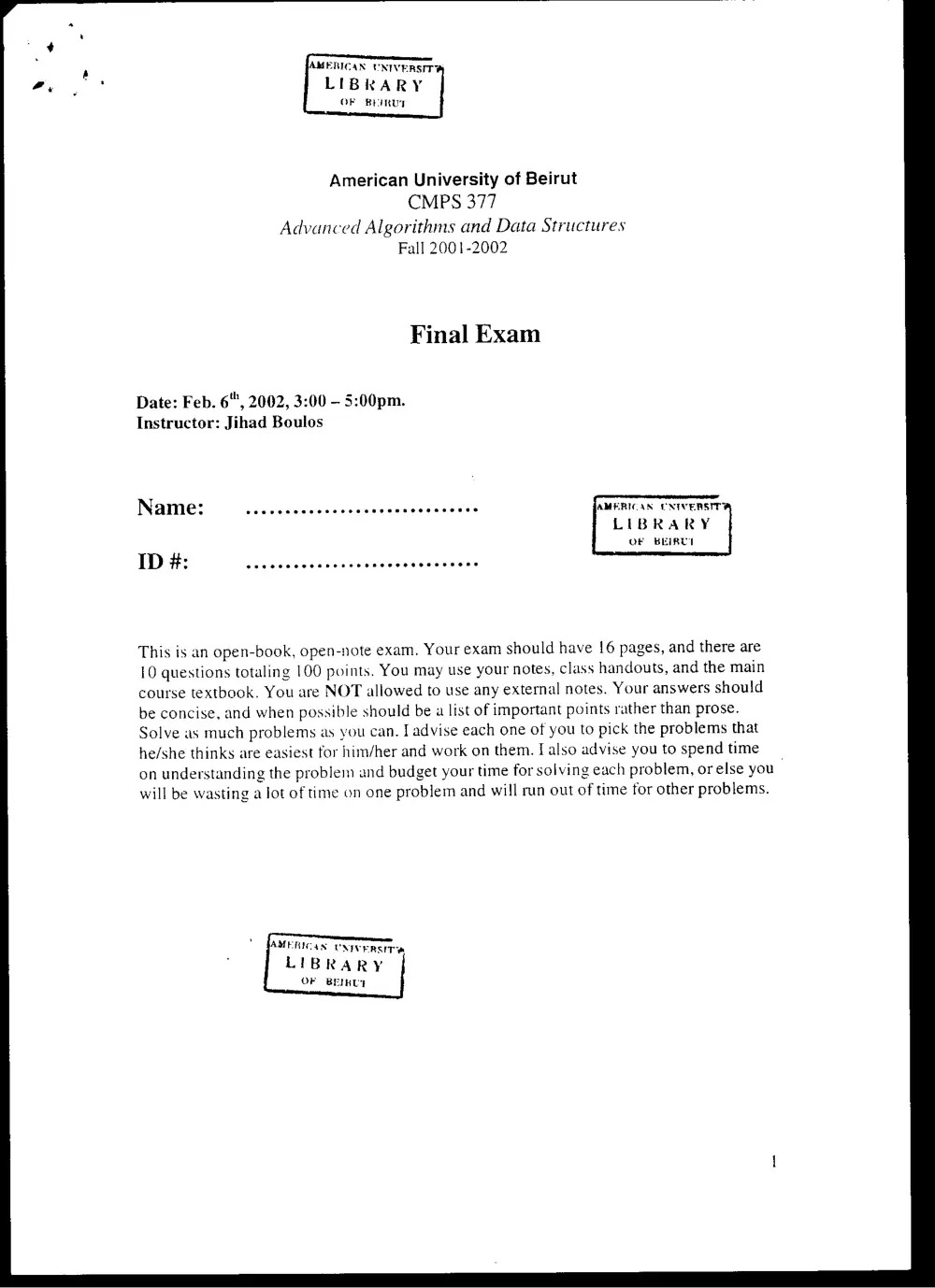
American University of Beirut
CMPS 377
Advanced Algorithms and Data Structures
Fall 2001-2002
Final Exam
Date: Feb. 6", 2002, 3:00 — 5:00pm.
Instructor: Jihad Boulos
Name: cca eeeccceccccceneeeeeeesseeee AMERICAN CNIVERSIT
LIBRARY
Of BEIRUT
This is an open-book, open-note exam. Your exam should have 16 pages, and there are
10 questions totaling 100 points. You may use your notes, class handouts, and the main
course textbook. You are NOT allowed to use any external notes. Your answers should
be concise, and when possible should be a list of important points rather than prose.
Solve us much problems as you can. I advise each one of you to pick the problems that
he/she thinks are easiest for him/her and work on them. I also advise you to spend time
on understanding the problem and budget your time for solving each problem, or else you
will be wasting a lot of time on one problem and will run out of time for other problems.
LIBRARY
OF BEIKUT
Exercise 1 (10 points):
Suppose we have two relations: R(a, b, c) and S(c, d, e). Give 6 valid logical plans (either
in relational algebra or as logical plan trees) for the following SQL query:
SELECT B, C.D
FROM R, S
WHERE R.c = S.c AND Ruu=5
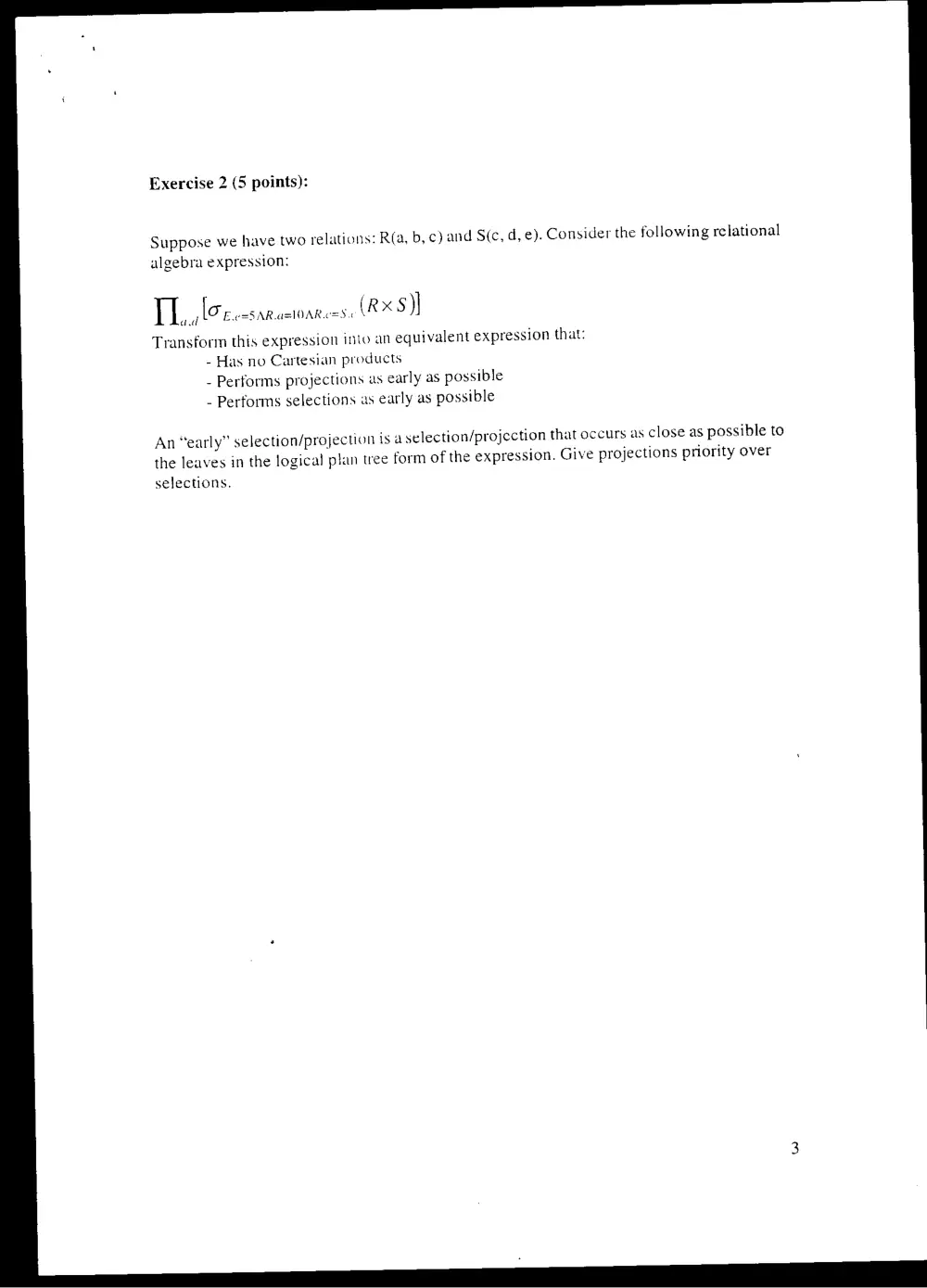
Exercise 2 (5 points):
Suppose we have two relations: R(a, b, c) and S(c, d, €). Consider the following relational
algebra expression:
IL. [Op esaRacWARe=S: (Rx S)]
Transform this expression into an equivalent expression that:
- Has no Cartesian products
- Performs projections as early as possible
- Performs selections as early as possible
An “early” selection/projection is a selection/projection that occurs as close as possible to
the leaves in the logical plan tree form of the expression. Give projections priority over
selections.
Exercise 3 (15 points):
Suppose relations R and S are not stored in any particular order. Suppose furthermore
that two indexes exist on relation R, one on column a and one on column c. No other
indexes are present. Give 7 valid physical plans (as physical plan trees) for the following
logical plan:
[O28 (R)] x Re=Sc {S}
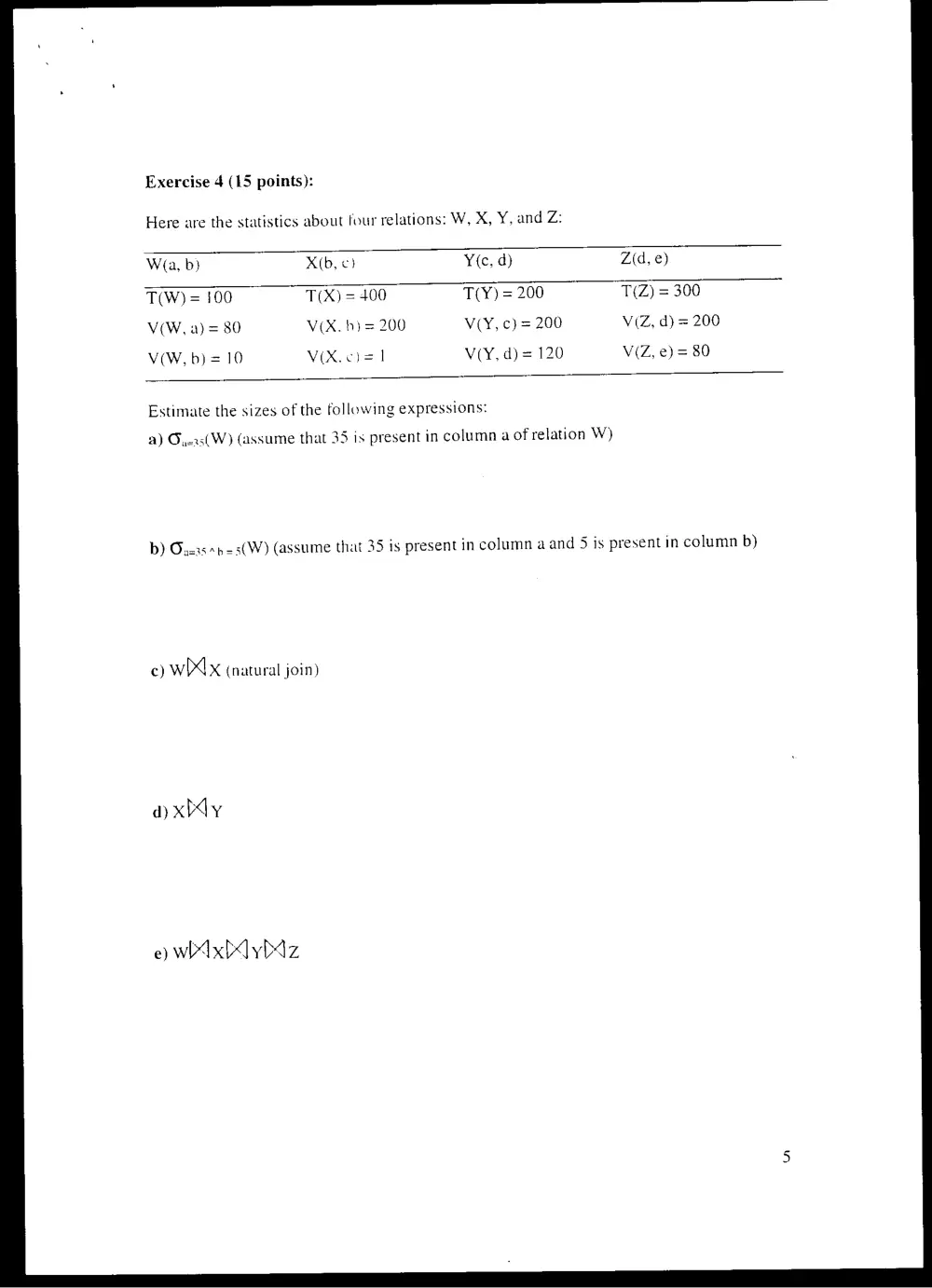
Exercise 4 (15 points):
Here are the statistics about four relations: W, X, Y, and Z:
W(a, b} X(b, ¢} Y(c, d) Z(d, e)
T(W) = 100 T(X) = 400 T(Y) = 200 T(Z) = 300
V(W, a) = 80 V(X.) = 200 VCY, c) = 200 ViZ, d) = 200
V(W, b) = 10 V(X.c)= 1 V(Y, d) = 120 VIZ, e) = 80
Estimate the sizes of the following expressions:
a) O,235(W) (assume that 35 is present in column a of relation W)
b) Osers +h =3(W) (assume that 35 is present in column a and 5 is present in column b)
c) wll X (natural join)
e) WI xl yz
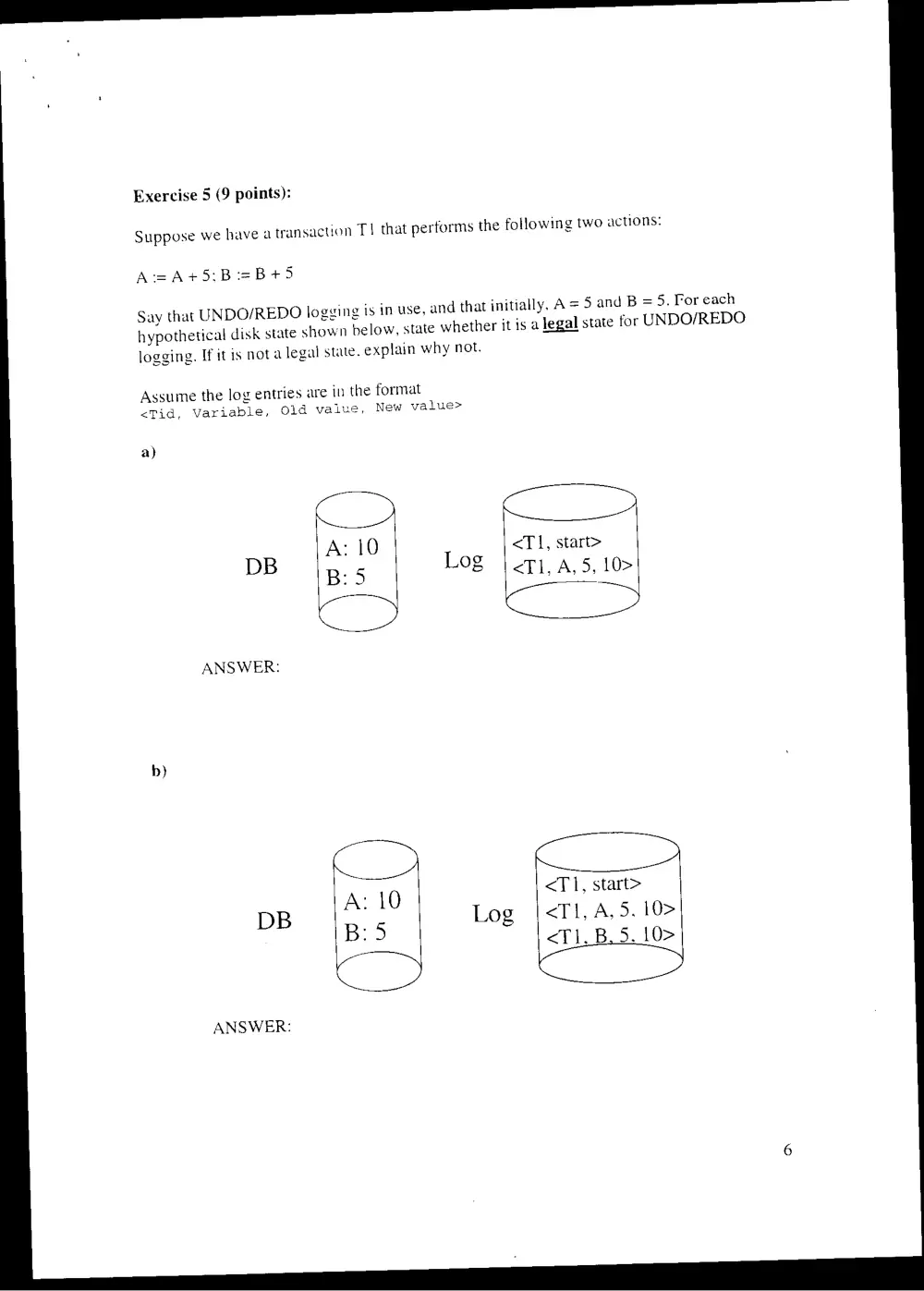
Exercise 5 (9 points):
Suppose we have a transaction TI that performs the following two actions:
A= A+5:B:=Bt5
Say that UNDO/REDO jogaing is in use, and that initially, A = 5 and B = 5. For each
hypothetical disk state shown below, state whether it is a legal state for UNDO/REDO
logging. If itis nota legal state. explain why not.
Assume the log entries are in the format
<Tid, Variable, Old value, New value>
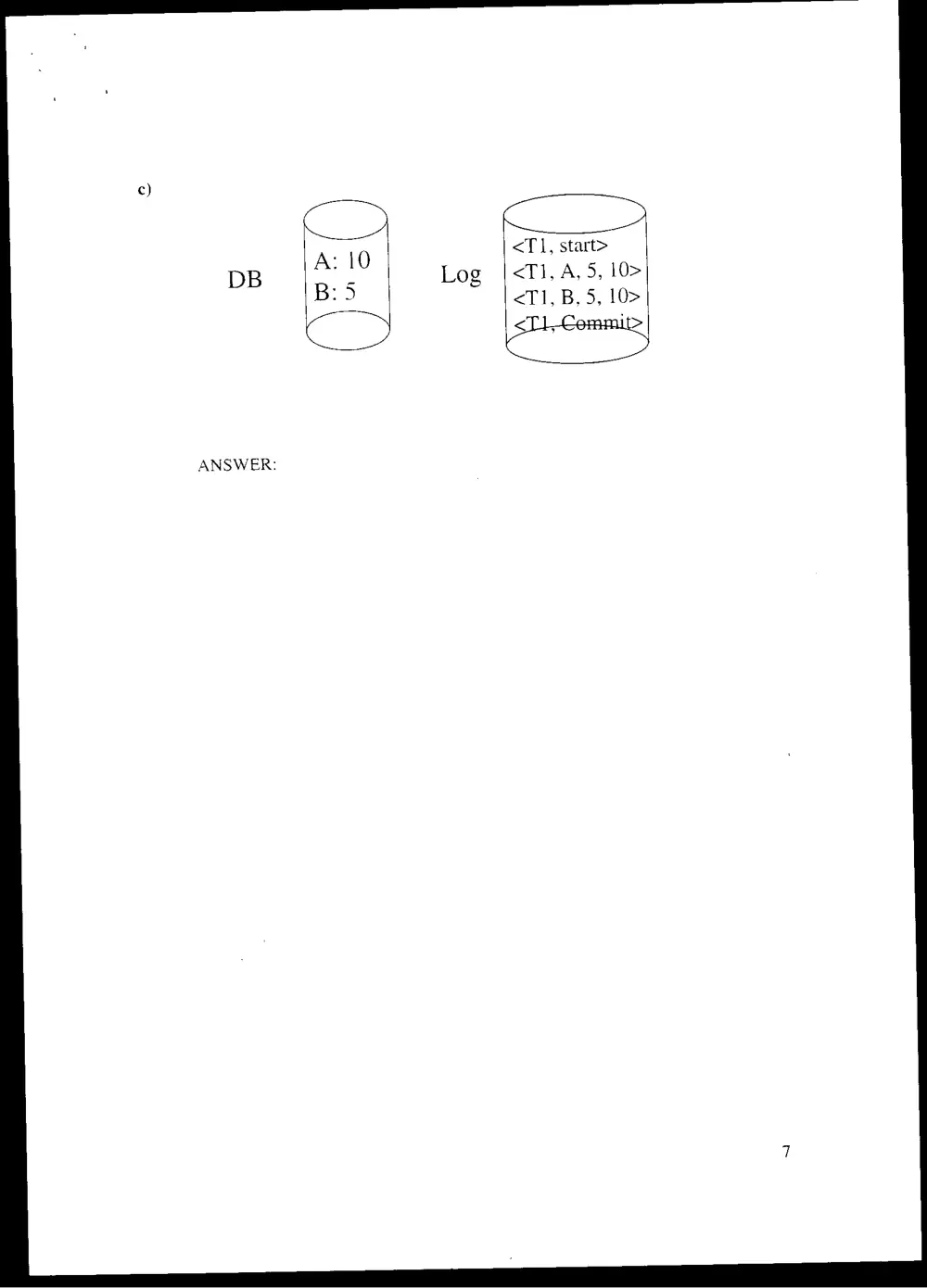
a)
DB Log
ANSWER:
b)
. <T1, start>
DB : <T1, A, 5. 10>
<T1. B, 5. 10>
ANSWER:
<T1, start>
DB <T1, A, 5, 10>
<T1,B, 5, 10>
ANSWER:
Exercise 6 (8 points):
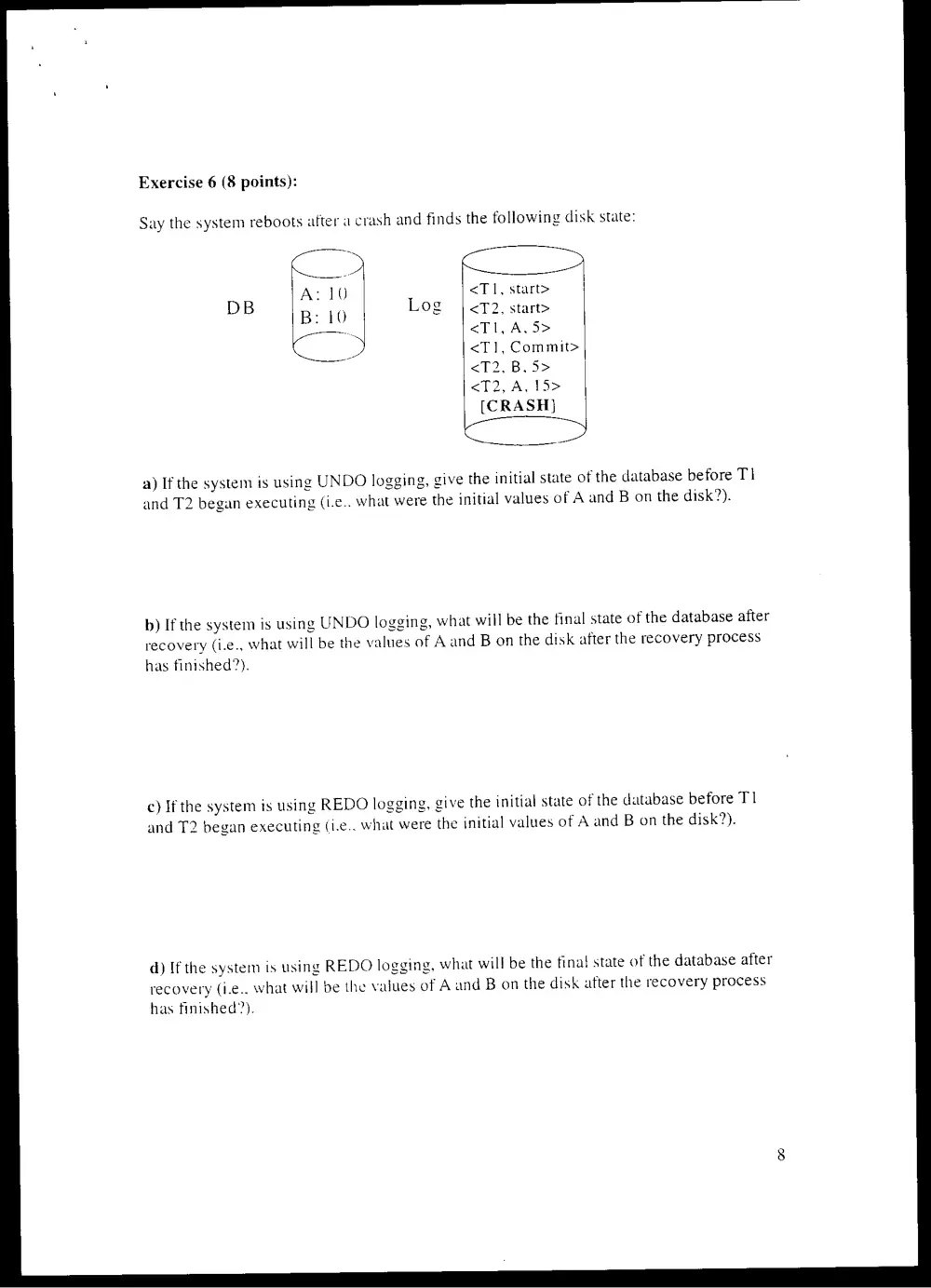
Say the system reboots after a crash and finds the following disk state:
a
<T1, start>
<T2, start>
<TI,A.5>
<T1, Commit>
<T2, B.5>
<T2, A, 15>
(CRASH)
a
CO
a) If the system is using UNDO logging, give the initial state of the database before T1
and T2 began executing (i.e.. what were the initial values of A and B on the disk?).
b) If the system is using UNDO logging, what will be the final state of the database after
recovery (i.e., what will be the values of A and B on the disk after the recovery process
has finished?).
c) If the system is using REDO logging, give the initial state of the database before T1
and T2 began executing (i.e.. what were the initial values of A and B on the disk?).
d) If the system is using REDO logging, what will be the final! state of the database after
recovery (i.e.. what will be the values of A and B on the disk after the recovery process
has finished?).
Exercise 7 (10 points):
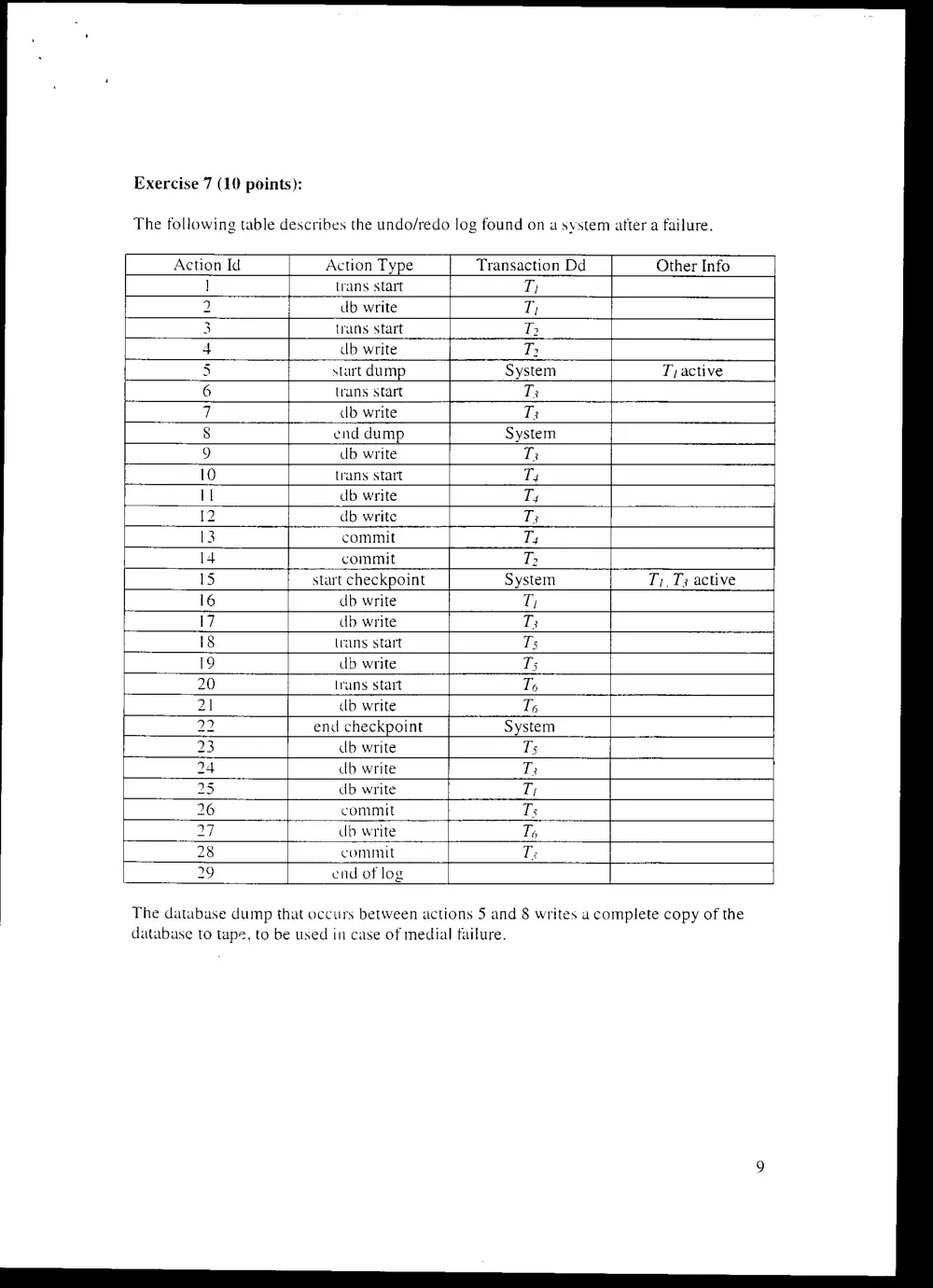
The following table describes the undo/redo log found on a system after a failure.
Action Id
Action Type
Transaction Dd
Other Info
trans start
T;
db write
T;
ta| to
trans start
Th
db write
T2
tn] fe
start dump
System
T; active
nN
trans Start
Ts
al
db write
T3
n
end dump
System
oO
db write
S
trans start
db write
)
t
db write
commit
commit
start checkpoint
T,, T3 active
db write
db write
(rans start
db write
trans start
db write
end checkpoint
System
lb write
Ts
db write
db write
commit
T,
db write
28
commit
39
end of log
The database dump that occurs between actions 5 and 8 writes a complete copy of the
database to tape, to be used in case of medial failure.
a) Assume that at action 29 the system crashes but the database is nor lost. Assume that a
two pass algorithm is run for recovery, where actions are first undone, and then
actions are redone. In the two lines below indicate what actions are undone in the first
pass, and what actions are redone. Write the actions in the order they would be
undone or redone (left to right). Identify each action by its id given in the first column
in the table.
b) Now assume that the database is Jost at action 29. In this case we load the saved
database from tape and bring it up to date. In the two lines below again indicate what
actions are undone and redone to bring the dumped database up to date.