
CMPS 377 Final, Spring 2003
American University of Beirut · Database Management Systems · 15 pages


Showing the first 10 of 15 pages. Download the PDF to see all of it.
More CMPS 377 files
Show the text of this final exam
Law oe
AUN CHAE
BISHAAINA VOTES
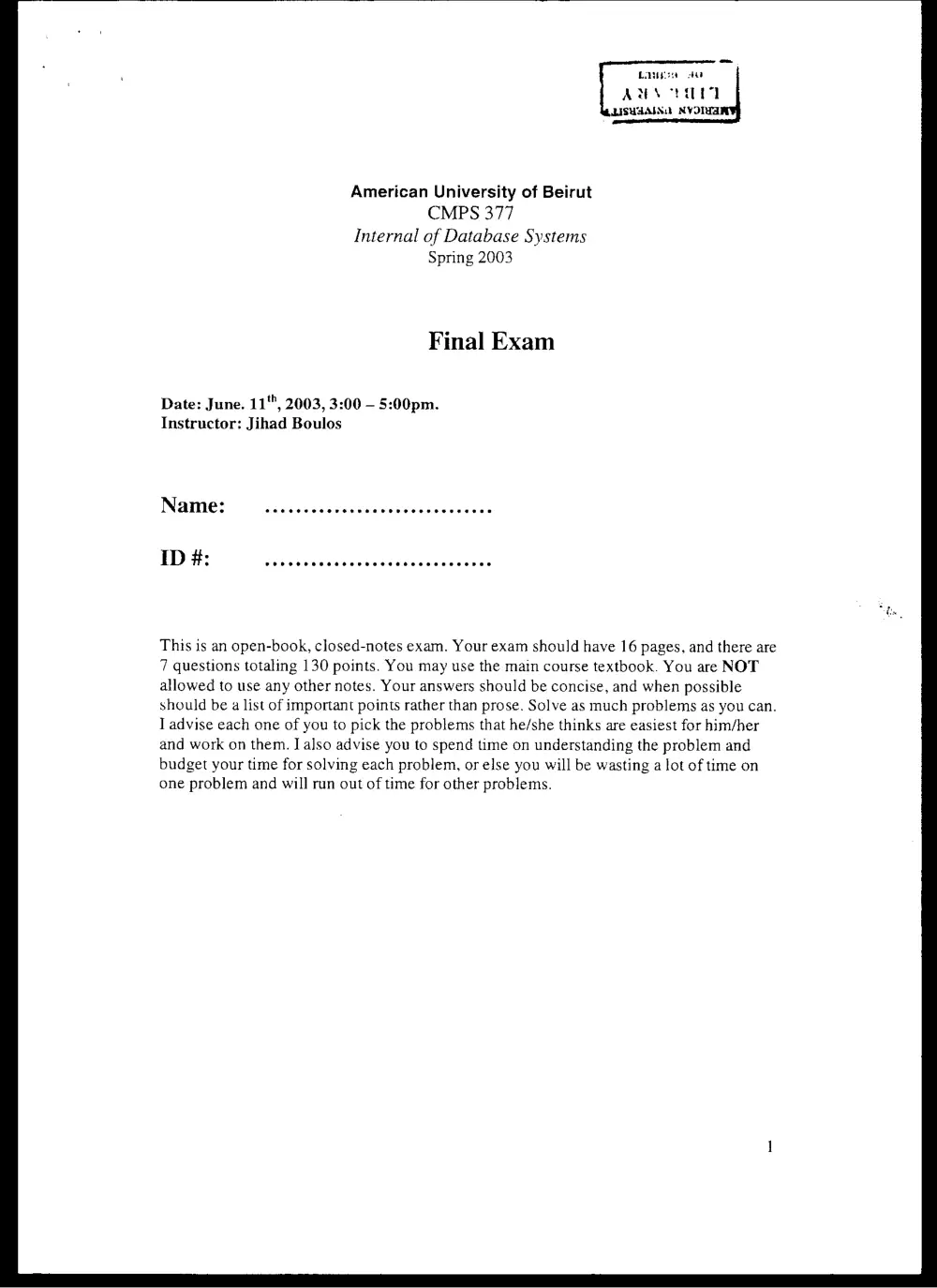
American University of Beirut
CMPS 377
Internal of Database Systems
Spring 2003
Final Exam
Date: June. 11", 2003, 3:00 — 5:00pm.
Instructor: Jihad Boulos
Name: sae ceeceeveeneneeescsceeersees
This is an open-book, closed-notes exam. Your exam should have 16 pages, and there are
7 questions totaling 130 points. You may use the main course textbook. You are NOT
allowed to use any other notes. Your answers should be concise, and when possible
should be a list of important points rather than prose. Solve as much problems as you can.
I advise each one of you to pick the problems that he/she thinks are easiest for him/her
and work on them. J also advise you to spend time on understanding the problem and
budget your time for solving each problem, or else you will be wasting a lot of time on
one problem and will run out of time for other problems.
Exercise 1 (8 points):
Imagine that you have a data warehouse with the following relations:
- Customers (Name, Age, Gender, CustID): 100,000 disk blocks.
- Purchases (CustID, Product, Date, Location, Amount): 2,000,000 disk block.
- SalesCalls(CustID, Salesperson, Date, Result): 300,000 disk blocks.
You have observed the following query mix over these relations:
10% queries selecting on Customers.CustID
30% queries selecting on Customers.Name.
35% queries selecting on Purchases.Product.
10% queries selecting on SalesCalls.Salesperson.
15% queries selecting on SalesCalls.Date.
You want to create indexes over these relations to speed up queries over these relations.
You decide that you have enough resources (disk space, etc.) to build two indexes. You
may assume that the index allows you to retrieve the answer to the query with
significantly less cost than doing a table scan.
Which attributes should you build indexes over? Please explain briefly.
MEKIONS ENIVERS,
LIBRARY
OF BEIRUT
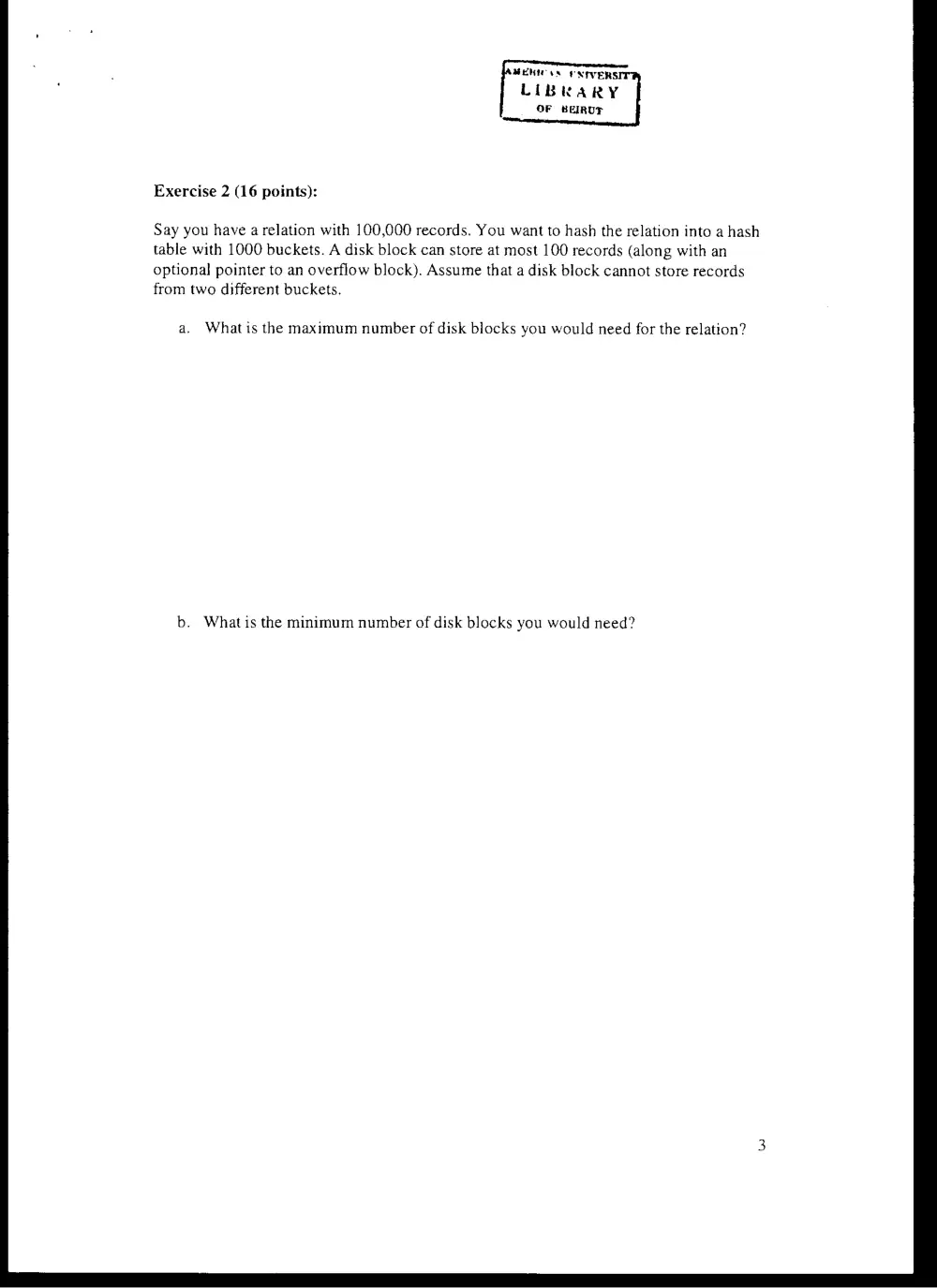
Exercise 2 (16 points):
Say you have a relation with 100,000 records. You want to hash the relation into a hash
table with 1000 buckets. A disk block can store at most 100 records (along with an
optional pointer to an overflow block). Assume that a disk block cannot store records
from two different buckets.
a. What is the maximum number of disk blocks you would need for the relation?
b. What is the minimum number of disk blocks you would need?
| oe yen
tabs AMID?
Lib WKY
OF SEIRUT
Next, suppose that you want to store the relation with 100,000 records in a B+-tree.
However, unlike a standard B+-tree, here the leaf nodes store the actual records, as
opposed to just pointers to the records. Thus, a leaf node can store a maximum of 100
records. That is, for leafs the order is 100. For non-leaf, the order is 1000, ie., a
maximum of 1000 keys can be stored.
c. What is the maximum number of disk blocks you would need to store the relation
in this B+-tree?
d. What is the minimum number of disk blocks you would need?
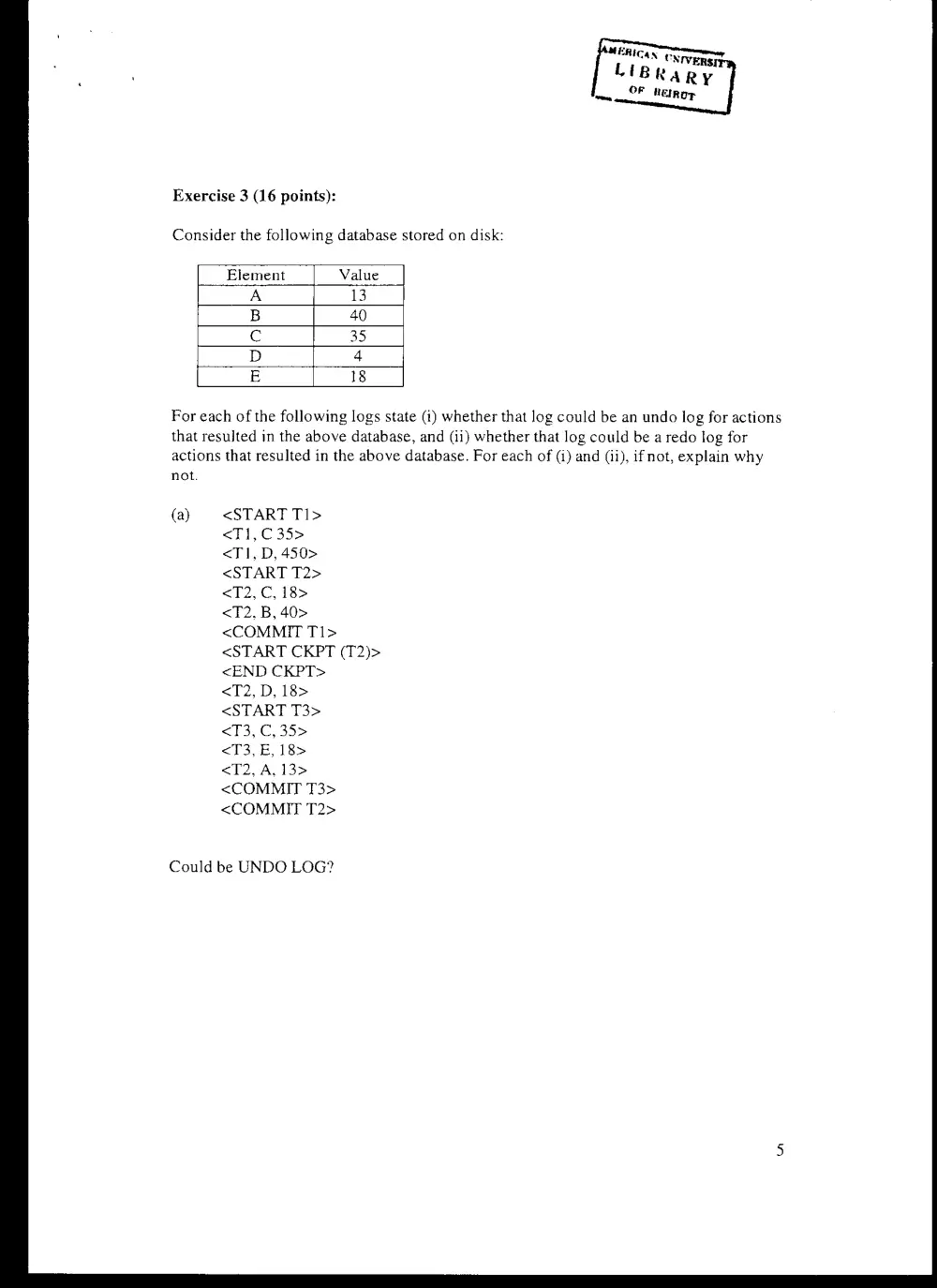
Exercise 3 (16 points):
Consider the following database stored on disk:
Element Value
A 13
B 40
Cc 35
D 4
E 18
For each of the following logs state (i) whether that Jog could be an undo log for actions
that resulted in the above database, and (ii) whether that log could be a redo log for
actions that resulted in the above database. For each of (i) and (ii), if not, explain why
not.
(a) <START T1>
<T1,C35>
<T1, D, 450>
<START T2>
<T2, C, 18>
<T2, B, 40>
<COMMIT T1>
<START CKPT (T2)>
<END CKPT>
<T2, D, 18>
<START T3>
<T3, C, 35>
<T3,E,18>
<T2, A, 13>
<COMMIT T3>
<COMMIT T2>
Could be UNDO LOG?
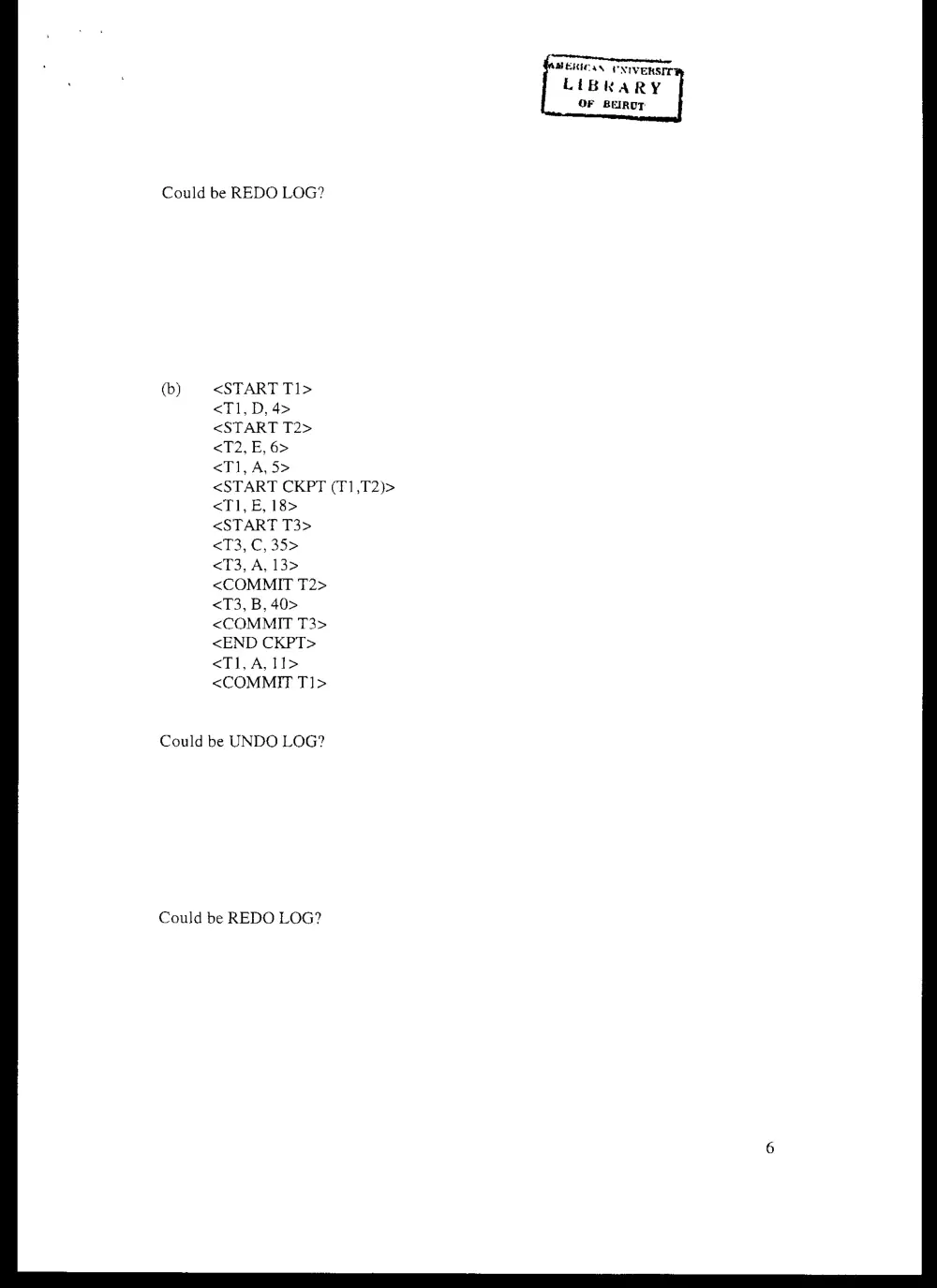
Could be REDO LOG?
(b)
<START T1>
<T1, D, 4>
<START T2>
<T2, E, 6>
<T1, A, 5>
<START CKPT (T1,T2)>
<T1,E, 18>
<START T3>
<T3, C, 35>
<T3, A, 13>
<COMMIT T2>
<T3, B, 40>
<COMMIT T3>
<END CKPT>
<T1,A, 11>
<COMMIT T1>
Could be UNDO LOG?
Could be REDO LOG?
LIBKARY
OF BEIRCT
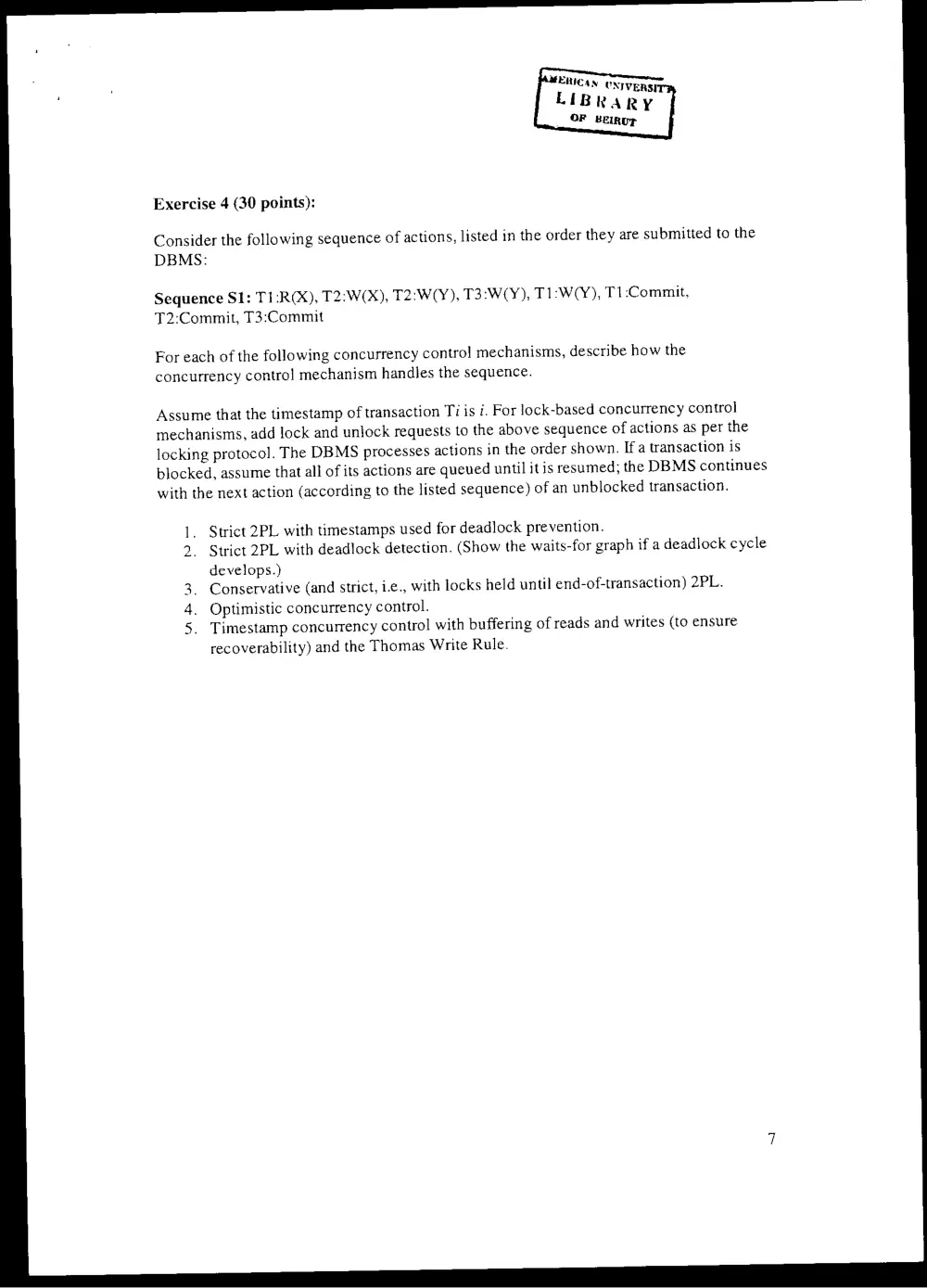
Exercise 4 (30 points):
Consider the following sequence of actions, listed in the order they are submitted to the
DBMS:
Sequence S1: T1:R(X), T2:W(X), T2:W(Y), T3:W(Y), T1 “W(Y), T1:Commit.
T2:Commit, T3:Commit
For each of the following concurrency control mechanisms, describe how the
concurrency control mechanism handles the sequence.
Assume that the timestamp of transaction Ti is i. For lock-based concurrency control
mechanisms, add lock and unlock requests to the above sequence of actions as per the
locking protocol. The DBMS processes actions in the order shown. If a transaction is
blocked, assume that all of its actions are queved until it is resumed; the DBMS continues
with the next action (according to the listed sequence) of an unblocked transaction.
Strict 2PL with timestamps used for deadlock prevention.
Strict 2PL with deadlock detection. (Show the waits-for graph if a deadlock cycle
develops.)
Conservative (and strict, i.c., with locks held until end-of-transaction) 2PL.
Optimistic concurrency control.
Timestamp concurrency control with buffering of reads and writes (to ensure
recoverability) and the Thomas Write Rule.
N
tn
Sd
Cragg SERSIT by
LIBRARY
OF BEIRUT
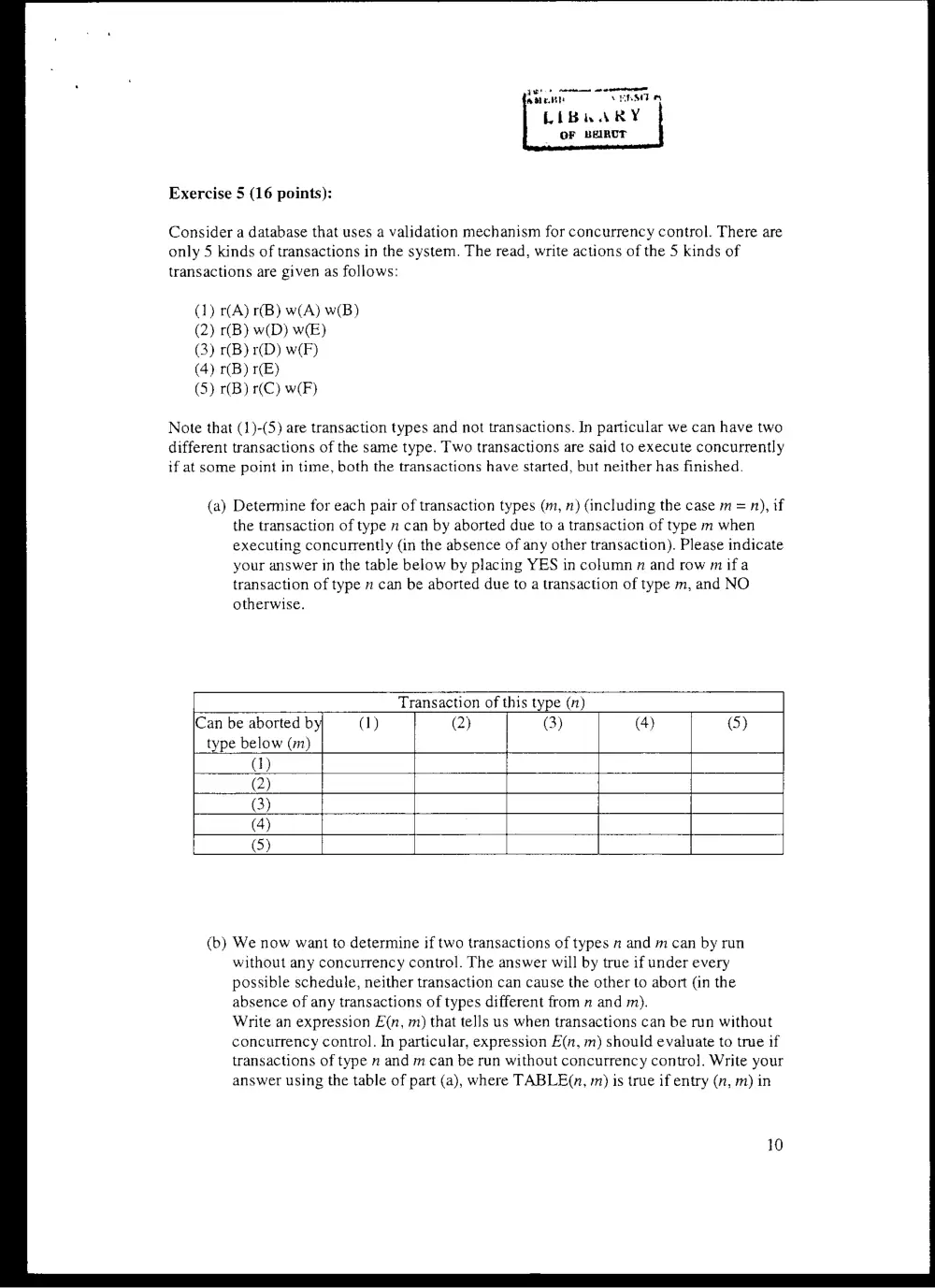
Exercise 5 (16 points):
Consider a database that uses a validation mechanism for concurrency control. There are
only 5 kinds of transactions in the system. The read, write actions of the 5 kinds of
transactions are given as follows:
(1) r(A) r(B) w(A) w(B)
(2) r(B) wD) wE)
(3) 1(B) 1D) w(F)
(4) r(B) rE)
(5) r(B) (C) w(F)
Note that (1)-(5) are transaction types and not transactions. In particular we can have two
different transactions of the same type. Two transactions are said to execute concurrently
if at some point in time, both the transactions have started, but neither has finished.
(a) Determine for each pair of transaction types (m, n) (including the case m =n), if
the transaction of type 1 can by aborted due to a transaction of type m when
executing concurrently (in the absence of any other transaction). Please indicate
your answer in the table below by placing YES in column n and row mifa
transaction of type n can be aborted due to a transaction of type m, and NO
otherwise.
Transaction of this type (1)
Can be aborted b ql) (2) (3)
type below (7)
qd)
2)
3)
(4)
)
(b) We now want to determine if two transactions of types n and m can by run
without any concurrency control. The answer will by true if under every
possible schedule, neither transaction can cause the other to abort (in the
absence of any transactions of types different from n and m).
Write an expression E(n, m) that tells us when transactions can be run without
concurrency control. In particular, expression E(n, m) should evaluate to true if
transactions of type n and mcan be run without concurrency control. Write your
answer using the table of part (a), where TABLE(n, m) is true if entry (, m) in
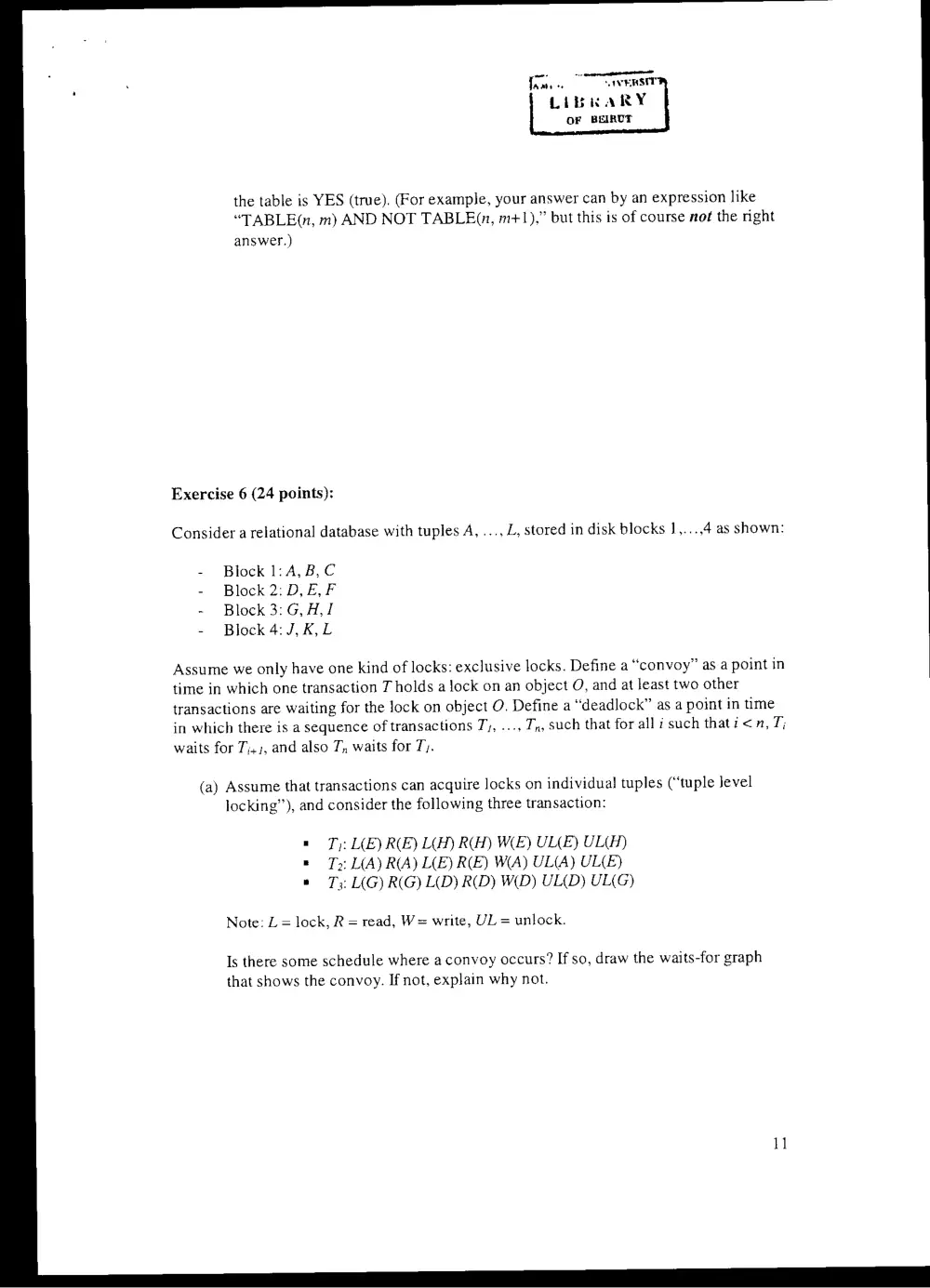
the table is YES (true). (For example, your answer can by an expression like
“TABLE(n, m) AND NOT TABLE(n, m+1),” but this is of course not the right
answer.)
Exercise 6 (24 points):
Consider a relational database with tuples A, ..., L, stored in disk blocks J,...,4 as shown:
Block 1:4, B,C
Block 2: D, E, F
Block 3: G, A, I
Block 4: J, K,L
Assume we only have one kind of locks: exclusive locks. Define a “convoy” as a point in
time in which one transaction T holds a lock on an object O, and at least two other
transactions are waiting for the lock on object O. Define a “deadlock” as a point in time
in which there is a sequence of transactions 7), ..., Tn, such that for all i such thati <n, T;
waits for 7;4;, and also 7;, waits for Ty.
(a) Assume that transactions can acquire locks on individual tuples (“tuple level
locking”), and consider the following three transaction:
= Ty): L(E) R(E) LWA) RH) WE) UL(E) UL)
* Ty L(A) R(A) L(E) R(E) WA) UL(A) UL(E)
*® Tz L(G) R(G) LW) R(D) WD) UL(D) UL{G)
Note: L = lock, R = read, W= write, UL = unlock.
Is there some schedule where a convoy occurs? If so, draw the waits-for graph
that shows the convoy. If not, explain why not.
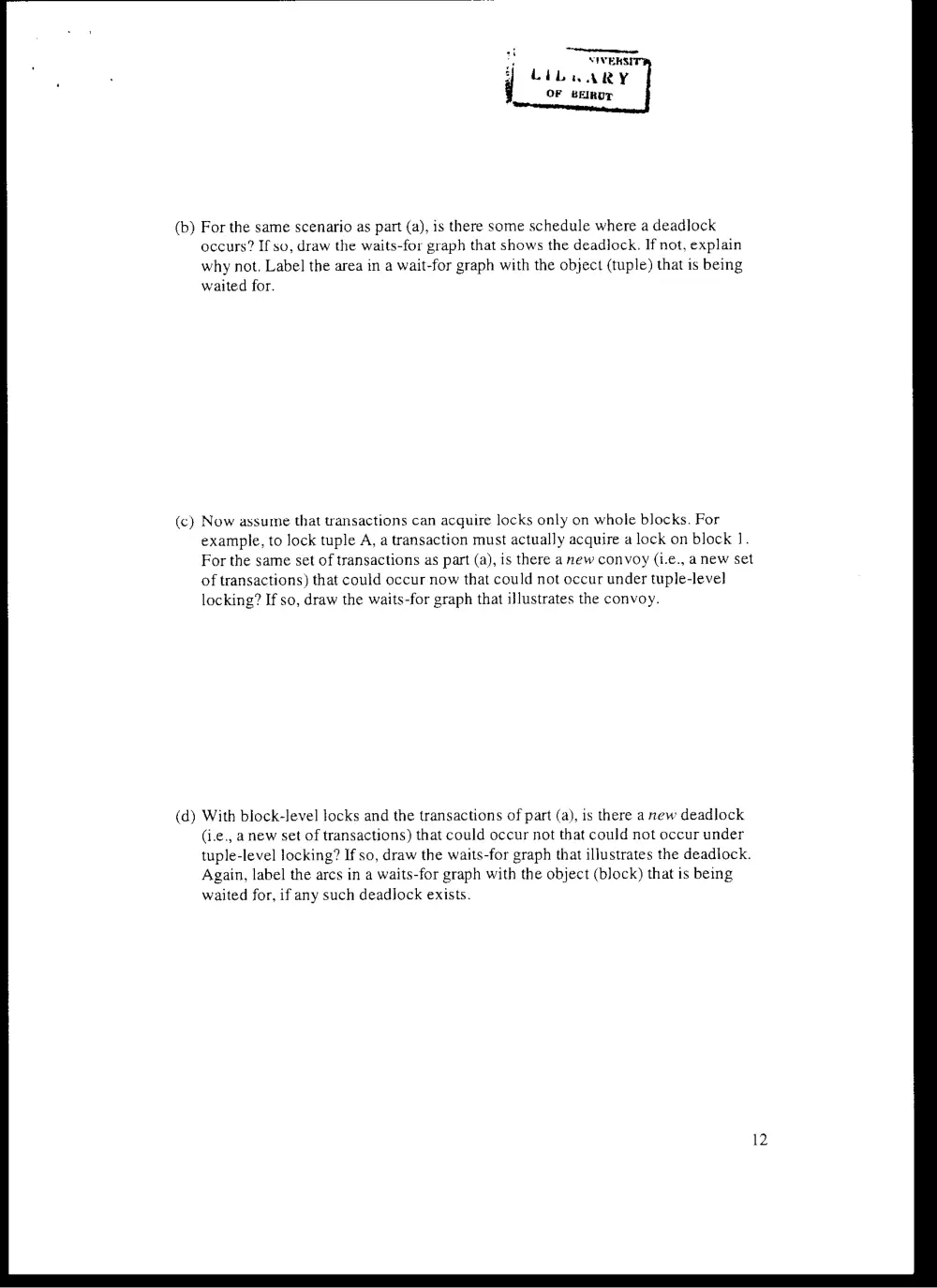
(b) For the same scenario as part (a), is there some schedule where a deadlock
occurs? If so, draw the waits-for graph that shows the deadlock. If not, explain
why not. Label the area in a wait-for graph with the object (tuple) that is being
waited for.
(c) Now assume that transactions can acquire locks only on whole blocks. For
example, to lock tuple A, a transaction must actually acquire a lock on block 1.
For the same set of transactions as part (a), is there a new convoy (i.€., anew set
of transactions) that could occur now that could not occur under tuple-level
locking? If so, draw the waits-for graph that illustrates the convoy.
(d) With block-level locks and the transactions of part (a), is there a new deadlock
(i.e., anew set of transactions) that could occur not that could not occur under
tuple-level locking? If so, draw the waits-for graph that illustrates the deadlock.
Again, label the arcs in a waits-for graph with the object (block) that is being
waited for, if any such deadlock exists.
12