
CMPS 377 Final, Spring 2003
American University of Beirut · Database Management Systems · 11 pages

Showing the first 10 of 11 pages. Download the PDF to see all of it.
More CMPS 377 files
Show the text of this final exam
American University of Beirut
Advanced Algorithms & Data Structures
Spring 2003
CMPsS 344
Final Exam
Date: Monday, June 9, 2003 - 3:00 pm to 5:00 pm
Instructor: Dr. Mohamed Kobeissi
Name: oeeeecccecscescctseresertenseeceneeensenaseeeeeseeners
TD He eccecccecesecseetsceeececseesesenenseecseserteeriees
Section: 1
This is NOT an open-book exam. However, you are allowed to have 2 papers format A4 on
which you can write whatever you want. Your exam should have 10 pages, and there are 8
questions totaling 100 points. Your are NOT allowed to use any external notes. Your answers
should be concise, and when possible should be a list of important points rather than prose.
Solve as much problems as you can. I advise each one of you to pick the problems that he/she
thinks easiest for him/her and work on them. J also advise you to spend time on understanding
the problem and budget your time for solving each problem, or else you will wasting a lot of
time on one problem and will run out of time for other problems.
Wordy and/or irrelevant answers will reduce your score for that problem. Your answers should
be the summary of work done on scratch paper that you do not hand in. If I could not read your
writing, I will just give a ZERO without bothering myself trying to understand what you are
writing. The space allocated for answers should be sufficient for your answers. If not, you can
continue each exercise on the reverse side.
Good luck
MERICUN UNITERS)!
LIBRARY
Exercise 1 (Multiple choice) [20 points}: OF BEIRUT
Circle the correct answer. No explanation are required. Each correct answer is worth 2 points,
but 1 point will be subtracted for each wrong answer, so answer only if you are reasonably
certain.
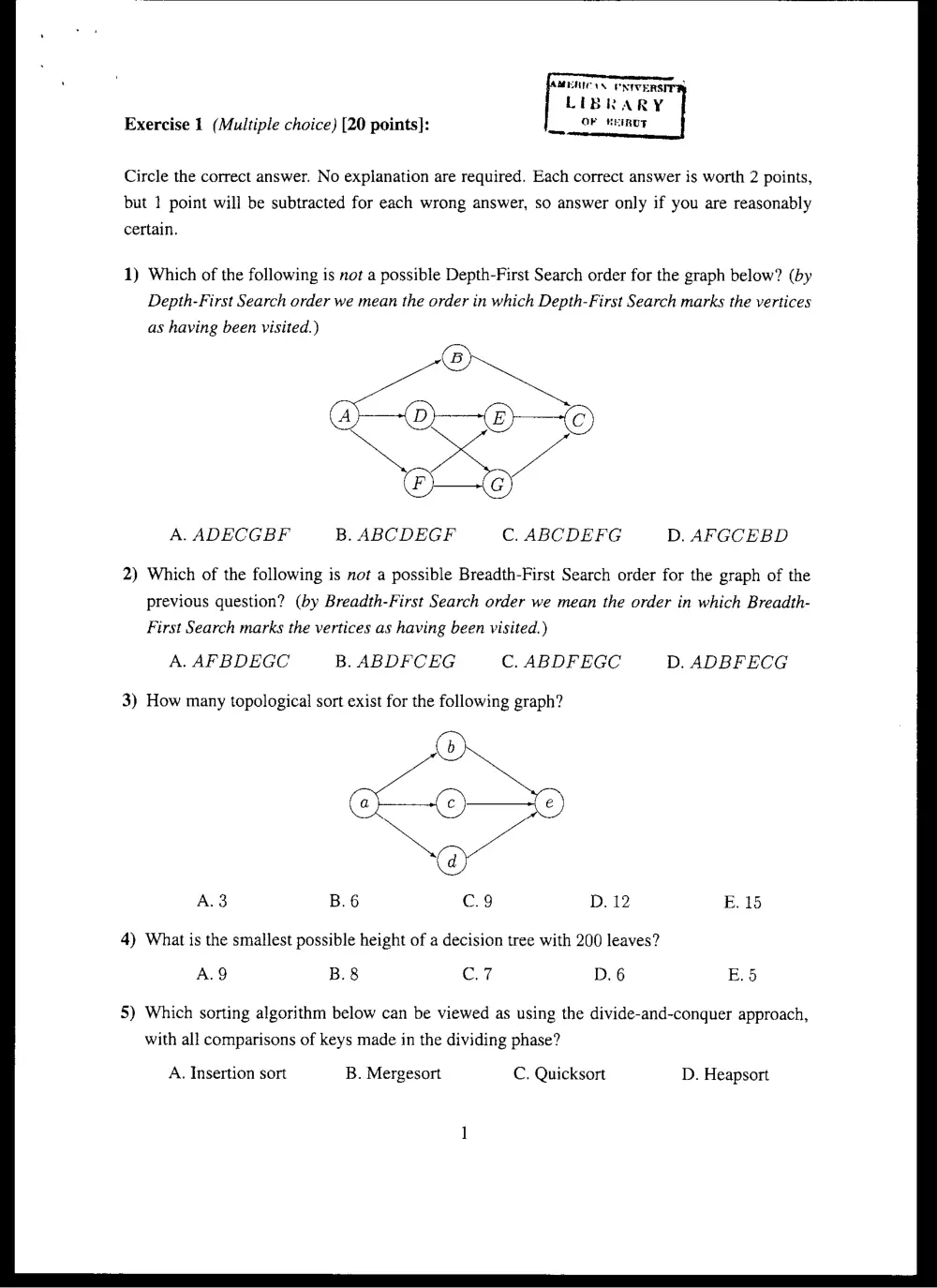
1) Which of the following is not a possible Depth-First Search order for the graph below? (by
Depth-First Search order we mean the order in which Depth-First Search marks the vertices
as having been visited.)
ie —
NewS
A. ADECGBF B. ABCDEGF C. ABCDEFG D. AFGCEBD
2) Which of the following is not a possible Breadth-First Search order for the graph of the
previous question? (by Breadth-First Search order we mean the order in which Breadth-
First Search marks the vertices as having been visited.)
A. AFBDEGC B. ABDFCEG C. ABDFEGC D. ADBFECG
3) How many topological sort exist for the following graph?
La
\
A.3 B.6 C.9 D. 12 E.15
4) What is the smallest possible height of a decision tree with 200 leaves?
A.9 B.8 C7 D.6 E.5
5) Which sorting algorithm below can be viewed as using the divide-and-conquer approach,
with all comparisons of keys made in the dividing phase?
A. Insertion sort B. Mergesort C. Quicksort D. Heapsort
meant
fares en IVENSIT
LIBAARY
OF BCIAUT
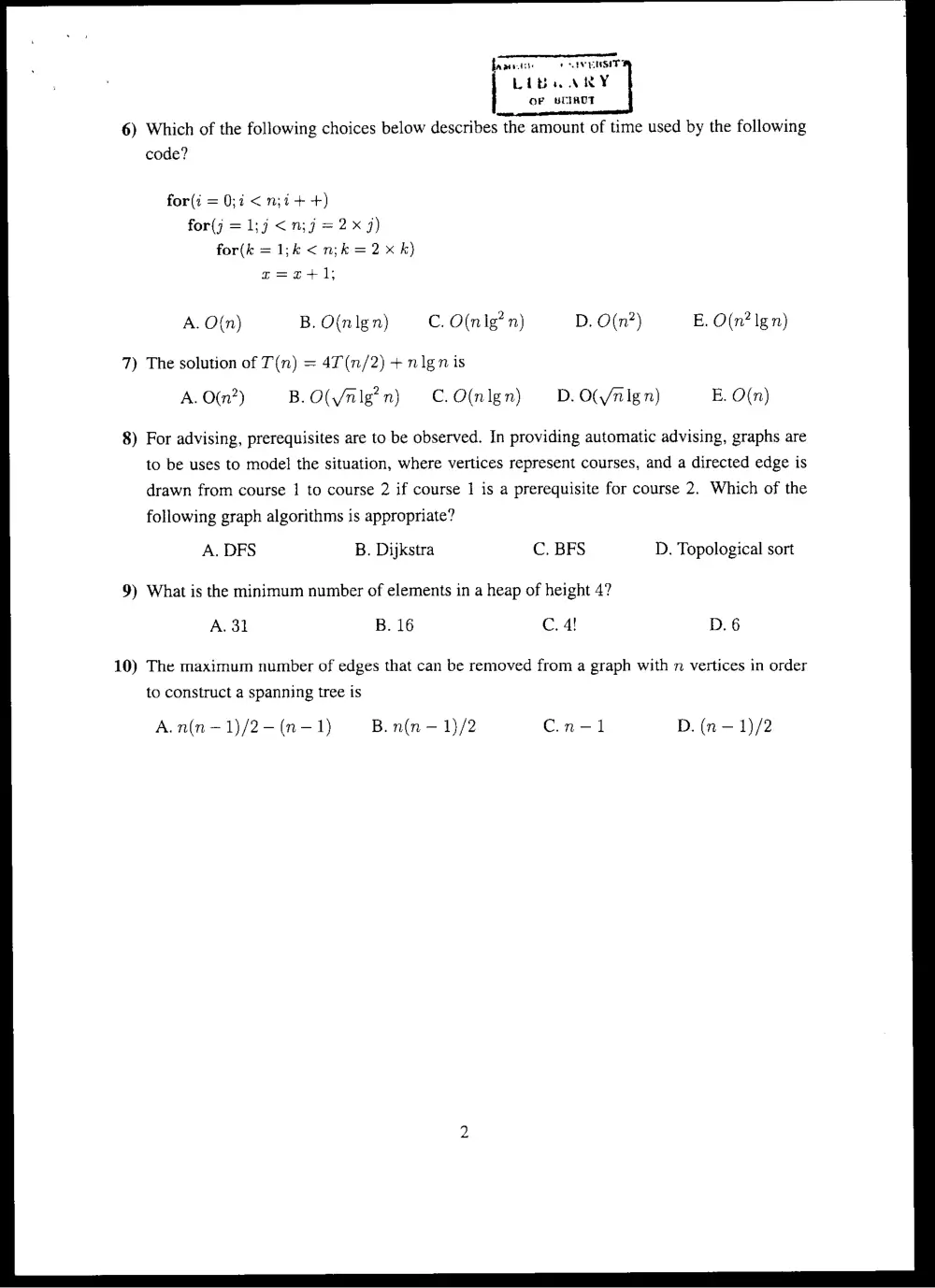
6) Which of the following choices below describes the amount of time used by the following
code?
for(i = 0;1 < mji+ +)
for(j =1lj <mj=2x J)
for(k =1;k < n;k =2 x k)
g=zt+],;
A. O(n) B.O(nlgn) —-C. O(n lg? n) D. O(n?) E. O(n? Ign)
7) The solution of T(n) = 47 (n/2) + nlgn is
A. O(n?) B.O(/nlg’?n}) C.O(nign) D.OG/nign) E. O(n)
8) For advising, prerequisites are to be observed. In providing automatic advising, graphs are
to be uses to model the situation, where vertices represent courses, and a directed edge is
drawn from course 1 to course 2 if course 1 is a prerequisite for course 2. Which of the
following graph algorithms is appropriate?
A. DFS B. Dijkstra C. BFS D. Topological sort
9) What is the minimum number of elements in a heap of height 4?
A. 31 B. 16 C, 4! D.6
10) The maximum number of edges that can be removed from a graph with n vertices in order
to construct a spanning tree is
A. n(n —1)/2-(n-1) B. n(n — 1)/2 C.n-1 D. (n — 1)/2
ae edhe CNIVERSIT
LIBKARY
emul
OF HOLIRCT
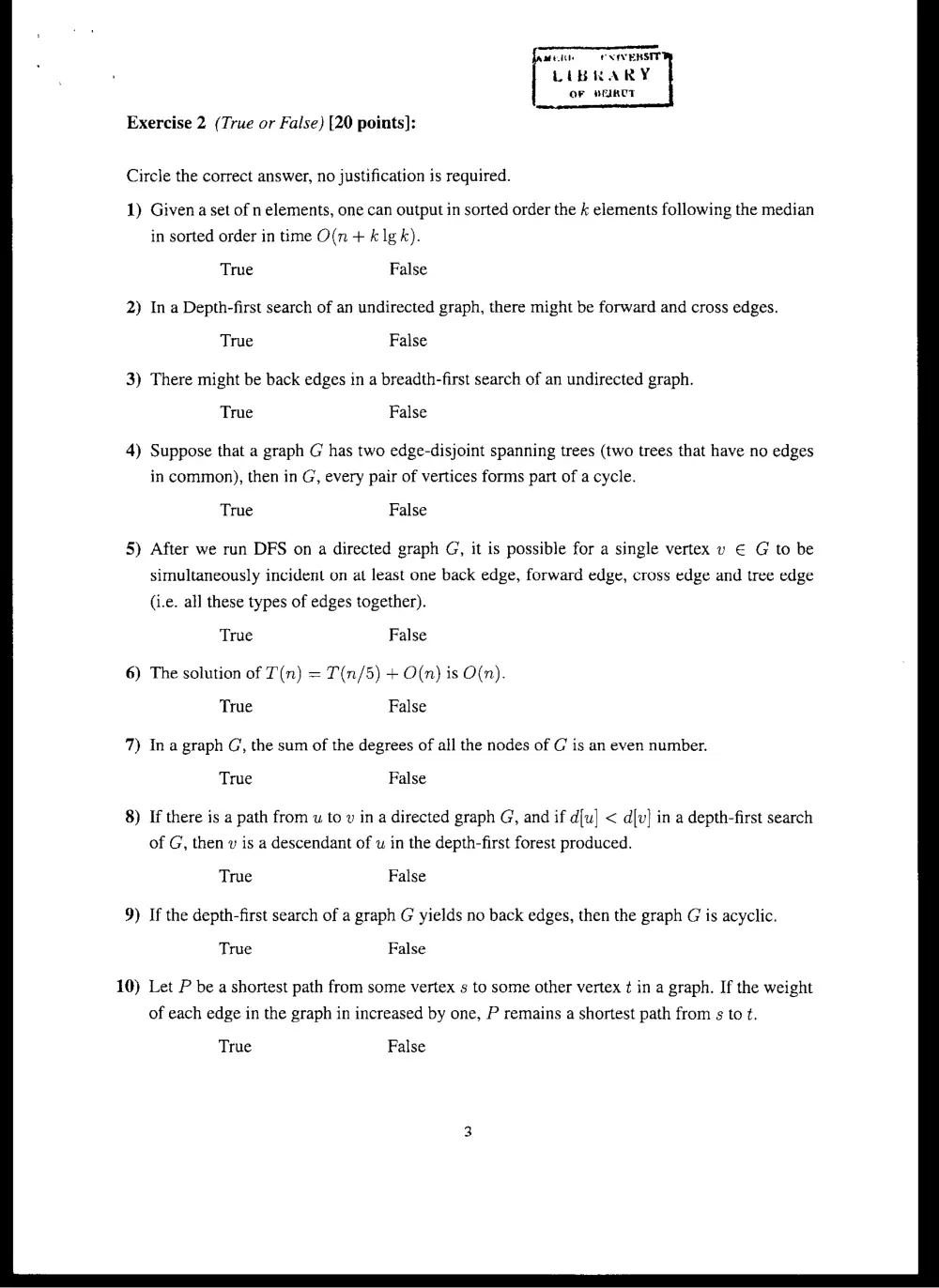
Exercise 2 (True or False) [20 points):
Circle the correct answer, no justification is required.
1) Given a set of n elements, one can output in sorted order the k elements following the median
in sorted order in time O(n + klgk).
True False
2) In a Depth-first search of an undirected graph, there might be forward and cross edges.
True False
3) There might be back edges in a breadth-first search of an undirected graph.
True False
4) Suppose that a graph G' has two edge-disjoint spanning trees (two trees that have no edges
in common), then in G, every pair of vertices forms part of a cycle.
True False
5) After we run DFS on a directed graph G, it is possible for a single vertex v € G to be
simultaneously incident on at least one back edge, forward edge, cross edge and tree edge
(i.e. all these types of edges together).
True False
6) The solution of T(n) = T(n/5) + O(n) is O(n).
True False
7) Ina graph G, the sum of the degrees of all the nodes of G' is an even number.
True False
8) If there is a path from u to v in a directed graph G, and if d[u] < d[v] in a depth-first search
of G, then v is a descendant of w in the depth-first forest produced.
True False
9) If the depth-first search of a graph G yields no back edges, then the graph G is acyclic.
True False
10) Let P be a shortest path from some vertex s to some other vertex ¢ in a graph. If the weight
of each edge in the graph in increased by one, P remains a shortest path from s to t.
True False
Exercise 3 (BFS) [8 points]:
a. Prove that in a breadth-first search of an undirected graph, for each tree edge (u,v), we have
d{v] = d[u] +1.
b. Prove that in a breadth-first search of an undirected graph, there are no forward edges.
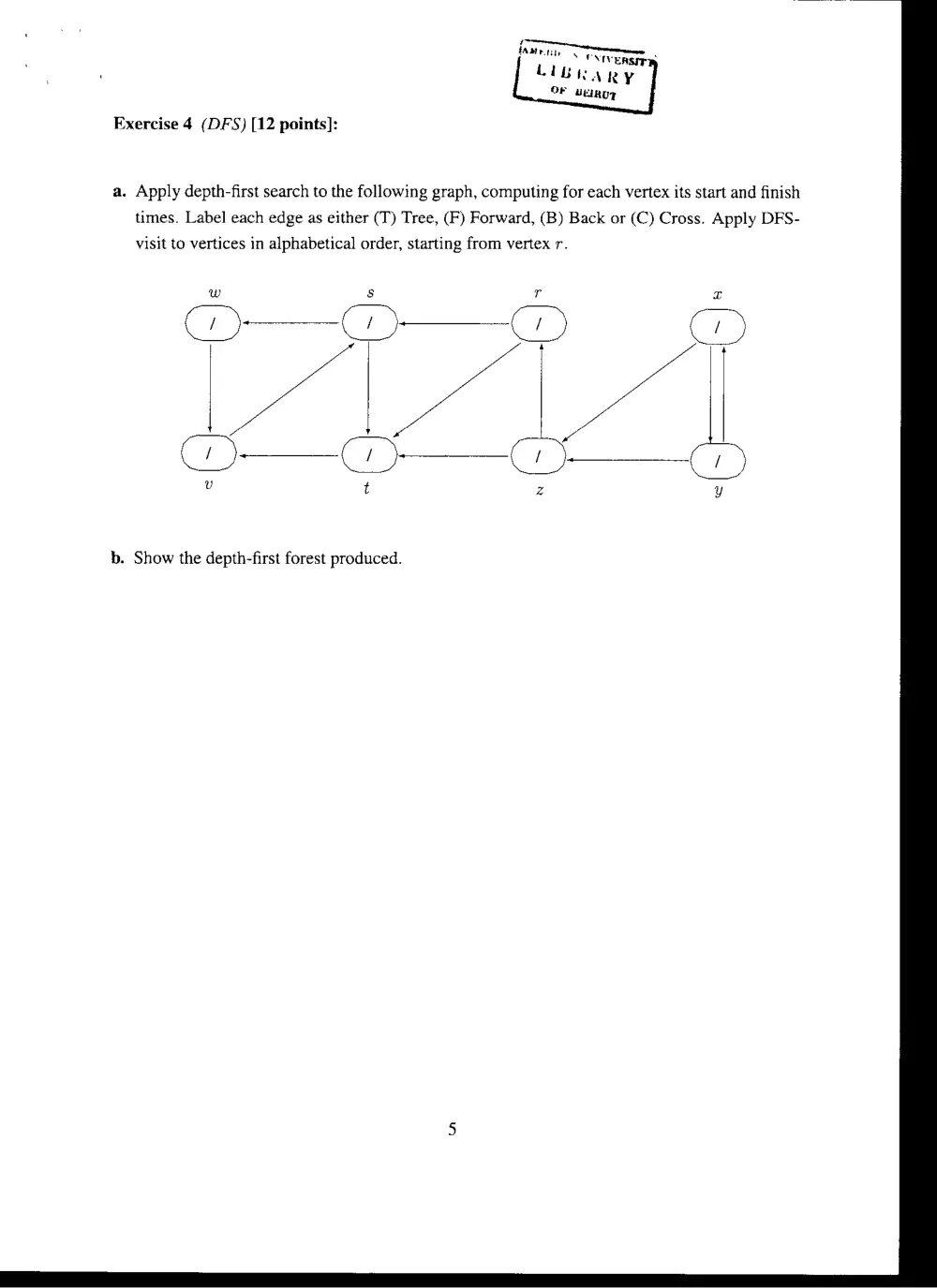
Exercise 4 (DFS) [12 points]:
a. Apply depth-first search to the following graph, computing for each vertex its start and finish
times. Label each edge as either (T) Tree, (F) Forward, (B) Back or (C) Cross. Apply DFS-
visit to vertices in alphabetical order, starting from vertex r.
C—O
C)
'
f
,
b. Show the depth-first forest produced.
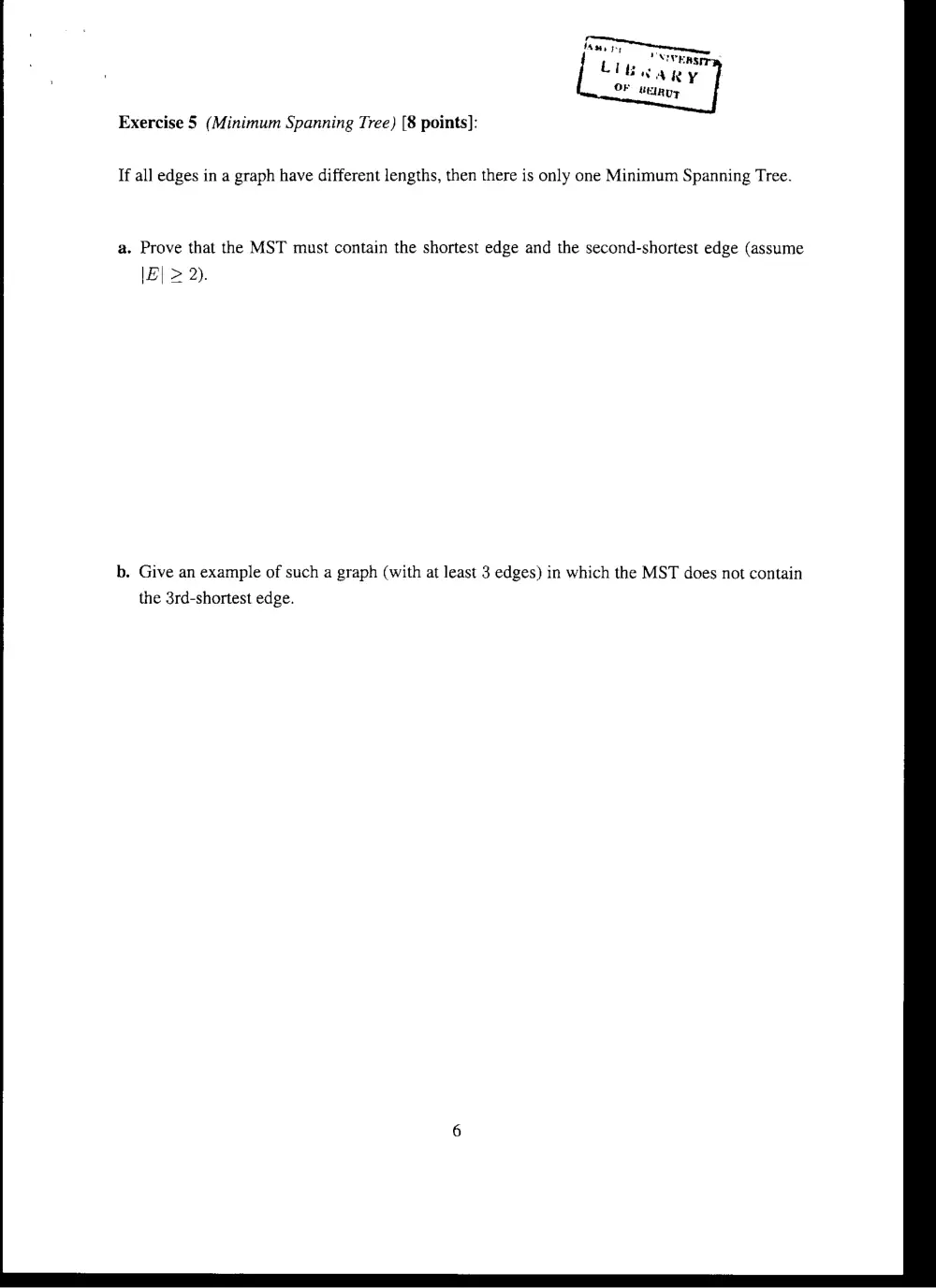
Exercise 5 (Minimum Spanning Tree) [8 points]:
If all edges in a graph have different lengths, then there is only one Minimum Spanning Tree.
a. Prove that the MST must contain the shortest edge and the second-shortest edge (assume
|B| > 2).
b. Give an example of such a graph (with at least 3 edges) in which the MST does not contain
the 3rd-shortest edge.
users
Lie. .ay
OF LEIROT
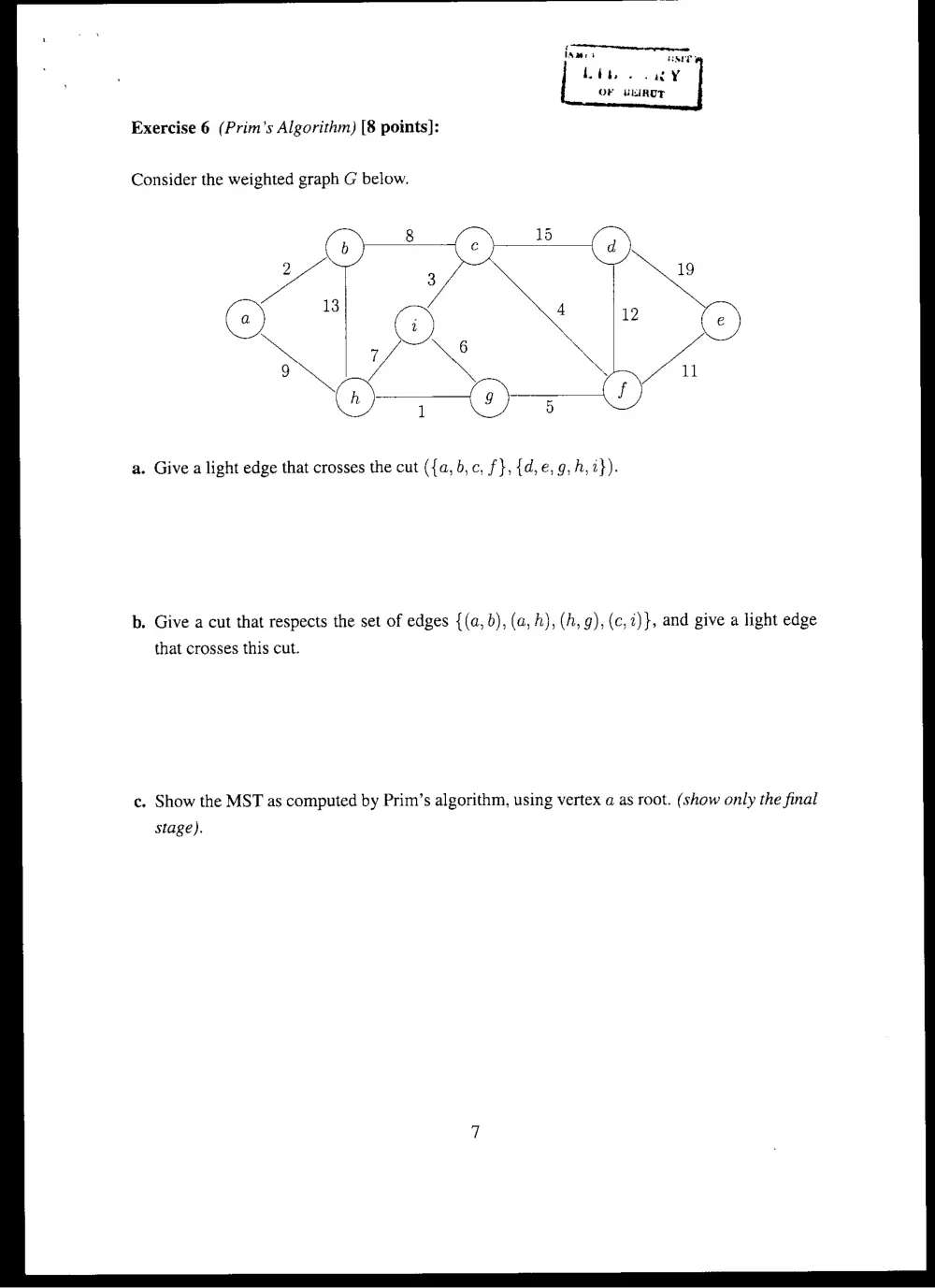
Exercise 6 (Prim’s Algorithm) [8 points]:
Consider the weighted graph G below.
aN
no
. Give a light edge that crosses the cut ({a, b,c, f}, {d,e, 9, h, t}).
. Give a cut that respects the set of edges {(a,b), (a, h), (A, 9), (c,i)}, and give a light edge
that crosses this cut.
. Show the MST as computed by Prim’s algorithm, using vertex a as root. (show only the final
stage).
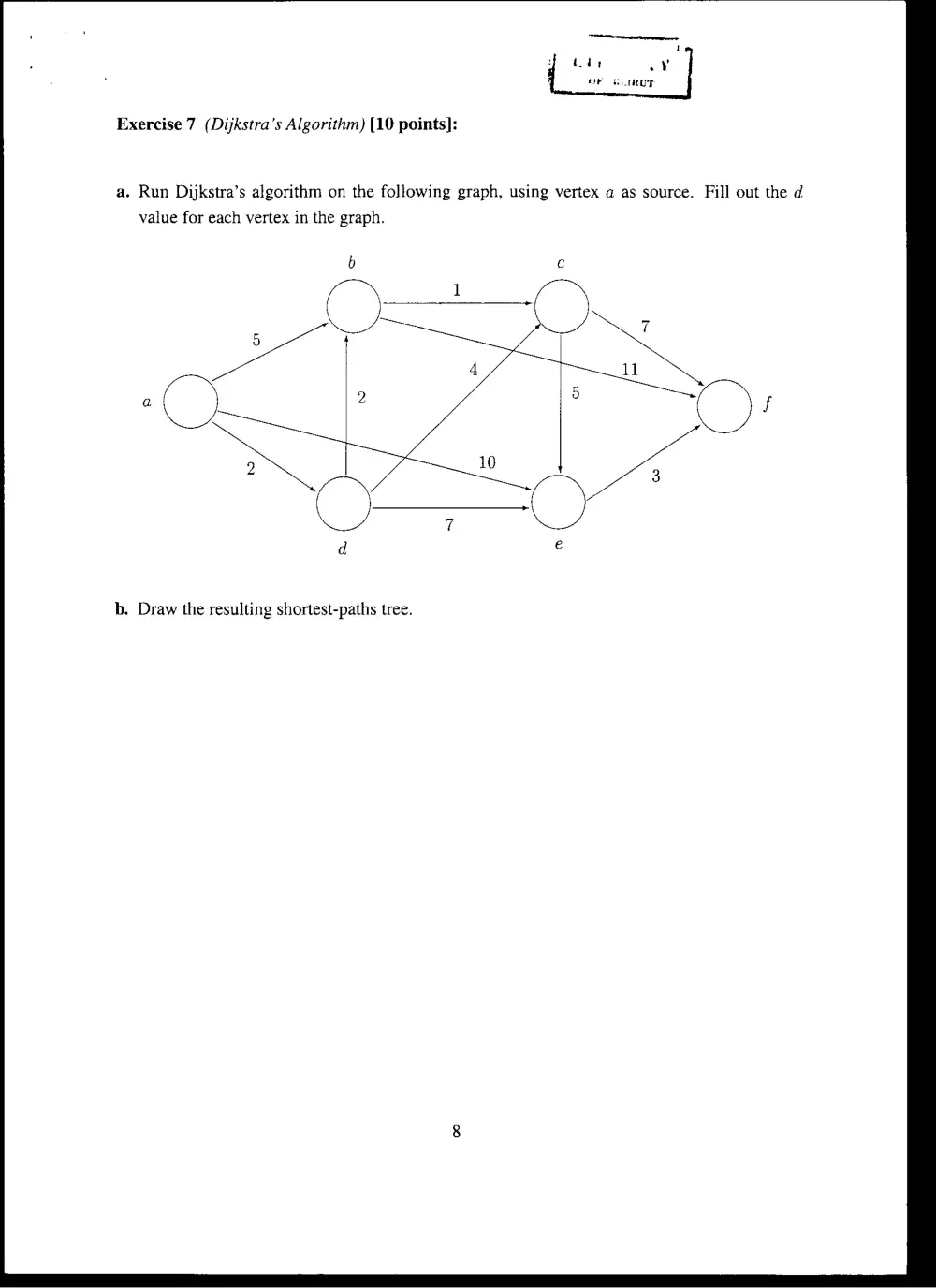
Exercise 7 (Dijkstra’s Algorithm) (10 points]:
a. Run Dijkstra’s algorithm on the following graph, using vertex a as source. Fill out the d
value for each vertex in the graph.
b. Draw the resulting shortest-paths tree.
AAMERICAS. ONTWERSITS
. LIBRARY
OF BEIRUT
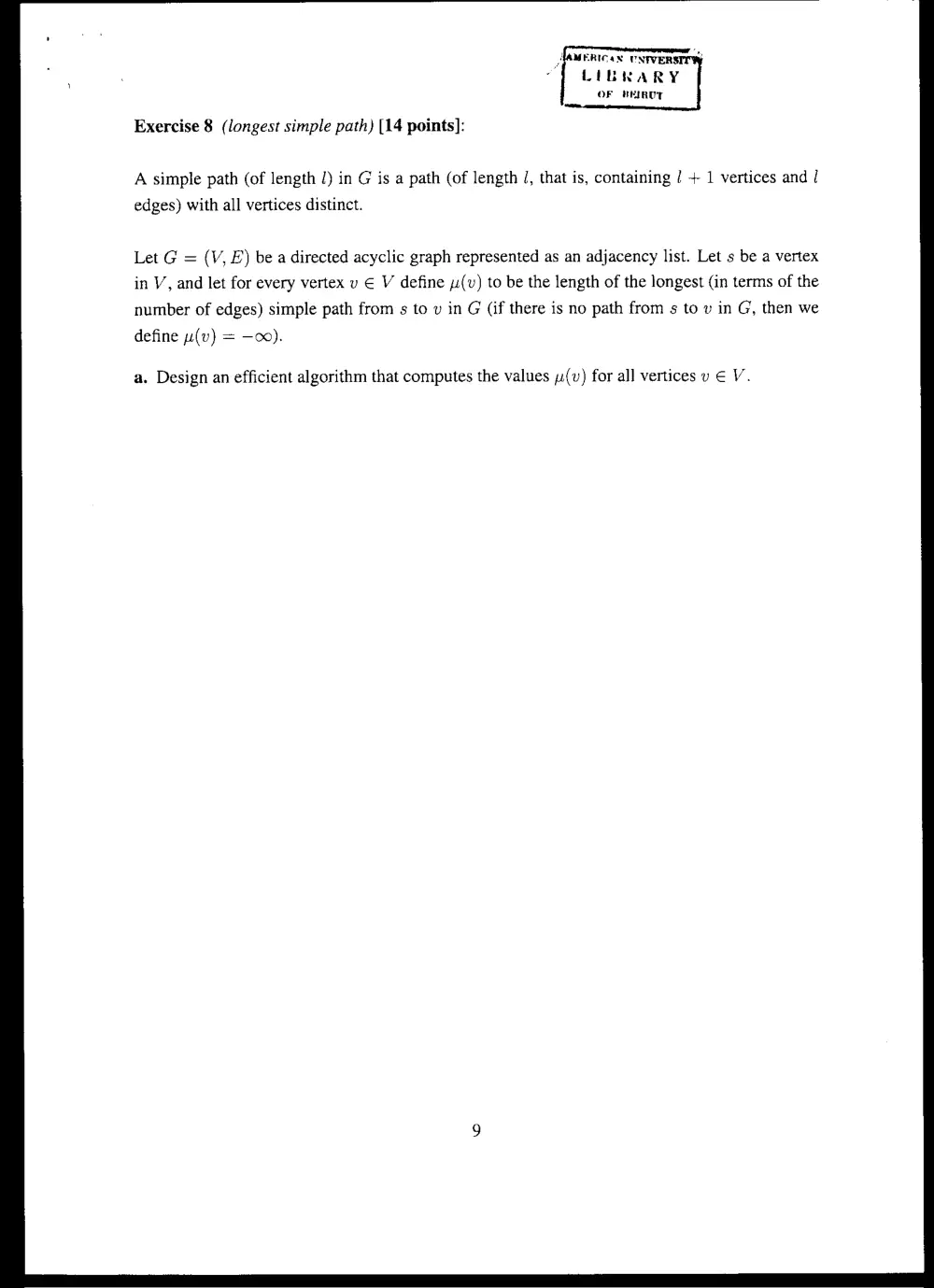
A simple path (of length /) in G is a path (of length J, that is, containing / + 1 vertices and /
Exercise 8 (longest simple path) (14 points]:
edges) with all vertices distinct.
Let G = (V, E) be a directed acyclic graph represented as an adjacency list. Let s be a vertex
in V, and let for every vertex v € V define y(v) to be the length of the longest (in terms of the
number of edges) simple path from s to v in G (if there is no path from s to v in G, then we
define y(v) = —o0).
a. Design an efficient algorithm that computes the values y(v) for all vertices v € V.