
CVSP 201 Final, Fall 2002
American University of Beirut · Ancient, Medieval and Renaissance Culture · 2 pages
More CVSP 201 files
Show the text of this final exam
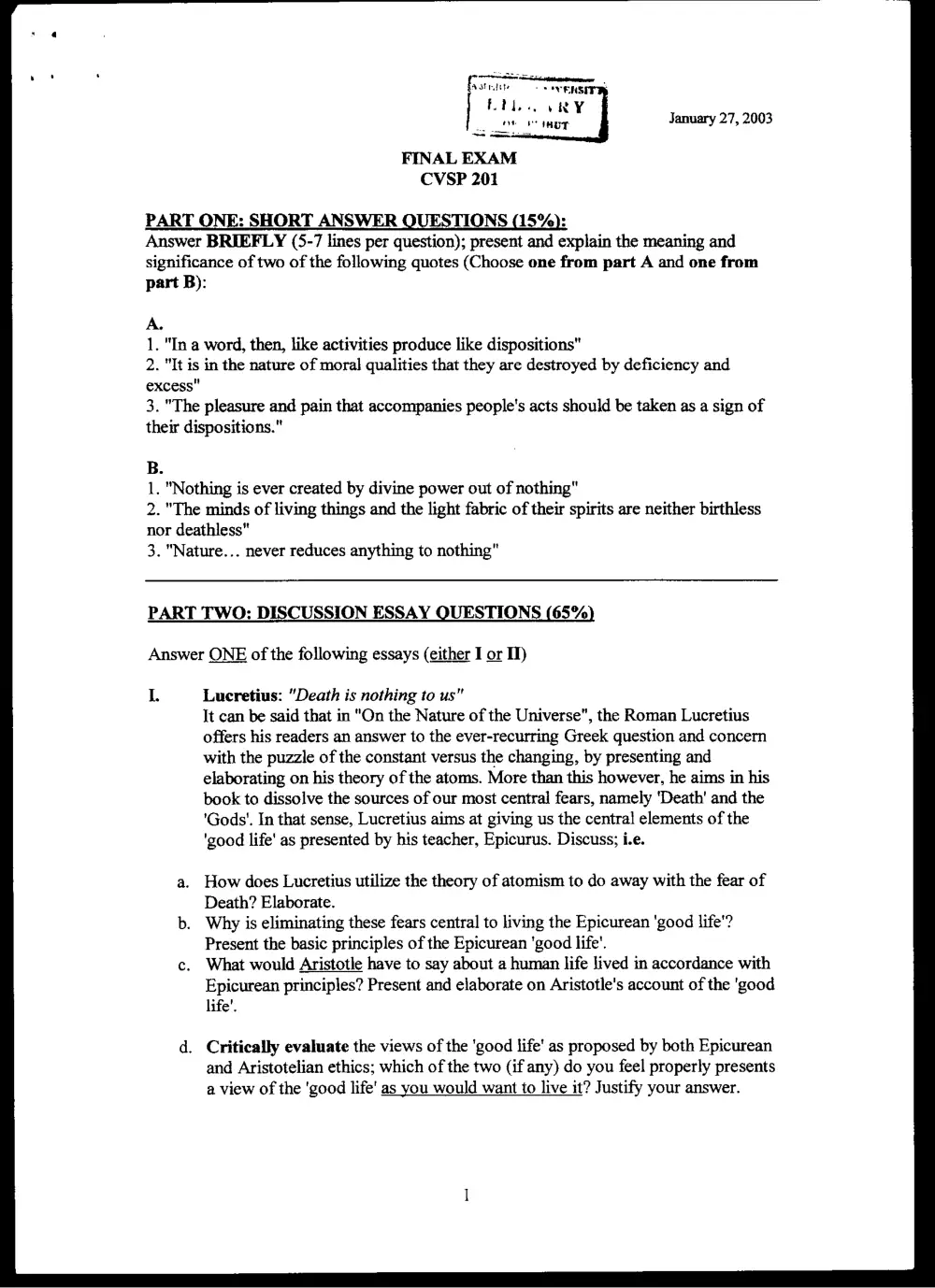
te emer January 27, 2003
CVSP 201
PART ONE: SHORT ANSWER QUESTIONS (15%):
Answer BRIEFLY (5-7 lines per question); present and explain the meaning and
significance of two of the following quotes (Choose one from part A and one from
part B):
A.
1. "In a word, then, like activities produce like dispositions"
2. "It is in the nature of moral qualities that they are destroyed by deficiency and
excess"
3. "The pleasure and pain that accompanies people's acts should be taken as a sign of
their dispositions."
B.
1. "Nothing is ever created by divine power out of nothing"
2. "The minds of living things and the light fabric of their spirits are neither birthless
nor deathless"
3. "Nature... never reduces anything to nothing"
PART TWO: DISCUSSION ESSAY QUESTIONS (65%
Answer ONE of the following essays (either I or I)
IL Lucretius: “Death is nothing to us"
It can be said that in "On the Nature of the Universe", the Roman Lucretius
offers his readers an answer to the ever-recurring Greek question and concern
with the puzzle of the constant versus the changing, by presenting and
elaborating on his theory of the atoms. More than this however, he aims in his
book to dissolve the sources of our most central fears, namely ‘Death’ and the
‘Gods’. In that sense, Lucretius aims at giving us the central elements of the
'good life’ as presented by his teacher, Epicurus. Discuss; i.e.
. How does Lucretius utilize the theory of atomism to do away with the fear of
Death? Elaborate.
. Why is eliminating these fears central to living the Epicurean 'good life’?
Present the basic principles of the Epicurean 'good life’.
. What would Aristotle have to say about a human life lived in accordance with
Epicurean principles? Present and elaborate on Aristotle's account of the 'good
life’.
. Critically evaluate the views of the 'good life’ as proposed by both Epicurean
and Aristotelian ethics; which of the two (if any) do you feel properly presents
a view of the 'good life' as you would want to live it? Justify your answer.
MER. UNIVERSIT RS
LIBRARY
ar BGROT
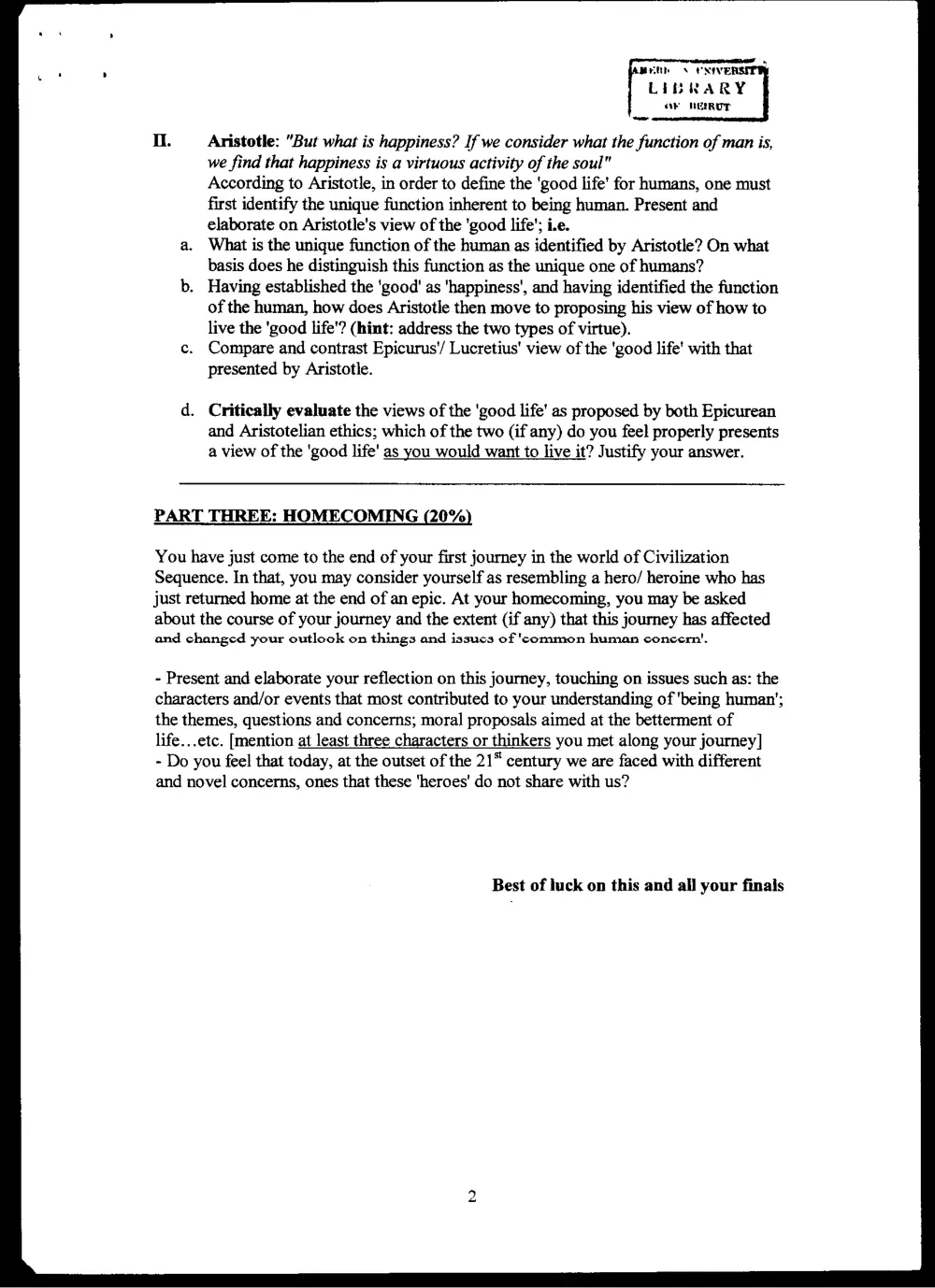
Aristotle: "But what is happiness? If we consider what the function of man is,
we find that happiness is a virtuous activity of the soul"
According to Aristotle, in order to define the ‘good life’ for humans, one must
first identify the unique function inherent to being human. Present and
elaborate on Aristotle's view of the 'good life’; i.e.
What is the unique function of the human as identified by Aristotle? On what
basis does he distinguish this function as the unique one of humans?
. Having established the 'good' as ‘happiness’, and having identified the function
of the human, how does Aristotle then move to proposing his view of how to
live the 'good life’? (hint: address the two types of virtue).
Compare and contrast Epicurus’/ Lucretius' view of the 'good life’ with that
presented by Aristotle.
. Critically evaluate the views of the 'good life' as proposed by both Epicurean
and Aristotelian ethics; which of the two (if any) do you feel properly presents
a view of the 'good life' as you would want to live it? Justify your answer.
PART THREE: HOMECOMING (20%)
You have just come to the end of your first journey in the world of Civilization
Sequence. In that, you may consider yourself as resembling a hero/ heroine who has
just returned home at the end of an epic. At your homecoming, you may be asked
about the course of your journey and the extent (if any) that this journey has affected
and changed your outlook on things and issucs of ‘common human concern.
- Present and elaborate your reflection on this journey, touching on issues such as: the
characters and/or events that most contributed to your understanding of 'being human’;
the themes, questions and concerns; moral proposals aimed at the betterment of
life...etc. [mention at least three characters or thinkers you met along your journey]
- Do you feel that today, at the outset of the 21* century we are faced with different
and novel concerns, ones that these ‘heroes’ do not share with us?
Best of luck on this and all your finais