
CVSP 201 Final, Fall 2008
American University of Beirut · Ancient, Medieval and Renaissance Culture · 1 page
Stuck on a question? A tutor can walk you through it.
More CVSP 201 files
Show the text of this final exam
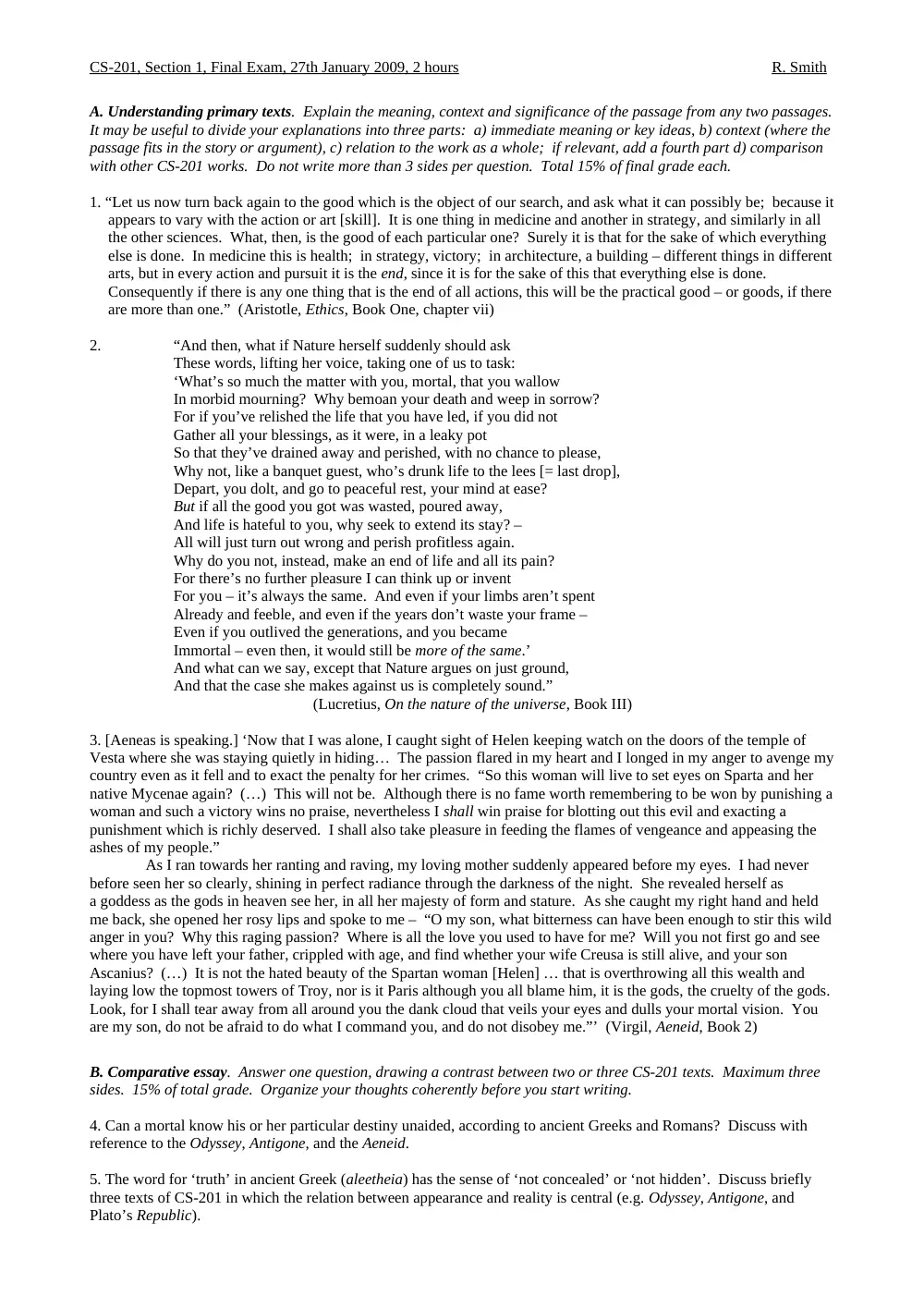
CS-201, Section 1, Final Exam, 27th January 2009, 2 hours
R. Smith
A. Understanding primary texts. Explain the meaning, context and significance of the passage from any two passages.
It may be useful to divide your explanations into three parts: a) immediate meaning or key ideas, b) context (where the
passage fits in the story or argument), c) relation to the work as a whole; if relevant, add a fourth part d) comparison
with other CS-201 works. Do not write more than 3 sides per question. Total 15% of final grade each.
1. “Let us now turn back again to the good which is the object of our search, and ask what it can possibly be; because it
appears to vary with the action or art [skill]. It is one thing in medicine and another in strategy, and similarly in all
the other sciences. What, then, is the good of each particular one? Surely it is that for the sake of which everything
else is done. In medicine this is health; in strategy, victory; in architecture, a building – different things in different
arts, but in every action and pursuit it is the end, since it is for the sake of this that everything else is done.
Consequently if there is any one thing that is the end of all actions, this will be the practical good – or goods, if there
are more than one.” (Aristotle, Ethics, Book One, chapter vii)
2.
“And then, what if Nature herself suddenly should ask
These words, lifting her voice, taking one of us to task:
‘What’s so much the matter with you, mortal, that you wallow
In morbid mourning? Why bemoan your death and weep in sorrow?
For if you’ve relished the life that you have led, if you did not
Gather all your blessings, as it were, in a leaky pot
So that they’ve drained away and perished, with no chance to please,
Why not, like a banquet guest, who’s drunk life to the lees [= last drop],
Depart, you dolt, and go to peaceful rest, your mind at ease?
But if all the good you got was wasted, poured away,
And life is hateful to you, why seek to extend its stay? –
All will just turn out wrong and perish profitless again.
Why do you not, instead, make an end of life and all its pain?
For there’s no further pleasure I can think up or invent
For you – it’s always the same. And even if your limbs aren’t spent
Already and feeble, and even if the years don’t waste your frame –
Even if you outlived the generations, and you became
Immortal – even then, it would still be more of the same.’
And what can we say, except that Nature argues on just ground,
And that the case she makes against us is completely sound.”
(Lucretius, On the nature of the universe, Book III)
3. [Aeneas is speaking.] ‘Now that I was alone, I caught sight of Helen keeping watch on the doors of the temple of
Vesta where she was staying quietly in hiding… The passion flared in my heart and I longed in my anger to avenge my
country even as it fell and to exact the penalty for her crimes. “So this woman will live to set eyes on Sparta and her
native Mycenae again? (…) This will not be. Although there is no fame worth remembering to be won by punishing a
woman and such a victory wins no praise, nevertheless I shall win praise for blotting out this evil and exacting a
punishment which is richly deserved. I shall also take pleasure in feeding the flames of vengeance and appeasing the
ashes of my people.”
As I ran towards her ranting and raving, my loving mother suddenly appeared before my eyes. I had never
before seen her so clearly, shining in perfect radiance through the darkness of the night. She revealed herself as
a goddess as the gods in heaven see her, in all her majesty of form and stature. As she caught my right hand and held
me back, she opened her rosy lips and spoke to me – “O my son, what bitterness can have been enough to stir this wild
anger in you? Why this raging passion? Where is all the love you used to have for me? Will you not first go and see
where you have left your father, crippled with age, and find whether your wife Creusa is still alive, and your son
Ascanius? (…) It is not the hated beauty of the Spartan woman [Helen] … that is overthrowing all this wealth and
laying low the topmost towers of Troy, nor is it Paris although you all blame him, it is the gods, the cruelty of the gods.
Look, for I shall tear away from all around you the dank cloud that veils your eyes and dulls your mortal vision. You
are my son, do not be afraid to do what I command you, and do not disobey me.”’ (Virgil, Aeneid, Book 2)
B. Comparative essay. Answer one question, drawing a contrast between two or three CS-201 texts. Maximum three
sides. 15% of total grade. Organize your thoughts coherently before you start writing.
4. Can a mortal know his or her particular destiny unaided, according to ancient Greeks and Romans? Discuss with
reference to the Odyssey, Antigone, and the Aeneid.
5. The word for ‘truth’ in ancient Greek (aleetheia) has the sense of ‘not concealed’ or ‘not hidden’. Discuss briefly
three texts of CS-201 in which the relation between appearance and reality is central (e.g. Odyssey, Antigone, and
Plato’s Republic).