
CVSP 201 Final, Fall 2008
American University of Beirut · Ancient, Medieval and Renaissance Culture · 1 page
Stuck on a question? A tutor can walk you through it.
More CVSP 201 files
Show the text of this final exam
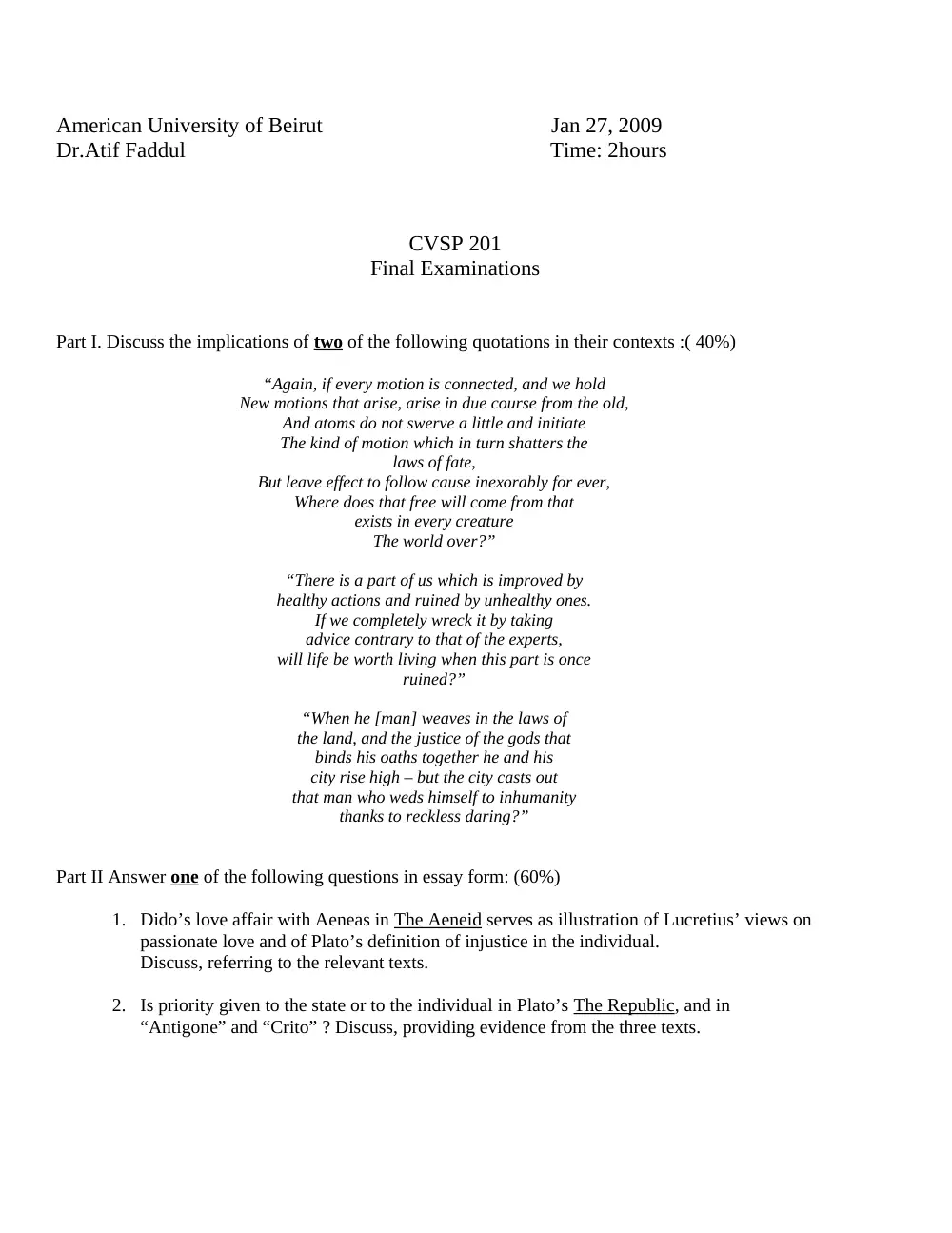
American University of Beirut Jan 27, 2009
Dr.Atif Faddul Time: 2hours
CVSP 201
Final Examinations
Part I. Discuss the implications of two of the following quotations in their contexts :( 40%)
“Again, if every motion is connected, and we hold
New motions that arise, arise in due course from the old,
And atoms do not swerve a little and initiate
The kind of motion which in turn shatters the
laws of fate,
But leave effect to follow cause inexorably for ever,
Where does that free will come from that
exists in every creature
The world over?”
“There is a part of us which is improved by
healthy actions and ruined by unhealthy ones.
If we completely wreck it by taking
advice contrary to that of the experts,
will life be worth living when this part is once
ruined?”
“When he [man] weaves in the laws of
the land, and the justice of the gods that
binds his oaths together he and his
city rise high – but the city casts out
that man who weds himself to inhumanity
thanks to reckless daring?”
Part II Answer one of the following questions in essay form: (60%)
1. Dido’s love affair with Aeneas in The Aeneid serves as illustration of Lucretius’ views on
passionate love and of Plato’s definition of injustice in the individual.
Discuss, referring to the relevant texts.
2. Is priority given to the state or to the individual in Plato’s The Republic, and in
“Antigone” and “Crito” ? Discuss, providing evidence from the three texts.