
CVSP 201 Final, Fall 2002
American University of Beirut · Ancient, Medieval and Renaissance Culture · 2 pages
More CVSP 201 files
Show the text of this final exam
MERICAN UNIVERSIT
LIBRARY
OF BEIRUT
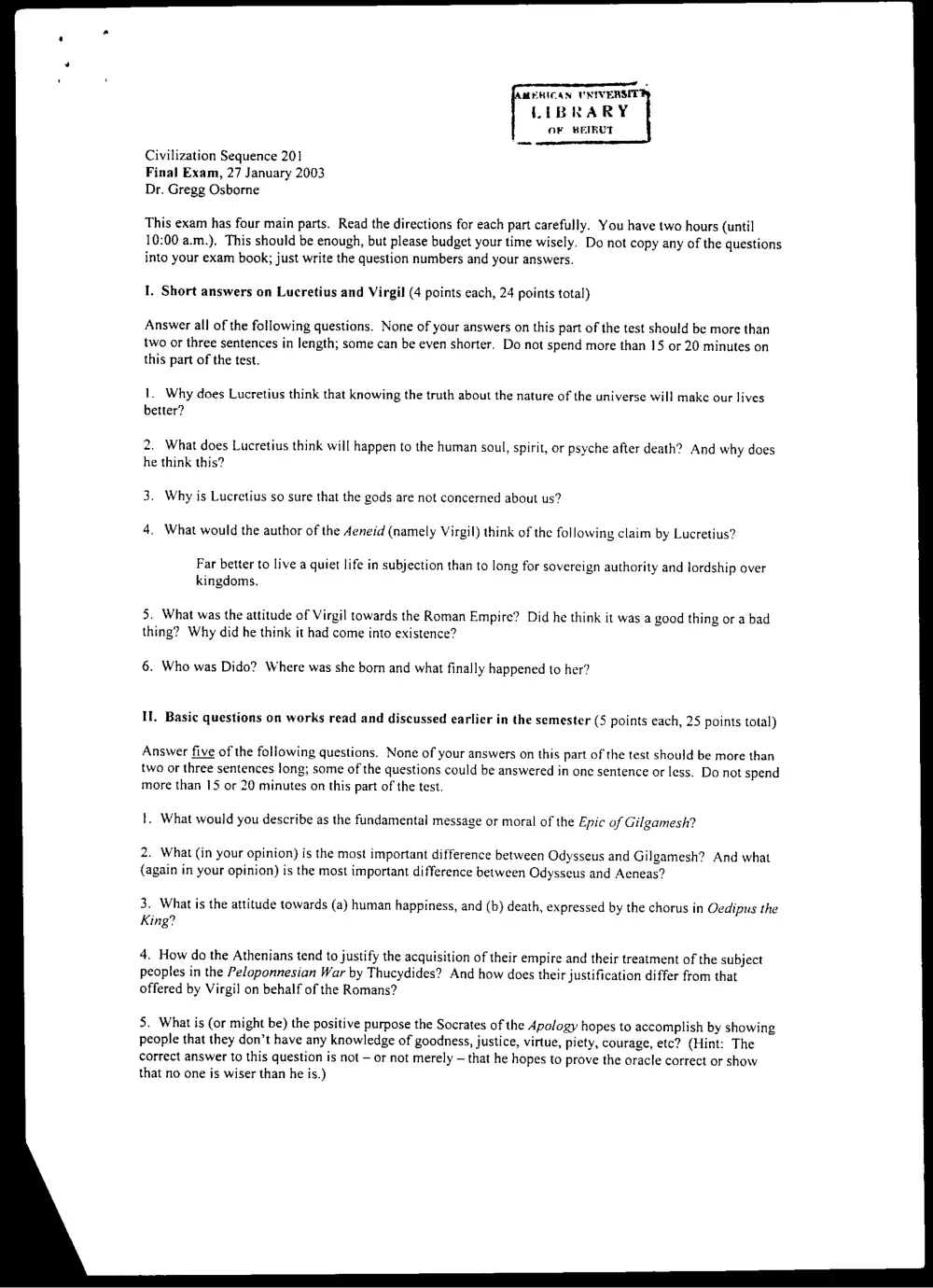
Civilization Sequence 201
Final Exam, 27 January 2003
Dr. Gregg Osborne
This exam has four main parts. Read the directions for each part carefully. You have two hours (until
10:00 a.m.), This should be enough, but please budget your time wisely. Do not copy any of the questions
into your exam book; just write the question numbers and your answers.
I. Short answers on Lucretius and Virgil (4 points each, 24 points total)
Answer all of the following questions. None of your answers on this part of the test should be more than
two or three sentences in length; some can be even shorter. Do not spend more than 15 or 20 minutes on
this part of the test.
1. Why does Lucretius think that knowing the truth about the nature of the universe will make our lives
better?
2. What does Lucretius think wiil happen to the human soul, spirit, or psyche after death? And why does
he think this?
3. Why is Lucretius so sure that the gods are not concerned about us?
4, What would the author of the Aeneid (namely Virgil) think of the following claim by Lucretius?
Far better to live a quiet life in subjection than to long for sovereign authority and lordship over
kingdoms.
5. What was the attitude of Virgil towards the Roman Empire? Did he think it was a good thing or a bad
thing? Why did he think it had come into existence?
6. Who was Dido? Where was she born and what finally happened to her?
II. Basic questions on works read and discussed earlier in the semester (5 points each, 25 points total)
Answer five of the following questions. None of your answers on this part of the test should be more than
two or three sentences long; some of the questions could be answered in one sentence or less. Do not spend
more than 15 or 20 minutes on this part of the test.
1. What would you describe as the fundamental message or moral of the Epic of Gilgamesh?
2. What (in your opinion) is the most important difference between Odysseus and Gilgamesh? And what
{again in your opinion) is the most important difference between Odysseus and Aeneas?
3. What is the attitude towards (a) human happiness, and (b) death, expressed by the chorus in Oedipus the
King?
4. How do the Athenians tend to justify the acquisition of their empire and their treatment of the subject
peoples in the Peloponnesian War by Thucydides? And how does their justification differ from that
offered by Virgil on behalf of the Romans?
5. What is (or might be) the positive purpose the Socrates of the Apology hopes to accomplish by showing
people that they don’t have any knowledge of goodness, justice, virtue, piety, courage, etc? (Hint: The
correct answer to this question is not — or not merely — that he hopes to prove the oracle correct or show
that no one is wiser than he is.)
LIBRARY
OF SEIRDT
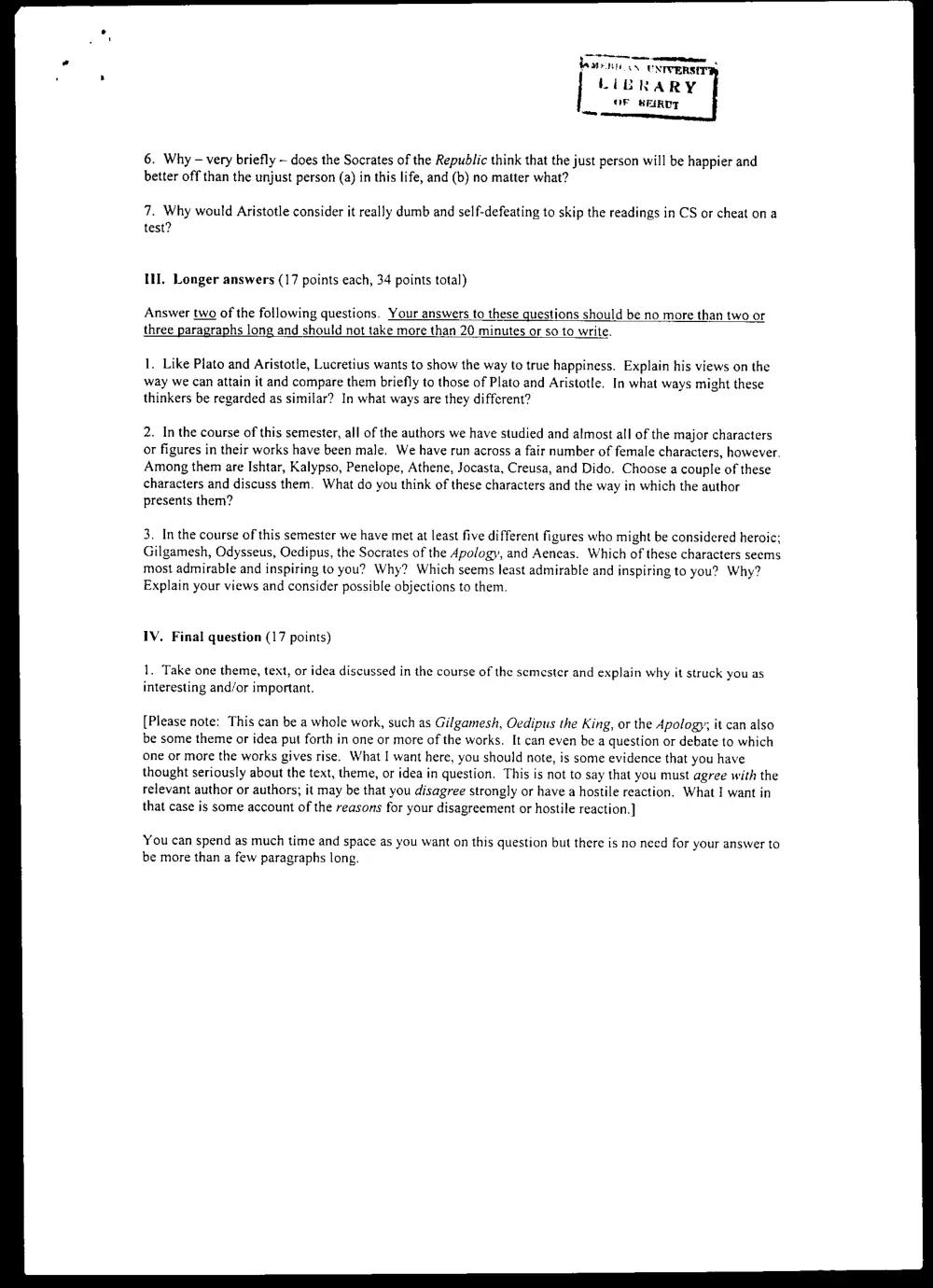
6. Why — very briefly ~ does the Socrates of the Republic think that the just person will be happier and
better off than the unjust person (a) in this life, and (b) no matter what?
7. Why would Aristotle consider it really dumb and self-defeating to skip the readings in CS or cheat ona
test?
II. Longer answers (17 points each, 34 points total)
Answer two of the following questions. Your answers to these questions should be no more than two or
three paragraphs long and should not take more than 20 minutes or so to write.
1. Like Plato and Aristotle, Lucretius wants to show the way to true happiness. Explain his views on the
way we can attain it and compare them briefly to those of Plato and Aristotle. In what ways might these
thinkers be regarded as similar? In what ways are they different?
2. In the course of this semester, all of the authors we have studied and almost all of the major characters
or figures in their works have been male. We have run across a fair number of female characters, however.
Among them are Ishtar, Kalypso, Penelope, Athene, Jocasta, Creusa, and Dido. Choose a couple of these
characters and discuss them. What do you think of these characters and the way in which the author
presents them?
3. In the course of this semester we have met at least five different figures who might be considered heroic;
Gilgamesh, Odysseus, Oedipus, the Socrates of the Apology, and Aeneas. Which of these characters seems
most admirable and inspiring to you? Why? Which seems least admirable and inspiring to you? Why?
Explain your views and consider possible objections to them.
1V. Final question (17 points)
1. Take one theme, text, or idea discussed in the course of the semester and explain why it struck you as
interesting and/or important.
[Please note: This can be a whole work, such as Gilgamesh, Oedipus the King, or the Apology; it can also
be some theme or idea put forth in one or more of the works. It can even be a question or debate to which
one or more the works gives rise. What I want here, you should note, is some evidence that you have
thought seriously about the text, theme, or idea in question. This is not to say that you must agree with the
relevant author or authors; it may be that you disagree strongly or have a hostile reaction. What I want in
that case is some account of the reasons for your disagreement or hostile reaction. ]
You can spend as much time and space as you want on this question but there is no need for your answer to
be more than a few paragraphs long.