
CVSP 201 Final, Fall 2002
American University of Beirut · Ancient, Medieval and Renaissance Culture · 2 pages

More CVSP 201 files
Show the text of this final exam
fast Et NTVERS!
LIBRARY
OF SERUT
CVSP 201 Fall 2002 Final Exam (2 hours) Dr Wrisley
This exam is in three parts. No books or notes are to be used in answering the questions. Absolute
silence is required in the room. Eyes on your own paper. Note the point values assigned to each
section.
PartI: Identifications (15 minutes, 20 points). Choose two (2) of the following six (6) quotations below.
As best as you can in about 5 sentences, identify (a) from what text it comes and the author
(b) its context within the work or in what argument it is found (c) its significance to the work as a
whole, that is, what are some of the major themes of the author’s work reflected in it. Do not recopy
the passage.
1. “Virtue, then, is of two kinds, intellectual and moral. Intellectual virtue owes both its
inception and its growth chiefly to instruction, and for this reason needs time and experience.
Moral goodness, on the other hand, is the result of habit, from which it has actually got its
name, being a slight modification of the word ethos. This fact makes it obvious that none of
the moral virtues is engendered in us by nature.”
“As children in blank darkness tremble and start at everything, so we in broad daylight are
oppressed at times by fears as baseless as those horrors which children imagine coming upon
them in the dark. This dread and darkness of the mind cannot be dispelled by the sunbeams,
the shining shafts of day, but only by an understanding of the outward form and inner
workings of nature.”
“Have no fear, men of Troy. Put every anxious thought out of your hearts. This is anew
kingdom, and it is harsh necessity that forces me to take these precautions and to post guards
on all our frontiers. But who could fail to know about the people of Aeneas and his ancestry,
or the city of Troy, the valour of its men and the flames of war that engulfed it? We here in
Carthage are not so dull in mind as that ... Do you wish to settle with me on an equal footing,
even here in this kingdom of Carthage? The city which I am founding is yours. Draw your
ships on the beach. Trojan and Tyrian shall be as one in my eyes. I wish only that your king
Aeneas had been driven by the same south wind, and were here with you now.”
“For contemplation is the highest form of activity (since the intellect is the highest thing in us,
and the objects that it apprehends are the highest things that can be known), and also it is the
most continuous, because we are more capable of continuous contemplation than we are of
any practical activity. Also we assume that happiness must contain an admixture of pleasure;
now activity in accordance with (philosophic) wisdom is admittedly the most pleasant of the
virtuous activities; at any rate philosophy is held to entail pleasures that are marvelous in
purity and permanence; and it stands to reason that those who possess knowledge pass their
time more pleasantly than those who are still in pursuit of it.”
“Do not move away. Do not leave my sight. Who are you running from?”
“Let us now consider why reverence for the gods is widespread among the nations. What has
crowded their cities with altars and inaugurated those solemn rites that are in vogue today in
great and powerful states? What has implanted in mortal hearts that chill of dread which even
now rears new temples of the gods the wide world over and packs them on holy days with
pious multitudes? The explanation is not far to seek. Already in those early days men had
visions when their minds were awake, and more clearly in sleep, of divine figures,
outstanding in beauty and impressive in stature... They pictured their lot as far superior to that
of mortals and in dreams they saw them perform all sorts of miracles without the slightest
effort.”
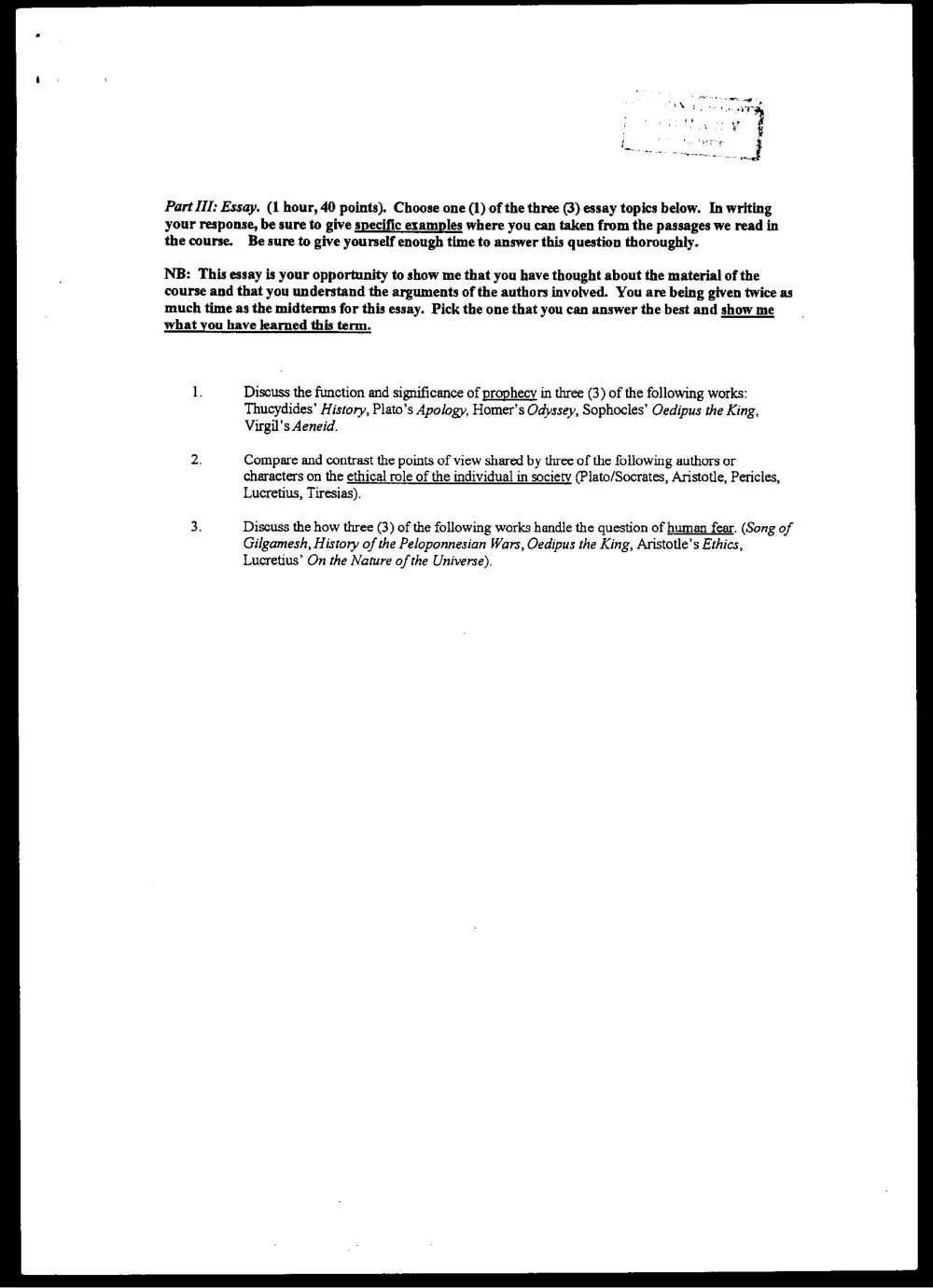
Part III: Essay. (1 hour, 40 points). Choose one (1) of the three (3) essay topics below. In writing
your response, be sure to give specific examples where you can taken from the passages we read in
the course. Be sure to give yourself enough time to answer this question thoroughly.
NB: This essay is your opportunity to show me that you have thought about the material of the
course and that you understand the arguments of the authors involved. You are being given twice as
much time as the midterms for this essay. Pick the one that you can answer the best and show me
what you have learned this term.
Discuss the function and significance of prophecy in three (3) of the following works:
Thucydides’ History, Plato’s Apology, Homer’s Odyssey, Sophocles’ Oedipus the King,
Virgil’s Aeneid.
Compare and contrast the points of view shared by three of the following authors or
characters on the ethical role of the individual in society (Plato/Socrates, Aristotle, Pericles,
Lucretius, Tiresias).
Discuss the how three (3) of the following works handle the question of human fear. (Song of
Gilgamesh, History of the Peloponnesian Wars, Oedipus the King, Aristotle’s Ethics,
Lucretius’ On the Nature of the Universe).