
CVSP 201 Final, Fall 2004
American University of Beirut · Ancient, Medieval and Renaissance Culture · 4 pages
More CVSP 201 files
Show the text of this final exam
ere eee
ERICAN PME Sa
Libary |
OF REIRE?
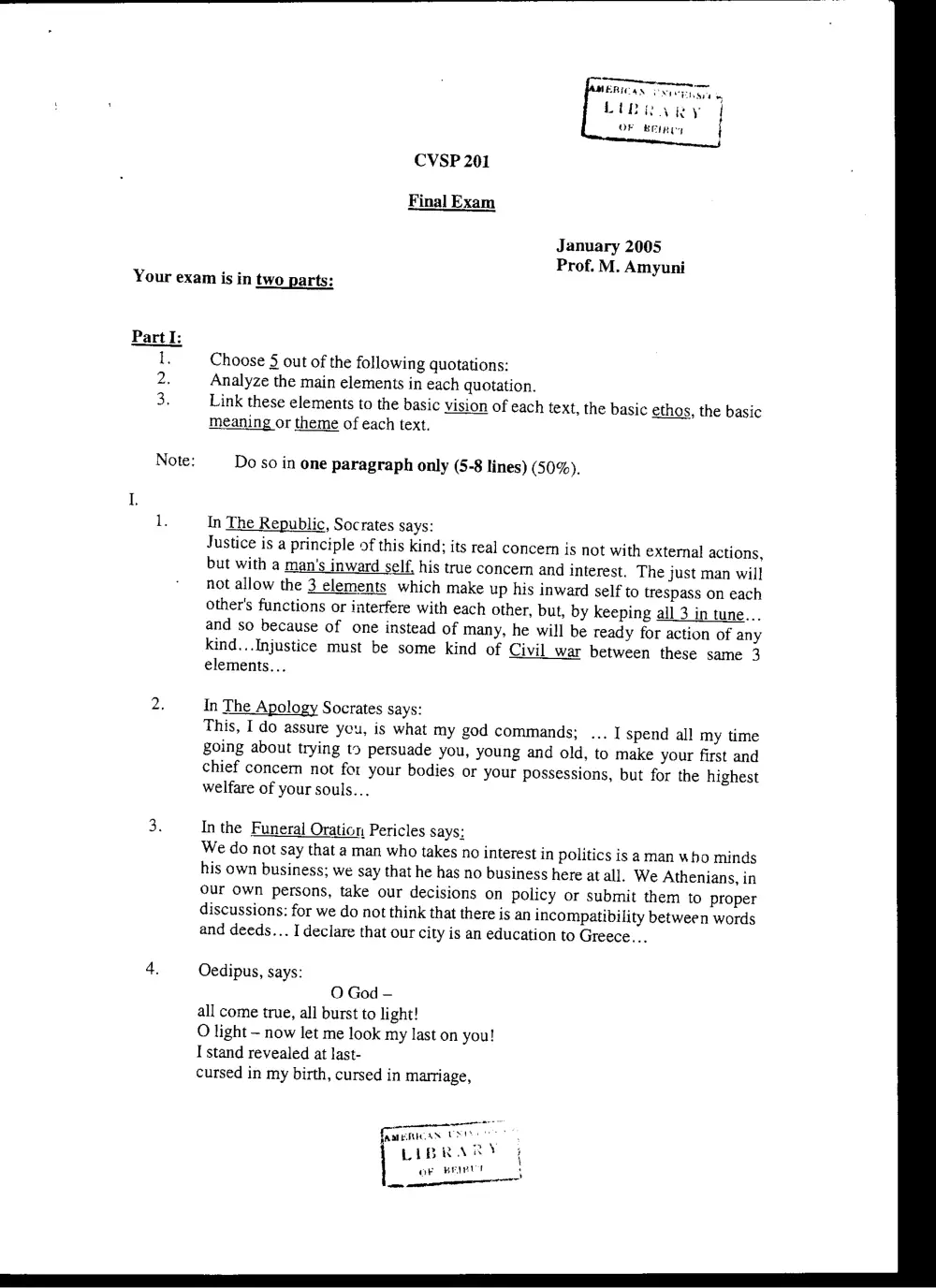
CVSP 201
Final Exam
January 2005
Prof. M. Amyuni
Your exam is in two parts:
Part I:
WN
Note:
Choose 5 out of the following quotations:
Analyze the main elements in each quotation.
Link these elements to the basic vision of each text, the basic ethos, the basic
meaning or theme of each text.
Do so in one paragraph only (5-8 lines) (50%).
In The Republic, Socrates says:
Justice is a principle of this kind: its real concern is not with external actions,
but with a man's inward self, his true concern and interest. The just man will
not allow the 3 elements which make up his inward self to trespass on each
other's functions or interfere with each other, but, by keeping all 3 in tune...
and so because of one instead of many, he will be ready for action of any
kind...Injustice must be some kind of Civil war between these same 3
elements...
In The Apology Socrates says:
This, I do assure you, is what my god commands; ... I spend all my time
going about trying t> persuade you, young and old, to make your first and
chief concem not for your bodies or your possessions, but for the highest
welfare of your souls...
In the Funeral Oration Pericles Says:
We do not say that a man who takes no interest in politics is a man who minds
his own business; we say that he has no business here at all. We Athenians, in
our own persons, take our decisions on policy or submit them to proper
discussions: for we do not think that there is an incompatibility between words
and deeds... I declare that our city is an education to Greece...
Oedipus, says:
O God —
all come true, all burst to light!
O light — now let me look my last on you!
I stand revealed at last-
cursed in my birth, cursed in marriage,
ae
famemican Exe
{ a .
LIBRARY i
oR BEIRUT 4
ane ee
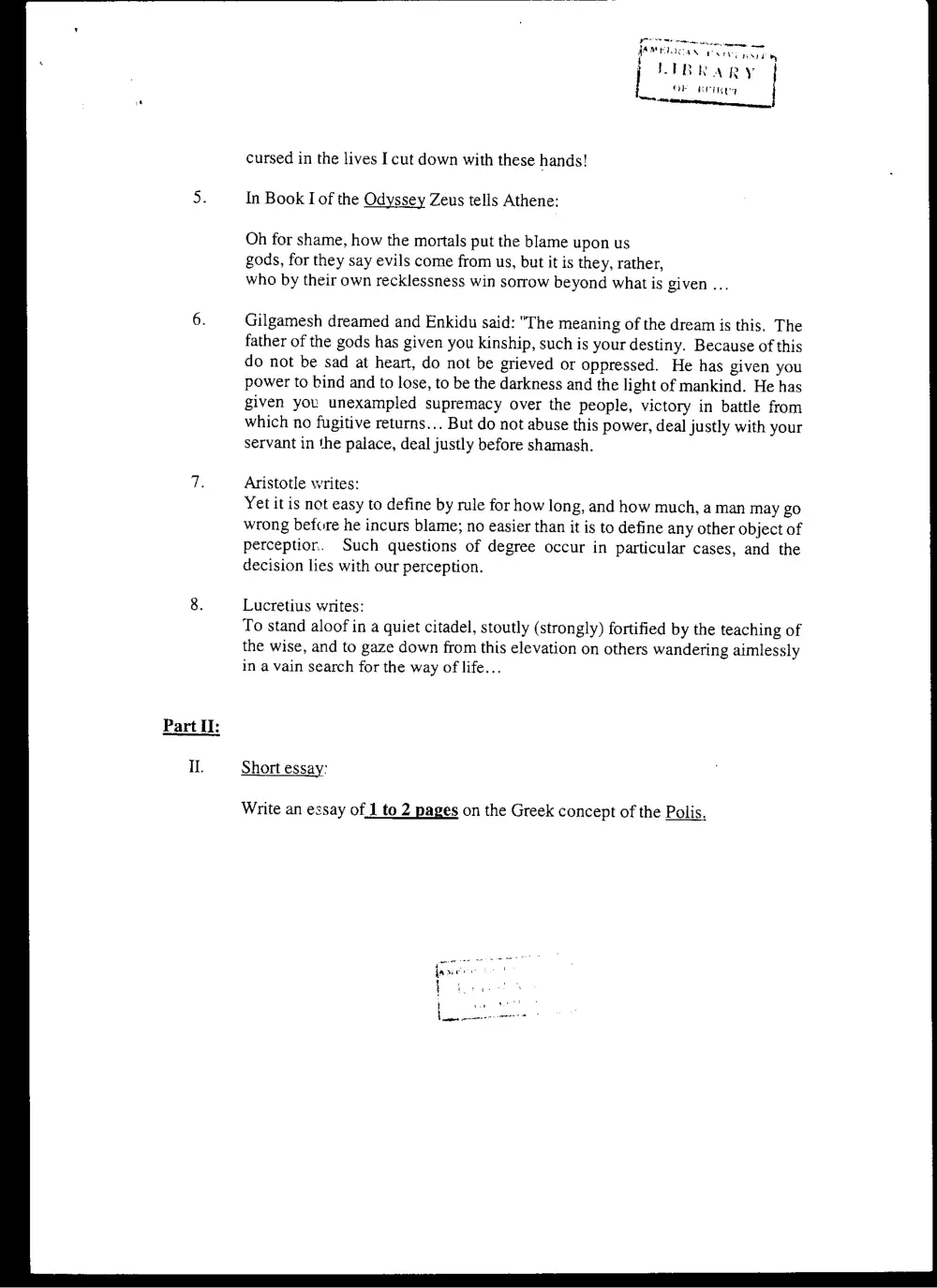
Part II:
II.
cursed in the lives I cut down with these hands!
In Book I of the Odyssey Zeus tells Athene:
Oh for shame, how the mortals put the blame upon us
gods, for they say evils come from us, but it is they, rather,
who by their own recklessness win sorrow beyond what is given ...
Gilgamesh dreamed and Enkidu said: "The meaning of the dream is this. The
father of the gods has given you kinship, such is your destiny. Because of this
do not be sad at heart, do not be grieved or oppressed. He has given you
power to bind and to lose, to be the darkness and the light of mankind. He has
given you unexampled supremacy over the people, victory in battle from
which no fugitive returns... But do not abuse this power, deal justly with your
servant in the palace, deal justly before shamash.
Aristotle writes:
Yet it is not easy to define by rule for how long, and how much, a man may go
wrong before he incurs blame; no easier than it is to define any other object of
perceptior.. Such questions of degree occur in particular cases, and the
decision lies with our perception.
Lucretius writes:
To stand aloof in a quiet citadel, stoutly (strongly) fortified by the teaching of
the wise, and to gaze down from this elevation on others wandering aimlessly
in a vain search for the way of life...
Short essay:
Write an essay of_1 to 2 pages on the Greek concept of the Polis.
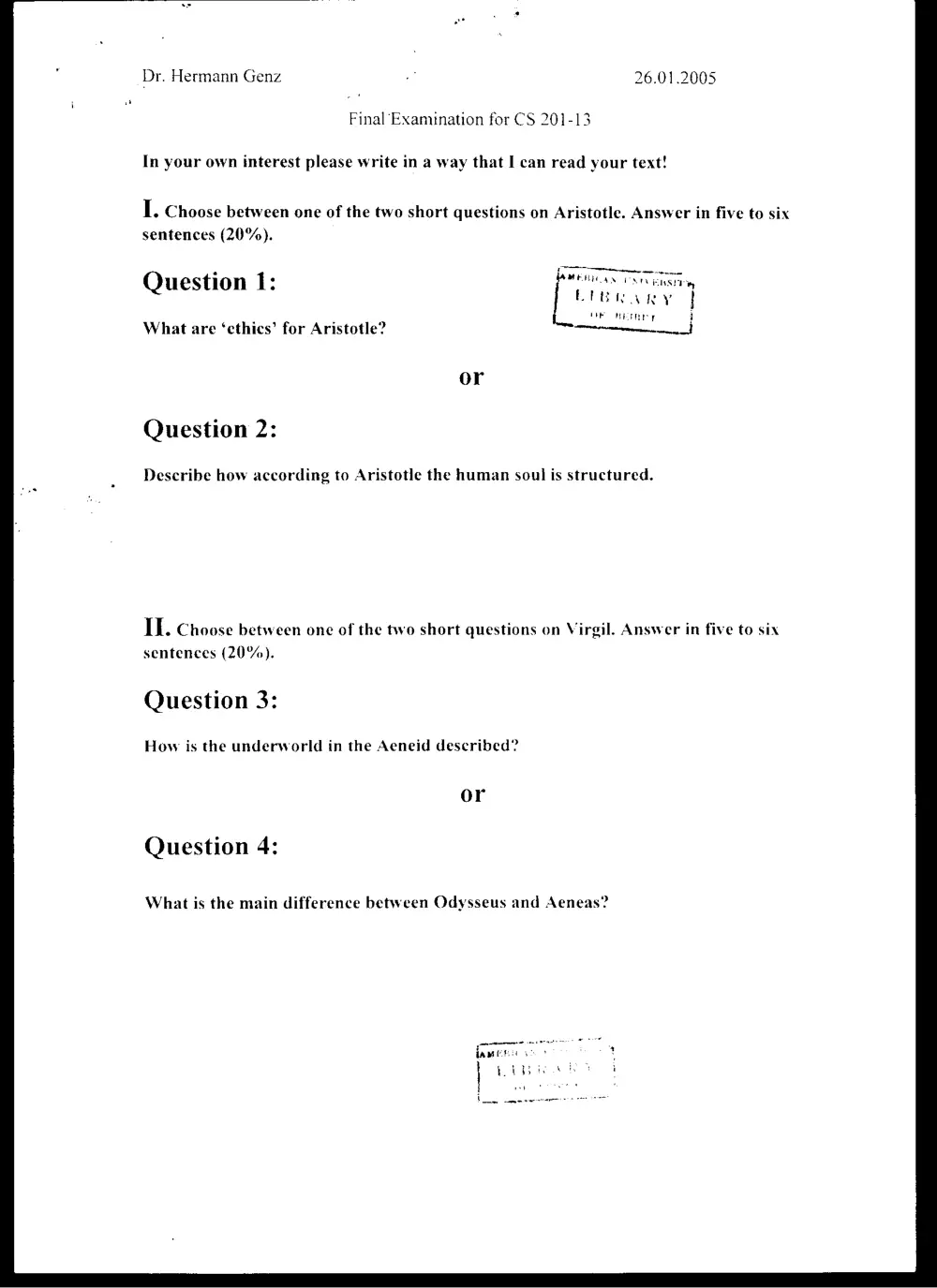
Dr. Hermann Genz a 26.01.2005
Final Examination for CS 201-13
In your own interest please write in a way that I can read your text!
I. Choose between one of the two short questions on Aristotle. Answer in five to six
sentences (20%).
Question 1: buenas oan nneiry
LIBRaky }
OF Kern, }
What are ‘ethics’ for Aristotle?
or
Question 2:
Describe how according to Aristotle the human soul is structured.
IL. Choose between one of the two short questions on Virgil. Answer in five to six
sentences (20%).
Question 3:
How is the underworld in the Aeneid described?
or
Question 4:
What is the main difference between Odysseus and Aeneas?
dam Ris
bib we 4 i
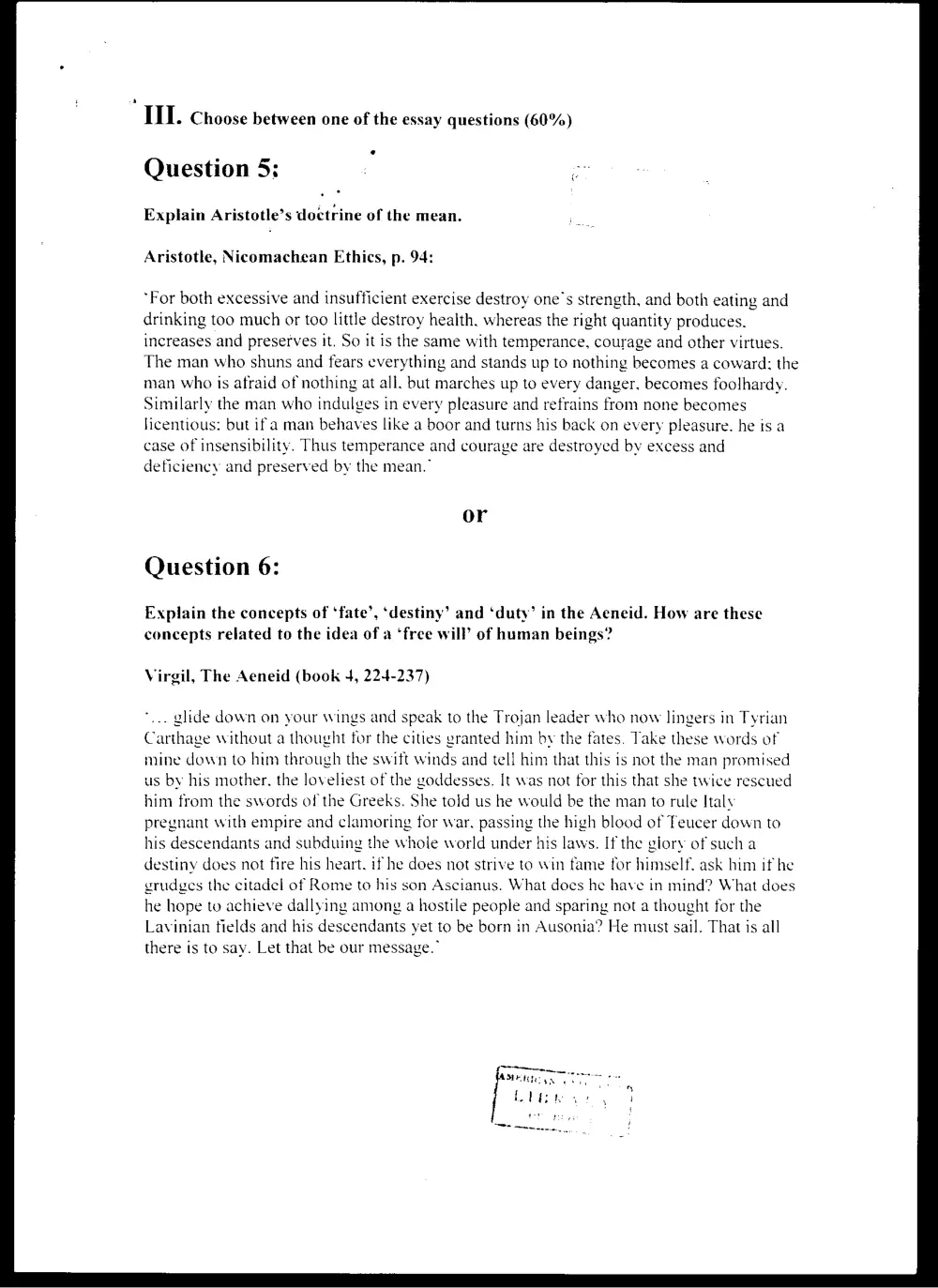
III. Choose between one of the essay questions (60%)
Question 5;
Explain Aristotle’s doctrine of the mean.
Aristotle, Nicomachean Ethics, p. 94:
‘For both excessive and insufficient exercise destroy one’s strength, and both eating and
drinking too much or too little destroy health, whereas the right quantity produces.
increases and preserves it. So it is the same with temperance, courage and other virtues.
The man who shuns and fears everything and stands up to nothing becomes a coward: the
man who is afraid of nothing at all. but marches up to every danger, becomes foolhardy.
Similarly the man who indulges in every pleasure and refrains from none becomes
licentious: but if a man behaves like a boor and turns his back on every pleasure. he is a
case of insensibilitv. Thus temperance and courage are destroyed by excess and
deficiency and preserved by the mean.”
Question 6:
Explain the concepts of ‘fate’, ‘destiny’ and ‘duty’ in the Aeneid. How are these
concepts related to the idea of a ‘free will’ of human beings?
Virgil, The Aeneid (book 4, 224-237)
*... glide down on your wings and speak to the Trojan leader who now lingers in Tyrian
Carthage without a thought for the cities granted him by the fates. Take these words of
mine down to him through the swift winds and tel! him that this is not the man promised
us by his mother. the loveliest of the goddesses. It was not for this that she twice rescued
him from the swords of the Greeks. She told us he would be the man to rule Italy
pregnant with empire and clamoring for war, passing the high blood of Teucer down to
his descendants and subduing the whole world under his laws. If the giory of such a
destiny does not fire his heart. if he does not strive to win fame for himself. ask him if he
grudges the citadel of Rome to his son Ascianus. What docs he have in mind? What does
he hope to achieve dallying among a hostile people and sparing not a thought for the
Lavinian fields and his descendants yet to be born in Ausonia? He must sail. That is all
there is to say. Let that be our message.”