
CVSP 201 Final, Fall 2005
American University of Beirut · Ancient, Medieval and Renaissance Culture · 2 pages
More CVSP 201 files
Show the text of this final exam
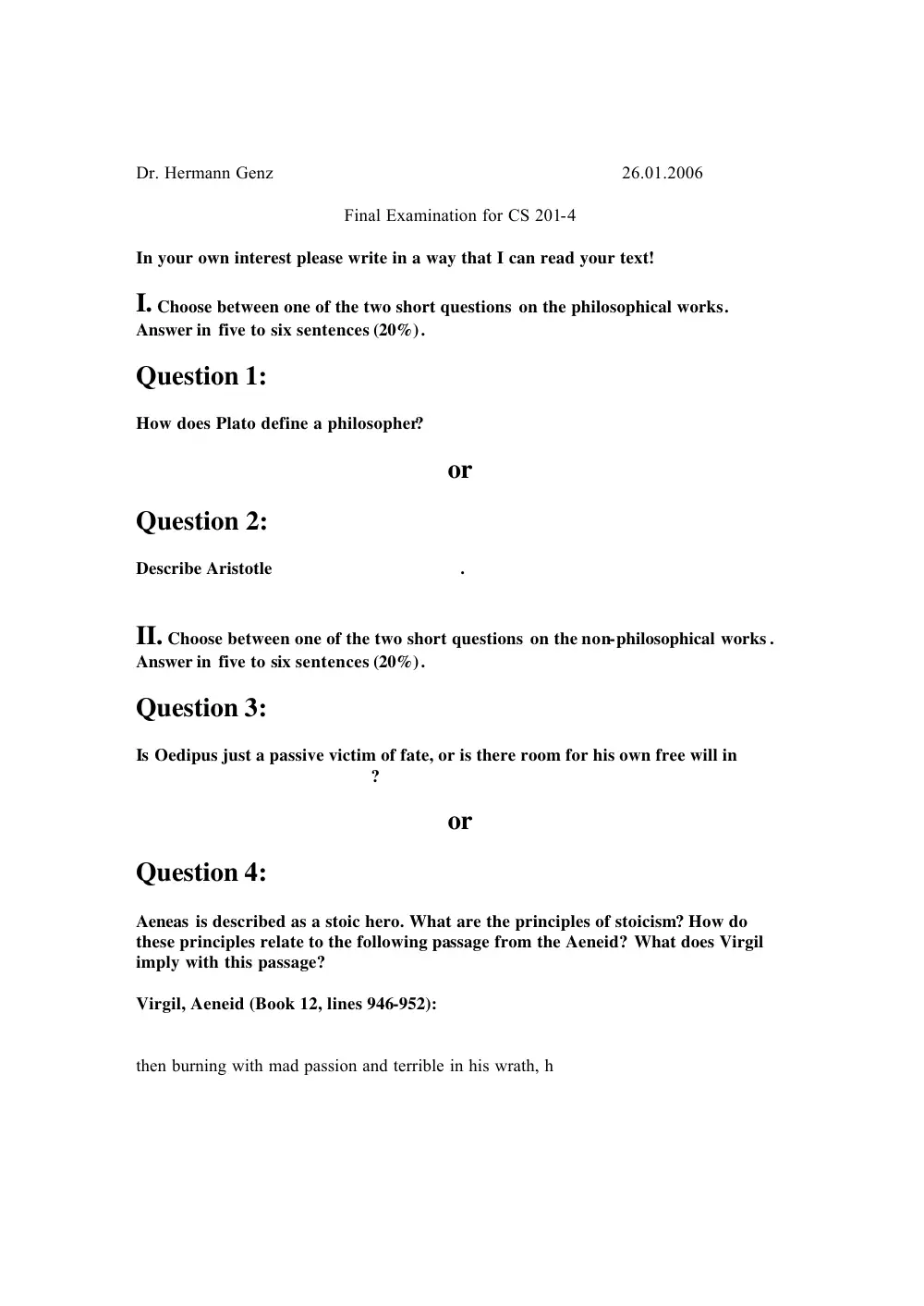
Dr. Hermann Genz
26.01.2006
Final Examination for CS 201-4
In your own interest please write in a way that I can read your text!
I. Choose between one of the two short questions on the philosophical works.
Answer in five to six sentences (20%).
Question 1:
How does Plato define a philosopher?
or
Question 2:
Describe Aristotle
.
II. Choose between one of the two short questions on the non-philosophical works .
Answer in five to six sentences (20%).
Question 3:
Is Oedipus just a passive victim of fate, or is there room for his own free will in
?
or
Question 4:
Aeneas is described as a stoic hero. What are the principles of stoicism? How do
these principles relate to the following passage from the Aeneid? What does Virgil
imply with this passage?
Virgil, Aeneid (Book 12, lines 946-952):
then burning with mad passion and terrible in his wrath, h
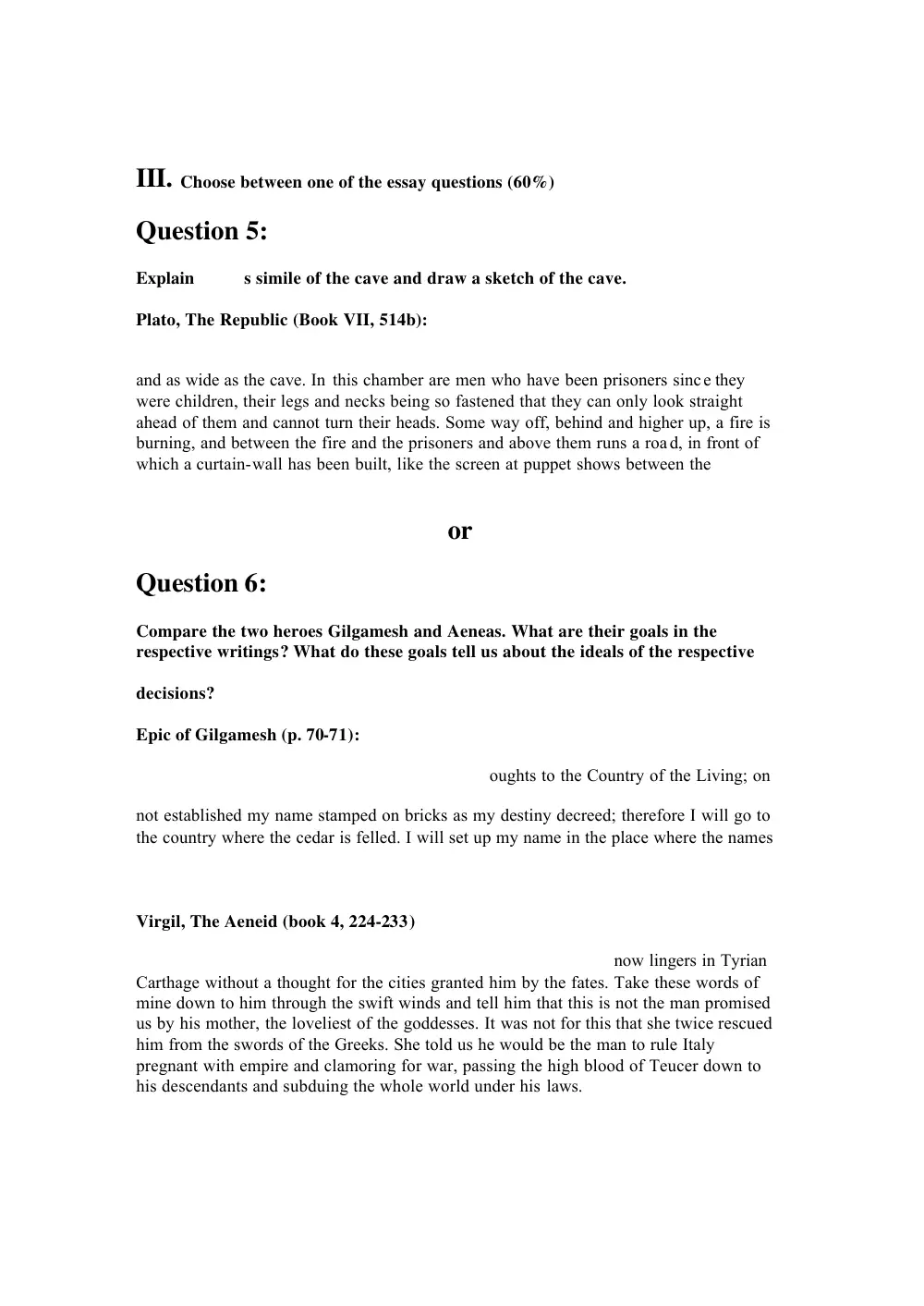
III. Choose between one of the essay questions (60%)
Question 5:
Explain
s simile of the cave and draw a sketch of the cave.
Plato, The Republic (Book VII, 514b):
and as wide as the cave. In this chamber are men who have been prisoners since they
were children, their legs and necks being so fastened that they can only look straight
ahead of them and cannot turn their heads. Some way off, behind and higher up, a fire is
burning, and between the fire and the prisoners and above them runs a road, in front of
which a curtain-wall has been built, like the screen at puppet shows between the
or
Question 6:
Compare the two heroes Gilgamesh and Aeneas. What are their goals in the
respective writings? What do these goals tell us about the ideals of the respective
decisions?
Epic of Gilgamesh (p. 70-71):
oughts to the Country of the Living; on
not established my name stamped on bricks as my destiny decreed; therefore I will go to
the country where the cedar is felled. I will set up my name in the place where the names
Virgil, The Aeneid (book 4, 224-233)
now lingers in Tyrian
Carthage without a thought for the cities granted him by the fates. Take these words of
mine down to him through the swift winds and tell him that this is not the man promised
us by his mother, the loveliest of the goddesses. It was not for this that she twice rescued
him from the swords of the Greeks. She told us he would be the man to rule Italy
pregnant with empire and clamoring for war, passing the high blood of Teucer down to
his descendants and subduing the whole world under his laws.