
CVSP 201 Final, Fall 2007
American University of Beirut · Ancient, Medieval and Renaissance Culture · 2 pages
More CVSP 201 files
Show the text of this final exam
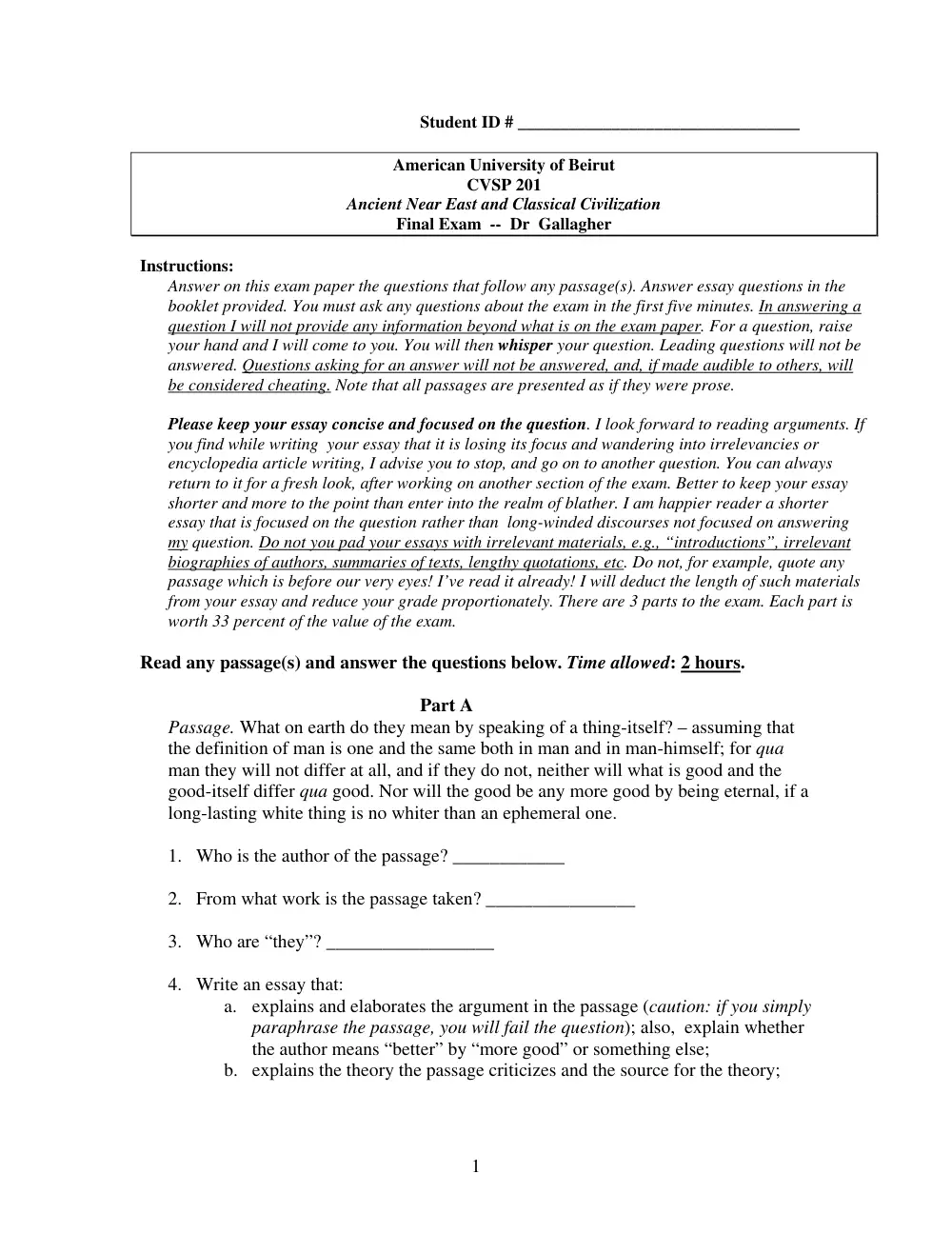
Student ID # _________________________________
American University of Beirut
CVSP 201
Ancient Near East and Classical Civilization
Final Exam -- Dr Gallagher
Instructions:
Answer on this exam paper the questions that follow any passage(s). Answer essay questions in the
booklet provided. You must ask any questions about the exam in the first five minutes. In answering a
question I will not provide any information beyond what is on the exam paper. For a question, raise
your hand and I will come to you. You will then whisper your question. Leading questions will not be
answered. Questions asking for an answer will not be answered, and, if made audible to others, will
be considered cheating. Note that all passages are presented as if they were prose.
Please keep your essay concise and focused on the question. I look forward to reading arguments. If
you find while writing your essay that it is losing its focus and wandering into irrelevancies or
encyclopedia article writing, I advise you to stop, and go on to another question. You can always
return to it for a fresh look, after working on another section of the exam. Better to keep your essay
shorter and more to the point than enter into the realm of blather. I am happier reader a shorter
essay that is focused on the question rather than long-winded discourses not focused on answering
my question. Do not you pad your essays with irrelevant materials, e.g., “introductions”, irrelevant
biographies of authors, summaries of texts, lengthy quotations, etc. Do not, for example, quote any
passage which is before our very eyes! I’ve read it already! I will deduct the length of such materials
from your essay and reduce your grade proportionately. There are 3 parts to the exam. Each part is
worth 33 percent of the value of the exam.
Read any passage(s) and answer the questions below. Time allowed: 2 hours.
Part A
Passage. What on earth do they mean by speaking of a thing-itself? – assuming that
the definition of man is one and the same both in man and in man-himself; for qua
man they will not differ at all, and if they do not, neither will what is good and the
good-itself differ qua good. Nor will the good be any more good by being eternal, if a
long-lasting white thing is no whiter than an ephemeral one.
1. Who is the author of the passage? ____________
2. From what work is the passage taken? ________________
3. Who are “they”? __________________
4. Write an essay that:
a. explains and elaborates the argument in the passage (caution: if you simply
paraphrase the passage, you will fail the question); also, explain whether
the author means “better” by “more good” or something else;
b. explains the theory the passage criticizes and the source for the theory;
1
2
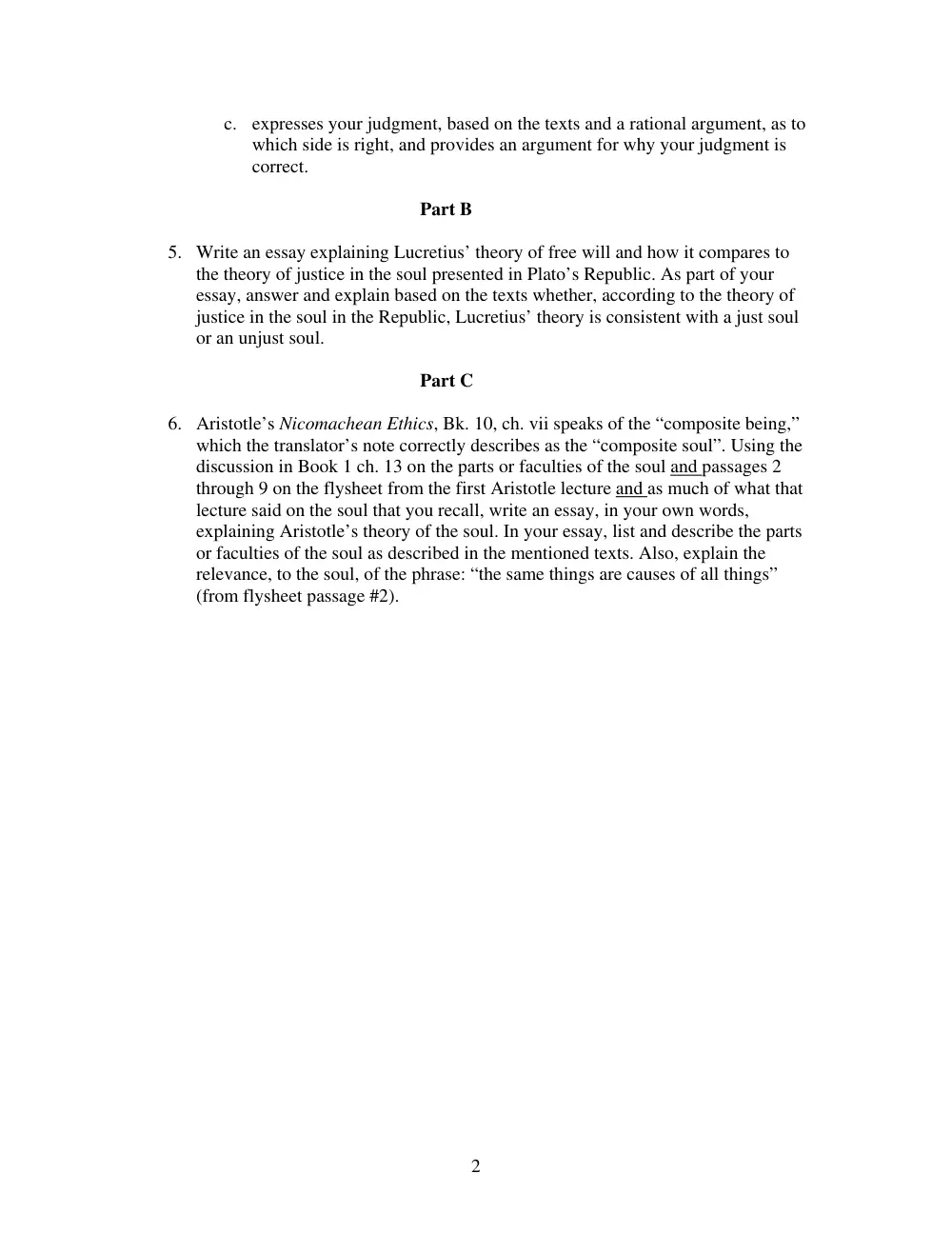
c. expresses your judgment, based on the texts and a rational argument, as to
which side is right, and provides an argument for why your judgment is
correct.
Part B
5. Write an essay explaining Lucretius’ theory of free will and how it compares to
the theory of justice in the soul presented in Plato’s Republic. As part of your
essay, answer and explain based on the texts whether, according to the theory of
justice in the soul in the Republic, Lucretius’ theory is consistent with a just soul
or an unjust soul.
Part C
6. Aristotle’s Nicomachean Ethics, Bk. 10, ch. vii speaks of the “composite being,”
which the translator’s note correctly describes as the “composite soul”. Using the
discussion in Book 1 ch. 13 on the parts or faculties of the soul and passages 2
through 9 on the flysheet from the first Aristotle lecture and as much of what that
lecture said on the soul that you recall, write an essay, in your own words,
explaining Aristotle’s theory of the soul. In your essay, list and describe the parts
or faculties of the soul as described in the mentioned texts. Also, explain the
relevance, to the soul, of the phrase: “the same things are causes of all things”
(from flysheet passage #2).