
CVSP 201 Final, Spring 2000
American University of Beirut · Ancient, Medieval and Renaissance Culture · 3 pages
More CVSP 201 files
Show the text of this final exam
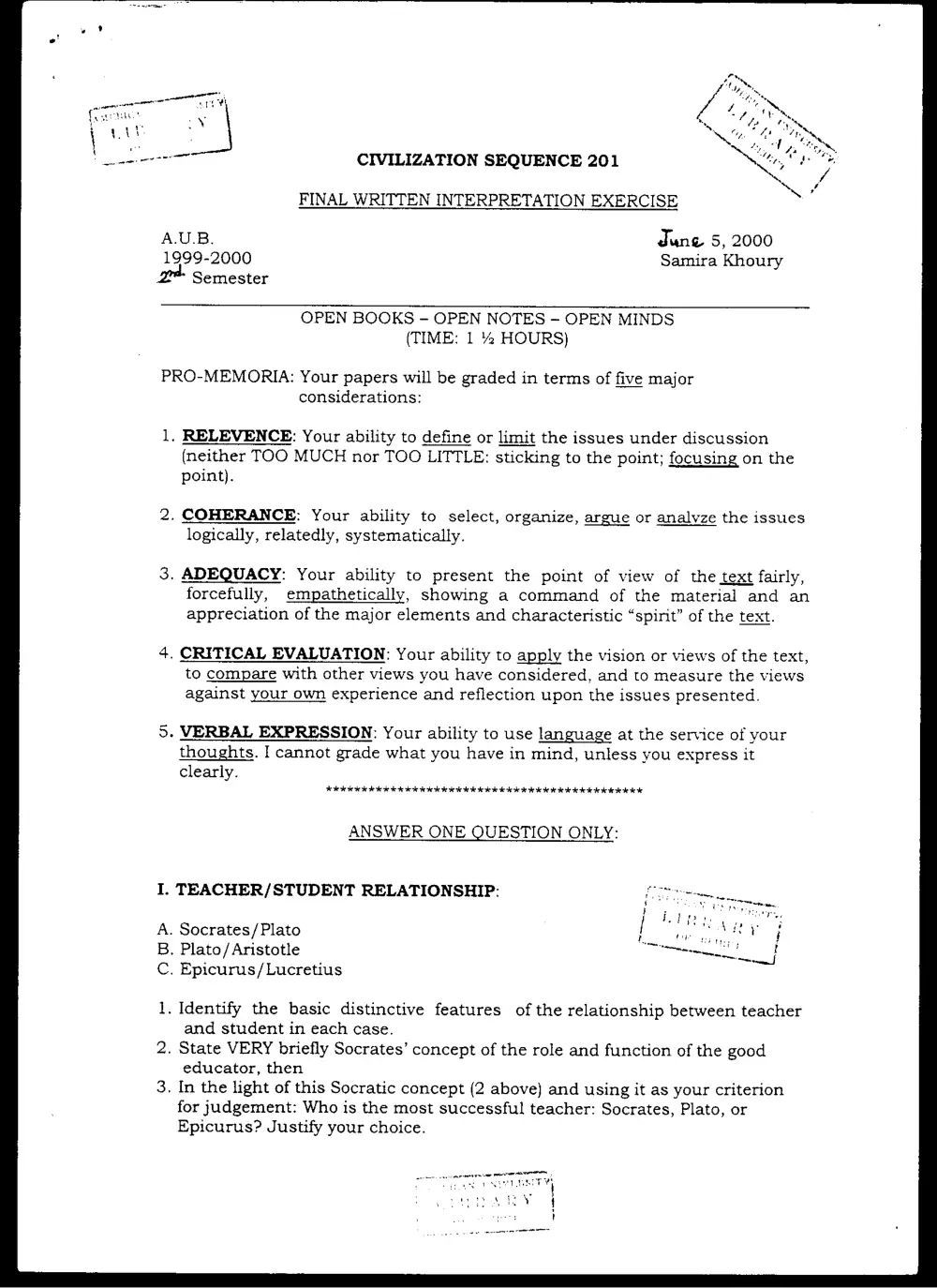
CIVILIZATION SEQUENCE 201
FINAL WRITTEN INTERPRETATION EXERCISE
dune 5, 2000
1999-2000 Samira Khoury
Semester
OPEN BOOKS - OPEN NOTES - OPEN MINDS
(TIME: | % HOURS)
PRO-MEMORIA: Your papers will be graded in terms of five major
considerations:
. RELEVENCE: Your ability to define or limit the issues under discussion
(neither TOO MUCH nor TOO LITTLE: sticking to the point; focusing on the
point).
. COHERANCE: Your ability to select, organize, argue or analvze the issues
logically, relatedly, systematically.
. ADEQUACY: Your ability to present the point of view of the text fairly,
forcefully, empathetically, showing a command of the material and an
appreciation of the major elements and characteristic “spirit” of the text.
. CRITICAL EVALUATION: Your ability to apply the vision or views of the text,
to compare with other views you have considered, and to measure the views
against your own experience and reflection upon the issues presented.
. VERBAL EXPRESSION: Your ability to use language at the service of your
thoughts. I cannot grade what you have in mind, unless you express it
clearly.
HR IIR RRR TR IIT IK III RIK RT TAIT RIK TR RIKI IA IKI.
ANSWER ONE QUESTION ONLY:
I. TEACHER/STUDENT RELATIONSHIP:
. Socrates/Plato
. Plato/ Aristotle
. Epicurus/Lucretius
. Identify the basic distinctive features of the relationship between teacher
and student in each case.
. State VERY briefly Socrates’ concept of the role and function of the good
educator, then
. In the light of this Socratic concept (2 above) and using it as your criterion
for judgement: Who is the most successful teacher: Socrates, Plato, or
Epicurus? Justify your choice.
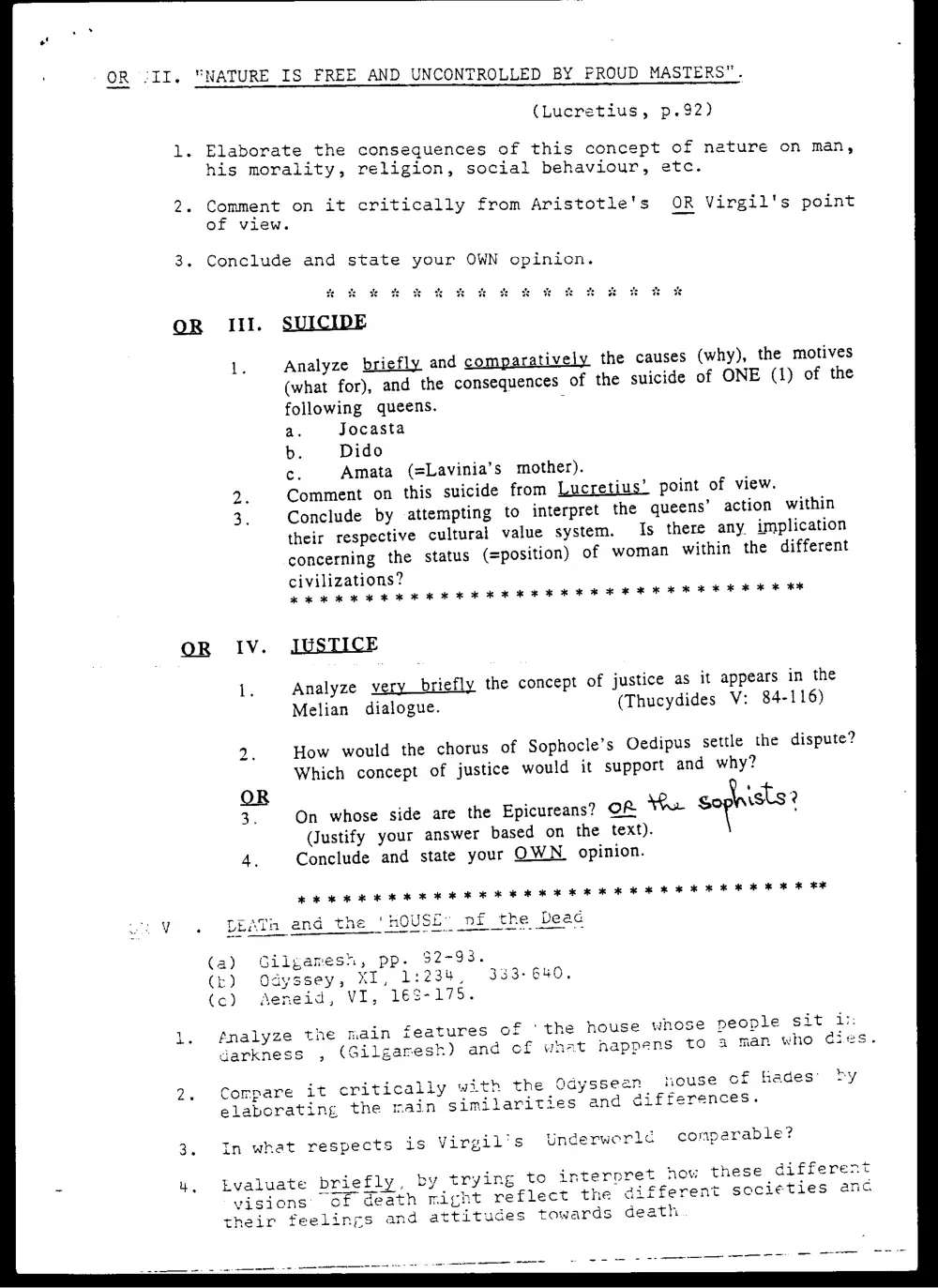
SII. "NATURE IS FREE AND UNCONTROLLED BY FROUD MASTERS".
(Lucretius, p.92)
Elaborate the consequences of this concept of neture on man,
his morality, religion, social behaviour, etc.
Comment on it iti . to. .
eee, it critically from Aristotle's OR Virgil's point
Conclude and state your OWN opinion.
eo ok eo eo RK
SUICIDE
Analyze briefly and comparatively the causes (why), the motives
(what for), and the consequences of the suicide of ONE (1) of the
following queens. .
a. Jocasta
b. Dido
Cc. Amata (=Lavinia’s mother).
Comment on this suicide from Lucretius’ point of view.
Conclude by attempting to interpret the queens’ action within
their respective cultural value system. Is there any implication
concerning the status (=position) of woman within the different
civilizations?
eR KR ORR RR RRR EE ER EOF
IUSTICE
Analyze very briefly the concept of justice as it appears in the
Melian dialogue. (Thucydides V: 84-116)
How would the chorus of Sophocle’s Oedipus settle the dispute?
Which concept of justice would it support and why?
On whose side are the Epicureans? oR aan soprists
(Justify your answer based on the text).
Conclude and state your OWN opinion.
ERE ORR RE RR RRR REE FF
DEATA and the 'nOUSE” nf the Deac
(a) Gilgamesh, pp. 92-93.
(r) Odyssey, KI, 1:234, 333-640.
(c) Aeneid, VI, 1€8-175.
fnalyze the main features of ‘the house whose people sit i:
darkness , (Gilgamesh) and of what happens to a man who dies.
Compare it critically with the Odyssean iouse cf hades’ by
elaborating the main similarities and differences.
In what respects is Virgil's Underworld comparable?
Lvaluate briefly, by trying to interpret how these different
visions’ of death might reflect the aifferent societies anG
their feelings and attitudes towards death
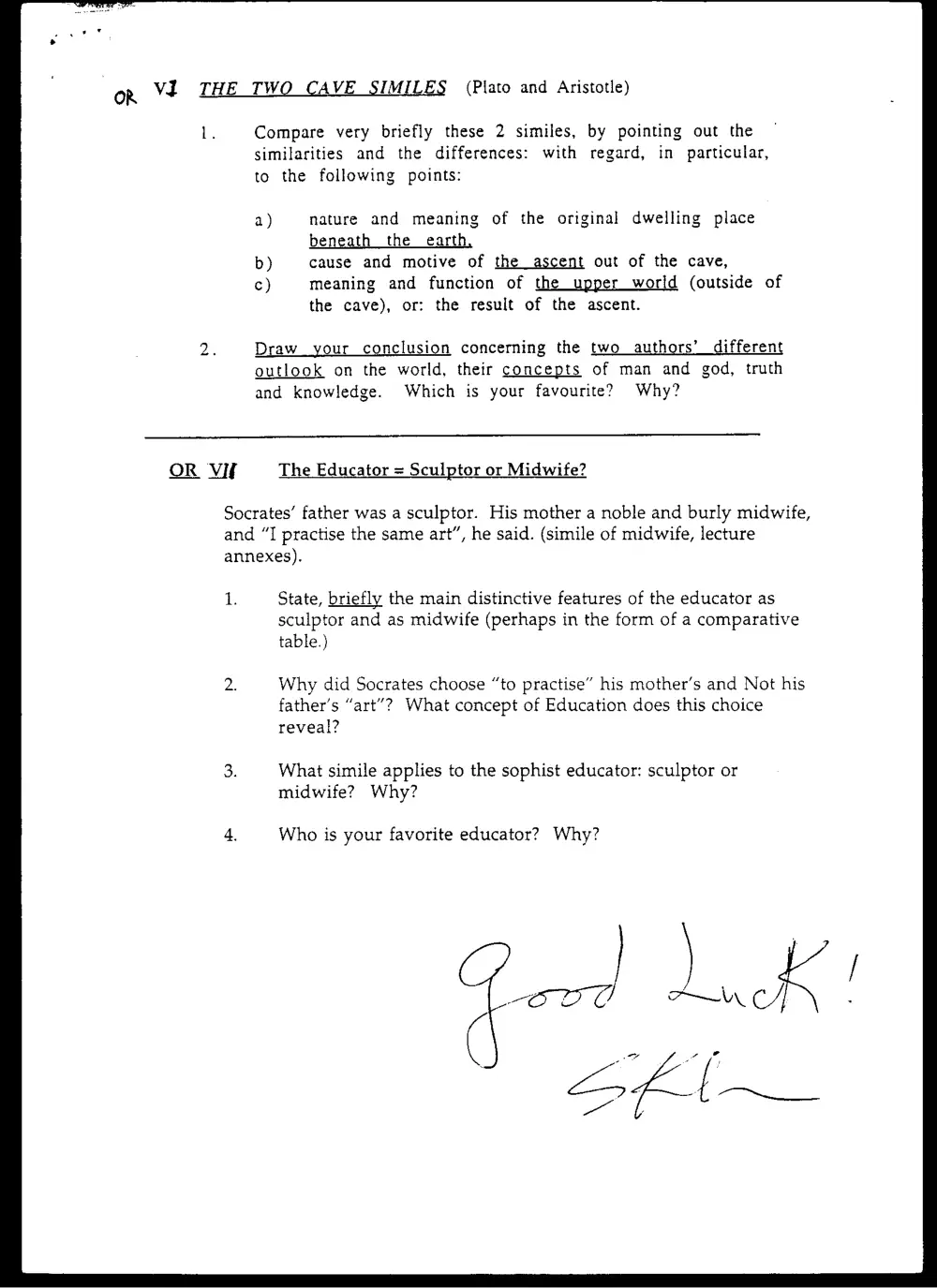
OR V1 THE TWO CAVE SIMILES (Plato and Aristotle)
lL. Compare very briefly these 2 similes, by pointing out the
similarities and the differences: with regard, in particular,
to the following points:
a) nature and meaning of the original dwelling place
beneath the earth,
b) cause and motive of the ascent out of the cave,
c) meaning and function of the upper world (outside of
the cave), or: the result of the ascent.
Draw your conclusion concerning the two authors’ different
outlook on the world, their concepts of man and god, truth
and knowledge. Which is your favourite? Why?
OR Vit The Educator = Sculptor or Midwife?
Socrates’ father was a sculptor. His mother a noble and burly midwife,
and “I practise the same art”, he said. (simile of midwife, lecture
annexes).
1. State, briefly the main distinctive features of the educator as
sculptor and as midwife (perhaps in the form of a comparative
table.)
Why did Socrates choose “to practise” his mother’s and Not his
father’s “art”? What concept of Education does this choice
reveal?
What simile applies to the sophist educator: sculptor or
midwife? Why?
Who is your favorite educator? Why?