
CVSP 201 Final, Spring 2004
American University of Beirut · Ancient, Medieval and Renaissance Culture · 3 pages
More CVSP 201 files
Show the text of this final exam
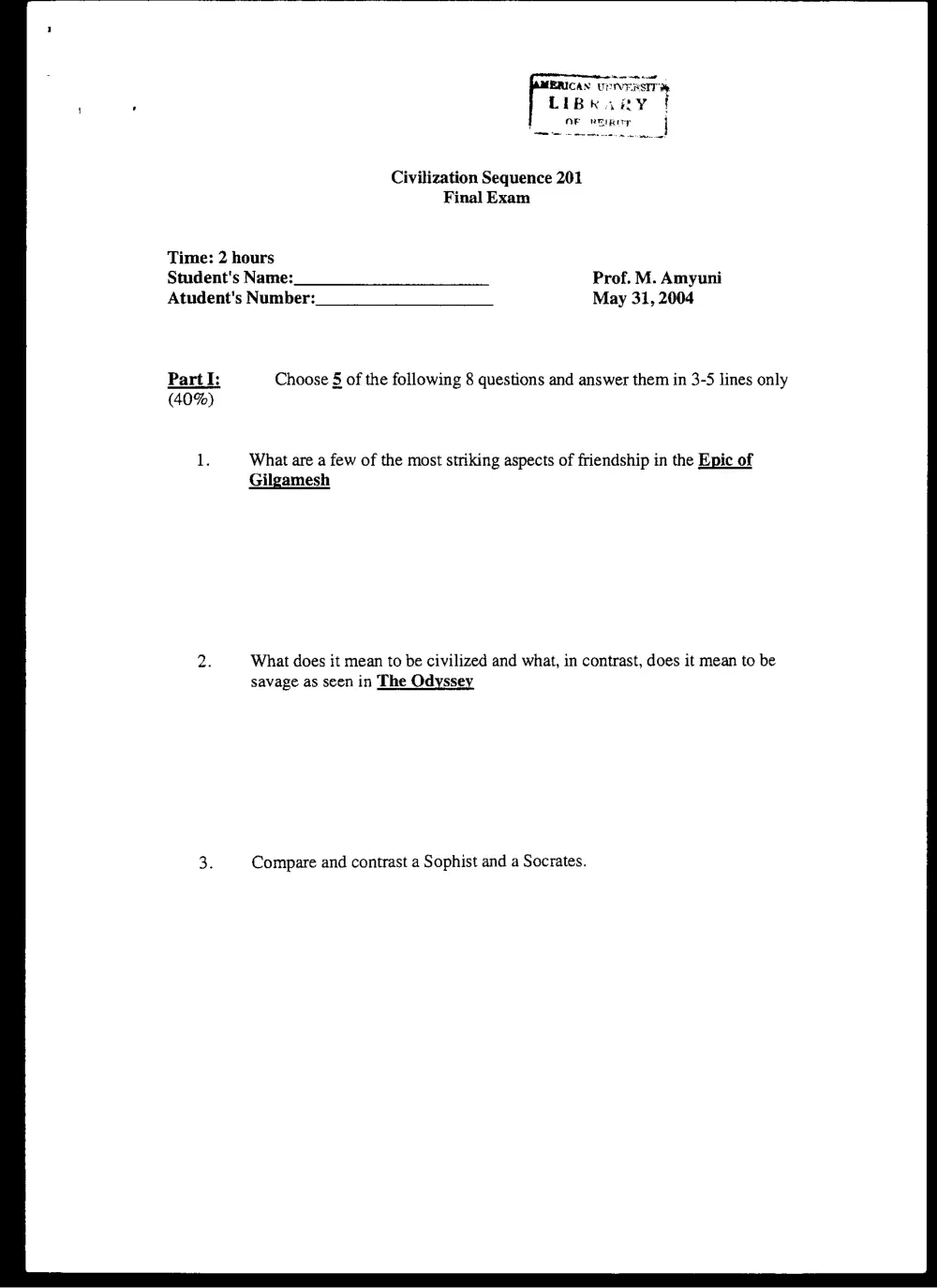
ERICAN UnWERSITY
LIBRARY
AF RERETT |
Civilization Sequence 201
Final Exam
Time: 2 hours
Student's Name: Prof. M. Amyuni
Atudent's Number: May 31, 2004
Part I: Choose § of the following 8 questions and answer them in 3-5 lines only
(40%)
1. What are a few of the most striking aspects of friendship in the Epic of
Gilgamesh
2. What does it mean to be civilized and what, in contrast, does it mean to be
savage as seen in The Odyssey
3. Compare and contrast a Sophist and a Socrates.
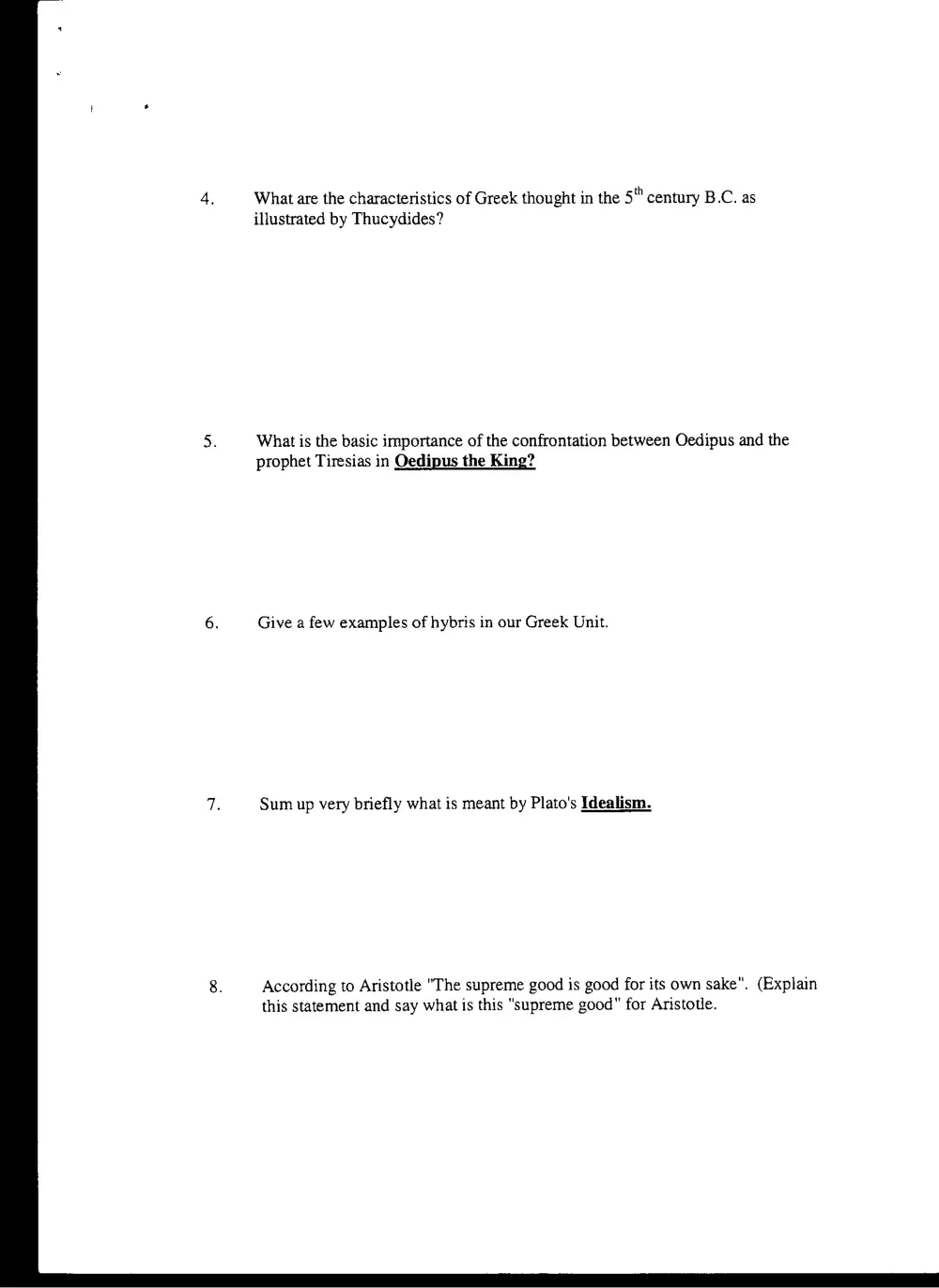
4. What are the characteristics of Greek thought in the 5" century B.C. as
illustrated by Thucydides?
5. What is the basic importance of the confrontation between Oedipus and the
prophet Tiresias in Oedipus the King?
6. Give a few examples of hybris in our Greek Unit.
7. Sum up very briefly what is meant by Plato's Idealism.
8. According to Aristotle "The supreme good is good for its own sake". (Explain
this statement and say what is this "supreme good” for Aristode.
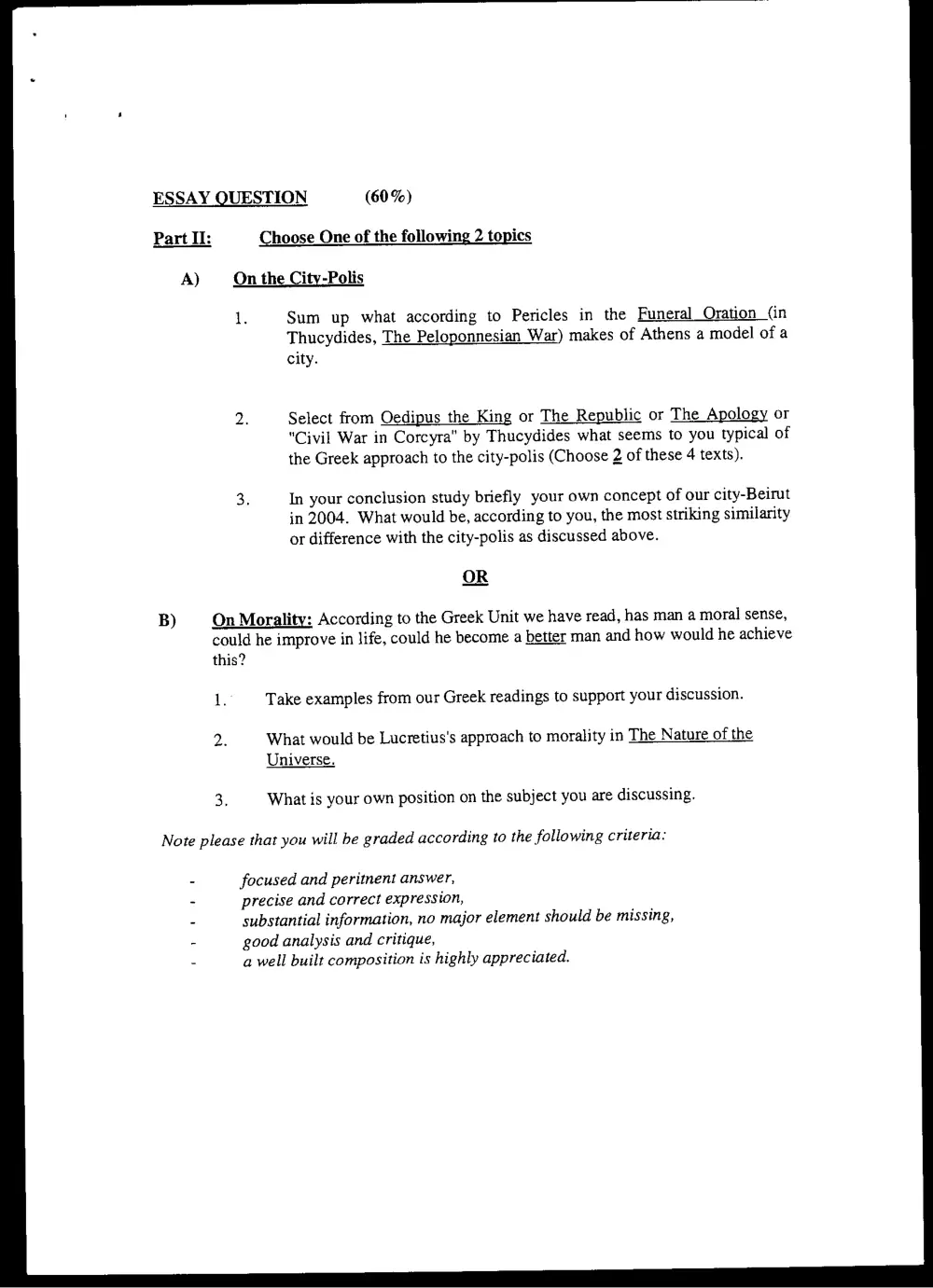
ESSAY QUESTION (60%)
Part II: Choose One of the following 2 topics
A) On the City-Polis
1. Sum up what according to Pericles in the Funeral Oration (in
Thucydides, The Peloponnesian War) makes of Athens a model of a
city.
Select from Oedipus the King or The Republic or The Apology or
"Civil War in Corcyra" by Thucydides what seems to you typical of
the Greek approach to the city-polis (Choose 2 of these 4 texts).
In your conclusion study briefly your own concept of our city-Beirut
in 2004. What would be, according to you, the most striking similarity
or difference with the city-polis as discussed above.
OR
B) On Morality: According to the Greek Unit we have read, has man a moral sense,
could he improve in life, could he become a better man and how would he achieve
this?
1 Take examples from our Greek readings to support your discussion.
2. What would be Lucretius's approach to morality in The Nature of the
Universe.
3. What is your own position on the subject you are discussing.
Note please that you will be graded according to the following criteria:
focused and peritnent answer,
precise and correct expression,
substantial information, no major element should be missing,
good analysis and critique,
a well built composition is highly appreciated.