
CVSP 201 Final, Spring 2004
American University of Beirut · Ancient, Medieval and Renaissance Culture · 2 pages

More CVSP 201 files
Show the text of this final exam
o_O
{emenican ONIV
LIBKARY
or SEIROT
CS-201, Section 13, Final Exam, 31st May 2004. 2 hours R.S. Smith
A. Understanding primary texts. Explain the meaning, context and significance of two of the
following passages. It may be helpful to divide your explanations into three parts: a)
immediate meaning or key ideas, b) context (where the passage fits in the story or argument),
and c) relation to the work as a whole. After explaining the passage add a fourth part d)
comparison with another CS-201 work. Do not write more than 3 sides per question. 15% of
final grade each.
1. So virtue is a purposive disposition, lying in a mean that is relative to us and determined
by a rational principle, and by that which a prudent man would use to determine it. It is a
mean between two kinds of vice, one of excess and the other of deficiency; and also for this
reason, that whereas these vices fall short of or exceed the right measure in both feelings
and actions, virtue discovers the mean and chooses it. Thus from the point of view of its
essence and the definition of its real nature, virtue is a mean; but in respect of what is right
and best, it is an extreme. (Aristotle, Ethics, pp. 101-102)
2. But suppose it is some man of riper years who complains... Would she [Nature] not have
every right to protest more vehemently and repulse him in stern tones: ‘Away with your
tears, old [man]! Have done with your grumbling! You are withering now after tasting all
the joys of life. But, because you are always pining for what is not and unappreciative of
the things at hand, your life has slipped away unfulfilled and unprized. Death has stolen
upon you unawares, before you are ready to retire from life’s banquet filled and satisfied.
Come now, put away all that is unbecoming to your years and compose your mind to make
way for others. You have no choice.’ I cannot question but that she would have right on
her side; her censure and rebuke would be well merited. The old is always thrust aside to
make way for the new, and one thing must be built out of the wreck of others. There is no
murky pit of Tartarus [Hell] awaiting anyone. There is need of matter, so that later
generations may arise; when they have lived out their span, they will all follow you.
Bygone generations have taken your road, and those to come will take it no less. So one
thing will never cease to spring from another. To none is life given in freehold; to all on
lease. Look back at the eternity that passed before we were born, and mark how utterly it
counts to us as nothing. This is a mirror that Nature holds up to us, in which we may see
the time that shall be after we are dead. Is there anything terrifying in the sight — anything
depressing — anything that is not more restful than the soundest sleep? (Lucretius, pp.
90-1.)
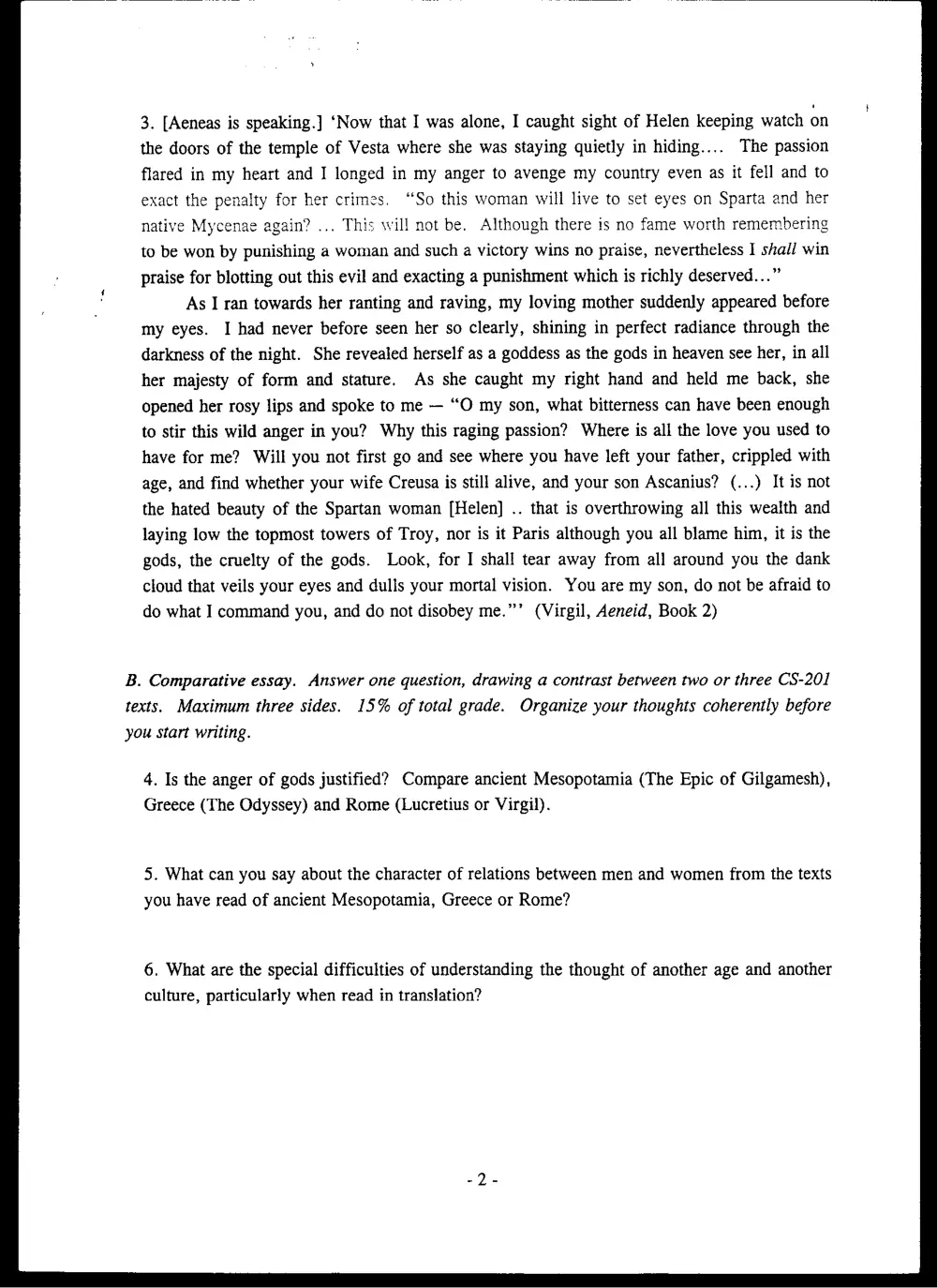
3. [Aeneas is speaking.] ‘Now that I was alone, I caught sight of Helen keeping watch on
the doors of the temple of Vesta where she was staying quietly in hiding.... The passion
flared in my heart and J longed in my anger to avenge my country even as it fell and to
exact the penalty for her crimes. “So this woman will live to set eyes on Sparta and her
native Mycenae again? ... This will not be. Although there is no fame worth remembering
to be won by punishing a woman and such a victory wins no praise, nevertheless I shall win
praise for blotting out this evil and exacting a punishment which is richly deserved...”
As | ran towards her ranting and raving, my loving mother suddenly appeared before
my eyes. I had never before seen her so clearly, shining in perfect radiance through the
darkness of the night. She revealed herself as a goddess as the gods in heaven see her, in all
her majesty of form and stature. As she caught my right hand and held me back, she
opened her rosy lips and spoke to me — “O my son, what bitterness can have been enough
to stir this wild anger in you? Why this raging passion? Where is all the love you used to
have for me? Will you not first go and see where you have left your father, crippled with
age, and find whether your wife Creusa is still alive, and your son Ascanius? (...) It is not
the hated beauty of the Spartan woman [Helen] .. that is overthrowing all this wealth and
laying low the topmost towers of Troy, nor is it Paris although you all blame him, it is the
gods, the cruelty of the gods. Look, for I shall tear away from all around you the dank
cloud that veils your eyes and dulls your mortal vision. You are my son, do not be afraid to
do what I command you, and do not disobey me.”’ (Virgil, Aeneid, Book 2)
B. Comparative essay. Answer one question, drawing a contrast between two or three CS-201
texts. Maximum three sides. 15% of total grade. Organize your thoughts coherently before
you start writing.
4. Is the anger of gods justified? Compare ancient Mesopotamia (The Epic of Gilgamesh),
Greece (The Odyssey) and Rome (Lucretius or Virgil).
5. What can you say about the character of relations between men and women from the texts
you have read of ancient Mesopotamia, Greece or Rome?
6. What are the special difficulties of understanding the thought of another age and another
culture, particularly when read in translation?