
CVSP 201 Final, Spring 2005
American University of Beirut · Ancient, Medieval and Renaissance Culture · 3 pages
More CVSP 201 files
Show the text of this final exam
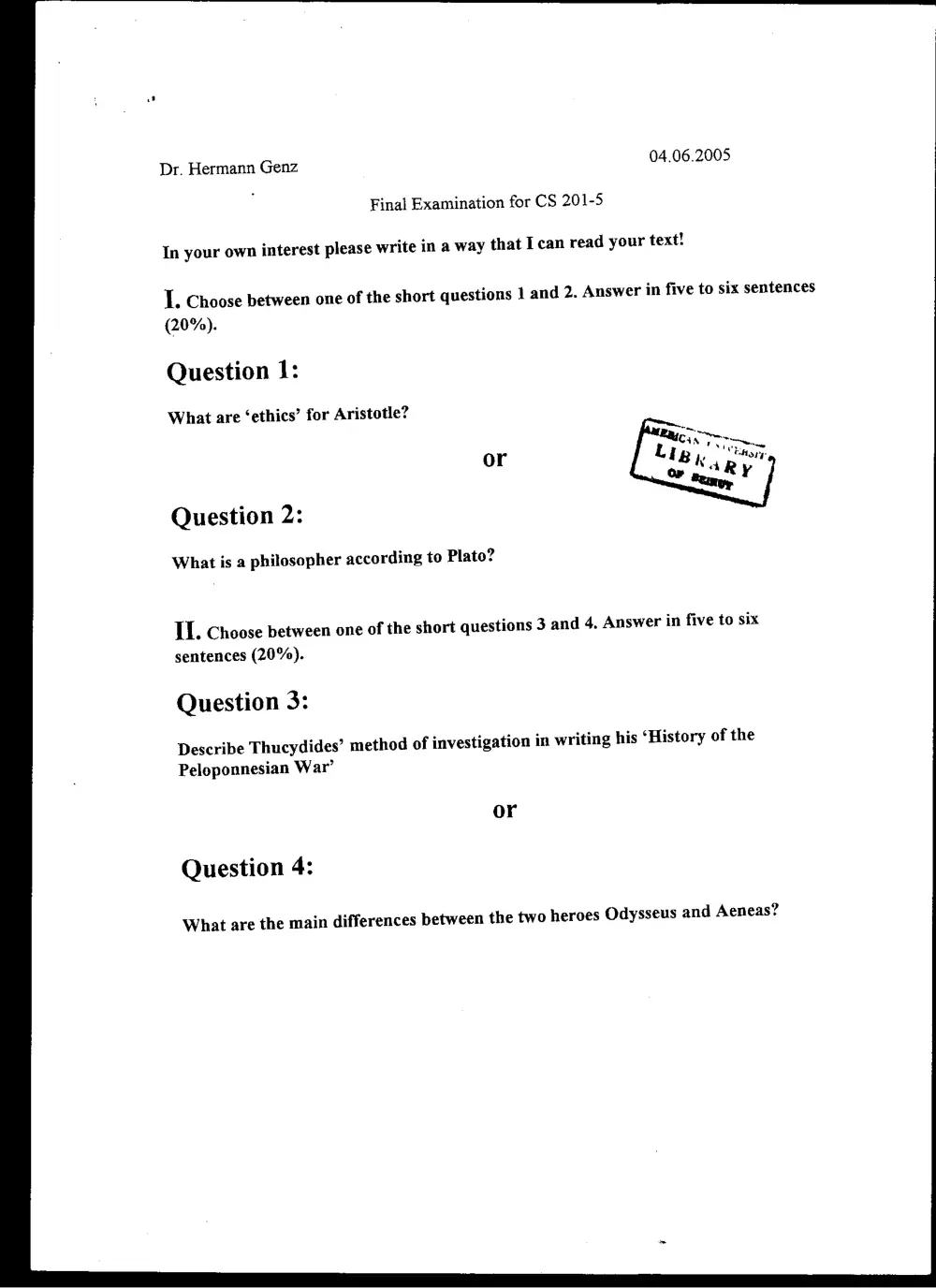
Dr. Hermann Genz 04.06.2005
Final Examination for CS 201-5
In your own interest please write in a way that I can read your text!
I. Choose between one of the short questions 1 and 2. Answer in five to six sentences
(20%).
Question 1:
What are ‘ethics’ for Aristotle?
or
Question 2:
What is a philosopher according to Plato?
TI. Choose between one of the short questions 3 and 4. Answer in five to six
sentences (20%).
Question 3:
Describe Thucydides’ method of investigation in writing his ‘History of the
Peloponnesian War’
or
Question 4:
What are the main differences between the two heroes Odysseus and Aeneas?
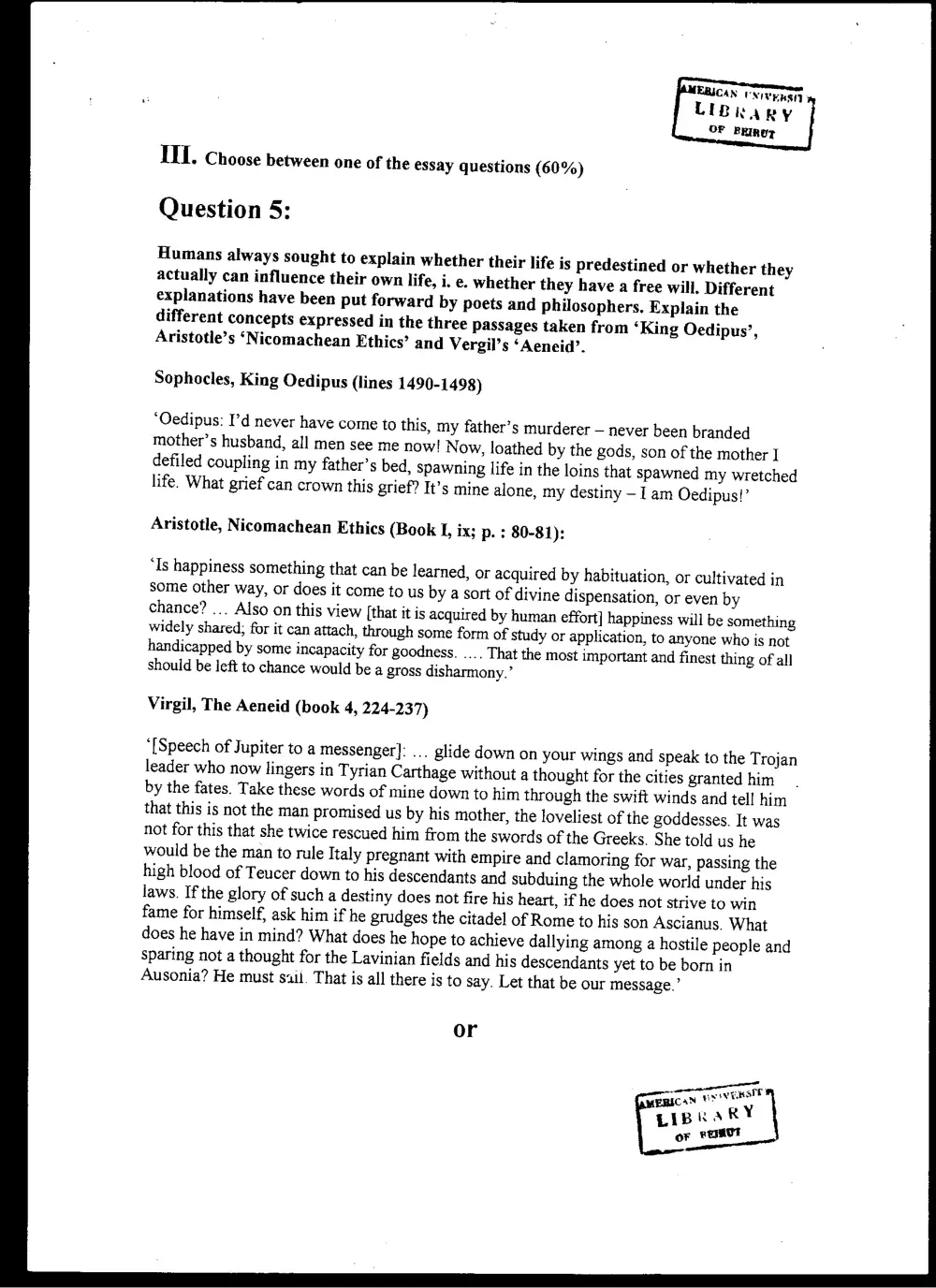
I. Choose between one of the essay questions (60%)
Question 5:
Humans always sought to explain whether their life is predestined or whether they
actually can influence their own life, i. e. whether they have a free will. Different
explanations have been put forward by poets and philosophers. Explain the
different concepts expressed in the three Passages taken from ‘King Oedipus’,
Aristotle’s ‘Nicomachean Ethics’ and Vergil’s ‘Aeneid’.
Sophocles, King Oedipus (lines 1490-1498)
“Oedipus: I’d never have come to this, my father’s murderer — never been branded
mother’s husband, all men see me now! Now, loathed by the gods, son of the mother I
defiled coupling in my father’s bed, spawning life in the loins that spawned my wretched
life. What grief can crown this grief? It’s mine alone, my destiny —I am Oedipus!’
Aristotle, Nicomachean Ethics (Book I, ix; p. : 80-81):
“Is happiness something that can be learned, or acquired by habituation, or cultivated in
some other way, or does it come to us by a sort of divine dispensation, or even by
chance? ... Also on this view [that it is acquired by human effort] happiness will be something
widely shared; for it can attach, through some form of study or application, to anyone who is not
handicapped by some incapacity for goodness. .... That the most important and finest thing of all
should be left to chance would be a gross disharmony.’
Virgil, The Aeneid (book 4, 224-237)
‘[Speech of Jupiter to a messenger]: ... glide down on your wings and speak to the Trojan
leader who now lingers in Tyrian Carthage without a thought for the cities granted him
by the fates. Take these words of mine down to him through the swift winds and tell him
that this is not the man promised us by his mother, the loveliest of the goddesses. It was
not for this that she twice rescued him from the swords of the Greeks. She told us he
would be the man to rule Italy pregnant with empire and clamoring for war, passing the
high blood of Teucer down to his descendants and subduing the whole world under his
laws. If the glory of such a destiny does not fire his heart, if he does not strive to win
fame for himself, ask him if he grudges the citadel of Rome to his son Ascianus. What
does he have in mind? What does he hope to achieve dallying among a hostile people and
sparing not a thought for the Lavinian fields and his descendants yet to be born in
Ausonia? He must saii. That is all there is to say. Let that be our message.’
ERICAN Pe VERSE
LipeaR Y
oF PEMOT
or
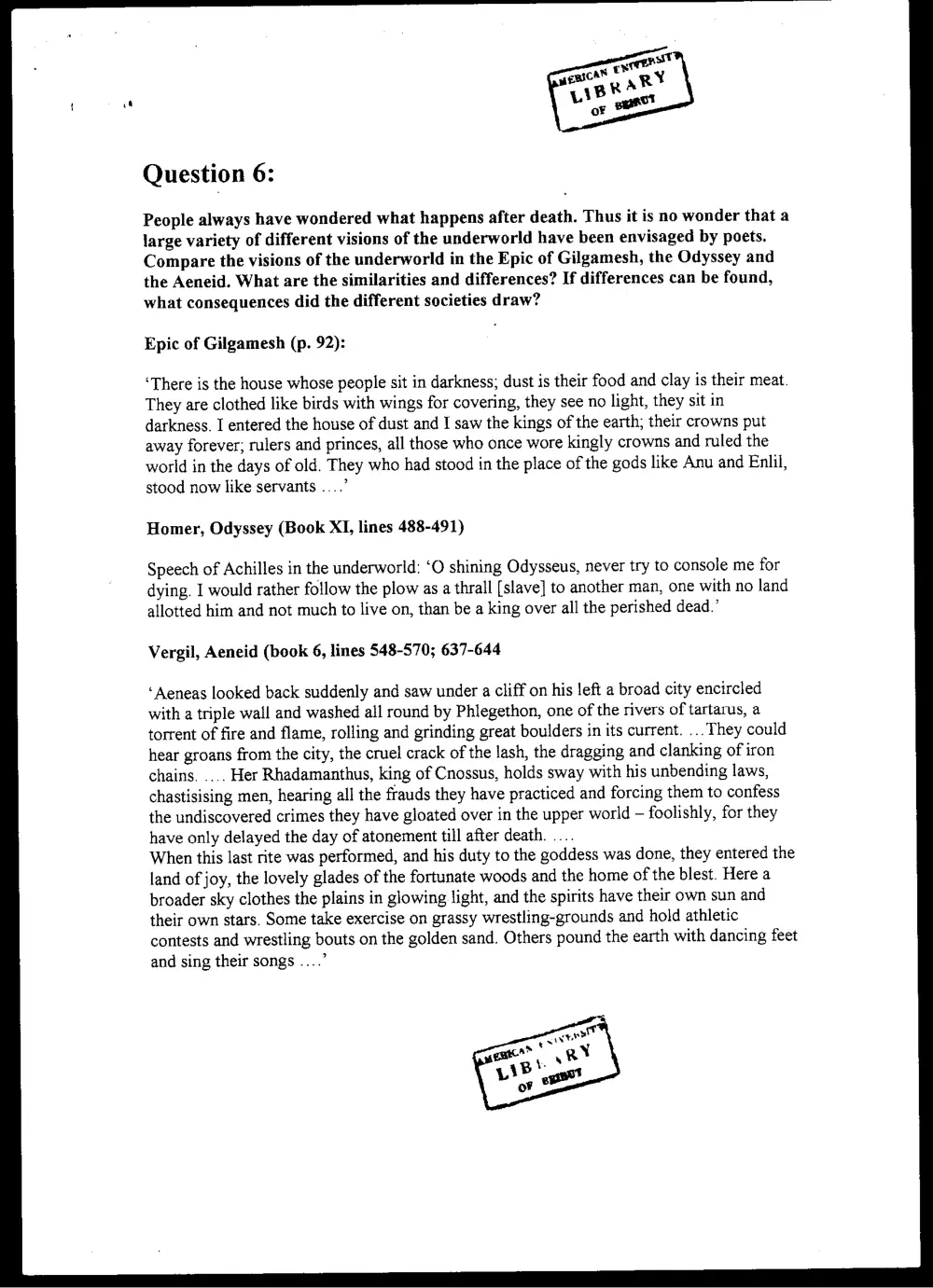
Question 6:
People always have wondered what happens after death. Thus it is no wonder that a
large variety of different visions of the underworld have been envisaged by poets.
Compare the visions of the underworld in the Epic of Gilgamesh, the Odyssey and
the Aeneid. What are the similarities and differences? If differences can be found,
what consequences did the different societies draw?
Epic of Gilgamesh (p. 92):
‘There is the house whose people sit in darkness; dust is their food and clay is their meat.
They are clothed like birds with wings for covering, they see no light, they sit in
darkness. I entered the house of dust and I saw the kings of the earth; their crowns put
away forever; rulers and princes, all those who once wore kingly crowns and ruled the
world in the days of old. They who had stood in the place of the gods like Anu and Enlil,
stood now like servants ....’
Homer, Odyssey (Book XI, lines 488-491)
Speech of Achilles in the underworld: ‘O shining Odysseus, never try to console me for
dying. I would rather follow the plow as a thrall [slave] to another man, one with no land
allotted him and not much to live on, than be a king over all the perished dead.’
Vergil, Aeneid (book 6, lines 548-570; 637-644
‘Aeneas looked back suddenly and saw under a cliff on his left a broad city encircled
with a triple wall and washed all round by Phlegethon, one of the rivers of tartarus, a
torrent of fire and flame, rolling and grinding great boulders in its current. ... They could
hear groans from the city, the cruel crack of the lash, the dragging and clanking of iron
chains. .... Her Rhadamanthus, king of Cnossus, holds sway with his unbending laws,
chastisising men, hearing all the frauds they have practiced and forcing them to confess
the undiscovered crimes they have gloated over in the upper world — foolishly, for they
have only delayed the day of atonement till after death. ....
When this last rite was performed, and his duty to the goddess was done, they entered the
land of joy, the lovely glades of the fortunate woods and the home of the blest. Here a
broader sky clothes the plains in glowing light, and the spirits have their own sun and
their own stars. Some take exercise on grassy wrestling-grounds and hold athletic
contests and wrestling bouts on the golden sand. Others pound the earth with dancing feet
and sing their songs ....’