
CVSP 201 Final, Spring 2005
American University of Beirut · Ancient, Medieval and Renaissance Culture · 5 pages

More CVSP 201 files
Show the text of this final exam
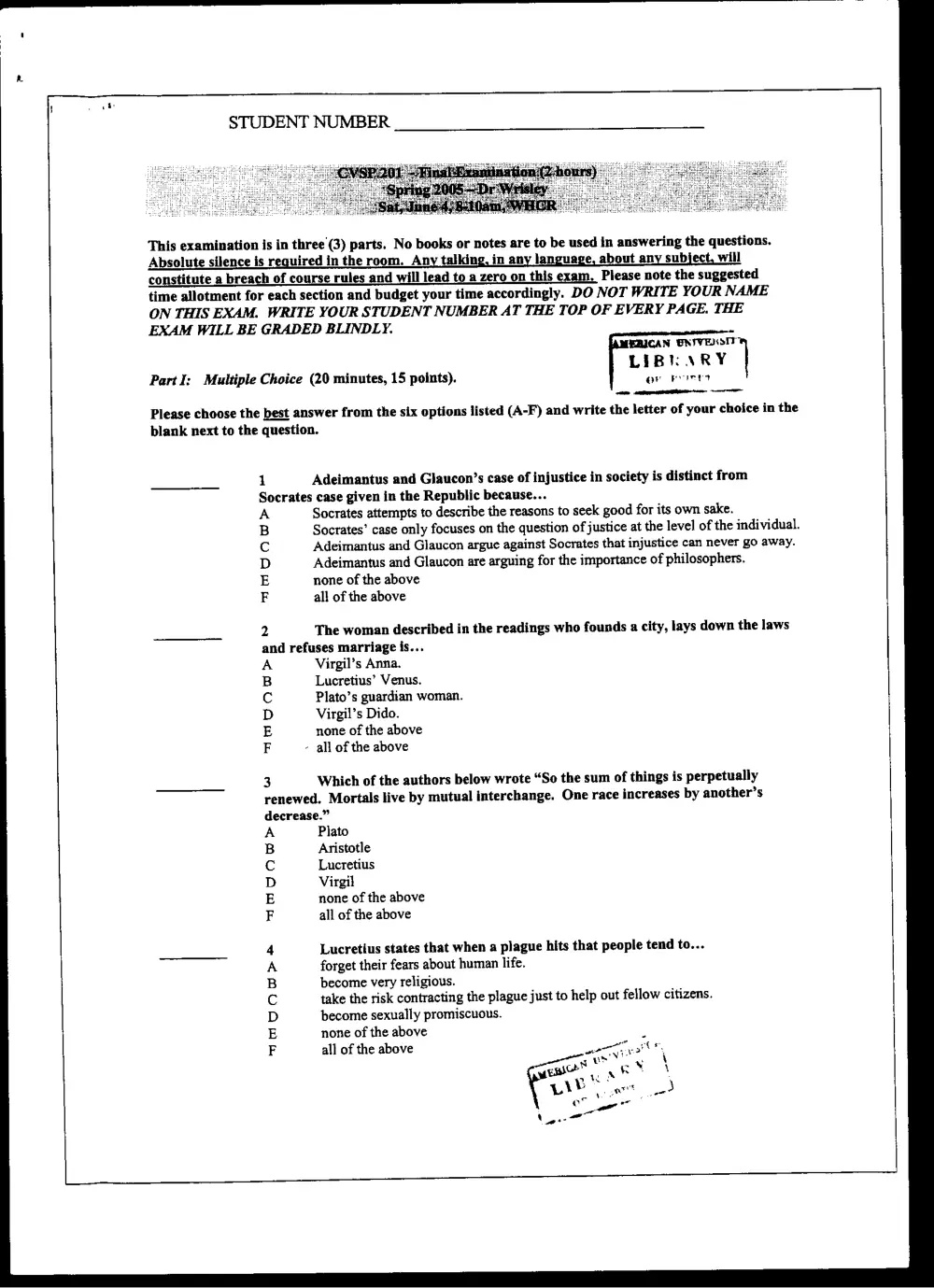
STUDENT NUMBER
This examination is in three (3) parts. No books or notes are to be used in answering the questions.
Absolute silence is required in the room. Any talking, in any language, about any subject, will
constitute a breach of course rules and will lead to a zero on this exam. Please note the suggested
time allotment for each section and budget your time accordingly. DO NOT WRITE YOUR NAME
ON THIS EXAM. WRITE YOUR STUDENT NUMBER AT THE TOP OF EVERY PAGE. THE
EXAM WILL BE GRADED BLINDLY.
PartI: Multiple Choice (20 minutes, 15 points).
Please choose the best answer from the six options listed (A-F) and write the letter of your choice in the
blank next to the question.
1 Adeimantus and Glaucon’s case of injustice in society is distinct from
Socrates case given in the Republic because...
A Socrates attempts to describe the reasons to seek good for its own sake.
B Socrates’ case only focuses on the question of justice at the level of the individual.
Cc Adeimantus and Glaucon argue against Socrates that injustice can never go away.
D Adeimantus and Glaucon are arguing for the importance of philosophers.
E none of the above
F all of the above
The woman described in the readings who founds a city, lays down the laws
nd refuses marriage is...
Virgil’s Anna.
Lucretius’ Venus.
Plato’s guardian woman.
Virgil’s Dido.
none of the above
- all of the above
ph
AMOS
3 Which of the authors below wrote “So the sum of things is perpetually
renewed. Mortals live by mutual interchange. One race increases by another’s
decrease.”
Plato
Aristotle
Lucretius
Virgil
none of the above
all of the above
AMIS
Lucretius states that when a plague hits that people tend to...
forget their fears about human life.
become very religious.
take the risk contracting the plague just to help out fellow citizens.
become sexually promiscuous.
none of the above
all of the above
tAvOOS >
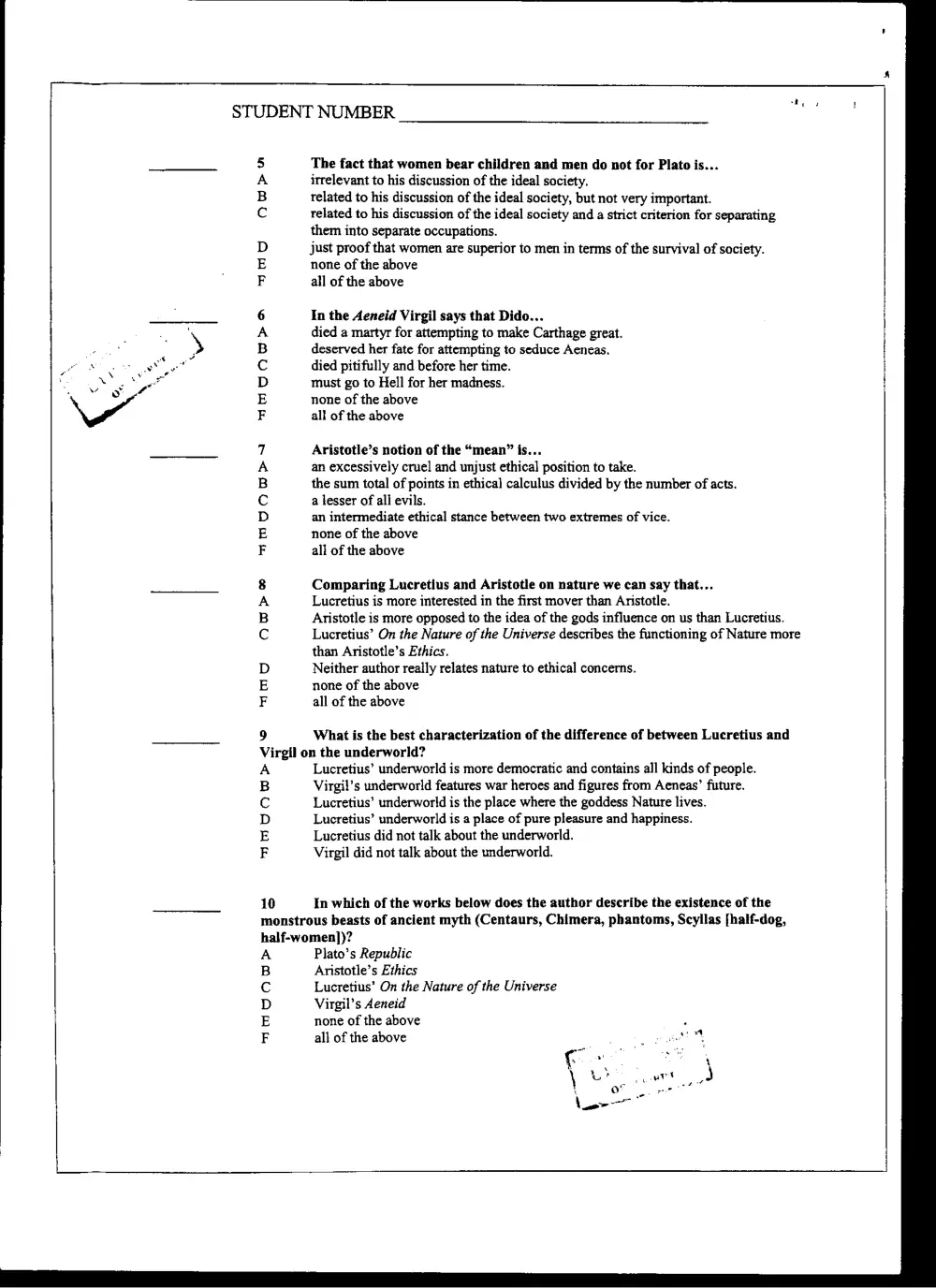
STUDENT NUMBER
The fact that women bear children and men do not for Plato is...
irrelevant to his discussion of the ideal society.
related to his discussion of the ideal society, but not very important.
related to his discussion of the ideal society and a strict criterion for separating
them into separate occupations.
just proof that women are superior to men in terms of the survival of society.
none of the above
all of the above
IMHO AWPMm
In the Aeneid Virgil says that Dido...
died a martyr for attempting to make Carthage great.
deserved her fate for attempting to seduce Aeneas.
died pitifully and before her time.
must go to Hell for her madness.
none of the above
all of the above
AMOADr aA
Aristotle’s notion of the “mean” is...
an excessively cruel and unjust ethical position to take.
the sum total of points in ethical calculus divided by the number of acts.
a lesser of all evils.
an intermediate ethical stance between two extremes of vice.
none of the above
all of the above
AMOOWOS>»
Comparing Lucretius and Aristotle on nature we can say that...
Lucretius is more interested in the first mover than Aristotle.
Aristotle is more opposed to the idea of the gods influence on us than Lucretius.
Lucretius’ On the Nature of the Universe describes the functioning of Nature more
than Aristotle’s Ethics.
Neither author really relates nature to ethical concerns.
none of the above
all of the above
mmo OWPe
What is the best characterization of the difference of between Lucretius and
irgil on the underworld?
Lucretius’ underworld is more democratic and contains all kinds of people.
Virgil’s underworld features war heroes and figures from Aeneas’ future.
Lucretius’ underworld is the place where the goddess Nature lives.
Lucretius’ underworld is a place of pure pleasure and happiness.
Lucretius did not talk about the underworld.
Virgil did not talk about the underworld.
MmHovdOwWr<de
10 In which of the works below does the author describe the existence of the
monstrous beasts of ancient myth (Centaurs, Chimera, phantoms, Scyllas [half-dog,
half-women])?
Plato’s Republic
Aristotle’s Ethics
Lucretius’ On the Nature of the Universe
Virgil’s Aeneid
none of the above .
all of the above Co te
IMAOAD >
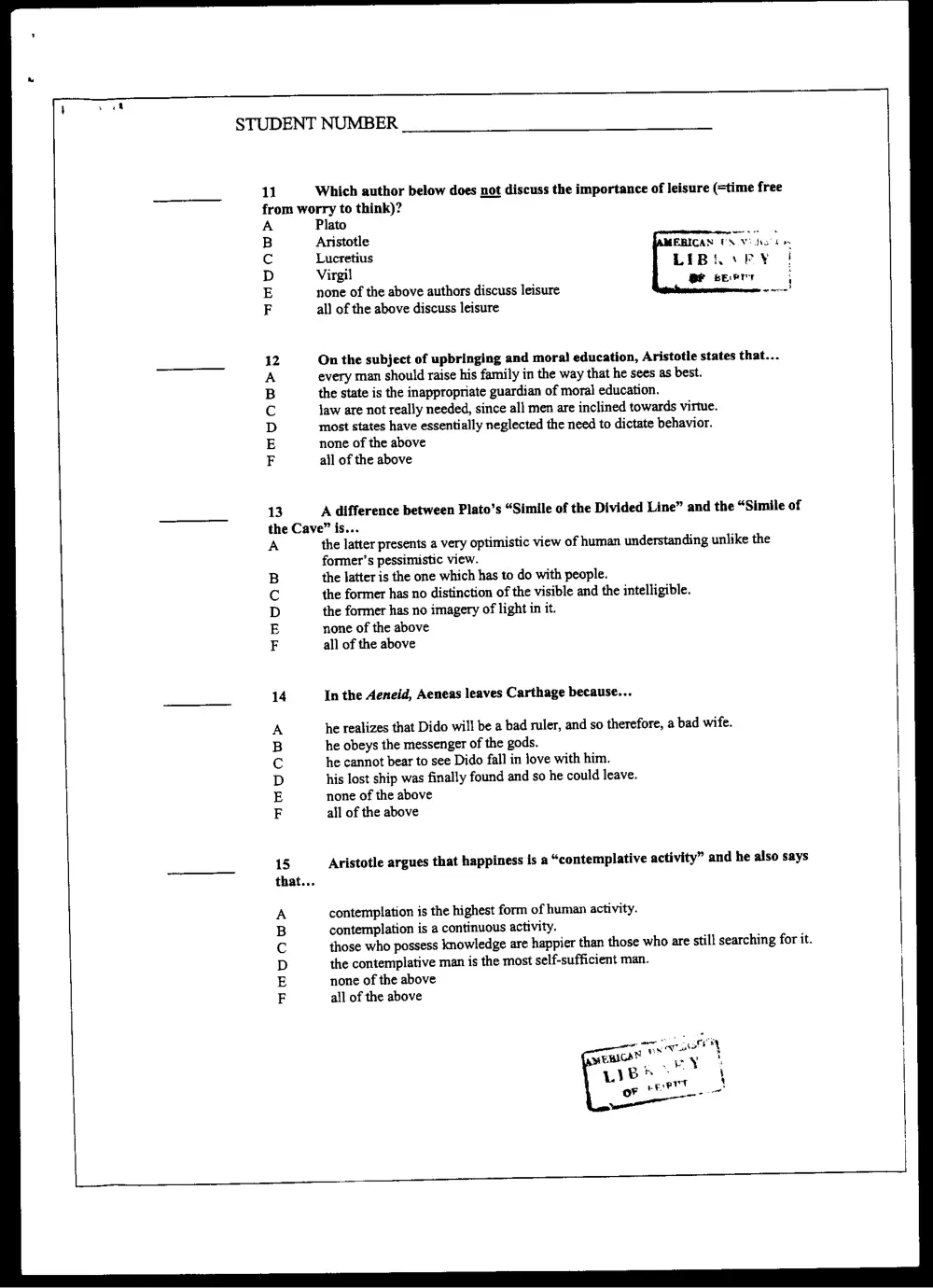
STUDENT NUMBER
11 Which author below does not discuss the importance of leisure (“time free
from worry to think)?
Plato
Aristotle
Lucretius
Virgil
none of the above authors discuss leisure
all of the above discuss leisure
EBIGAN UAV! hod
LIBR OFY !
eF BEET :
On the subject of upbringing and moral education, Aristotle states that...
every man should raise his family in the way that he sees as best.
the state is the inappropriate guardian of moral education.
jaw are not really needed, since all men are inclined towards virtue.
most states have essentially neglected the need to dictate behavior.
none of the above
all of the above
13 A difference between Plato’s “Simile of the Divided Line” and the “Simile of
the Cave” is...
A the latter presents a very optimistic view of human understanding unlike the
former’s pessimistic view.
the latter is the one which has to do with people.
the former has no distinction of the visible and the intelligible.
the former has no imagery of light in it.
none of the above
all of the above
In the Aeneid, Aeneas leaves Carthage because...
he realizes that Dido will be a bad ruler, and so therefore, a bad wife.
he obeys the messenger of the gods.
he cannot bear to see Dido fall in love with him.
his lost ship was finally found and so he could leave.
none of the above
all of the above
Aristotle argues that happiness is a “contemplative activity” and he also says
contemplation is the highest form of human activity.
contemplation is a continuous activity.
those who possess knowledge are happier than those who are still searching for it.
the contemplative man is the most self-sufficient man.
none of the above
all of the above
STUDENT NUMBER
Part IT: Textual Analysis and Identification. Choose one (1) of the following three (3) quotations below.
In your response, 2-3 paragraphs at least, please identify the following: (30 minutes, 25 points total)
a. The text and the author (5 points)
b. The context within the work. Explain the relevance of the passage to the plot (Who is speaking?
Where are they speaking? When are they speaking?) or to the argument of the work (What in
general is being argued? At what point of the work is it being argued?) (5 points)
¢.* Three major themes of the author’s work reflected in the passage. Please make sure that each
theme is developed. You might bring to your analysis: (15 points)
* — specific vocabulary/expressions characteristic of the author
Tepetition or contrast of key concepts
metaphors or striking images
tone, irony
contradictions
the form of the passage
“The earth in her prime spontaneously generated for mortals smiling crops and lusty (=hearty,
robust) vines, sweet fruits and gladsome (=cheerful) pastures, which now can scarcely be made to
grow by our toil(=manual labor). We wear down the oxen and wear out the strength of farmers,
we wear out the ploughshare(=p/ow) and find ourselves scarcely supplied by the fields that grudge
their fruits and multiply our toil. Already the ploughman of ripe years shakes his head with many
a sigh that his heavy labors have gone for nothing: and, when he compares the present with the
past, he often applauds his father’s luck. In the same despondent(=hopeless) vein, the cultivator of
old and wilted(=weak from lack of water) vines decries(=speak badly about) the trend of the times
and rails(=scold) at heaven. He grumbles that past generations, when men were old-fashioned and
god-fearing, supported life easily enough on their small farms, though one man’s holding was then
far less than now. He does not realize that everything is gradually decaying and going aground
onto the rocks, worn out by old age.”
“In the beginning Spint fed all things from within, the sky and the earth, the level waters, the
shining globe of the moon and the Titan’s star, the sun. It was Mind that set all this matter in
motion. Infused through all the limbs, it mingled(=mixed) with that great body, and from the
union there sprang the families of men and of animals, the living things of the air and the strange
creatures born beneath the marble surface of the sea. The living force within them is of fire and its
seeds have their source in heaven, but their guilt-ridden bodies make them slow and they are
dulled by earthly limbs and dying flesh. It is this that gives them their fears and desires, their
griefs and joys. Closed in the blind darkness prison they do not see on their last day of light, they
are not wholly freed from all the many ills and miseries of the body which must harden in them
over the long years and become ingrained(=infused, fixed) in ways we cannot understand. And so
they are put to punishment, to pay the penalty for all their ancient sins. Some are stretched and
hung out empty to dry in the winds. Some have the stain of evil washed out of them under a vast
tide of water or scorched out by fire. Each of us suffers his own fate in the after-life.”
“Some thinkers hold that it is by nature that people become good, others that it is by habit, and
others that it is by instruction. The bounty of nature is clearly beyond our control; it is bestowed
by some divine dispensation upon those who are truly fortunate. It is a regrettable fact that
discussion and instruction are not effective in all cases; just as a piece of land has to be prepared
beforehand if it is to nourish the seed, so the mind of the pupil has to be prepared in its habits if it
is to enjoy and dislike the right things; because the man who lives in accordance with his feelings
would not listen to an argument to dissuade(=advise against) him, or understand it if he did. And
when a man is in that state, how is it possible to persuade him out of it. In general, feeling seems
to yield not to argument but only to force. Therefore we must have a character to work on that has
some affinity to virtue: one that appreciates what is noble and objects to what is base(=not noble).”
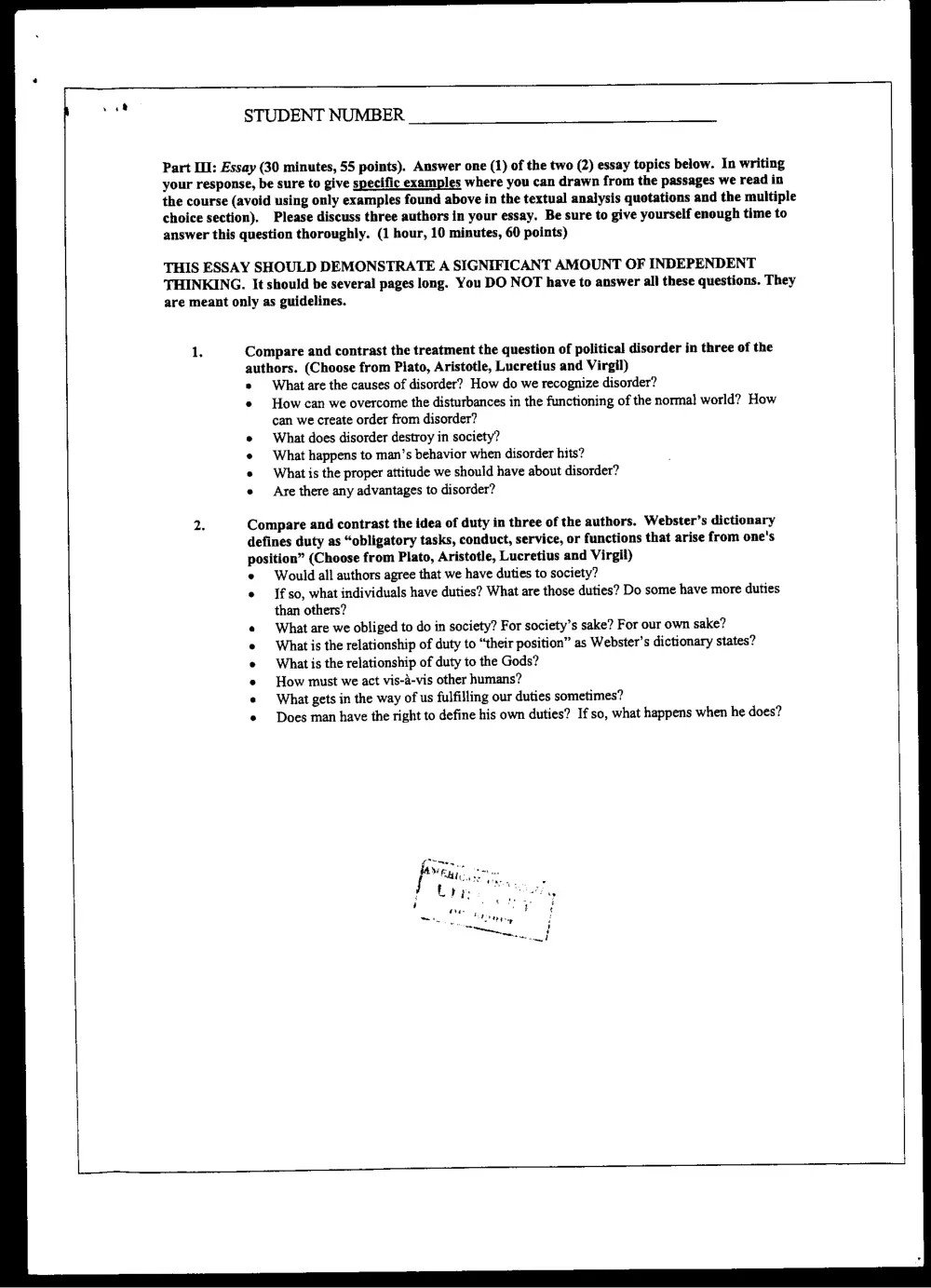
STUDENT NUMBER
Part III: Essay (30 minutes, 55 points). Answer one (1) of the two (2) essay topics below. In writing
your response, be sure to give specific examples where you can drawn from the passages we read in
the course (avoid using only examples found above in the textual analysis quotations and the multiple
choice section). Please discuss three authors in your essay. Be sure to give yourself enough time to
answer this question thoroughly. (1 hour, 10 minutes, 60 points)
THIS ESSAY SHOULD DEMONSTRATE A SIGNIFICANT AMOUNT OF INDEPENDENT
THINKING. It should be several pages long. You DO NOT have to answer all these questions. They
are meant only as guidelines.
1, Compare and contrast the treatment the question of political disorder in three of the
authors. (Choose from Piato, Aristotle, Lucretius and Virgil)
What are the causes of disorder? How do we recognize disorder?
How can we overcome the disturbances in the functioning of the norma! world? How
can we create order from disorder?
© What does disorder destroy in society?
* What happens to man’s behavior when disorder hits?
© What is the proper attitude we should have about disorder?
e Are there any advantages to disorder?
2. Compare and contrast the idea of duty in three of the authors. Webster’s dictionary
defines duty as “obligatory tasks, conduct, service, or functions that arise from one's
position” (Choose from Plato, Aristotle, Lucretius and Virgil)
Would all authors agree that we have duties to society?
Jf so, what individuals have duties? What are those duties? Do some have more duties
than others?
What are we obliged to do in society? For society’s sake? For our own sake?
What is the relationship of duty to “their position” as Webster’s dictionary states?
What is the relationship of duty to the Gods?
How must we act vis-a-vis other humans?
What gets in the way of us fulfilling our duties sometimes?
Does man have the right to define his own duties? If so, what happens when he does?