
CVSP 201 Final, Spring 2005
American University of Beirut · Ancient, Medieval and Renaissance Culture · 1 page
Stuck on a question? A tutor can walk you through it.
More CVSP 201 files
Show the text of this final exam
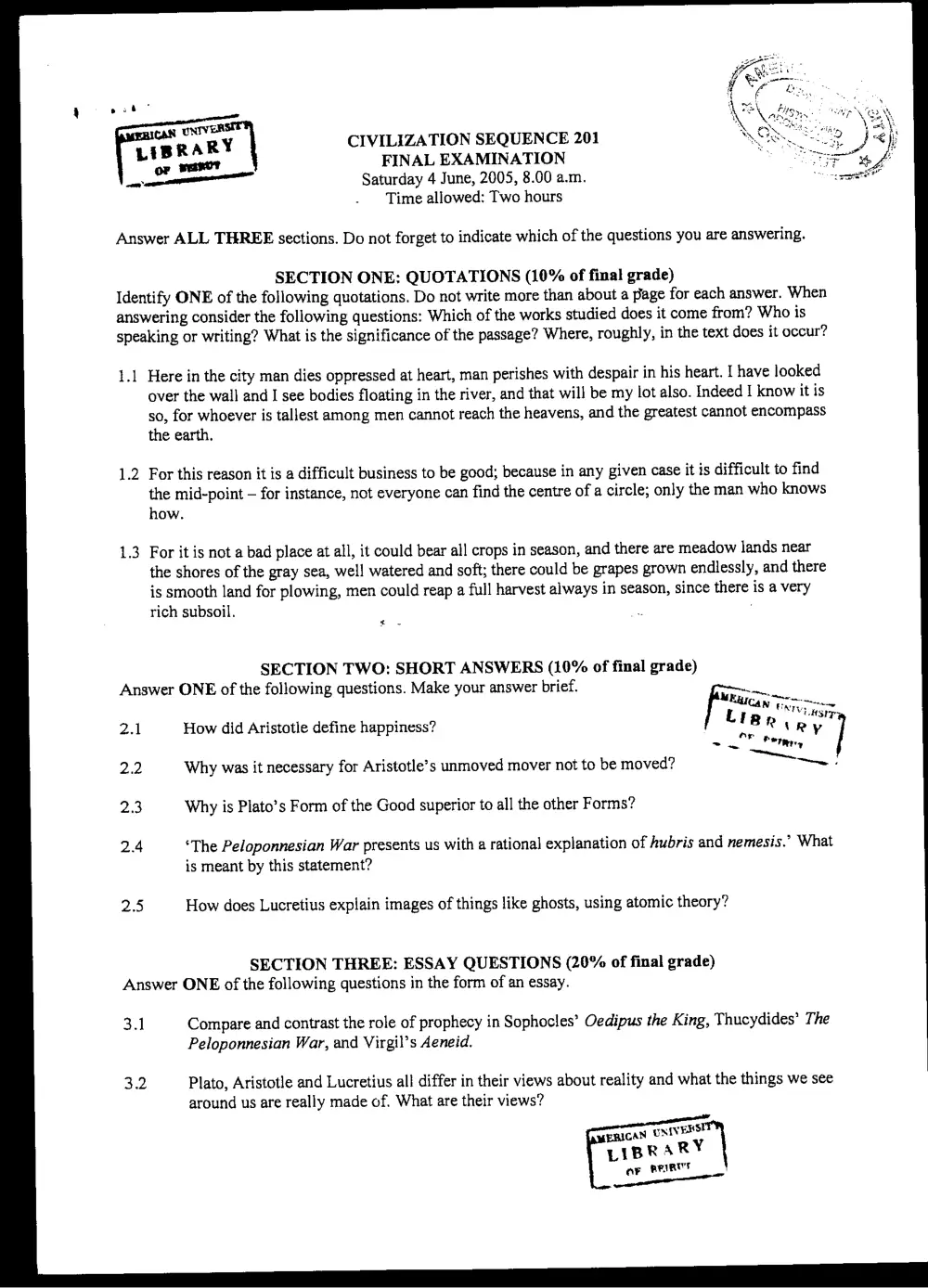
CIVILIZATION SEQUENCE 201
FINAL EXAMINATION
Saturday 4 June, 2005, 8.00 a.m.
Time allowed: Two hours
Answer ALL THREE sections. Do not forget to indicate which of the questions you are answering.
SECTION ONE: QUOTATIONS (10% of final grade)
Identify ONE of the following quotations. Do not write more than about a page for each answer. When
answering consider the following questions: Which of the works studied does it come from? Who is
speaking or writing? What is the significance of the passage? Where, roughly, in the text does it occur?
1.1 Here in the city man dies oppressed at heart, man perishes with despair in his heart. I have looked
over the wall and I see bodies floating in the river, and that will be my lot also. Indeed I know it is
so, for whoever is tallest among men cannot reach the heavens, and the greatest cannot encompass
the earth.
For this reason it is a difficult business to be good; because in any given case it is difficult to find
the mid-point — for instance, not everyone can find the centre of a circle; only the man who knows
how.
For it is not a bad place at all, it could bear all crops in season, and there are meadow lands near
the shores of the gray sea, well watered and soft; there could be grapes grown endlessly, and there
is smooth land for plowing, men could reap a full harvest always in season, since there is a very
rich subsoil. .
moe
SECTION TWO: SHORT ANSWERS (10% of final grade)
Answer ONE of the following questions. Make your answer brief.
2.1 How did Aristotle define happiness?
2.2 Why was it necessary for Aristotle’s unmoved mover not to be moved?
2.3 Why is Plato's Form of the Good superior to all the other Forms?
2.4 ‘The Peloponnesian War presents us with a rational explanation of hubris and nemesis.’ What
: Ip P P:
is meant by this statement?
2.5 How does Lucretius explain images of things like ghosts, using atomic theory?
SECTION THREE: ESSAY QUESTIONS (20% of final grade)
Answer ONE of the following questions in the form of an essay.
3.1 Compare and contrast the role of prophecy in Sophocles’ Oedipus the King, Thucydides’ The
Peloponnesian War, and Virgil’s Aeneid.
3.2 Plato, Aristotle and Lucretius all differ in their views about reality and what the things we see
around us are really made of. What are their views?