
CVSP 202 Final, Fall 2007
American University of Beirut · Ancient, Medieval and Renaissance Culture · 2 pages

More CVSP 202 files
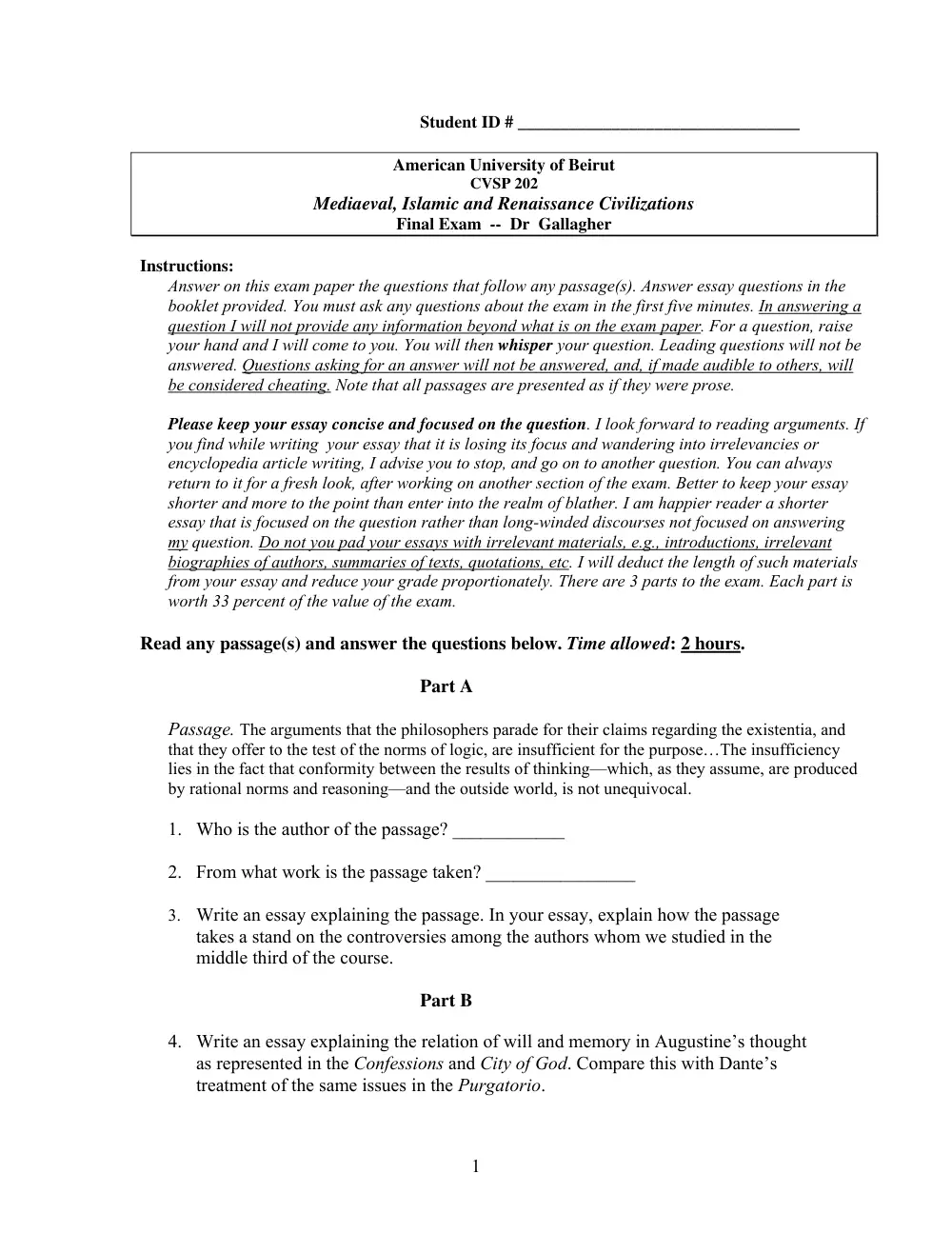
Show the text of this final exam
Student ID # _________________________________
American University of Beirut
CVSP 202
Mediaeval, Islamic and Renaissance Civilizations
Final Exam -- Dr Gallagher
Instructions:
Answer on this exam paper the questions that follow any passage(s). Answer essay questions in the
booklet provided. You must ask any questions about the exam in the first five minutes. In answering a
question I will not provide any information beyond what is on the exam paper. For a question, raise
your hand and I will come to you. You will then whisper your question. Leading questions will not be
answered. Questions asking for an answer will not be answered, and, if made audible to others, will
be considered cheating. Note that all passages are presented as if they were prose.
Please keep your essay concise and focused on the question. I look forward to reading arguments. If
you find while writing your essay that it is losing its focus and wandering into irrelevancies or
encyclopedia article writing, I advise you to stop, and go on to another question. You can always
return to it for a fresh look, after working on another section of the exam. Better to keep your essay
shorter and more to the point than enter into the realm of blather. I am happier reader a shorter
essay that is focused on the question rather than long-winded discourses not focused on answering
my question. Do not you pad your essays with irrelevant materials, e.g., introductions, irrelevant
biographies of authors, summaries of texts, quotations, etc. I will deduct the length of such materials
from your essay and reduce your grade proportionately. There are 3 parts to the exam. Each part is
worth 33 percent of the value of the exam.
Read any passage(s) and answer the questions below. Time allowed: 2 hours.
Part A
Passage. The arguments that the philosophers parade for their claims regarding the existentia, and
that they offer to the test of the norms of logic, are insufficient for the purpose…The insufficiency
lies in the fact that conformity between the results of thinking—which, as they assume, are produced
by rational norms and reasoning—and the outside world, is not unequivocal.
1. Who is the author of the passage? ____________
2. From what work is the passage taken? ________________
3. Write an essay explaining the passage. In your essay, explain how the passage
takes a stand on the controversies among the authors whom we studied in the
middle third of the course.
Part B
4. Write an essay explaining the relation of will and memory in Augustine’s thought
as represented in the Confessions and City of God. Compare this with Dante’s
treatment of the same issues in the Purgatorio.
1
2
Part C
5. Decide whether Machiavelli attempts to arouse (in some way) ‘aşabiyya in the discourse
that he presents in the Prince. Then, based on your decision, write an essay that explains
and evaluates whether Machiavelli’s text is stronger (or weaker) because of his attempt
(or lack of attempt) to arouse ‘aşabiyya. In your essay, you must define and explain
‘aşabiyya as discussed in the text that presents that concept, and explicitly show, with
references to the text of the Prince, how Machiavelli employs (or fails to employ) a like
concept. Note that I am not asking whether Machiavelli read, or was influenced by, the
writings of the author who develops the concept of ‘aşabiyya.
6. Name the author of the concept of ‘aşabiyya. _________________
7. Name the work in which he states that concept. ________________