
CVSP 202 Final, Fall 2008
American University of Beirut · Ancient, Medieval and Renaissance Culture · 2 pages
More CVSP 202 files
Show the text of this final exam
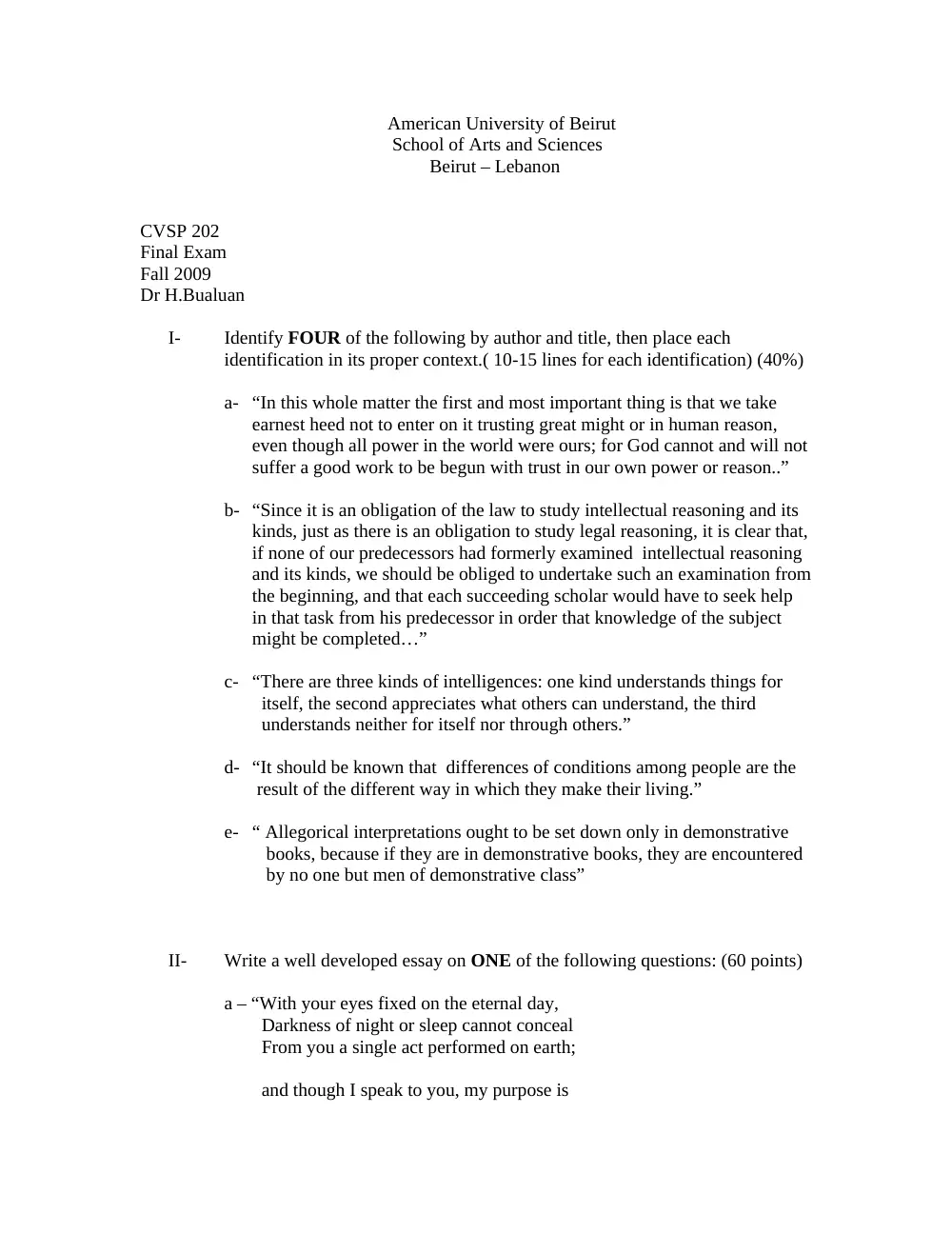
American University of Beirut
School of Arts and Sciences
Beirut – Lebanon
CVSP 202
Final Exam
Fall 2009
Dr H.Bualuan
I-
Identify FOUR of the following by author and title, then place each
identification in its proper context.( 10-15 lines for each identification) (40%)
a- “In this whole matter the first and most important thing is that we take
earnest heed not to enter on it trusting great might or in human reason,
even though all power in the world were ours; for God cannot and will not
suffer a good work to be begun with trust in our own power or reason..”
b- “Since it is an obligation of the law to study intellectual reasoning and its
kinds, just as there is an obligation to study legal reasoning, it is clear that,
if none of our predecessors had formerly examined intellectual reasoning
and its kinds, we should be obliged to undertake such an examination from
the beginning, and that each succeeding scholar would have to seek help
in that task from his predecessor in order that knowledge of the subject
might be completed…”
c- “There are three kinds of intelligences: one kind understands things for
itself, the second appreciates what others can understand, the third
understands neither for itself nor through others.”
d- “It should be known that differences of conditions among people are the
result of the different way in which they make their living.”
e- “ Allegorical interpretations ought to be set down only in demonstrative
books, because if they are in demonstrative books, they are encountered
by no one but men of demonstrative class”
II-
Write a well developed essay on ONE of the following questions: (60 points)
a – “With your eyes fixed on the eternal day,
Darkness of night or sleep cannot conceal
From you a single act performed on earth;
and though I speak to you, my purpose is
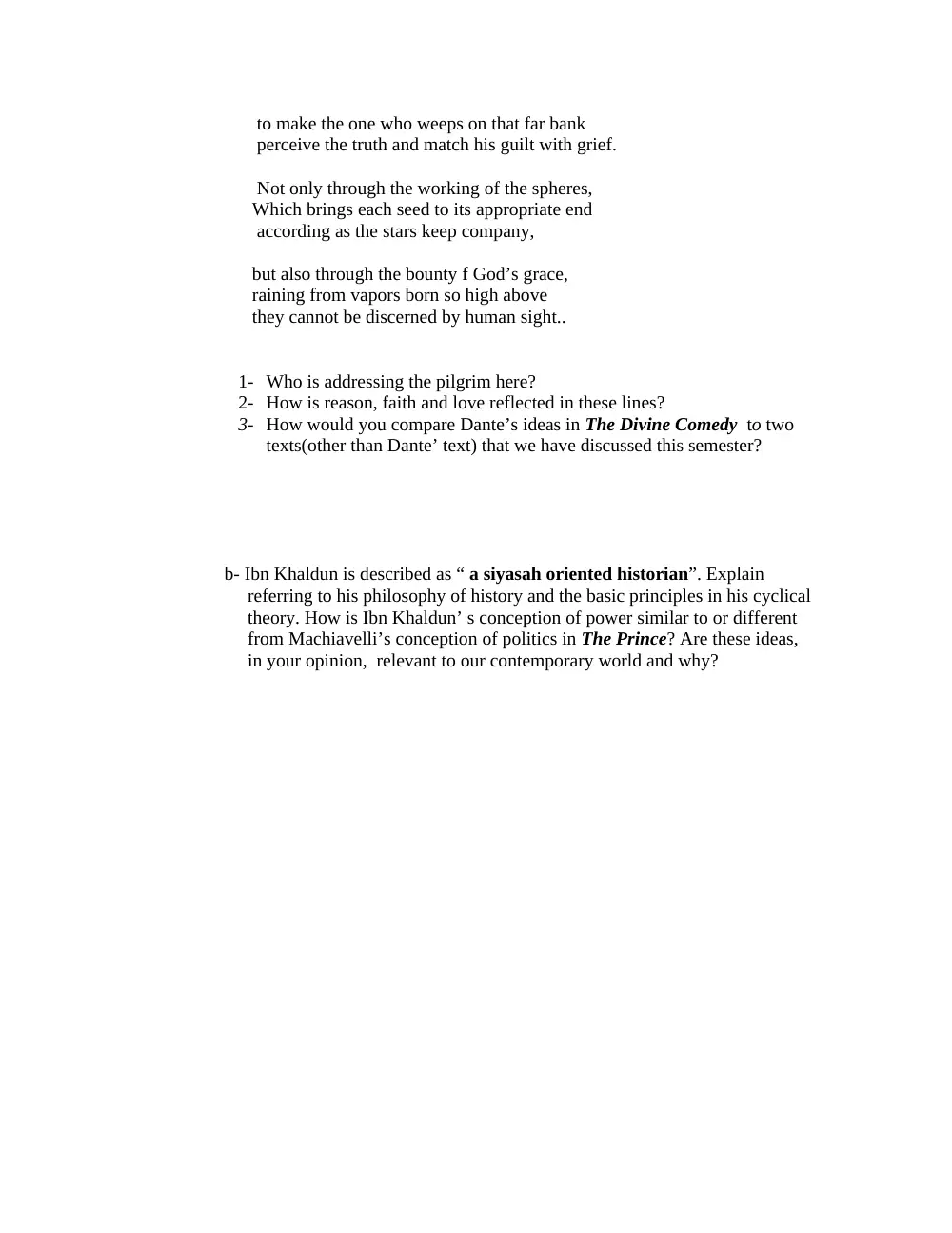
to make the one who weeps on that far bank
perceive the truth and match his guilt with grief.
Not only through the working of the spheres,
Which brings each seed to its appropriate end
according as the stars keep company,
but also through the bounty f God’s grace,
raining from vapors born so high above
they cannot be discerned by human sight..
1- Who is addressing the pilgrim here?
2- How is reason, faith and love reflected in these lines?
3- How would you compare Dante’s ideas in The Divine Comedy to two
texts(other than Dante’ text) that we have discussed this semester?
b- Ibn Khaldun is described as “ a siyasah oriented historian”. Explain
referring to his philosophy of history and the basic principles in his cyclical
theory. How is Ibn Khaldun’ s conception of power similar to or different
from Machiavelli’s conception of politics in The Prince? Are these ideas,
in your opinion, relevant to our contemporary world and why?