
CVSP 202 Final, Fall 2008
American University of Beirut · Ancient, Medieval and Renaissance Culture · 1 page
Stuck on a question? A tutor can walk you through it.
More CVSP 202 files
Show the text of this final exam
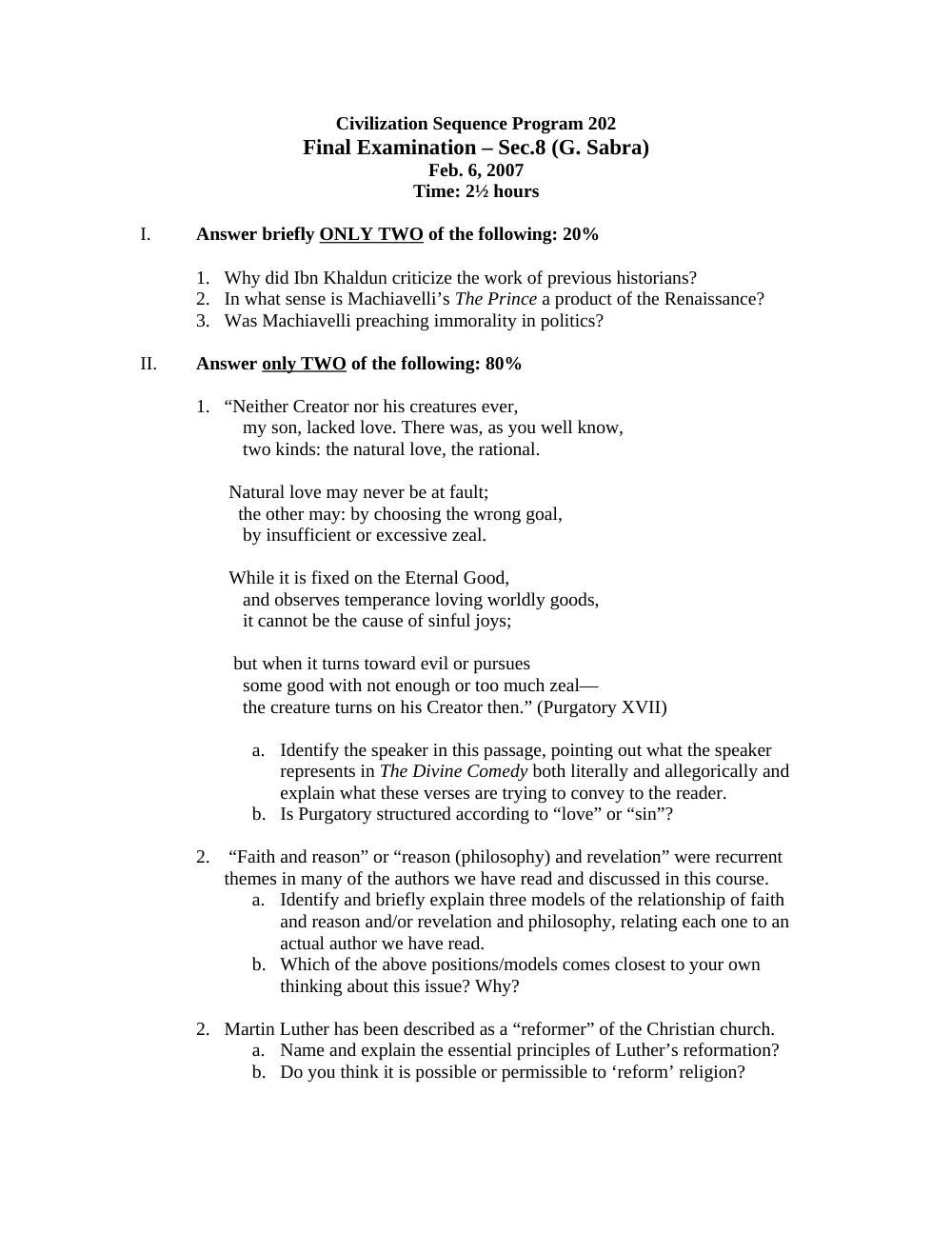
Civilization Sequence Program 202
Final Examination – Sec.8 (G. Sabra)
Feb. 6, 2007
Time: 2½ hours
I.
Answer briefly ONLY TWO of the following: 20%
1. Why did Ibn Khaldun criticize the work of previous historians?
2. In what sense is Machiavelli’s The Prince a product of the Renaissance?
3. Was Machiavelli preaching immorality in politics?
II.
Answer only TWO of the following: 80%
1. “Neither Creator nor his creatures ever,
my son, lacked love. There was, as you well know,
two kinds: the natural love, the rational.
Natural love may never be at fault;
the other may: by choosing the wrong goal,
by insufficient or excessive zeal.
While it is fixed on the Eternal Good,
and observes temperance loving worldly goods,
it cannot be the cause of sinful joys;
but when it turns toward evil or pursues
some good with not enough or too much zeal—
the creature turns on his Creator then.” (Purgatory XVII)
a.
Identify the speaker in this passage, pointing out what the speaker
represents in The Divine Comedy both literally and allegorically and
explain what these verses are trying to convey to the reader.
b. Is Purgatory structured according to “love” or “sin”?
2. “Faith and reason” or “reason (philosophy) and revelation” were recurrent
themes in many of the authors we have read and discussed in this course.
a.
Identify and briefly explain three models of the relationship of faith
and reason and/or revelation and philosophy, relating each one to an
actual author we have read.
b. Which of the above positions/models comes closest to your own
thinking about this issue? Why?
2. Martin Luther has been described as a “reformer” of the Christian church.
a.
Name and explain the essential principles of Luther’s reformation?
b. Do you think it is possible or permissible to ‘reform’ religion?