
CVSP 203 Final, Fall 2000
American University of Beirut · Modern and Contemporary Culture · 2 pages
More CVSP 203 files
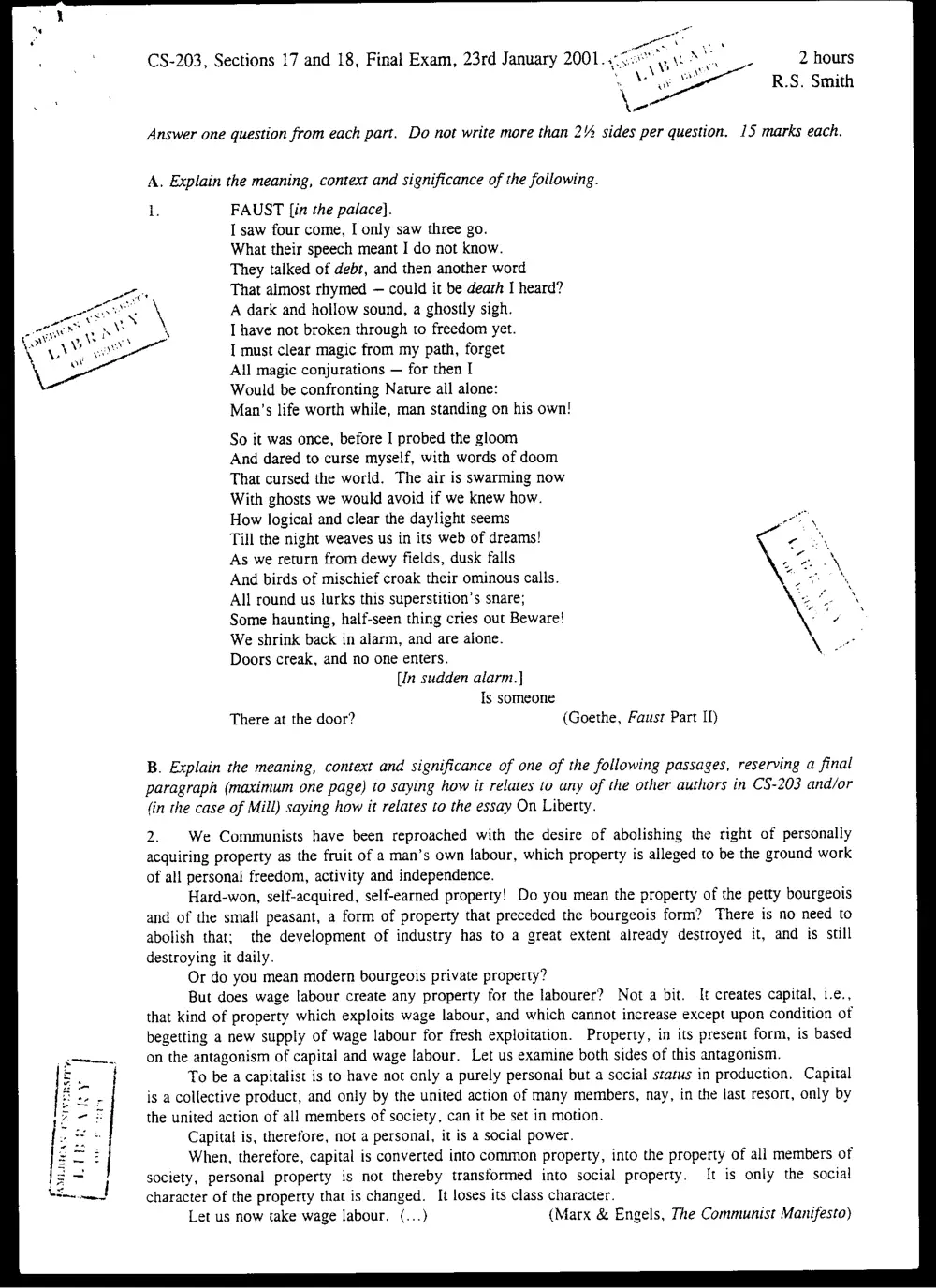
Show the text of this final exam
CS-203, Sections 17 and 18, Final Exam, 23rd January 2001. +- Nae - - 2 hours
* oo R.S. Smith
\-
Answer one question from each part. Do not write more than 24 sides per question. 15 marks each.
A. Explain the meaning, context and significance of the following.
FAUST [in the palace).
I saw four come, I only saw three go.
What their speech meant I do not know.
They talked of debt, and then another word
That almost rhymed — could it be death I heard?
A dark and hollow sound, a ghostly sigh.
I have not broken through to freedom yet.
I must clear magic from my path, forget
All magic conjurations — for then I
Would be confronting Nature all alone:
Man’s life worth while, man standing on his own!
So it was once, before I probed the gloom
And dared to curse myself, with words of doom
That cursed the world. The air is swarming now
With ghosts we would avoid if we knew how.
How logical and clear the daylight seems
Till the night weaves us in its web of dreams!
As we return from dewy fields, dusk falls
And birds of mischief croak their ominous calls.
All round us lurks this superstition’s snare;
Some haunting, haif-seen thing cries out Beware!
We shrink back in alarm, and are alone.
Doors creak, and no one enters.
[in sudden alarm.}
Is someone
There at the door? (Goethe, Faust Part II)
B. Explain the meaning, context and significance of one of the following passages, reserving a final
paragraph (maximum one page) to saying how it relates to any of the other authors in CS-203 and/or
(in the case of Mill) saying how it relates to the essay On Liberty.
2. We Communists have been reproached with the desire of abolishing the right of personally
acquiring property as the fruit of a man’s own labour, which property is alleged to be the ground work
of all personal freedom, activity and independence.
Hard-won, self-acquired, self-earned property! Do you mean the property of the petty bourgeois
and of the small peasant, a form of property that preceded the bourgeois form? There is no need to
abolish that; the development of industry has to a great extent already destroyed it, and is still
destroying it daily.
Or do you mean modern bourgeois private property?
But does wage labour create any property for the labourer? Not a bit. It creates capital, i.e.,
that kind of property which exploits wage labour, and which cannot increase except upon Condition of
begetting a new supply of wage labour for fresh exploitation. Property, in its present form, is based
on the antagonism of capital and wage labour. Let us examine both sides of this antagonism.
To be a capitalist is to have not only a purely personal but a social status in production. Capital
is a collective product, and only by the united action of many members, nay, in the last resort, only by
the united action of all members of society, can it be set in motion.
Capital is, therefore, not a personal, it is a social power.
When, therefore, capital is converted into common property, into the property of all members of
society, personal property is not thereby transformed into social property. [It is only the social
character of the property that is changed. It loses its class character.
Let us now take wage labour. (...) (Marx & Engels, The Communist Manifesto)
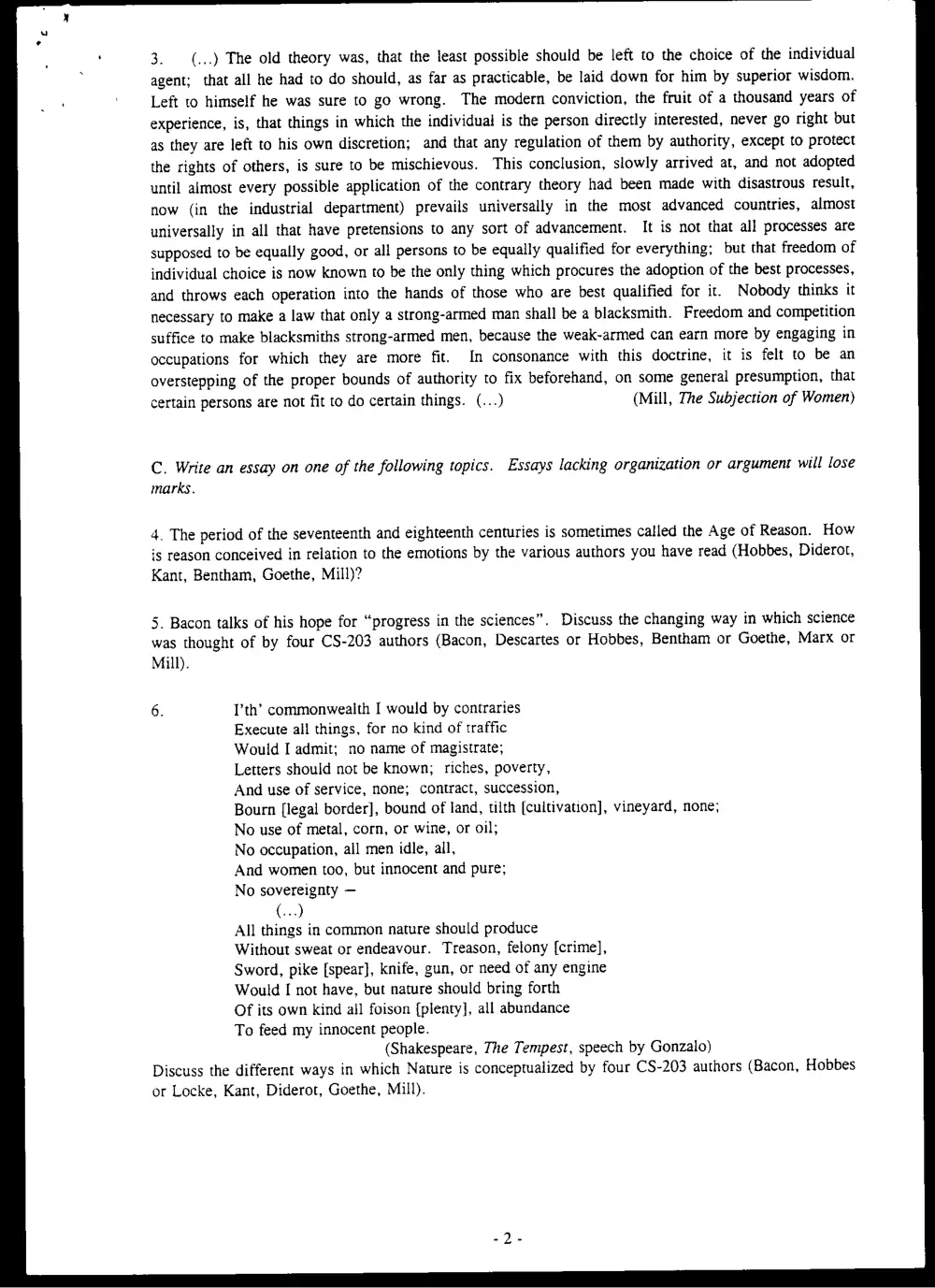
3. (...) The old theory was, that the least possible should be left to the choice of the individual
agent; that all he had to do should, as far as practicable, be laid down for him by superior wisdom.
Left to himself he was sure to go wrong. The modern conviction, the fruit of a thousand years of
experience, is, that things in which the individual is the person directly interested, never go right but
as they are left to his own discretion, and that any regulation of them by authority, except to protect
the rights of others, is sure to be mischievous. This conclusion, slowly arrived at, and not adopted
until almost every possible application of the contrary theory had been made with disastrous result,
now (in the industrial department) prevails universally in the most advanced countries, almost
universally in all that have pretensions to any sort of advancement. It is not that all processes are
supposed to be equally good, or all persons to be equally qualified for everything; but that freedom of
individual choice is now known to be the only thing which procures the adoption of the best processes,
and throws each operation into the hands of those who are best qualified for it. Nobody thinks it
necessary to make a law that only a strong-armed man shall be a blacksmith. Freedom and competition
suffice to make blacksmiths strong-armed men, because the weak-armed can earn more by engaging in
occupations for which they are more fit. In consonance with this doctrine, it is felt to be an
overstepping of the proper bounds of authority to fix beforehand, on some general presumption, that
certain persons are not fit to do certain things. (...) (Mill, The Subjection of Women)
C. Write an essay on one of the following topics. Essays lacking organization or argument will lose
marks.
4. The period of the seventeenth and eighteenth centuries is sometimes called the Age of Reason. How
is reason conceived in relation to the emotions by the various authors you have read (Hobbes, Diderot,
Kant, Bentham, Goethe, Mill)?
5. Bacon talks of his hope for “progress in the sciences”. Discuss the changing way in which science
was thought of by four CS-203 authors (Bacon, Descartes or Hobbes, Bentham or Goethe, Marx or
Mill).
I’th’ commonwealth I would by contraries
Execute all things, for no kind of traffic
Would I admit; no name of magistrate;
Letters should not be known; riches, poverty,
And use of service, none; contract, succession,
Bourn [legal border], bound of land, tilth [cultivation], vineyard, none;
No use of metal, corn, or wine, or oil;
No occupation, all men idle, all,
And women too, but innocent and pure;
No sovereignty —
(...)
All things in common nature should produce
Without sweat or endeavour. Treason, felony [crime],
Sword, pike [spear], knife, gun, or need of any engine
Would [ not have, but nature should bring forth
Of its own kind all foison {plenty], all abundance
To feed my innocent people.
(Shakespeare, The Tempest, speech by Gonzalo)
Discuss the different ways in which Nature is conceptualized by four CS-203 authors (Bacon, Hobbes
or Locke, Kant, Diderot, Goethe, Mill).