
CVSP 203 Final, Fall 2000
American University of Beirut · Modern and Contemporary Culture · 2 pages
More CVSP 203 files
Show the text of this final exam
Foster
PUMEREOUN Pre
LIBRARY
Oe
ere etna
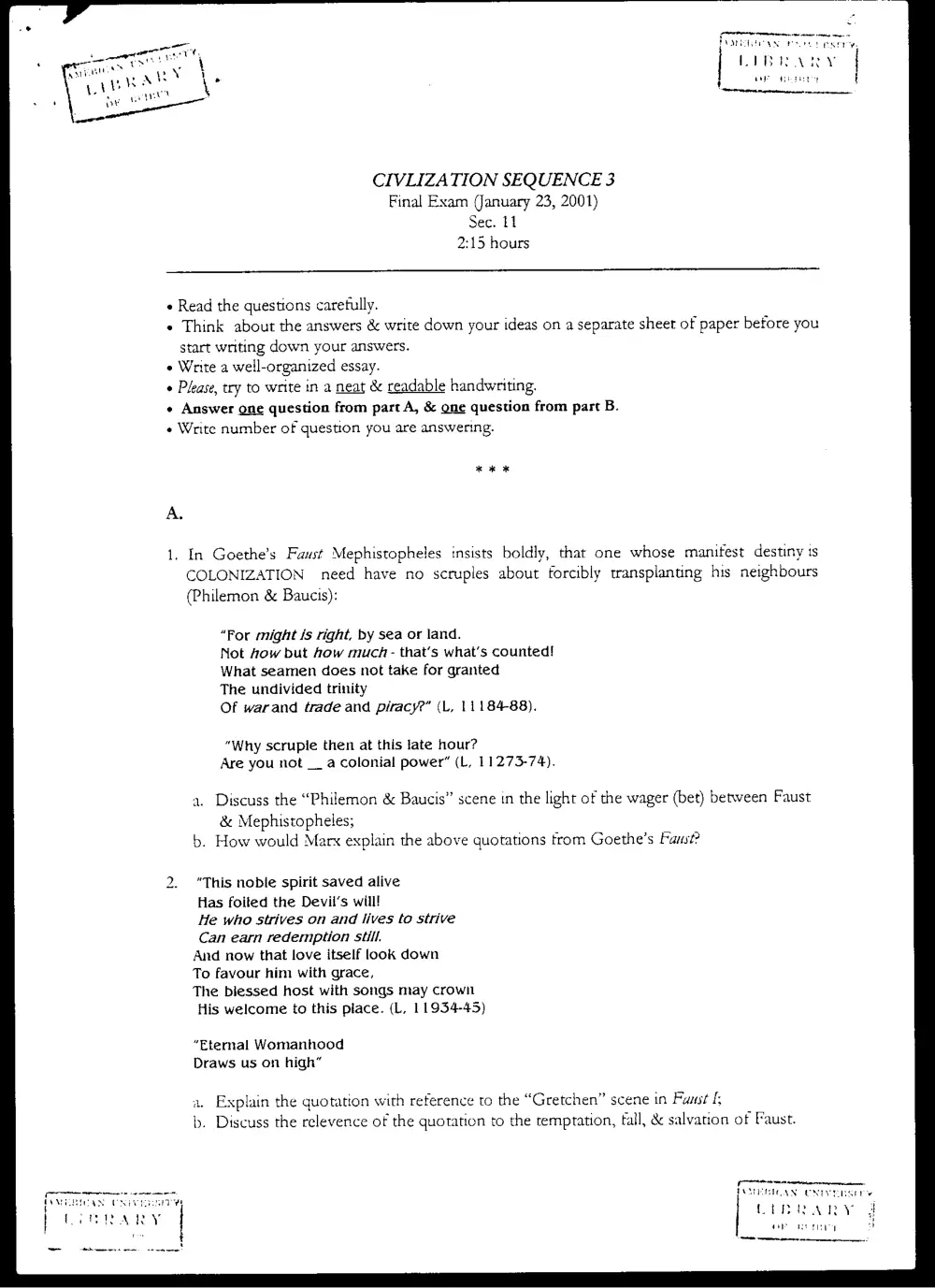
CIVLIZATION SEQUENCE 3
Final Exam (January 23, 2001)
Sec. 11
2:15 hours
« Read the questions carefully.
¢ Think about the answers & write down your ideas on a separate sheet of paper before you
start writing down your answers.
« Write a well-organized essay.
+ Phase, try to write in a neat & readable handwriting.
« Answer one question from part A, & gne question from part B.
« Write number of question you are answering.
KOK
A.
1. In Goethe’s Faust Mephistopheles insists boldly, that one whose manifest destiny ts
COLONIZATION need have no scruples about forcibly transplanting his neighbours
(Philemon & Baucis):
“For might is right, by sea or land.
Not How but how much - that’s what's counted!
What seamen does not take for granted
The undivided trinity
Of warand trade and piracye” (L, 1 1184-88).
“Why scruple then at this late hour?
Are you not __ a colonial power” (L, 11273-74).
a. Discuss the “Philemon & Baucis” scene in the light of the wager (bet) between Faust
& Mephistopheles;
b. How would Marx explain the above quotations from Goethe’s Faust?
2. “This noble spirit saved alive
Has foited the Devil's will!
He who strives on and lives to strive
Can earn redemption still.
And now that love itself look down
To favour him with grace,
The biessed host with songs may crown
His welcome to this piace. (L. 11934-45)
“Eternal Womanhood
Draws us on high”
a. Explain the quotation with reference to the “Gretchen” scene in Fanst f;
b. Discuss the relevence of the quotation to the temptation, fall, & salvation of Faust.
aentabatemareneeemed
POMETIOAN ONTVERSED®
Liperary 3
erste u
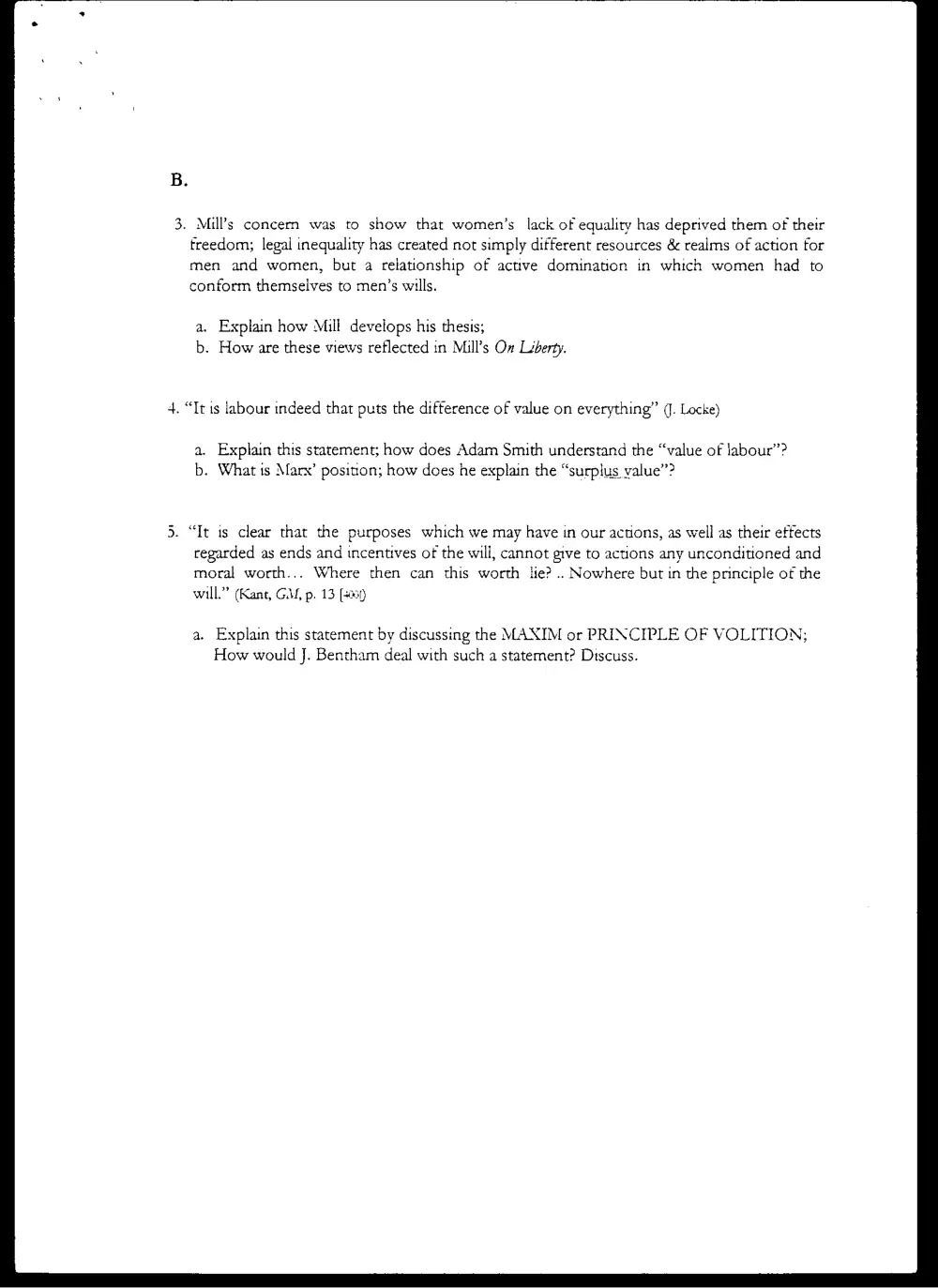
B.
3. Mill’s concern was to show that women’s lack of equality has deprived them of their
freedom; legal inequality has created not simply different resources & realms of action for
men and women, but a relationship of active domination in which women had to
conform themselves to men’s wills.
a. Explain how Mill develops his thesis;
b. How are these views reflected in Mill’s On Liberty.
4. “It is labour indeed that puts the difference of value on everything” (. Locke)
a. Explain this statement; how does Adarn Smith understand the “value of labour”?
“Tt is clear that the purposes which we may have in our actions, as well as their eftects
regarded as ends and incentives of the will, cannot give to actions any unconditioned and
moral worth... Where then can this worth lie? .. Nowhere but in the principle of the
will.” (Kant, GM, p. 13 (4001)
uw
a. Explain this statement by discussing the MAXIM or PRINCIPLE OF VOLITION;
How would J. Bentham deal with such a statement? Discuss.