
CVSP 203 Final, Fall 2001
American University of Beirut · Modern and Contemporary Culture · 2 pages
More CVSP 203 files
Show the text of this final exam
f . AMERICAN UNIVER!
LIBRARY
Ae TEMOT
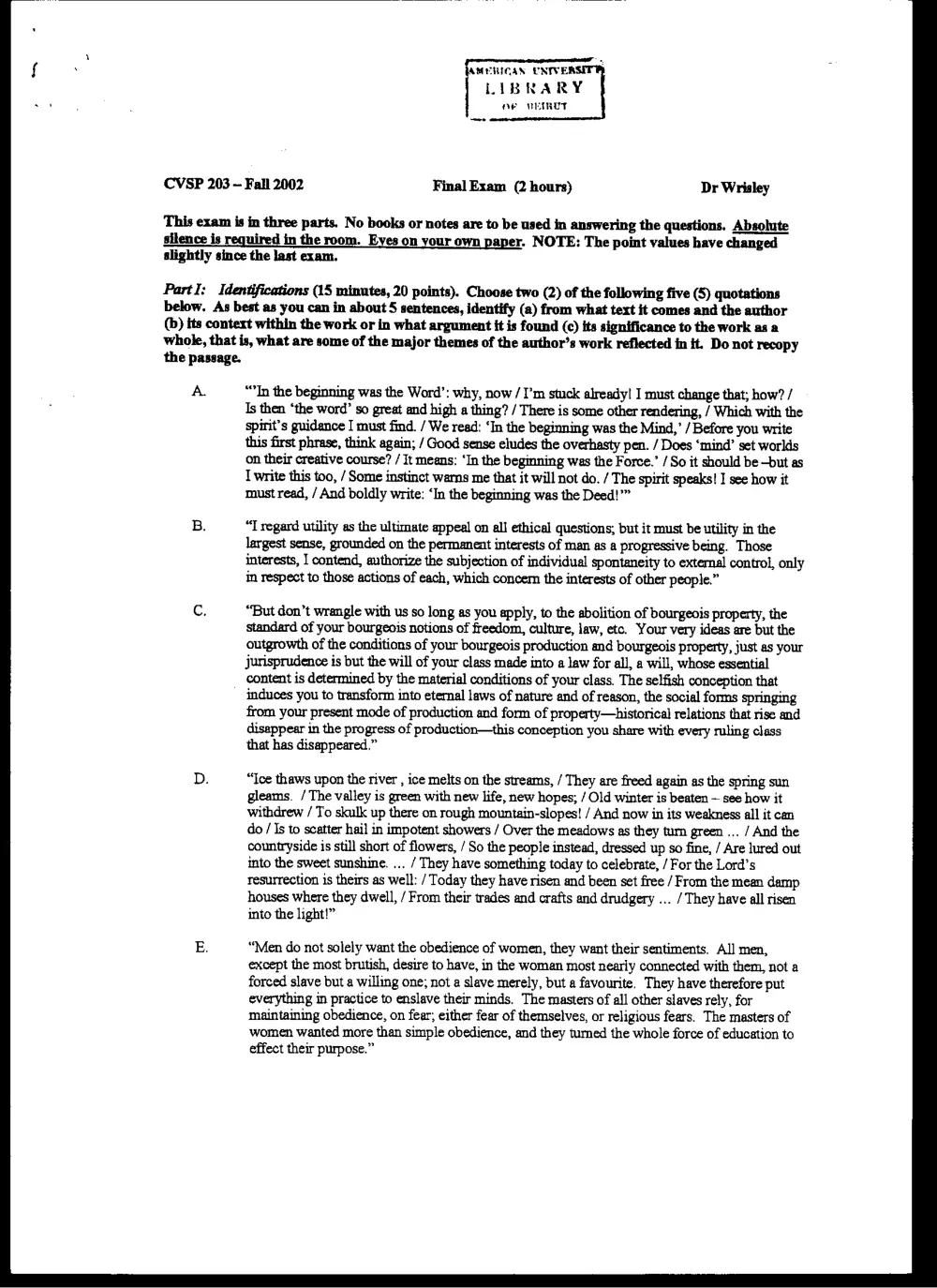
CVSP 203 ~ Fall 2002 Final Exam (2 hours) Dr Wrisley
This exam is in three parts. No books or notes are to be used in answering the questions. Absolute
silence is required in the room. Eyes on your own paper. NOTE: The point values have changed
slightly since the last exam.
PartI: Identifications (15 minutes, 20 points). Choose two (2) of the following five (5) quotations
below. As best as you can in about 5 sentences, identify (a) from what text it comes and the author
(b) its context within the work or in what argument it is found (c) its significance to the work as a
whoke, that is, what are some of the major themes of the author’s work reflected in it. Do not recopy
the passage.
A “In the beginning was the Word’: why, now /I’m stuck already! I must change that; how? /
Is then ‘the word’ so great and high a thing? / There is some other rendering, / Which with the
spirit’s guidance I must find. / We read: ‘In the beginning was the Mind,’ / Before you write
this first phrase, think again; / Good sense eludes the overhasty pen. / Does ‘mind’ set worlds
on their creative course? / It means: ‘In the beginning was the Force.’ / So it should be -but as
I write this too, / Some instinct warns me that it will not do. / The spirit speaks! ] see how it
must read, / And boldly write: ‘In the beginning was the Deed!”
B. “T regard utility as the ultimate appeal on all ethical questions; but it must be utility in the
largest sense, grounded on the permanent interests of man as a progressive being. Those
interests, 1 contend, authorize the subjection of individual spontaneity to external control, only
in respect to those actions of each, which concem the interests of other people.”
C. “But don’t wrangle with us so long as you apply, to the abolition of bourgeois property, the
standard of your bourgeois notions of freedom, culture, law, etc. Your very ideas are but the
outgrowth of the conditions of your bourgeois production and bourgeois property, just as your
jurisprudence is but the will of your class made into a law for all, a will, whose essential
content is determined by the material conditions of your class. The selfish conception that
induces you to transform into eternal laws of nature and of reason, the social forms springing
from your present mode of production and form of property—historical relations that rise and
disappear in the progress of production—this conception you share with every ruling class
that has disappeared,”
D. “Ice thaws upon the river , ice melts on the streams, / They are freed again as the spring sun
gleams. / The valley is green with new life, new hopes; / Old winter is beaten ~ see how it
withdrew / To skulk up there on rough mountain-slopes! / And now in its weakness all it can
do / Is to scatter hail in impotent showers / Over the meadows as they turn green ... / And the
countryside is still short of flowers, / So the people instead, dressed up so fine, / Are lured out
into the sweet sunshine. ... / They have something today to celebrate, / For the Lord’s
resurrection is theirs as well: / Today they have risen and been set free / From the mean damp
houses where they dwell, / From their trades and crafts and drudgery ... / They have all risen
into the light!”
E. “Men do not solely want the obedience of women, they want their sentiments. Al] men,
except the most brutish, desire to have, in the woman most nearly connected with them, not a
forced slave but a willing one; not a slave merely, but a favourite. They have therefore put
everything in practice to enslave their minds. The masters of all other slaves rely, for
maintaining obedience, on fear, either fear of themselves, or religious fears. The masters of
women wanted more than simple obedience, and they tumed the whole force of education to
effect their purpose.”
{ . Ahte uy UNIVERSE .
LIBRARY
to, . OF BEIRUT
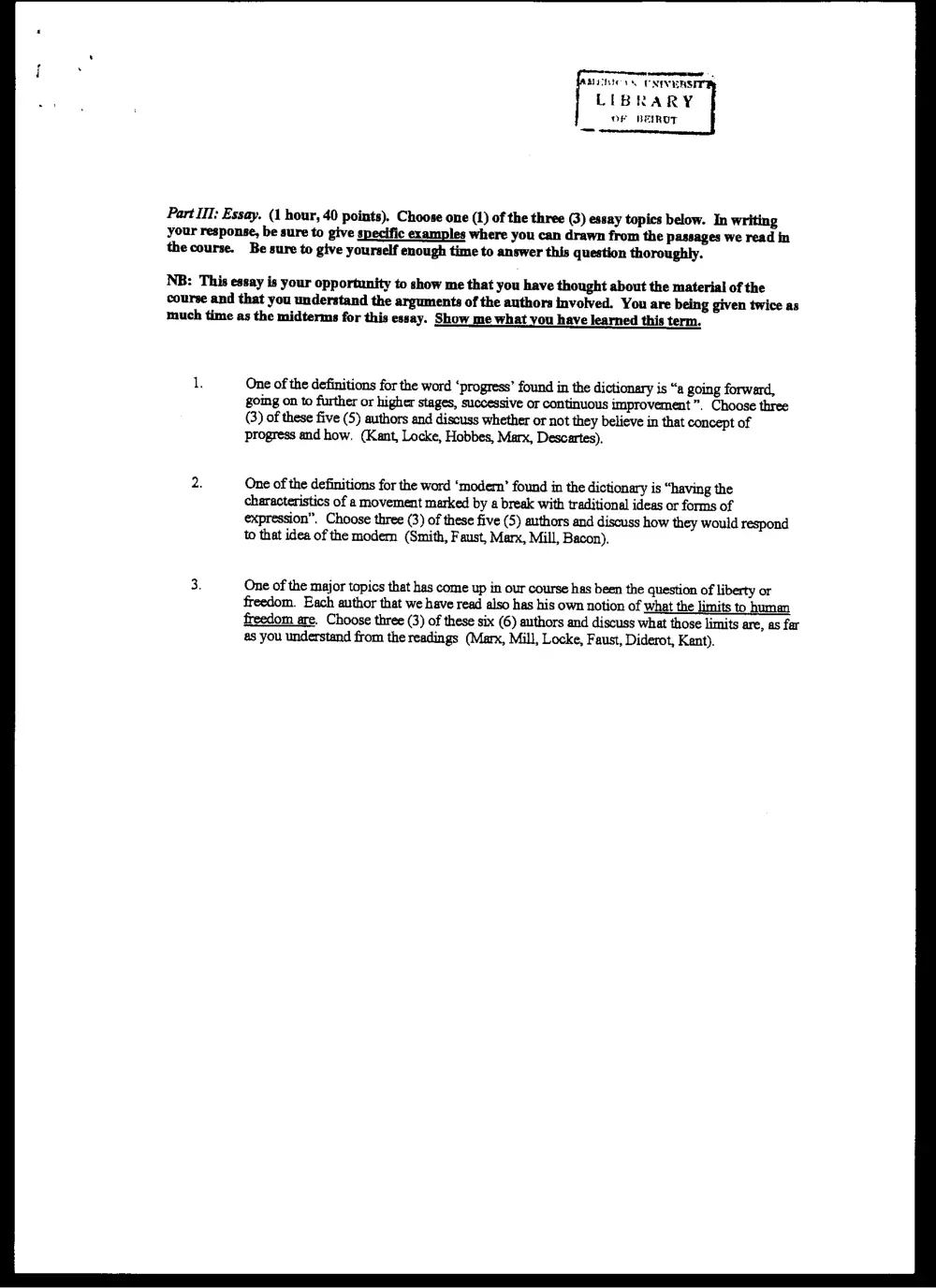
Part IIT: Essay. (1 hour, 40 points). Choose one ( of the three (3) essay topics below. In writing
your response, be sure to give specific examples where you can drawn from the passages we read in
the course. Be sure to give yourself enough time to answer this question thoroughly.
NB: This essay is your opportunity to show me that you have thought about the material of the
course and that you understand the arguments of the authors involved. You are being given twice as
much time as the midterms for this essay. Show me what you have learned this term.
1. One of the definitions for the word ‘progress’ found in the dictionary is “a going forward,
going on to further or higher stages, successive or continuous improvement”. Choose three
(3) of these five (5) authors and discuss whether or not they believe in that concept of
progress and how. (Kant, Locke, Hobbes, Marx, Descartes).
2. One of the definitions for the word ‘modem’ found in the dictionary is “having the
characteristics of a movement marked by a break with traditional ideas or forms of
expression”. Choose three (3) of these five (5) authors and discuss how they would respond
to that idea of the modern (Smith, Faust, Marx, Mill, Bacon).
3. One of the major topics that has come up in our course has been the question of liberty or
freedom. Each author that we have read also has his own notion of what the limits to human
freedom are. Choose three (3) of these six (6) authors and discuss what those limits are, as far
as you understand from the readings (Marx, Mill, Locke, Faust, Diderot, Kant).