
CVSP 203 Final, Fall 2002
American University of Beirut · Modern and Contemporary Culture · 3 pages

More CVSP 203 files
Show the text of this final exam
Dr. Mallette
Final exam
Name
Part A: Identifications and short answer questions (30 possible points). You will
answer five questions in this section of the exam.
Identifications: Choose three of the following passages. As best as you can, in about
5-7 sentences, identify: (a) the name of the text and the author, and (b) its significance
to the themes central to early modernity that we have discussed in the course.
1. Iam thy creature, and I will be even mild and docile* to my natural lord and
king if thou wilt also perform thy part, the which thou owest me. Oh,
Frankenstein, be not equitable* to every other and trample upon me alone, to
whom thy justice, and even thy clemency* and affection, is most due.
Remember that I am thy creature; I ought to be thy Adam, but I am rather the
fallen angel, whom thou drivest from joy for no misdeed. Everywhere I see
bliss, from which I alone am irrevocably excluded. I was benevolent and good;
misery made me a fiend. Make me happy, and I shall again be virtuous.
docile = sweet, gentle
equitable = just, treating equally
clemency = mercy, gentleness
. Lam the spirit of perpetual negation;
And rightly so, for all things that exist
Deserve to perish, and would not be missed —
Much better it would be if nothing were
Brought into being. Thus, what you men call
Destruction, sin, evil in short, is all
My sphere, the element I most prefer.
“The ancient teachers of this science promised impossibilities and performed
nothing. The modern masters promise very little; they know that metals cannot
be transmuted and that the elixir of life is a chimera.* But these philosophers,
whose hands seem only made to dabble in dirt, and their eyes to pore over the
microscope or crucible,* have indeed performed miracles. They penetrate into
the recesses of nature and show how she works in her hiding-places. They
ascend into the heavens; they have discovered how the blood circulates, and the
nature of the air we breathe. They have acquired new and almost unlimited
powers; they can command the thunders of heaven, mimic the earthquake, and
even mock the invisible world with its own shadows.”
chimera = a grotesque product of the imagination
crucible = a vessel made of material that does not melt easily; used for high
temperature chemical reactions
—
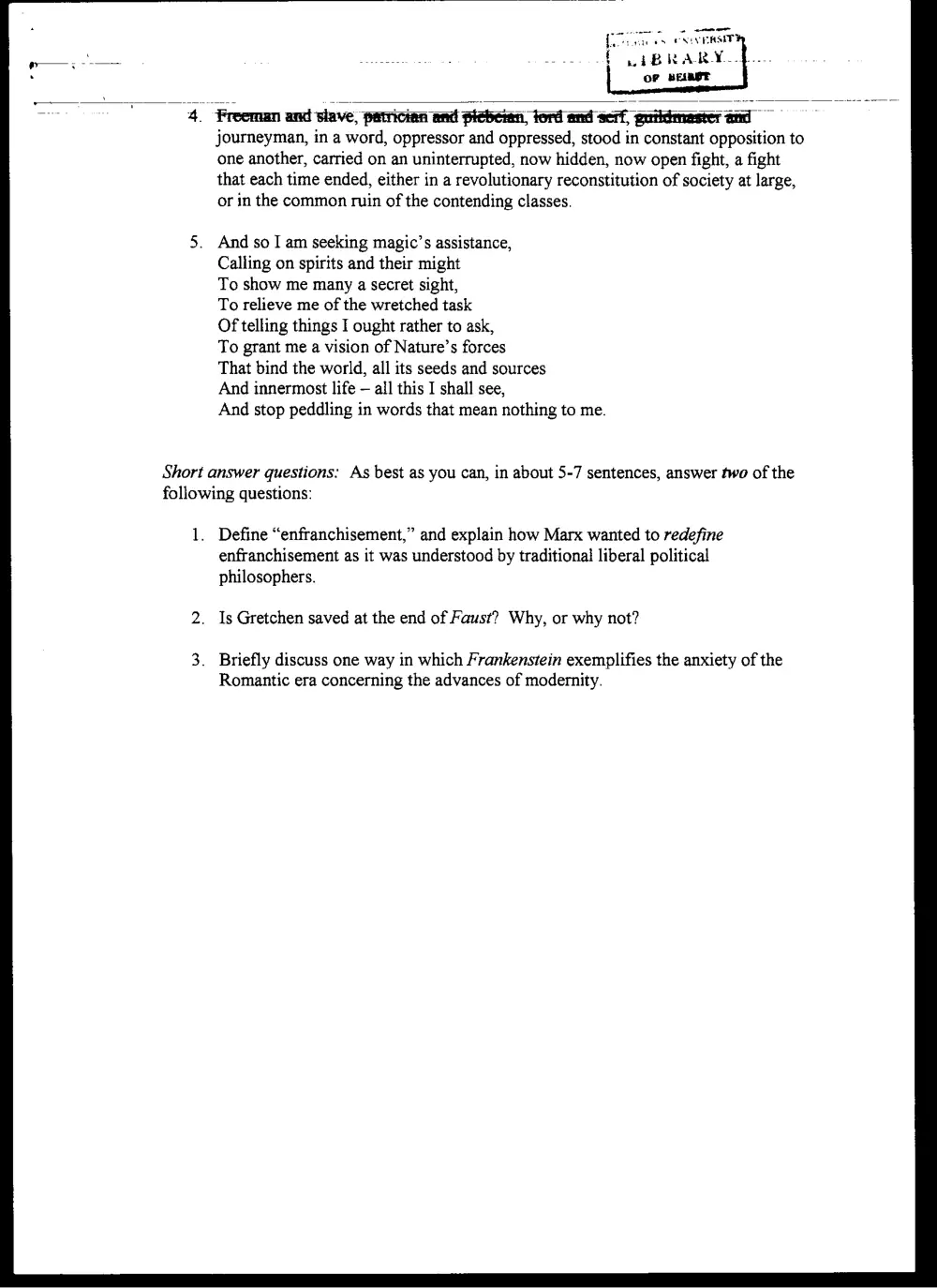
4.
ea ETN nn eSV EAST
-f Va BRARY$..
OP BEAST
Freeman and slave, patrician and piebeian, tord and seri, gutkimaster and
journeyman, in a word, oppressor and oppressed, stood in constant opposition to
one another, carried on an uninterrupted, now hidden, now open fight, a fight
that each time ended, either in a revolutionary reconstitution of society at large,
or in the common ruin of the contending classes.
And so I am seeking magic’s assistance,
Calling on spirits and their might
To show me many a secret sight,
To relieve me of the wretched task
Of telling things I ought rather to ask,
To grant me a vision of Nature’s forces
That bind the world, all its seeds and sources
And innermost life — all this I shall see,
And stop peddling in words that mean nothing to me.
Short answer questions: As best as you can, in about 5-7 sentences, answer two of the
following questions:
1.
Define “enfranchisement,” and explain how Marx wanted to redefine
enfranchisement as it was understood by traditional liberal political
philosophers.
Is Gretchen saved at the end of Faust? Why, or why not?
Briefly discuss one way in which Frankenstein exemplifies the anxiety of the
Romantic era concerning the advances of modernity.
ee i meme tae RR
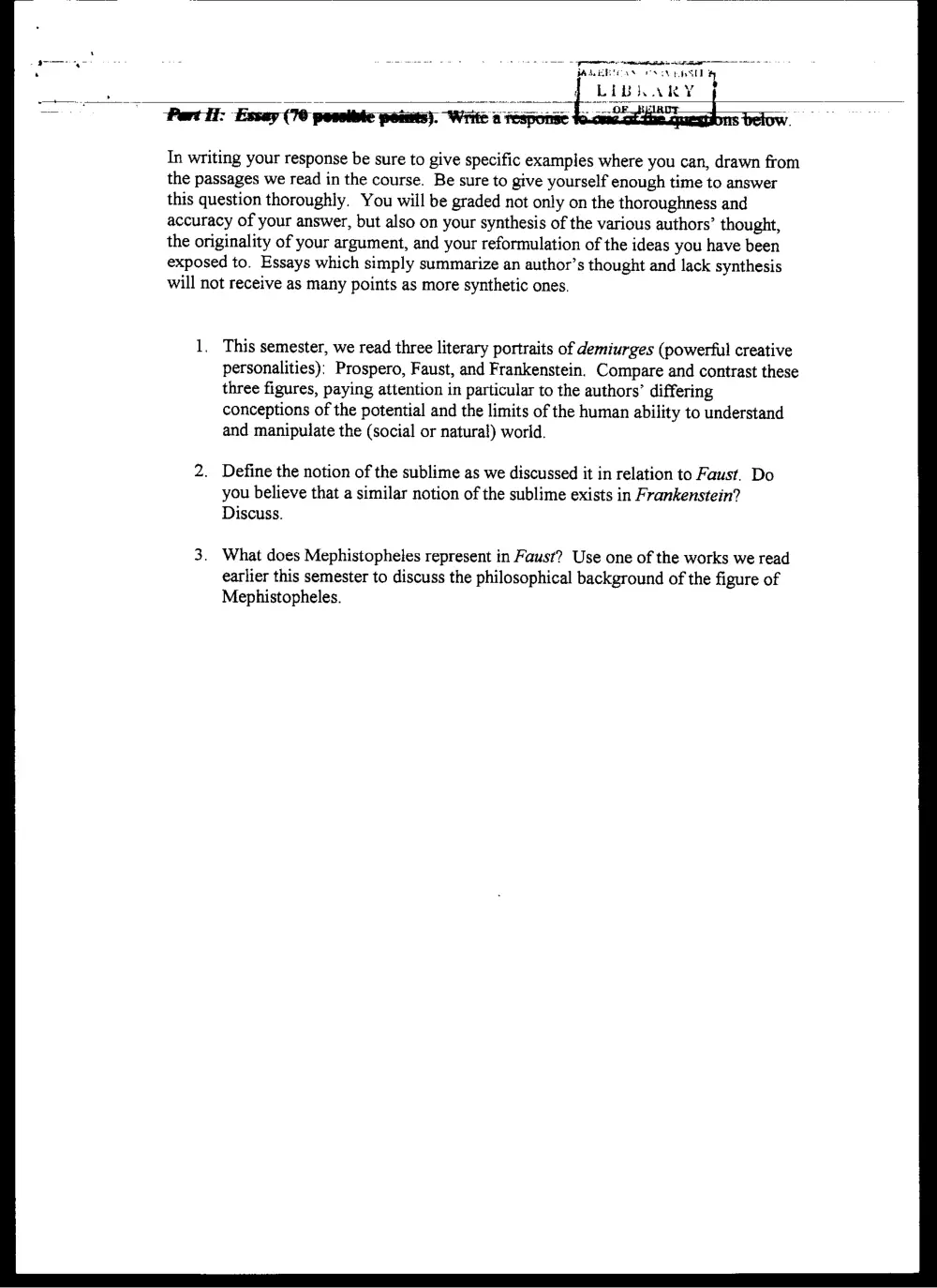
In writing your response be sure to give specific examples where you can, drawn from
the passages we read in the course. Be sure to give yourself enough time to answer
this question thoroughly. You will be graded not only on the thoroughness and
accuracy of your answer, but also on your synthesis of the various authors’ thought,
the originality of your argument, and your reformulation of the ideas you have been
exposed to. Essays which simply summarize an author’s thought and lack synthesis
will not receive as many points as more synthetic ones.
1, This semester, we read three literary portraits of demiurges (powerful creative
personalities); Prospero, Faust, and Frankenstein. Compare and contrast these
three figures, paying attention in particular to the authors’ differing
conceptions of the potential and the limits of the human ability to understand
and manipulate the (social or natural) world.
2. Define the notion of the sublime as we discussed it in relation to Faust. Do
you believe that a similar notion of the sublime exists in Frankenstein?
Discuss.
3. What does Mephistopheles represent in Faust? Use one of the works we read
earlier this semester to discuss the philosophical background of the figure of
Mephistopheles.